Witch Hat Atelier and Japan's 'Thanks for Your Thanks' Loop
How the 'thanks for your thanks' exchange in Witch Hat Atelier opens a window onto Japan's habit of not letting gratitude end on the first reply.

Tokyo-born, 3rd-generation Edokko · writing on Japanese culture from outside Japan
Spoiler-Free Cultural Analysis
This piece looks at the cultural logic behind a small, comedic exchange in Witch Hat Atelier Season 2 — the back-and-forth of gratitude between two characters — and what it reveals about Japanese conversational manners. No story beats beyond the opening introductions are discussed.
Key Takeaways
- The "thanks for your thanks for your thanks" joke in Witch Hat Atelier is not random absurdity. It plays on a real Japanese conversational pattern where a single 「ありがとう」(Arigatō: thank you) is rarely allowed to close a polite exchange on its own.
- Stock returns like 「いえいえ」(Ie ie: no, no), 「こちらこそ」(Kochira koso: same to you / it's me who should thank you), and 「とんでもないです」(Tondemonai desu: not at all) are designed to keep the gratitude in motion rather than seal it off, mirroring the rhythm of repeated bowing.
- English-language audiences sometimes read this as Japanese people being "excessively polite." A closer look shows it is structural — the language gives conversations a built-in option to stay open instead of being snapped shut by a single reply.
Key Terms Explained
- 御礼 (Orei) / Thanks, Acknowledgment of a Kindness — The general Japanese category that covers verbal thanks, gift-giving in return, bows, and follow-up messages. Often treated as something owed rather than something offered.
- いえいえ (Ie ie) / No, No — A soft deflection used when someone thanks you; literally a doubled "no," but functionally a way to dial down the other person's gratitude so the exchange keeps breathing.
- こちらこそ (Kochira koso) / It Is I Who Should Thank You — A reversal that returns the thanks back to the speaker, often used to extend the loop by one more turn.
- とんでもないです (Tondemonai desu) / Not at All, Far From It — A stronger denial that the kindness even deserves thanks. More formal and a little stiffer than 「いえいえ」.
- お辞儀 (Ojigi) / The Bow — The physical counterpart to verbal gratitude. Bows often chain together in the same way thanks do: one triggers another, and neither party wants to be the one who stops first.
The Phone Call That Would Not End
The on-topic memory that came back to me when I watched the Witch Hat Atelier scene was a small ritual I used to slip into all the time on the phone in 東京(Tokyo: Japan's capital), especially with people I respected — older relatives, the senior at the office I was reporting to, the shopkeeper down the street I had asked a favor of.
 The kind of Japanese phone call where neither side can quite reach for the hang-up.
The exchange would go something like: I would say thank you for their time. They would say thank you for the trouble I had gone to. I would say no, no — 「こちらこそ」 — thank you for being so patient. They would say no, no — thank you for the careful response. We would both laugh a little, embarrassed, because we both knew the loop was already three or four passes deep and neither of us was reaching for the part of the sentence that lets you hang up. Eventually one of us would say something like 「では、失礼します」(Dewa, shitsurei shimasu: well then, I'll excuse myself), and only that semi-formal closing phrase had the authority to cut the chain.
Watching Tetia push the "thanks for your thanks" loop one beat past the point of comfort, while another apprentice tells the newcomer to just ignore her or she'll never stop, I recognized that exact rhythm. The show is making fun of it, but it is laughing at something real. The reason a single "thanks" feels insufficient in Japanese is that the language has invested heavily in the second turn — and in the third, and the fourth.
Related: Witch Hat Atelier and the Culture of Mongai-fushutsu: Why Japanese Masters Hide the Secret explains this in detail.
The Structural Reason Gratitude Loops in Japanese
A Conversation Designed Not to Close
Most English thanks-exchanges have a built-in stop. "Thank you." "You're welcome." Done. The phrase 「どういたしまして」(Dō itashimashite: you're welcome / don't mention it) is often taught in textbooks as the Japanese equivalent, but in daily life most native speakers reach for something else — 「いえいえ」, 「こちらこそ」, 「とんでもないです」 — precisely because those phrases do not close the door the way "you're welcome" does.
「いえいえ」 dials down the gratitude. 「こちらこそ」 sends it back. 「とんでもないです」 denies the gesture deserved any thanks at all. None of these is a clean stop; each is more like a soft return that invites another shot. The grammar of polite Japanese is structured so that, on any given turn, the speaker has the option to keep the exchange going for one more round rather than close it off.
Related: Witch Hat Atelier and the Monban-Ibara: How Japan Wards a Home with Thorns explains this in detail.
The Bow as the Physical Sibling
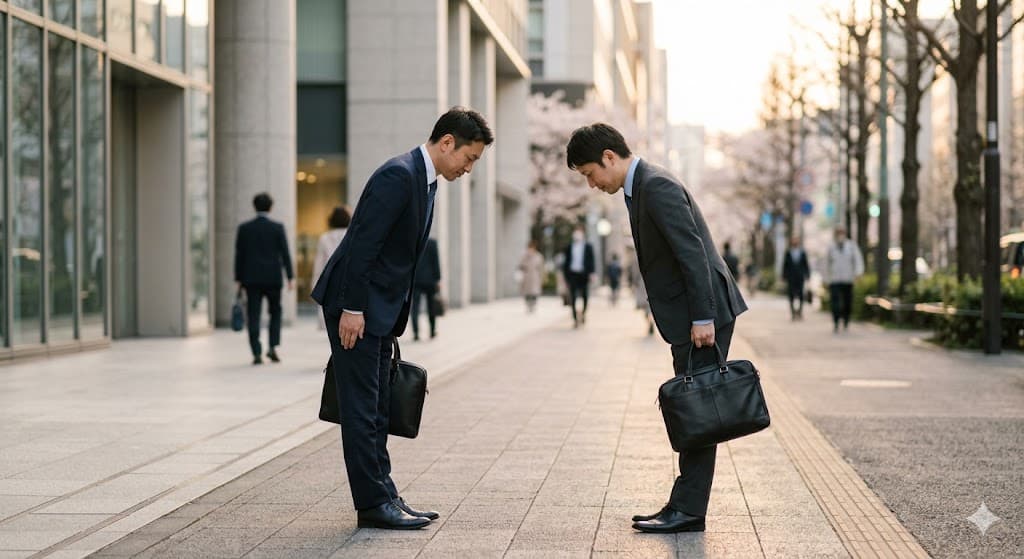
The same logic plays out silently in お辞儀(Ojigi: the bow). Two business people meet, bow, straighten, glance up, see the other person still slightly bent, and bow again. This is not parody — it is the standard finish to many face-to-face meetings in Japan. Once the chain has started, neither side wants to be the one who stops first, because stopping first reads as ending the respect first.
 Bows chain in the same way thanks do — neither side wants to be the one who stops first.
「ありがとう」 chains and 「お辞儀」 chains share a single logic: politeness in Japanese is not a one-shot token, it is a back-and-forth that gradually winds down. The closing only feels right when both parties have allowed the gesture to slow naturally, rather than when one of them slams a "you're welcome" onto the table and walks away.
Related: One Piece and the Straw Hat: Why Luffy's Crown Is a Japanese Summer Memory explains this in detail.
Why the Joke Lands in Witch Hat Atelier
The Witch Hat Atelier scene takes this rhythm and pushes it one click past where a normal Japanese speaker would actually go. Tetia's character is written as warm, overflowing, slightly excessive — and the loop is precisely the kind of thing a real Japanese person might start in earnest and then bail out of by laughing. The laugh in the scene is the laugh of "we all know we do this, we just don't usually keep going past three." Another apprentice's advice to simply not respond is the practical Japanese answer: the loop only stops when one side declines to take the next turn.
For viewers who grew up in English-speaking media environments, the joke often reads as "Japanese characters being weirdly over-polite for no reason." Knowing the structural background flips it — the scene is not exaggerating an alien custom, it is gently teasing a familiar one.
What the Loop Looks Like from Outside Japan
Living for many years now in a place where the daily working language is English, I have noticed the gratitude loop has thinned out in my own speech without me deciding to thin it. At a convenience store, "thanks" goes one way and that is the end of the transaction. In professional emails, a single line of thanks at the bottom closes the message, no return volley expected.
 Outside Japan, "thanks" often travels one way and the transaction is done.
But I have also seen that the "one-shot thanks" stereotype of English-speaking cultures is not the whole picture. In more relational settings — family gatherings, faith communities, drawn-out business negotiations — the exchange does stretch out. The local equivalent of "you're welcome," when layered with extra warmth, can run two or three turns before everyone moves on. The pattern is not absent abroad. What is distinctive about Japan is that the loop is structurally built into ordinary politeness rather than reserved for relational moments.
What modern Japan may be quietly losing — and what overseas viewers may be quietly misreading — is the sense that this rhythm is not weakness or excess. It is one of the few small spaces in a working day where a Japanese conversation deliberately refuses to be efficient, and instead chooses to linger. Each return phrase is a small refusal to let the gesture die on the first reply. When Tetia presses one more turn into the loop and the room groans, the show is also half-honoring the instinct that produced the loop in the first place.
FAQ
Q: Is the "thanks for your thanks" loop in Witch Hat Atelier exaggerated for comedy, or do Japanese people really do this?
A: Both. The chain is real and recognizable to most Japanese speakers, but the show pushes it one or two turns past where a typical exchange would naturally taper off. The comedy comes from the over-extension, not from inventing the pattern.
Q: Why do English subtitles for these scenes sometimes feel awkward?
A: Phrases like 「いえいえ」, 「こちらこそ」, and 「とんでもないです」 do not map cleanly to English. "You're welcome" closes a conversation, while the Japanese phrases are designed to keep it slightly open. Translators often pick "no, no" or "not at all" and lose the structural openness, which can make the loop look stranger than it sounds in the original.
Q: Is it rude to stop the loop after one "thank you"?
A: In casual settings with friends, a single thanks is fine. In more formal contexts — business, first meetings, exchanges with someone older or in a higher position — letting the gratitude breathe for at least one return turn is normal. Cutting it off too early can come across as cold, though no one will say so directly.
Key Insights to Remember
- The Japanese gratitude loop is not a bug in the language's politeness system, it is the system. Phrases like 「いえいえ」 and 「こちらこそ」 are engineered as soft returns rather than hard closes, which is why the exchange feels naturally open-ended to native speakers and oddly persistent to outsiders.
- The chain of 「ありがとう」 returns is the verbal counterpart to the chain of bows. Both rely on the same underlying logic: respect is shown by allowing the gesture to wind down gradually, not by being efficient with it. Either party may end the loop, but doing so too early feels like ending the respect too early.
- Witch Hat Atelier uses this loop as character comedy, but the joke only lands because the audience recognizes the rhythm. Knowing the structure behind it changes the scene from "those characters are being weirdly polite" to "the show is teasing a habit I share," which is also a quiet reminder of how much of everyday Japanese politeness lives in the second turn rather than the first.
Sources & References
About the author

Spoiler-free cultural deep-dives into anime, manga & live-action Japanese drama
- ●Tokyo-born, 3rd-generation Edokko (江戸っ子)
- ●Lifelong manga reader & anime viewer since the kaiju era
- ●Writes from outside Japan — distance as a cultural lens
- ●Spoiler-free · sourced · Kanji + Romaji + English
A Tokyo-born, 3rd-generation Edokko writer who has spent years living outside Japan. I use the anime, manga, and live-action Japanese drama you already love as a doorway into the folklore, language, religion, and everyday history behind them — written so even first-time fans can follow along, with sources for every claim.
Enjoy this article?
Get the next spoiler-free cultural deep-dive straight to your inbox.
Related Articles
Chihayafuru and the World of Competitive Karuta: The Speed, Silence, and Poetry Behind Japan's Fiercest Card Game
How Chihayafuru reveals competitive karuta, where poems from the 13th-century Hyakunin Isshu meet athletic reflexes and matches turn on hundredths of a second.
7/28/2026

Chainsaw Man and Why Every Japanese Dog Is Named Pochi: The Hidden History Behind Pochita
How Chainsaw Man's Pochita carries the history of Pochi, the Meiji-era nickname that became Japan's default dog name — and what that says about loyalty.
7/11/2026
Naruto and Yakuwarigo: The Real Meaning of Dattebayo and Why Translators Invented Believe It!
How Naruto's famous verbal tic dattebayo opens the door to yakuwarigo, Japan's role language system, and why English translators had to invent Believe it!
7/4/2026

Evangelion's Angels and Japan's Decorative Christianity
How Neon Genesis Evangelion's enemies are 使徒 (apostle) in Japanese but Angel in English — and how Japan wears Christianity as aesthetic, not faith.
7/3/2026

Solo Leveling and Te-ate: Why the Japanese Word for Treatment Means Placing the Hand
How Solo Leveling's healing magic opens onto te-ate, the Japanese word for treatment whose root is the simple act of placing a hand on a wound.
6/26/2026
Detective Conan and the -kun You Didn't Expect: How Japanese Honorifics Really Work
How Detective Conan reveals that the honorific -kun is not male-only — an inspector calls teenage Ran 'Ran-kun', a hierarchy English subtitles quietly drop.
6/11/2026