Neon Genesis Evangelion and the Evacuation Drill: Why Tokyo-3 Empties Without Panic
Why does Tokyo-3 evacuate so calmly in Neon Genesis Evangelion? A Tokyo-born writer traces Japan's evacuation-drill culture — from the 1923 earthquake and Disaster Prevention Day to the okashimo school chant.

Tokyo-born, 3rd-generation Edokko · writing on Japanese culture from outside Japan
Spoiler-Free Cultural Analysis
This article looks at the real Japanese culture of disaster drills and civil preparedness behind one background detail of Neon Genesis Evangelion's setting — the eerily calm, empty city. No plot is discussed beyond the publicly known premise.
Key Takeaways
- One of Evangelion's most unsettling images — a whole city that has already evacuated, calmly, before anything happens — is not science fiction to a Japanese viewer. It is a school memory. Japan rehearses disappearing indoors the way other countries rehearse fire alarms.
- Japan's drill culture has a birthday: September 1, the anniversary of the 1923 Great Kantō Earthquake, observed nationwide as Disaster Prevention Day with drills in schools, offices, and city halls.
- The famous calm of Japanese crowds in an emergency is not a temperament; it is choreography, drilled from early childhood until the correct behavior needs no thought at all.
Key Terms Explained
- 避難訓練 (Hinan Kunren) / Evacuation Drill — The rehearsed school and workplace ritual of evacuating for earthquake, fire, or other disaster.
- 防災の日 (Bōsai no Hi) / Disaster Prevention Day — September 1, the national day of preparedness, timed to the anniversary of the 1923 earthquake.
- 関東大震災 (Kantō Daishinsai) / Great Kantō Earthquake — The 1923 disaster that devastated Tokyo and Yokohama and still anchors Japan's preparedness culture.
- おかしも (O-ka-shi-mo) / The Drill Mnemonic — A syllable-per-rule reminder taught to schoolchildren: don't push, don't run, don't talk, don't go back.
The Siren in September
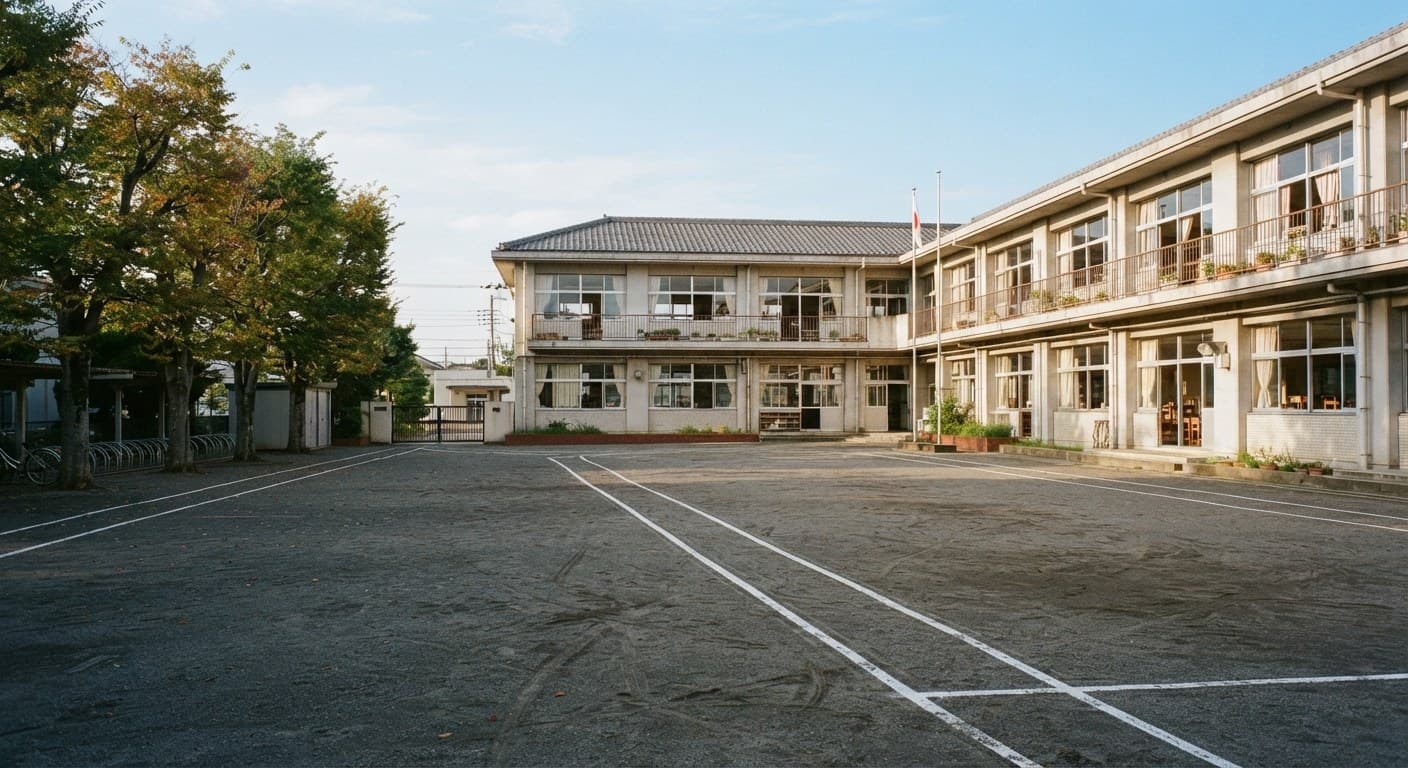
I was born and raised in Tokyo, a third-generation 江戸っ子 (Edokko: a true Tokyoite), and like every child in Japan I can still feel the rhythm of the drill in my body. The siren over the school loudspeaker. Under the desk, hands on the desk legs. Then the lines — quiet, unhurried — down the stairwell and out to the schoolyard, where teachers with clipboards counted heads. We were taught the rules as a chant, おかしも(o-ka-shi-mo: don't push, don't run, don't talk, don't go back), one syllable per commandment.
What strikes me now is what I did not feel then: fear. The drill was as routine as a math test, timed each year around the start of September. Nobody told us we were rehearsing for the worst day of our lives. We were simply learning, the way you learn to bow or to hold chopsticks, the correct form for catastrophe.
So when Evangelion shows its fortress city already emptied — streets bare, shutters down, the whole population folded away into shelters before the enemy even arrives — my reaction was never "how strange." It was recognition.
Related: Neon Genesis Evangelion and the Walkman: Why Shinji Retreats Into His Headphones explains this in detail.
Tokyo-3 and the Architecture of Preparedness
Neon Genesis Evangelion, Hideaki Anno's 1995 series at Studio Gainax, is set in Tokyo-3, a purpose-built fortress city whose publicly known premise includes buildings that retract underground and a population that evacuates to deep shelters on alarm. Battles happen in a city that has already practiced its own disappearance.
A city that knows the drill
To overseas viewers, the uncanny part is often the orderliness: no traffic jams of fleeing cars, no trampling crowds. To Japanese viewers, that orderliness is the realistic part. Japan's civil-defense imagination is built on rehearsal. Schools run evacuation drills several times a year; workplaces and municipalities run their own; department stores and train stations post evacuation routes as routinely as restroom signs. Tokyo-3 is a fantasy of engineering, but its citizens behave exactly the way the real curriculum trains people to behave.
Related: Neon Genesis Evangelion and the Danchi: The Loneliness of Japan's Concrete Utopia explains this in detail.
September 1 and the earthquake that started it
The date underneath all of this is September 1, 1923 — the 関東大震災, which destroyed vast areas of Tokyo and Yokohama. In 1960 Japan designated September 1 as 防災の日 (Bōsai no Hi: Disaster Prevention Day), and the entire country now uses it to rehearse: government agencies simulate a major quake, neighborhoods practice bucket relays, and schoolchildren nationwide file out to their schoolyards. Preparedness in Japan is not a private hobby; it is a calendar event with a national anniversary and a shared script.
Form first, feeling later
There is something deeply Japanese in the logic of the drill itself. Like 型 (kata: the practiced form in martial and traditional arts), the evacuation is rehearsed as pure form — steps, order, silence — until the body can perform it without consulting the mind. The bet is that in real terror, feeling will fail you but form will not. The famous images of Japanese crowds waiting in patient lines after the 2011 earthquake were not evidence of a calm national character. They were evidence of practice.
Related: Neon Genesis Evangelion and the Cicada: Why Japan's Endless Summer Needs a Soundtrack explains this in detail.
What Distance Taught Me About the Drill
Living outside Japan for many years has made the drill visible to me in a way it never was from inside. I have absorbed a great deal from the culture around me, but the foundations — the sense of time, the seasonal turning, and evidently this too — never got replaced. When a fire alarm sounds where I live now, I notice my own body waiting for a script that the people around me were never taught: line up, mouth closed, don't go back.
I have also come to see the melancholy in it. A country only rehearses disappearance this thoroughly because it has disappeared before — 1923, 1945, 1995, 2011. Evangelion's empty, waiting city carries that memory in its bones. The show never has to explain why Tokyo-3's citizens evacuate so well. Every Japanese viewer already did the homework, one September at a time.
FAQ
Q: Are evacuation drills really that frequent in Japanese schools? A: Yes. Schools typically run drills several times a year — for earthquakes, fires, and in some regions tsunami — and many time a major one to Disaster Prevention Day on September 1. The routine continues into adult life through workplace and neighborhood drills.
Q: Is Tokyo-3's retractable city based on anything real? A: The transforming skyline is fiction, but the underlying idea — infrastructure designed around disaster — is very real in Japan: deep underground flood channels, earthquake-resistant construction standards, designated evacuation sites, and nationwide alert systems.
Q: What does "okashimo" mean? A: It is a classroom mnemonic where each syllable stands for a rule: 押さない (don't push), 駆けない (don't run), 喋らない (don't talk), 戻らない (don't go back). Some schools teach variants with extra syllables, but the spirit is the same: orderly form over individual panic.
Key Insights to Remember
- Evangelion's emptied city reads as uncanny to some audiences and as documentary to others. That gap is cultural: Japan has spent a century turning evacuation from an emergency into a rehearsed, almost ceremonial form, and the show quietly assumes that competence in its world-building.
- The drill is kata applied to catastrophe. Japan's answer to the unreliability of human nerves is the same as its answer in calligraphy or judo — practice the form until it performs itself. Crowd calm in Japanese disasters is trained, not innate.
- Preparedness cultures are memory cultures. September 1 keeps 1923 in the national body the way rituals keep ancestors in the family. Tokyo-3's shelters are science fiction, but the habit of readiness they depict is the inheritance of a country that remembers exactly why it practices.
Sources
About the author

Spoiler-free cultural deep-dives into anime, manga & live-action Japanese drama
- ●Tokyo-born, 3rd-generation Edokko (江戸っ子)
- ●Lifelong manga reader & anime viewer since the kaiju era
- ●Writes from outside Japan — distance as a cultural lens
- ●Spoiler-free · sourced · Kanji + Romaji + English
A Tokyo-born, 3rd-generation Edokko writer who has spent years living outside Japan. I use the anime, manga, and live-action Japanese drama you already love as a doorway into the folklore, language, religion, and everyday history behind them — written so even first-time fans can follow along, with sources for every claim.
Enjoy this article?
Get the next spoiler-free cultural deep-dive straight to your inbox.
Related Articles

My Neighbor Totoro and the Katori Senko: The Meiji Invention That Gave Japanese Summer Its Smell
How My Neighbor Totoro's summer evokes the katori senko, the Meiji-era mosquito coil whose spiral was imagined in 1895 by the wife of Kincho's founder.
8/8/2026

Anohana and Kingyo-sukui: Why Japan Replaced a Working Net With Paper That Dissolves
How Anohana's summer world explains kingyo-sukui, the festival stall game where Japan swapped a net that worked for a paper scoop designed to fail.
8/2/2026

Chibi Maruko-chan and Rajio Taisō: Why Japanese Kids Spend Summer Mornings Doing Radio Calisthenics in a Car Park
How Chibi Maruko-chan's Shōwa childhood preserves rajio taiso, the summer radio calisthenics Japan imported from an American insurer that dropped it a decade later.
8/1/2026

Rurouni Kenshin and Uchimizu: Why Old Tokyo Cooled Its Streets With a Ladle of Water
How the Meiji-era streets of Rurouni Kenshin open onto uchimizu — a summer custom that began as tea-ceremony courtesy and spread through Edo because of dust.
7/31/2026

Ace of Diamond and the Dirt of Koshien: Why Japan's Losing Teams Scoop Soil Into Their Bags
How Ace of Diamond treats Koshien as a destination, and why eliminated high school players kneel to fill bags with soil that groundskeepers blend by season.
7/30/2026
Neon Genesis Evangelion and the Walkman: Why Shinji Retreats Into His Headphones
Why does Shinji's SDAT cassette player feel so Japanese? From Sony's 1979 Walkman to quiet packed trains and the meiwaku ethic, a Tokyo-born writer unpacks the headphone culture behind Evangelion's most human prop.
7/23/2026