Your Name and Kumihimo: The Real Japanese Craft Behind Mitsuha's Braided Cord
How Your Name dramatizes kumihimo as a picture of musubi, and the real braided-cord craft behind it, from samurai armor to the modern kimono obijime.

Tokyo-born, 3rd-generation Edokko · writing on Japanese culture from outside Japan
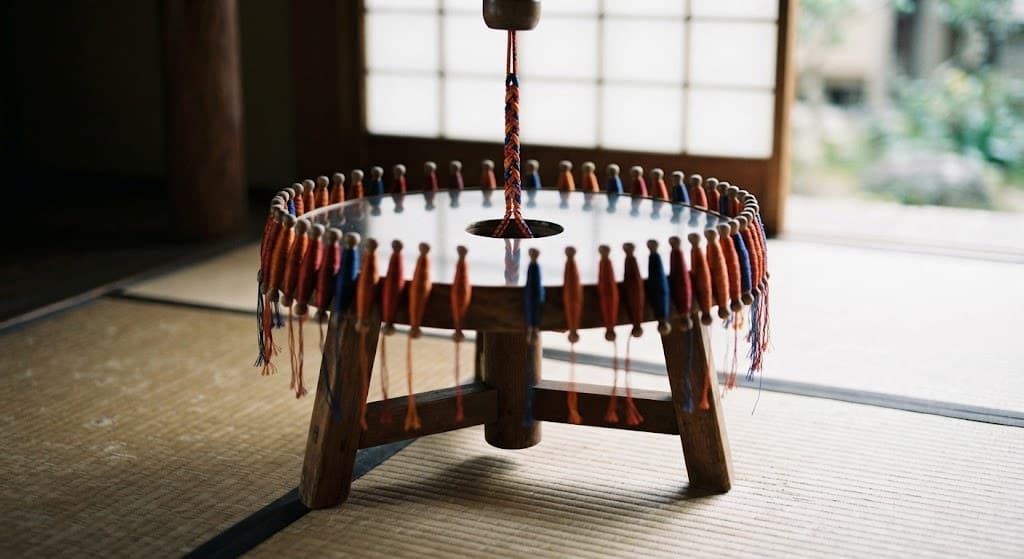
Watch 君の名は。(Kimi no Na wa.: Your Name), the 2016 film by 新海誠(Shinkai Makoto: the film's director), and cords keep catching your eye. One holds back the hair of 三葉(Mitsuha: the film's heroine). Another is wrapped twice around the right wrist of 瀧(Taki: the film's hero). And a grandmother and two girls sit at a round wooden stand, crossing coloured threads over one another. That craft is 組紐(Kumihimo: Japanese braided cord), and it was not invented for the screen. It is a real Japanese art with a long working life behind it: tying sacred scrolls, lacing samurai armor, hanging swords at the hip, and finally holding a kimono together. Behind it sits a Shinto word, musubi, that explains why a braided cord in Your Name can carry so much more than its own weight.
Spoiler-Free Cultural Analysis
This piece explores the real craft, history and Shinto ideas behind the braided cords in Your Name. It mentions only the family braiding, the cord in Mitsuha's hair and the cord Taki wears, and says nothing about how the story unfolds.
Key Takeaways
- Kumihimo is braiding, not weaving or knitting. Many threads are crossed over one another on a stand, such as the round marudai the family uses in Your Name, and Kyoto's braid makers alone count more than forty basic patterns.
- The cord's job changed as Japan changed. It tied sutra scrolls and ritual objects, laced warriors' armor and fastened swords at the waist, and when swords were banned in the Meiji era, braid makers turned to the obijime that holds a kimono sash in place.
- Musubi, the Shinto idea of an unseen power that brings things into being and joins them, is what lets a braided cord in the film stand for far more than a hair tie.
Key Terms Explained
- 組紐 (Kumihimo) / Braided Cord — A cord built up by crossing many threads, usually silk, over one another. It is neither woven nor knitted.
- 丸台 (Marudai) / Round Braiding Stand — A wooden stand with a round, mirror-like top. It is the tool the Miyamizu family uses in Your Name.
- 下げ緒 (Sageo) / Scabbard Cord — The cord that fastened a sword's scabbard at the waist, and the main use of kumihimo in the Edo period.
- 帯締め (Obijime) / Kimono Sash Cord — The cord tied over the obi sash of a kimono. Since the Meiji era it has been the braid makers' main product.
- 産霊 (Musuhi / Musubi) / Generative Power — The Shinto idea of an invisible working that brings heaven, earth and all things into being, and that joins them together.
A Sword Behind Glass in Ueno
I grew up in 東京(Tōkyō: Japan's capital) as a third-generation 江戸っ子(Edokko: a born-and-bred Tokyoite), and nearly every real 日本刀(Nihontō: Japanese sword) I have seen, I saw in a museum in 上野(Ueno: an old district of Tokyo). I would stand on my side of the glass case and follow the 刃文(Hamon: the wavy temper line along a blade) down the steel. That was the whole distance between me and a sword: one pane of glass and one line of tempered metal.
Those glass cases came back to me when I started reading about the cords in Your Name. A Japanese sword was never only steel. For centuries, braided silk was wound around its hilt and tied its scabbard to the wearer's belt. The craft that made those cords is the same one the film shows a family practising at home.
Ueno turns out to be part of the story too. The kumihimo house 道明(Dōmyō: a historic braid maker) was founded in 1652, and its main shop still stands in 池之端(Ikenohata: a neighbourhood in Ueno), near 湯島天神(Yushima Tenjin: a well-known Tokyo shrine).
Related: Rurouni Kenshin and the Haitōrei: Why a Samurai with a Sword Causes a Stir on Meiji Streets explains this in detail.
From Sutra Scrolls to Samurai Armor: The Long Life of Kumihimo
What Makes a Braid a Kumihimo
Kyoto Prefecture describes its local braid, 京くみひも(Kyō Kumihimo: Kyoto braided cord), as an art in which every single thread helps form the pattern. That is the key difference from weaving. Unlike weaving, there is no warp and weft. The threads are crossed over one another again and again until they become a single cord.
The braider works on a 組台(Kumidai: braiding stand). Four kinds are counted as traditional: the 丸台(Marudai: round stand) the family uses in the film, the 角台(Kakudai: square stand), the 綾竹台(Ayatakedai: another traditional braiding stand), and the 高台(Takadai: high stand). Kyoto braiding alone counts more than forty basic patterns.
Temple Cords and Court Silk
The oldest traces of simple braided cord in Japan come from sites of the early 縄文時代(Jōmon Jidai: Japan's prehistoric Jōmon period), roughly five to six thousand years ago. Complex braiding techniques and silk thread arrived from the continent around the sixth century. Braids from the 飛鳥(Asuka: the Asuka period) and 奈良時代(Nara Jidai: the Nara period) still survive at 正倉院(Shōsōin: an ancient treasure house in Nara) and 法隆寺(Hōryūji: an ancient temple in Nara).
These early cords were sacred working tools. 伊賀くみひも(Iga Kumihimo: braided cord from the Iga area of Mie Prefecture) is said to date back before the Nara period, and its first job was tying 経巻(Kyōkan: sutra scrolls) and the ritual implements of Buddhist temples and Shinto shrines.
The 平安時代(Heian Jidai: the Heian period) is called the golden age of kumihimo. Court nobles used braided cords to hang their swords and to tie their scrolls, designs drifted away from continental models toward a Japanese taste, and braids spread into musical instruments, furnishings and court dress.
Armor, Swords, and the Warrior's Braids
With the 鎌倉時代(Kamakura Jidai: the Kamakura period), the customers changed. New braids were developed for 武士(Bushi: the warrior class). Cord was wound around sword hilts, and it laced together the 小札(Kozane: small lacquered metal plates) that made up a suit of armor. One braid in particular, 亀甲組(Kikkō-gumi: the tortoiseshell braid), was widely used for armor.
In the 室町時代(Muromachi Jidai: the Muromachi period), the spread of 茶の湯(Cha no Yu: the tea ceremony) called for quieter work: subdued cords for the 仕覆(Shifuku: silk pouches for tea utensils) and for 掛軸(Kakejiku: hanging scrolls).
Then, in the 江戸時代(Edo Jidai: the Edo period), kumihimo reached ordinary townspeople. Its main use was the sageo, the cord that kept a sword's scabbard fixed at the waist, and named braids such as 貝ノ口組(Kainokuchi-gumi: a flat braid pattern), 高麗組(Kōrai-gumi: a braid pattern) and 内記組(Naiki-gumi: a braid pattern) grew out of that demand. Braiders also made cords to hang an 印籠(Inrō: a small hanging case) or a 煙草入れ(Tabako-ire: a tobacco pouch) from the belt, 羽織紐(Haori-himo: the cord that closes a haori jacket) and 組帯(Kumi-obi: braided sashes).
The Meiji Turn: From Sword Cords to the Obijime
I learned the 廃刀令(Haitōrei: the edict abolishing the wearing of swords) at school as a date to memorise for a history test. What it meant to the men who had to put their swords away never reached the classroom. Reading the history of kumihimo now, I can see it hit the braid makers hard too.
When the 明治時代(Meiji Jidai: the Meiji period) government banned swords, demand for scabbard cords and hilt wrappings all but disappeared. Braid makers survived by switching to the 帯締め(Obijime: the cord tied over a kimono sash) for women's 着物(Kimono: traditional Japanese dress). The obijime became their main product, and the market shrank again later as Western clothing spread.
The craft also found a new home in industry. Iga Kumihimo grew into a full-scale trade in the middle of the Meiji period, helped by a climate suited to silkworm farming and its closeness to Kyoto. It works mainly in silk, with gold and silver thread as well, and it is best known for cords braided by hand on the takadai, which make up most of Japan's output. Its main products are obijime and haori-himo. On 15 December 1976 it was named a 伝統的工芸品(Dentōteki Kōgeihin: a Traditional Craft designated by Japan's Minister of Economy, Trade and Industry). Iga, 江戸(Edo: the old name for Tokyo) and 京都(Kyōto: Japan's old imperial capital) were long counted as the three great kumihimo centres.
Musubi: Why a Braided Cord Carries Weight
At the braiding stand in Your Name, the grandmother gives the girls a word for what they are doing: musubi. In her telling, the same word covers the threads coming together, people being joined to one another, and the passing of time itself. I will leave her actual lines on the screen, where they belong. What interests me is where the word comes from.
In 神道(Shintō: Japan's native religion), 産霊(Musuhi: the generative power) is written with characters for birth and spirit, and is also written 産巣日. The Encyclopedia of Shinto published by 國學院大學(Kokugakuin Daigaku: a Tokyo university known for Shinto studies) explains it as the invisible working that gives birth to heaven, earth and everything in them. The "musu" part means coming into being and growing, and the "hi" part means a spiritual, wondrous force.
The idea is old. In the 古事記(Kojiki: Japan's oldest chronicle of myths), 高御産巣日神(Takamimusuhi no Kami: a creator deity) is one of the 造化三神(Zōka Sanshin: the three deities of creation). When 天照大御神(Amaterasu Ōmikami: the sun goddess) shuts herself in the 天岩戸(Ama-no-Iwato: the Heavenly Rock Cave), he has his child 思金神(Omoikane no Kami: the deity who devises the plan) work out a way to draw her out. Another musubi deity, 神産巣日神(Kamimusubi no Kami: a creator deity), brings the murdered 大穴牟遅神(Ōnamuchi no Kami: a deity of the Kojiki myths) back to life. From these stories, the encyclopedia suggests, people believed the musubi gods could rouse a weakened soul. 国学(Kokugaku: the Edo-period school of native Japanese studies) scholars later wrote about musubi at length as a core concept of Shinto.
Kokugakuin's short glossary of Shinto terms puts it even more plainly: birth and becoming, completion, joining, the power that brings forth and harmonises. Whether that sacred word and the everyday 結び(Musubi: a tie or knot) share one root is a question for linguists, and I won't try to settle it here. What strikes me is that "joining" is already inside the sacred meaning. A cord is threads brought together until they become something new. Seen that way, a braid is a small, physical picture of musubi, which is exactly how the film uses it.
What a Film Gave Back to an Old Craft
Your Name was a huge hit. By 14 November 2016 it had taken 18.49 billion yen at the box office and topped the charts for twelve weeks in a row. Braid makers felt it almost at once.
At くみひも平井(Kumihimo Hirai: an Iga kumihimo shop) on おかげ横丁(Okage Yokochō: a shopping street in Ise), the staff were surprised when a man in his twenties bought a standard obijime, about 115 centimetres long, for 4,320 yen. More customers in their twenties and thirties followed, and the staff could tell the film had sent them. Within about three weeks the shop made a new bracelet for 1,080 yen and a hair tie for 864 yen, which sold without any explanation. The company's president said he hoped interest in braided cord would grow into interest in traditional crafts and kimono culture.
A Kyoto braid maker that used to get one or two bracelet orders a week saw them climb from around September 2016. After it put a double-wrapped bracelet on its website for 1,944 yen, it was making as many as 250 a week at busy times, and was still turning out around 300 a week when a February 2017 report came out. Orange, red and blue was the favourite mix. The maker also pointed out that the exact design seen in the film cannot be produced with kumihimo methods. At 伊賀くみひもセンター 組匠の里(Iga Kumihimo Sentā Kumishō no Sato: Iga Kumihimo Center, run by the Mie Prefecture braid makers' cooperative), 923 people joined braiding classes in November 2016, more than double the usual number and the highest ever. Many buyers were men around twenty, often buying two or three cords at once.
At AnimeJapan 2017, craftspeople sat at each table and taught 指組紐(Yubi Kumihimo: simple braiding with the threads looped over the fingers), using the same orange, red and blue as the film's bracelet. Sessions of sixteen people ran for thirty minutes, at 3,000 yen, with a take-home kit for 2,500 yen. Then in 2019, at an exhibition of Shinkai's work in 名古屋(Nagoya: a city in central Japan), braided hair ornaments went on sale described as handmade by a craftsperson who had helped research the film's braiding scenes.
Those young men buying cords two and three at a time remind me of something from my own childhood. I was often bought little お守り(Omamori: protective charms) at 神社(Jinja: Shinto shrines) and お寺(Otera: Buddhist temples), the kind that cost around 100 yen. I never hung them on my ランドセル(Randoseru: a Japanese school backpack). I kept them carefully in a drawer, and I think I lost them in a house move. I wonder whether some of those bracelets ended up the same way: not as fashion, but as a small thing to keep close because it seemed to hold a connection.
After many years living outside Japan, I look at the obijime differently. It is the descendant of armor lacing and scabbard cords, tied over a kimono sash by wearers who may never think about samurai. A film did not invent that continuity. It made a new generation look at it.
FAQ
Q: Is the kumihimo in Your Name a real Japanese craft? A: Yes. Kumihimo is a traditional Japanese braiding craft with roots in ancient Japan, and the round marudai stand the family uses in the film is one of four traditional braiding stands. Iga Kumihimo from Mie Prefecture has been an officially designated Traditional Craft since 1976.
Q: Can I buy an exact copy of the bracelet from the film? A: Not exactly. A Kyoto braid maker said the precise design seen on screen cannot be made with kumihimo methods, so real shops sell close interpretations, such as double-wrapped bracelets in orange, red and blue. Those prices come from 2016 and 2017 reports, so check current ones with the makers directly.
Q: Where can I try kumihimo myself? A: The Iga Kumihimo Center in Mie Prefecture has run hands-on braiding classes, and in November 2016 it drew a record 923 participants. Finger braiding needs no stand at all, so it is the easiest way to start; a marudai set with thread cost just under 30,000 yen in early 2017.
Key Insights to Remember
- Kumihimo has always followed whoever needed tying. Temples needed scrolls bound, warriors needed armor laced and swords hung, and later kimono wearers needed a sash held firm. Its long survival comes from that ability to change jobs without changing its method.
- The Meiji sword ban looks like a footnote in samurai history, but for braid makers it was a near-death moment. Their turn to the obijime is why kumihimo is still a living trade rather than a museum piece.
- Musubi gives the braid its weight. In Shinto it is the unseen power that creates, joins and revives, so a cord made by joining threads becomes a natural image for ties between people. Your Name did not borrow an empty symbol; it borrowed one already full.
Sources
- Your Name Bracelet-Making Demonstration at AnimeJapan 2017 — Anime News Network
- Young customers visit an Iga kumihimo shop in Ise after Your Name (Japanese) — Ise-Shima Keizai Shimbun
- Kumihimo bracelet demand after Your Name (Japanese) — Nikkei
- Makoto Shinkai exhibition at JR Nagoya Takashimaya (Japanese) — Fashion Press
- Kumihimo: The Art of Japanese Silk Braiding by Domyo — History — Japan House Los Angeles
- The History of Kumihimo and Domyo — Domyo
- Kyō Kumihimo (Japanese) — Kyoto Prefecture
- Iga Kumihimo (Japanese) — Mie Prefecture
- Musuhi — Encyclopedia of Shinto — Kokugakuin University
- Musubi — Basic Terms of Shinto — Kokugakuin University
About the author

Spoiler-free cultural deep-dives into anime, manga & live-action Japanese drama
- ●Tokyo-born, 3rd-generation Edokko (江戸っ子)
- ●Lifelong manga reader & anime viewer since the kaiju era
- ●Writes from outside Japan — distance as a cultural lens
- ●Spoiler-free · sourced · Kanji + Romaji + English
A Tokyo-born, 3rd-generation Edokko writer who has spent years living outside Japan. I use the anime, manga, and live-action Japanese drama you already love as a doorway into the folklore, language, religion, and everyday history behind them — written so even first-time fans can follow along, with sources for every claim.
Enjoy this article?
Get the next spoiler-free cultural deep-dive straight to your inbox.
Related Articles

Touch and the Alps Stand of Koshien: Why Japan Unbolts Stadium Seats for a School Brass Band
How Touch's high-school baseball world leads to Koshien's Alps Stand, named by a cartoonist, and why seats are removed each August for school brass bands.
8/14/2026

Summer Wars and Hanafuda: The Flower Cards That Built Nintendo Before Video Games
How Summer Wars puts a deck designed to survive a gambling ban on the table, and why Nintendo spent its first 86 years making those flower cards by hand.
8/13/2026

In This Corner of the World and Japan's Noon Silence on August 15: The Minute a Whole Country Stops
How In This Corner of the World, set in wartime Kure, connects to Japan's mokutō, the noon silence each August 15 timed to the 1945 surrender broadcast.
8/12/2026

Sailor Moon and the Sailor Fuku: Why Japan Put a Skirt on a British Naval Uniform
How the sailor uniform behind Sailor Moon reached Japan — a British naval design adopted in 1920 so girls could do gymnastics, and the school that first paired the top with a skirt.
8/6/2026

Silver Spoon and Japan's Agricultural High Schools: The Real Nōgyō Kōkō Behind Ooezo
How Silver Spoon draws on Japan's real agricultural high schools — around 300 of them — and why their student farming clubs were deliberately modelled on an American organisation after the war.
8/5/2026

Doraemon and Jiyū Kenkyū: Why Every Japanese Child Must Invent a Science Project Each August
How Doraemon turns Nobita's summer homework panic into comedy — and why jiyū kenkyū, the open-ended August research project, was once a real school subject on the Japanese timetable.
8/3/2026