Rurouni Kenshin and the Haitōrei: Why a Samurai with a Sword Causes a Stir on Meiji Streets
How Rurouni Kenshin dramatizes the 1876 廃刀令 (Haitōrei) — the moment a sword turned a samurai from protector into outlaw, and the world quietly moved on.

Tokyo-born, 3rd-generation Edokko · writing on Japanese culture from outside Japan
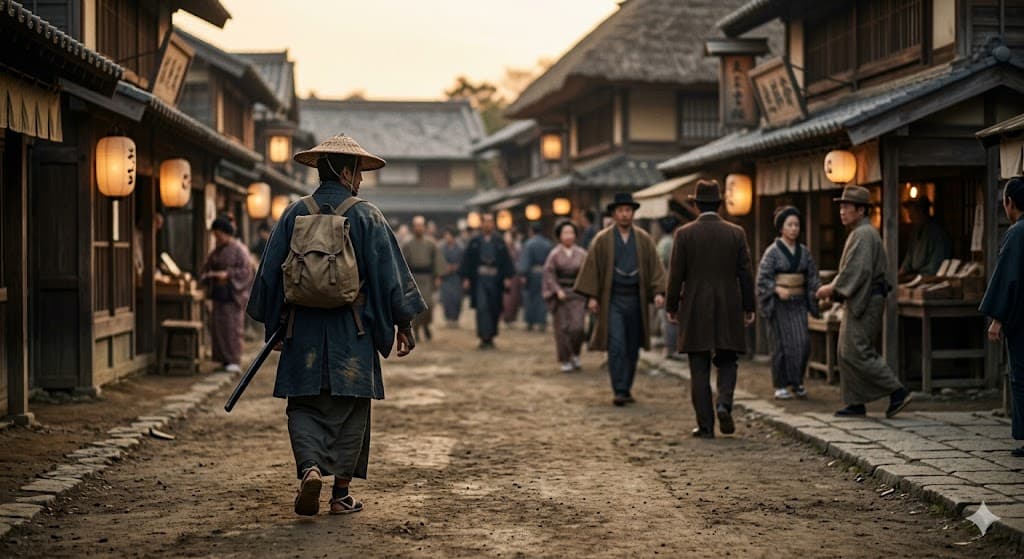
Spoiler-Free Cultural Analysis
This article unpacks the historical and legal context behind a single recurring image in 『るろうに剣心』(Rurouni Kenshin) — a man walking through Meiji streets with a sword on his hip while passersby whisper. No plot revelations beyond the show's premise: only the atmosphere, the law that shaped it, and the world it announced.
Key Takeaways
- The 廃刀令 (Haitōrei: 1876 Sword Abolishment Edict) banned everyone except the military and police from wearing a 刀 (katana: Japanese sword) in public, ending centuries in which the blade had been a daily extension of the samurai's body and status.
- A whispered street scene of bystanders giving a swordsman a wide berth is not background flavor — it is a precise legal portrait of 明治時代 (Meiji jidai: the Meiji era) showing that the protagonist is, by the standards of the new state, already a relic.
- The arc from 侍 (samurai: warrior class) → 警官 (keikan: police officer) → 軍刀 (guntō: military sword) is the actual route by which Japan's monopoly on armed force shifted from a hereditary class to a modern bureaucratic state.
Key Terms Explained
- 廃刀令 (Haitōrei) / Sword Abolishment Edict — The 1876 (明治9年) decree forbidding the wearing of swords in public by anyone other than military personnel, police, and those in formal court dress.
- 帯刀 (Taitō) / Wearing a Sword — The act of carrying a sword thrust through the sash at the waist, historically a privilege and duty of the samurai class.
- 士族 (Shizoku) / Former Samurai Class — The post-Restoration legal designation for ex-samurai families, a status with prestige but rapidly declining real privilege.
- 廃藩置県 (Haihan Chiken) / Abolition of Domains and Establishment of Prefectures — The 1871 reform that dissolved feudal domains and replaced them with centrally administered prefectures, the structural precondition for disarming the samurai.
- 秩禄処分 (Chitsuroku Shobun) / Stipend Abolition — The 1876 measure that converted samurai hereditary rice stipends into one-time government bonds, completing the economic dismantling of the warrior class.
A Textbook Line That Hid an Earthquake
The word 廃刀令 (Haitōrei) first entered my head as a single line in a junior-high history textbook — a year, a clause, something to underline for a test. 1876. Military and police only. End of an era. That was the entire treatment. I memorized it the way I memorized treaty dates, and moved on.
 A real Nihontō survives today as a museum artifact behind glass — the long downstream of the 1876 edict.
It took years, and eventually 『るろうに剣心』, for me to feel what that line actually was. A textbook turns a law into one sentence. 和月伸宏 (Watsuki Nobuhiro)'s manga, and the anime that followed, turns the same law into a street: a man with a sword walks past, ordinary townspeople tense up, and someone mutters that he must not have heard about the edict. Nobody draws. Nobody fights. The drama is entirely in the gap between a body that still moves like the old world and a sidewalk that already belongs to the new one.
Growing up as a 江戸っ子 (Edokko: a born-and-bred Tokyoite) of the third generation, I never met a samurai. Of course not — they had been legally dissolved a century before I was born. But I also never saw a real 日本刀 (Nihontō: Japanese sword) outside of a museum. The few times I have stood in front of one, it was always at 上野 (Ueno: a major museum district in Tokyo), behind glass, lit from above, labeled as a 重要文化財 (Jūyō Bunkazai: Important Cultural Property). That distance — that the sword has become an art object behind acrylic — is not natural. It is the long downstream effect of a decree that 剣心 (Kenshin), in the world of the show, is living through in real time.
The Edict and the Machinery Beneath It
The Haitōrei did not arrive out of nowhere. It was the last in a series of laws designed to do something extraordinary: take a hereditary military caste of roughly five to seven percent of the population and, within a single generation, convert them into civilians.
 For most of the Edo period, the daishō was not an accessory but the visible proof of samurai class, license, and identity.
The Sword as Body, Status, and Job Description
For most of the 江戸時代 (Edo jidai: Edo period, 1603–1868), a samurai walked with two swords — the 大小 (daishō: long-and-short pair) — thrust through the obi at the left hip. The blades were not optional accessories. They were the visible proof of membership in the 武士 (bushi: warrior) class, the legal license to enforce discipline, and, in extreme cases, the instrument of 切り捨て御免 (Kirisute Gomen: the samurai's right to cut down commoners for grave discourtesy). To remove the sword was, quite literally, to remove the samurai's job, identity, and social rank in one motion.
This is the weight the Meiji government had to pry loose. They did it incrementally.
The Three Hammer Blows: 1871, 1873, 1876
The 廃藩置県 (Haihan Chiken) of 1871 abolished the feudal domains and turned the daimyō's old territories into prefectures answerable to Tokyo. With the domains gone, the lord–retainer relationship that had given the samurai his salary and purpose simply had no scaffolding left.
Two years later, the 徴兵令 (Chōheirei: Conscription Ordinance) of 1873 created a national army drawn from all classes, including farmers and townspeople. The state no longer needed a hereditary warrior caste to defend itself. The samurai's monopoly on organized violence ended on paper.
Then came 1876. The 廃刀令 was issued in March, forbidding the public wearing of swords by anyone outside the military, police, and officials in formal dress. Later that same year, the 秩禄処分 (Chitsuroku Shobun) converted the samurai's hereditary rice stipends into government bonds — a one-time payout that, for most families, melted away within a decade. Within twelve months, the old warrior class had lost its sword, its salary, and its function.
Why Police and Military Were Carved Out
The exemptions were not sentimental. They were the blueprint for a modern state's monopoly on legitimate force. The 軍刀 (guntō: military saber, often a Western-style hilt over a Japanese blade) became the army officer's tool. The police, drawn heavily from former samurai of the 薩摩 (Satsuma: a former domain in southern Kyushu) and 会津 (Aizu: a former domain in northern Japan) lineages, were issued sabers as well. The sword did not disappear from Japan in 1876. It was nationalized. It moved from the hip of a hereditary caste to the belt of a salaried officer of the state.
This is exactly the world 斎藤一 (Saitō Hajime: a historical 新選組 captain who, in the series, serves as a Meiji policeman) — the former 新選組 (Shinsengumi: special police force of the 幕末 (Bakumatsu: the final years of the Tokugawa shogunate)) captain reborn as a Meiji officer — inhabits in the show. His ability to draw a blade in public is not a holdover from his samurai past. It is a uniformed power granted by the very government that took the same blade away from his old comrades.
The Backlash the Government Had Prepared For
The samurai did not all go quietly. The 神風連の乱 (Shinpūren no Ran: Shinpūren Rebellion) of October 1876 was a direct armed protest by ex-samurai in 熊本 (Kumamoto: a region in Kyushu) explicitly against the Haitōrei. It was crushed in days. The far larger 西南戦争 (Seinan Sensō: Satsuma Rebellion) of 1877, led by 西郷隆盛 (Saigō Takamori: Satsuma leader of the 1877 rebellion), was the last gasp of organized samurai resistance — and notably, it was a conscript army of commoners that put it down. The lesson was unmistakable: the sword had been outranked by the rifle, and the warrior had been outranked by the citizen.
What the Whispering Crowd Actually Sees
Knowing all this, the brief street scene that opens the 京都 (Kyōto: the former imperial capital) arc becomes one of the densest pieces of historical staging in the entire series. A man walks past with a blade. Pedestrians lower their voices. He must not know about the edict. Better not get too close.
 A Meiji street reads a swordsman's legal status in a single glance — military, police, or outlaw.
What the bystanders are reading, in a single glance, is a legal status. A sword on the hip in 1878 means one of three things: he is military, he is police, or he is breaking the law. Since he wears no uniform, the only remaining option is the third — and in a country that had just buried thousands of ex-samurai in the Seinan war, a man with an unexplained blade is not a curiosity. He is a danger and, possibly, an outlaw.
The genius of the framing is that nothing has to be explained. The crowd's body language is the explanation. A culture that had centered the sword for seven hundred years can, within roughly a decade, recoil from the sight of one — and the show captures that pivot in a fifteen-second street scene with no narration at all.
Living outside Japan for many years, I have come to notice something else about that scene. The modern Japanese 銃刀法 (Jūtōhō: Firearms and Swords Control Law) is so thoroughly absorbed into daily life that almost no one I grew up with ever thought about it. Nobody carries a blade. Nobody expects to. The idea that a sword could be a normal accessory has been gone so long that even thinking about it requires deliberate effort. That total absence — that easy, unconscious civilian peace — is the long downstream of the line in my old textbook. The edict did not just disarm a class. It rewrote the default mental image of what a person on the street looks like.
FAQ
Q: Was the Haitōrei the very first attempt to disarm the samurai?
A: No. Earlier orders had encouraged samurai to stop wearing swords voluntarily, and the 1871 prefecture reform and 1873 conscription law had already gutted the samurai's military role. The 1876 Haitōrei was the final, enforceable ban, paired the same year with the abolition of samurai stipends.
Q: Could ex-samurai keep their family swords at home?
A: Yes. The Haitōrei restricted the public wearing of swords, not private ownership. Family blades were generally retained as heirlooms, which is one reason so many Edo-period swords survive in Japanese households and museums today.
Q: How did the police end up carrying swords if the samurai could not?
A: Meiji police forces were heavily recruited from former samurai, particularly from the Satsuma domain after the Seinan War. The state granted uniformed officers the right to bear blades because the monopoly on legitimate armed force had been transferred from the samurai class to the state itself.
Key Insights to Remember
- The Haitōrei is the single sharpest legal line between the world of the samurai and the world of the modern Japanese citizen. Everything afterward — the rise of the salaried officer, the conscript soldier, the unarmed townsperson, the museum-cased blade — flows from this one decree. Understanding it explains why the protagonist of Rurouni Kenshin is dramatic just by walking down a street.
- The Meiji state did not abolish armed force. It nationalized it. By exempting the military and police, the edict moved the sword from a hereditary right into a state-issued tool, a pattern that would shape every modern Japanese institution from the army to the bureaucracy.
- A culture's relationship to a single object — in this case, a curved steel blade — can be turned inside out within a single generation when law, economics, and military reform move together. Japan's transition from the daishō at the hip to the museum vitrine took less than thirty years, and Rurouni Kenshin lives entirely inside that narrow window.
Sources
About the author

Spoiler-free cultural deep-dives into anime, manga & live-action Japanese drama
- ●Tokyo-born, 3rd-generation Edokko (江戸っ子)
- ●Lifelong manga reader & anime viewer since the kaiju era
- ●Writes from outside Japan — distance as a cultural lens
- ●Spoiler-free · sourced · Kanji + Romaji + English
A Tokyo-born, 3rd-generation Edokko writer who has spent years living outside Japan. I use the anime, manga, and live-action Japanese drama you already love as a doorway into the folklore, language, religion, and everyday history behind them — written so even first-time fans can follow along, with sources for every claim.
Enjoy this article?
Get the next spoiler-free cultural deep-dive straight to your inbox.
Related Articles
Your Name and Kumihimo: The Real Japanese Craft Behind Mitsuha's Braided Cord
How Your Name dramatizes kumihimo as a picture of musubi, and the real braided-cord craft behind it, from samurai armor to the modern kimono obijime.
10/12/2026

Touch and the Alps Stand of Koshien: Why Japan Unbolts Stadium Seats for a School Brass Band
How Touch's high-school baseball world leads to Koshien's Alps Stand, named by a cartoonist, and why seats are removed each August for school brass bands.
8/14/2026

Summer Wars and Hanafuda: The Flower Cards That Built Nintendo Before Video Games
How Summer Wars puts a deck designed to survive a gambling ban on the table, and why Nintendo spent its first 86 years making those flower cards by hand.
8/13/2026

In This Corner of the World and Japan's Noon Silence on August 15: The Minute a Whole Country Stops
How In This Corner of the World, set in wartime Kure, connects to Japan's mokutō, the noon silence each August 15 timed to the 1945 surrender broadcast.
8/12/2026

Sailor Moon and the Sailor Fuku: Why Japan Put a Skirt on a British Naval Uniform
How the sailor uniform behind Sailor Moon reached Japan — a British naval design adopted in 1920 so girls could do gymnastics, and the school that first paired the top with a skirt.
8/6/2026

Silver Spoon and Japan's Agricultural High Schools: The Real Nōgyō Kōkō Behind Ooezo
How Silver Spoon draws on Japan's real agricultural high schools — around 300 of them — and why their student farming clubs were deliberately modelled on an American organisation after the war.
8/5/2026