Demon Slayer and Taishō Roman: Why Demons Fit Its Era
How Demon Slayer uses the short Taishō era (1912–1926) and Taishō Roman style to build a world where electric light and man-eating demons share the same night.

Tokyo-born, 3rd-generation Edokko · writing on Japanese culture from outside Japan
Spoiler-Free Cultural Analysis
This article explores the real historical and cultural background of the era in which 鬼滅の刃(Kimetsu no Yaiba: Demon Slayer) is set — its atmosphere, its contradictions, and the folk beliefs that survived into it. No plot revelations beyond the setting and premise; only the history behind the work.
Key Takeaways
- The 大正(Taishō: "Great Righteousness" era name) period lasted only about fifteen years, making it one of the shortest named periods in modern Japanese history — and that brevity is exactly why it feels like a doorway rather than a destination.
- Demon Slayer's first episode is built on a seam: a charcoal-selling mountain village whose economy belongs to the old world, and a town below it that is already sliding into gaslight, trains, and Western collars.
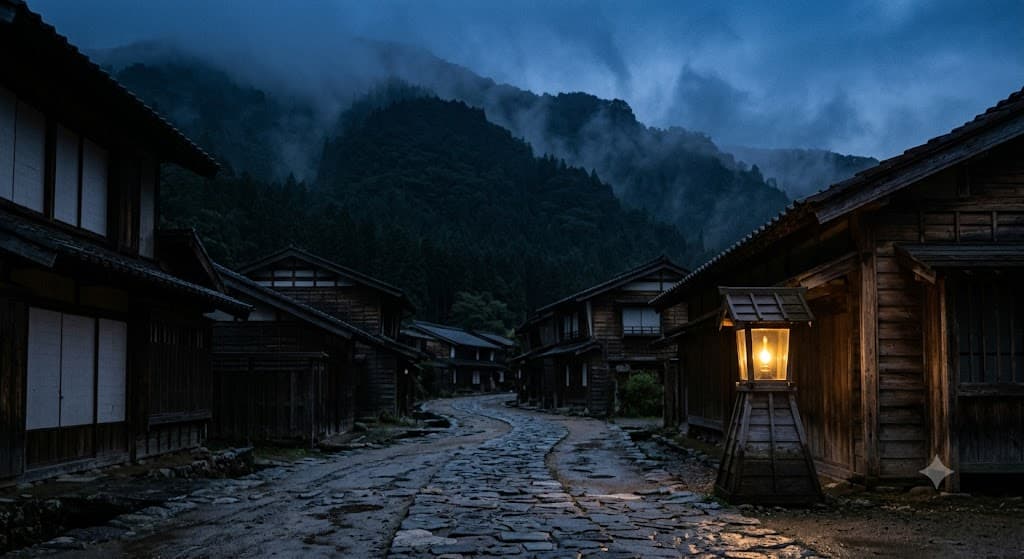
- Demons need darkness to survive, and Taishō Japan was the last moment when Japanese nights were still genuinely dark in most of the country — the electric grid had reached the cities but not the mountains.
Key Terms Explained
- 大正 (Taishō) / "Great Righteousness" — The reign name of the Emperor who ruled between the Meiji and Shōwa eras, roughly 1912 to 1926. A short, unstable, oddly beautiful gap between two much longer periods.
- 大正ロマン (Taishō Roman) / Taishō Romanticism — The aesthetic label for the era's blend of kimono and Western hats, brick facades and wooden houses, gaslight and superstition. Retro and modern at once.
- 文明開化 (Bunmei Kaika) / "Civilization and Enlightenment" — The Meiji-era slogan for rapid Westernization. By Taishō, its first wave had passed, and what remained was the residue: railways, uniforms, and a half-changed way of life.
- 廃仏毀釈 (Haibutsu Kishaku) / "Abolish Buddhism, Destroy Shakyamuni" — The early-Meiji campaign to separate Shinto from Buddhism, which damaged temples and unsettled the older, blended folk religion that had explained the dark for centuries.
- 過渡期 (Katoki) / Transitional Period — A word for a time that is no longer one thing and not yet the next. Taishō is the textbook case.
The Night That Lost Its Stars
When I was in elementary school in the working-class 下町(Shitamachi: the old low-lying districts of Tokyo), I could look up from the street outside my house and see stars. Not a few — many. By the time I was in middle school, standing in the same street, on the same kind of clear night, they were mostly gone. Whether it was the streetlights, or the smog, or both, I have never been able to say for certain.
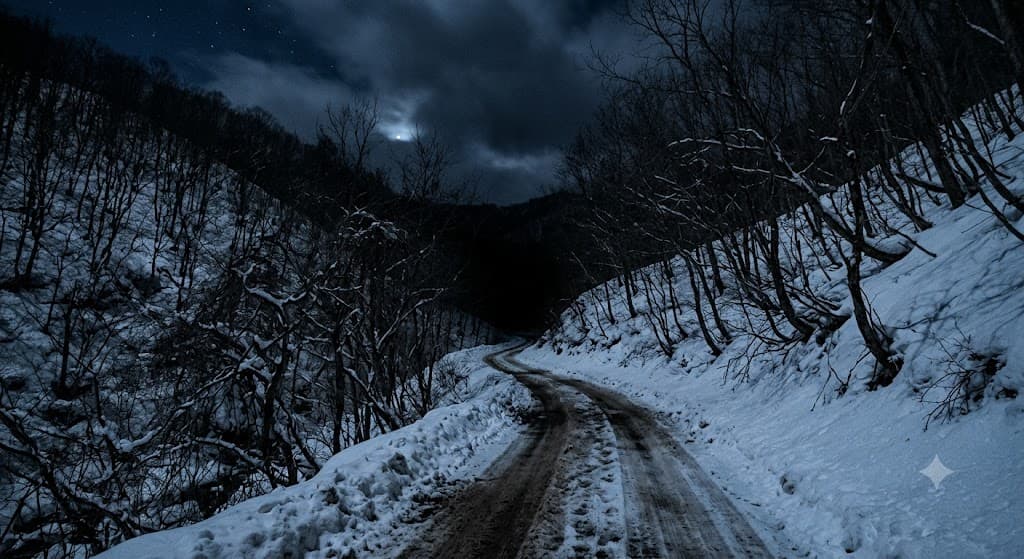 Before electric light reached the mountains, night in rural Japan was genuinely dark — the kind of dark a story about demons needs.
What stays with me is not the cause but the speed. Within a handful of years of one childhood, the dark simply drained out of the sky above my neighborhood, and I watched it happen without understanding that I was watching anything at all.
That is the closest I can come, in my own life, to the experience the Taishō era describes on a national scale. And it is why the opening of Demon Slayer lands the way it does for me. Tanjirō walks down from a snowbound mountain where his family burns and sells charcoal, into a town where people buy that charcoal because they still need it — and yet the town is already lighting itself differently, already living on a slightly different clock. He goes home in the dark because the mountain is still dark. An old man tells him to stay the night, because after sunset the demons come out. Both things are true in the same country, in the same year, an hour's walk apart.
Related: Demon Slayer: Kimetsu no Yaiba and Japan's Original Oni-Slayers: The Heian Heroes Who Existed a Long Time Ago explains this in detail.
A Fifteen-Year Doorway
I should be honest about my own distance from this period. I am a third-generation 江戸っ子(Edokko: a true native Tokyoite), but I never heard a Taishō story from a grandparent's own mouth. That era reached me through textbooks and screens, not through family voices at the dinner table. It is barely a century back, and my own ancestors were certainly alive inside it, yet it arrives in my hands as history rather than as memory. That gap — close enough to touch, too far to feel — is itself part of what makes Taishō such fertile ground for fiction.
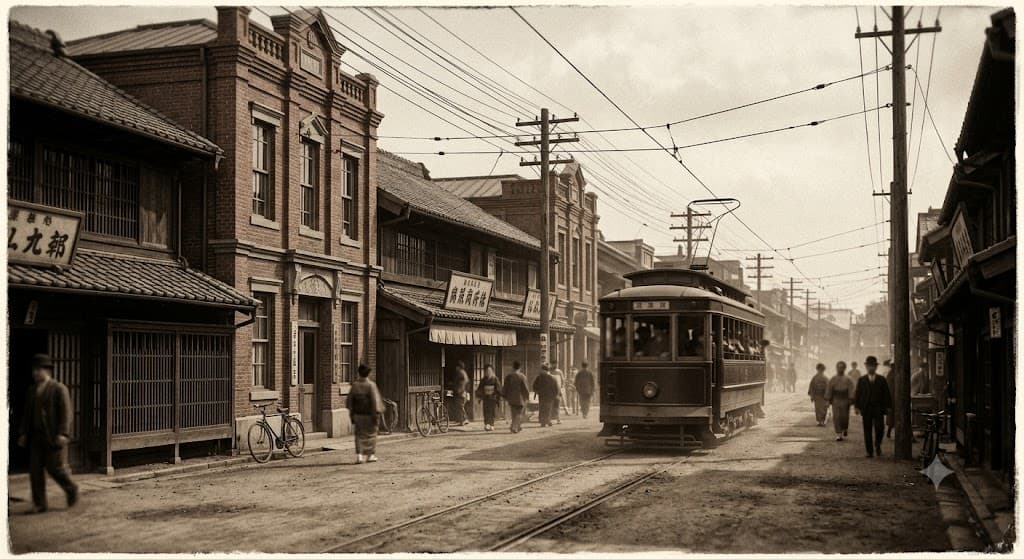 Taishō Japan was not half-modern so much as two complete worlds overlapping on the same street.
Related: Demon Slayer and the Lost Craft of Sumiyaki: What the Kamado Name Really Hides explains this in detail.
The Shortest Modern Era
明治(Meiji: "Enlightened Rule") ran for forty-four years and rebuilt the country. 昭和(Shōwa: "Bright Harmony") ran for sixty-two and carried Japan through war, defeat, and an economic miracle. Between them, Taishō lasted about fifteen. It is the narrow hallway between two enormous rooms.
Short eras have a particular quality: nothing has time to settle. The reforms of Meiji had already been imposed, but they had not yet been absorbed into the bones of ordinary life. A man could wear a Western suit to an office in Tokyo and go home to a house with no electricity. A girl could ride a streetcar past a shrine where the fox statues were still being given offerings. The country was not half-modern in the sense of being fifty percent finished; it was two complete worlds, overlapping.
The Residue of Bunmei Kaika
文明開化 was a Meiji slogan — the great push to adopt Western clothing, calendars, architecture, and law. By Taishō, the slogan itself was tired. What remained was residue: the railway lines already laid, the brick buildings already standing, the school uniforms already sewn. Modernity had stopped being an announcement and become furniture.
This is what gives 大正ロマン its distinctive flavor. It is not the excitement of the new. It is the strange, slightly melancholy coziness of the new having become ordinary while the old refuses to leave. Cafés with Western coffee and waitresses in aprons over kimono. Novels about individual feeling, printed on cheap paper, read by lamplight. A visual world that modern Japanese audiences find nostalgic and foreign at the same time — which is precisely why creators keep returning to it.
What Happened to the Old Explanations
Here is the part that matters most for a story about demons. During early Meiji, the state pushed 神仏分離(Shinbutsu Bunri: the forced separation of Shinto and Buddhism), and the popular violence that followed — 廃仏毀釈 — destroyed temple property and shook the informal, blended folk religion that ordinary people had used to make sense of misfortune for centuries.
That religion did not disappear. It went underground and it went rural. In a mountain village, when a family vanished in the night, the framework for understanding it was still the old one: something came from the dark. In the city, the same event would increasingly be filed as a crime, an accident, a bear.
Demon Slayer sits exactly on that fault line. The old man who warns Tanjirō speaks with the calm authority of somebody who has never doubted that demons exist. Tanjirō, kind and practical and modern enough, does not quite believe him. Neither of them is written as a fool. That is the era in one exchange.
Why Demons Need Taishō
Set this story fifty years earlier, in the late Edo period, and it loses its tension — a world of demons and swordsmen is simply the world, unremarkable. Set it fifty years later, in mid-Shōwa, and it becomes impossible — telephones, electric light, national police, and newspapers close the gaps where a demon could live.
Taishō is the only window where both halves hold. Trains exist, so the story can move across the country in a way an Edo-era tale could not. Swords are already outlawed for ordinary citizens, which makes a private organization of sword-carrying hunters something that must be hidden — an underground, not an institution. And the mountains at night are still black enough to swallow a family whole. Modernity has arrived, but it has not yet finished switching on the lights.
What the Lit World Left Behind
I grew up in a place where old and new did not replace each other so much as pile up. Wooden houses and narrow alleys stood right beside new construction, and a home with the latest appliances might share a wall with one that had not changed in decades. Nothing was ever cleanly one era or the other. Looking back, the 下町 of my childhood was running the Taishō trick a half-century late.
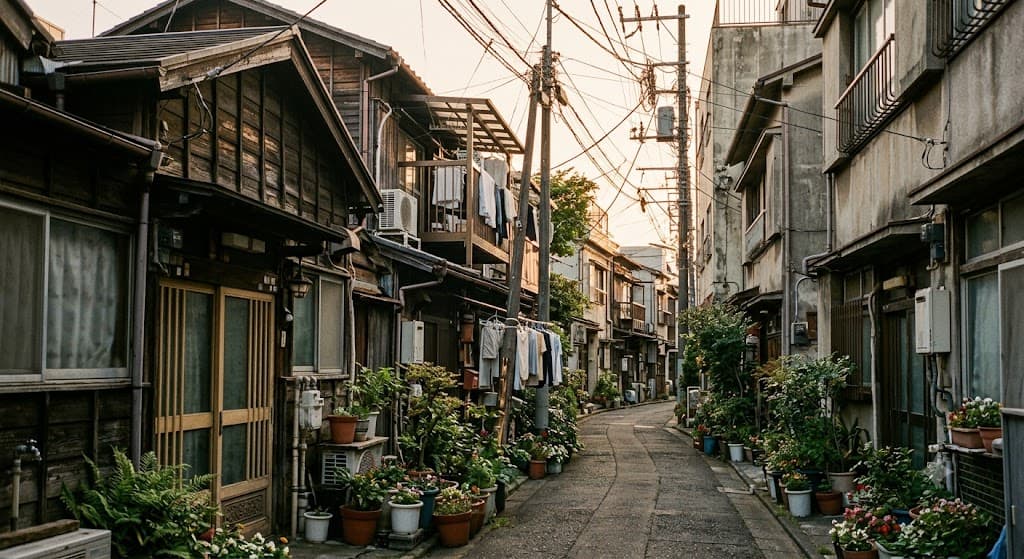 In the downtown Tokyo of my childhood, new layers piled on top of old ones rather than replacing them — the Taishō trick, running late.
Living outside Japan for many years has changed how I read that. I have come to notice that the things a country modernizes away are rarely announced. Nobody declared that the dark was over. It simply became harder to find, and with it went a whole grammar for talking about what the dark might contain. When I visit Japan now, the countryside still has genuine night in it, but the framework for interpreting that night has thinned. The fear remains; the explanation has gone.
That, I think, is the quiet ache running underneath 大正ロマン, and underneath Demon Slayer's setting. The work is not nostalgic for demons. It is nostalgic for a world in which a village elder could say, without embarrassment, that something walks after sunset — and be taken seriously by the person listening. Tanjirō's tragedy begins on the exact night that certainty was fading. He is one of the last people who could have been warned, and one of the first who did not quite believe it.
FAQ
Q: What time period is Demon Slayer set in?
A: The Taishō era, roughly 1912 to 1926, in the early twentieth century. The manga confirms this explicitly, and the visual details — school uniforms, brick buildings, trains, and gaslight in the cities — place it firmly in that window rather than in the samurai past that many overseas viewers first assume.
Q: Why did the creator choose the Taishō era instead of the Edo period?
A: The Taishō setting creates a productive contradiction. Modern infrastructure exists, so the world feels recognizable and the characters can travel; but rural Japan is still dark, poor, and governed by older beliefs, so demons remain plausible. It also explains why sword-carrying demon slayers must operate in secret — carrying a blade in public was no longer legal for ordinary citizens.
Q: What is Taishō Roman, and is it a real historical term?
A: 大正ロマン is a real and widely used aesthetic label in Japan, though it is a cultural descriptor rather than a formal historical category. It refers to the era's mixture of Japanese and Western styles — kimono with Western boots, cafés, brick facades, lamplight — and it carries a nostalgic, faintly melancholy tone that Japanese audiences recognize instantly.
Key Insights to Remember
- The Taishō era is dramatically useful precisely because it is unfinished. A period that lasted only about fifteen years never had time to resolve its contradictions, so a story set there can put a charcoal-burning mountain family and an electrified town in the same afternoon without straining credibility. Fiction thrives on seams, and Taishō is almost nothing but seam.
- Modernization does not delete folk belief; it relocates it. The Meiji separation of Shinto and Buddhism, and the destruction that followed, weakened the institutions that had housed Japan's older explanations of misfortune — but those explanations survived in villages, in warnings, in what old men told travelers after dark. Demon Slayer's opening dramatizes the moment when the city had stopped listening and the mountains had not.
- Darkness is a resource, and it is finite. The most quietly radical thing about setting a demon story in Taishō is that it captures the last generation for whom night was genuinely dark across most of the country. Once the lights go on, the demons do not get killed — they get explained away, which for a monster amounts to the same thing.
Sources & References
- Taishō period — Encyclopaedia Britannica
- Meiji Restoration — Encyclopaedia Britannica
- Great Kantō Earthquake of 1923 — Encyclopaedia Britannica
- Haibutsu kishaku — Wikipedia
- Taishō era — Wikipedia
About the author

Spoiler-free cultural deep-dives into anime, manga & live-action Japanese drama
- ●Tokyo-born, 3rd-generation Edokko (江戸っ子)
- ●Lifelong manga reader & anime viewer since the kaiju era
- ●Writes from outside Japan — distance as a cultural lens
- ●Spoiler-free · sourced · Kanji + Romaji + English
A Tokyo-born, 3rd-generation Edokko writer who has spent years living outside Japan. I use the anime, manga, and live-action Japanese drama you already love as a doorway into the folklore, language, religion, and everyday history behind them — written so even first-time fans can follow along, with sources for every claim.
Enjoy this article?
Get the next spoiler-free cultural deep-dive straight to your inbox.
Related Articles
Your Name and Kumihimo: The Real Japanese Craft Behind Mitsuha's Braided Cord
How Your Name dramatizes kumihimo as a picture of musubi, and the real braided-cord craft behind it, from samurai armor to the modern kimono obijime.
10/12/2026

Touch and the Alps Stand of Koshien: Why Japan Unbolts Stadium Seats for a School Brass Band
How Touch's high-school baseball world leads to Koshien's Alps Stand, named by a cartoonist, and why seats are removed each August for school brass bands.
8/14/2026

Summer Wars and Hanafuda: The Flower Cards That Built Nintendo Before Video Games
How Summer Wars puts a deck designed to survive a gambling ban on the table, and why Nintendo spent its first 86 years making those flower cards by hand.
8/13/2026

In This Corner of the World and Japan's Noon Silence on August 15: The Minute a Whole Country Stops
How In This Corner of the World, set in wartime Kure, connects to Japan's mokutō, the noon silence each August 15 timed to the 1945 surrender broadcast.
8/12/2026

Sailor Moon and the Sailor Fuku: Why Japan Put a Skirt on a British Naval Uniform
How the sailor uniform behind Sailor Moon reached Japan — a British naval design adopted in 1920 so girls could do gymnastics, and the school that first paired the top with a skirt.
8/6/2026

Silver Spoon and Japan's Agricultural High Schools: The Real Nōgyō Kōkō Behind Ooezo
How Silver Spoon draws on Japan's real agricultural high schools — around 300 of them — and why their student farming clubs were deliberately modelled on an American organisation after the war.
8/5/2026