Fruits Basket and the Zodiac Cat: The Real Japanese Folktale of the Cat Who Missed the Banquet
How Fruits Basket builds its outsider cat on the real Japanese folktale of the rat tricking the cat out of the zodiac, and what eto still means in Japan today.

Tokyo-born, 3rd-generation Edokko · writing on Japanese culture from outside Japan
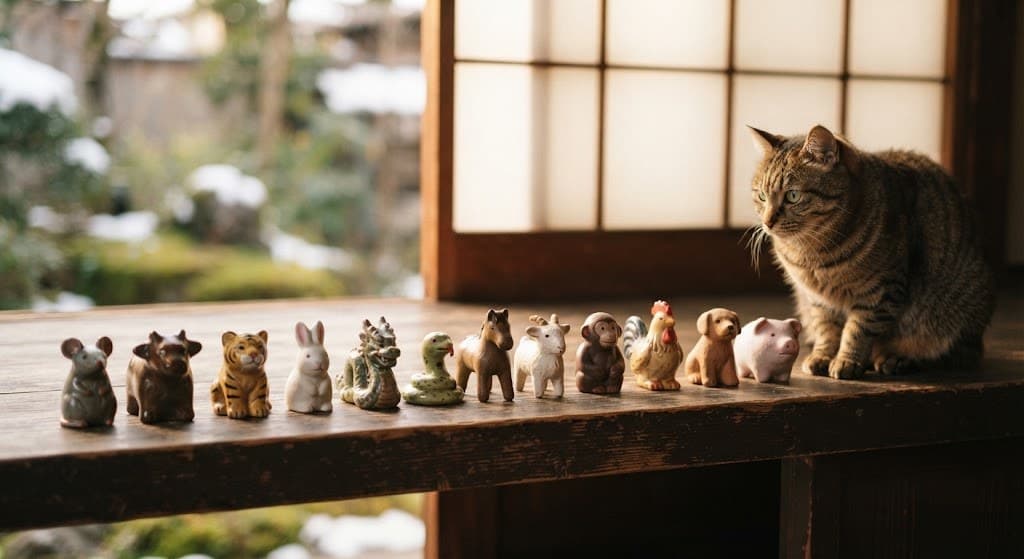
Why is there no cat in the Japanese zodiac? In Japan, the usual answer is a folktale. The rat lied. In フルーツバスケット(Furūtsu Basuketto: Fruits Basket), that small, unfair story becomes the emotional engine of an entire family, and the outsider cat at its centre makes far more sense once you know the tale it grew from.
Spoiler-Free Cultural Analysis
This article looks at the real Japanese folktale, calendar system, and everyday customs behind the zodiac cat in Fruits Basket. It covers only the opening premise described in the official synopses, with no later plot revelations.
Key Takeaways
- Japan has a real folktale in which the rat tricks the cat out of the twelve-animal zodiac by telling it the wrong day. Some tellings add that this is why cats still chase rats.
- The zodiac began as twelve signs for numbering months, hours, and compass directions. The animals were attached later, and no one can say for certain who chose them or why the cat was left out.
- Fruits Basket opens with its heroine remembering her mother's version of the cat's story, then builds a family curse around the twelve zodiac animals and the one that was shut out.
Key Terms Explained
- 十二支 (Jūnishi) / The Twelve Branches — The twelve signs, running from ne (rat) to i (boar), first used to mark the order of the months and only later tied to animals.
- 干支 (Eto) / Sign of the Year — Strictly, the sixty-step cycle made by pairing ten "stems" with the twelve branches. In everyday Japanese, "this year's eto" usually just means the year's animal.
- 年賀状 (Nengajō) / New Year Card — The postcard Japanese people send to greet the New Year, which carries the year's zodiac sign.
- 還暦 (Kanreki) / Sixtieth Birthday — Turning sixty, marked because the full cycle of stems and branches has come back to where it began.
- 宴 (Utage) / Banquet — A feast or celebration. The official anime synopsis uses this word for the gathering the cat never reached.
A Snake on the New Year Cards
I was born in 1965, which makes me a child of the 巳年(Mi-doshi: Year of the Snake). Growing up as a third-generation 江戸っ子(Edokko: a true-born Tokyoite) in 東京(Tōkyō: Japan's capital), I hardly ever thought about my sign. It was simply there. The moment it caught my attention was New Year, when a 年賀状(nengajō: New Year greeting card) arrived with the year's zodiac animal drawn on the front. The rest of the year, it stayed in the background.
That loose, half-serious relationship with signs and fortunes has stayed with me. For as long as I can remember, I have drawn an おみくじ(omikuji: a paper fortune) at 初詣(hatsumōde: the first shrine visit of the New Year). When I was young, star-sign and blood-type horoscopes filled the television and the magazines. I knew the word 大殺界(daisakkai: a fortune-teller's term for a run of bad years) because it became a buzzword, yet I never once took it to heart. Nor have I ever worried about 厄年(yakudoshi: the ages said to invite misfortune).
So I come to Fruits Basket as someone for whom the twelve animals were background: pictures on a card, labels on a year. What the series does is take that background and ask a pointed question. What about the animal who never made it onto the card?
Related: KILL BLUE and the Cat's Tongue: How One Word Reveals Japan's Hot-Drink Etiquette explains this in detail.
The Rat, the Ox, and the Cat Who Came a Day Late
The Folktale as Japan Tells It
The story is not a manga invention. It sits in Japanese reference works. A reference guide from the 大阪府立中央図書館(Ōsaka Furitsu Chūō Toshokan: Osaka Prefectural Central Library) summarises the entry in the 日本民俗大辞典(Nihon Minzoku Daijiten: Encyclopedia of Japanese Folklore). A god called the animals together and declared that the first twelve to arrive would become the zodiac. The cat forgot which day the gathering was and asked the rat. The rat deliberately gave it the following day, so the cat never reached the god and never joined the twelve. The same entry mentions another telling in which the animals gather when お釈迦さま(Oshaka-sama: the Buddha) dies.
A booklet made by a student seminar at 法政大学(Hōsei Daigaku: Hosei University) gives a fuller, more theatrical version. At the end of one year, a god announces that on the morning of 元日(Ganjitsu: New Year's Day), the first twelve animals to come and offer their greetings will each, in turn, lead the animals for one year. The ox, knowing it is slow, sets out early. The rat secretly rides on its back and, at the gate of the god's palace, hops down to arrive first. As for the cat, the rat had told it the wrong day, one day too late. The cat was left out, and, the folktale says, it has resented the rat and chased it ever since.
Look at the two tricks. The rat steals first place from the ox by stealth, and it shuts out the cat with a lie. The cat's only fault is trusting the wrong informant, and that distinction matters enormously for Fruits Basket.
The tale also travels. The library guide notes that a Japanese study of China's zodiac animals, 中国の十二支動物誌(Chūgoku no Jūnishi Dōbutsushi: A Natural History of China's Zodiac Animals), records a similar story in which the rat makes the cat late.
Signs Before Animals
The 国立天文台(Kokuritsu Tenmondai: National Astronomical Observatory of Japan) explains the system behind the story. The 六十干支(rokujikkanshi: the sixty-step cycle of signs) came to Japan from China long ago. It pairs the 十干(jikkan: the ten heavenly stems) with the 十二支(jūnishi: the twelve branches) to count long runs of years and days in place of numbers. The twelve branches are 子(ne: rat), 丑(ushi: ox), 寅(tora: tiger), 卯(u: rabbit), 辰(tatsu: dragon), 巳(mi: snake), 午(uma: horse), 未(hitsuji: sheep), 申(saru: monkey), 酉(tori: rooster), 戌(inu: dog), and 亥(i: boar).
Here is the part I find most surprising. The branches were originally just symbols for the order of the twelve months, and they were also used in China for hours and directions. The animals came later. One calendar encyclopedia cited by the Osaka library says the animals were attached from around China's 戦国時代(Sengoku jidai: Warring States period) to make the signs easier to grasp. The signs themselves are far older: the observatory notes they appear as dates in the 甲骨文(kōkotsubun: oracle-bone inscriptions) of the 殷(In: the Yin dynasty of ancient China). By the 後漢(Gokan: Later Han dynasty), years were simply counted along the cycle in sequence, and that is the practice still in use today.
Where the Zodiac Still Turns Up
The observatory points out that Japanese people write signs like 申年(Saru-doshi: Year of the Monkey) or 巳年 on their New Year cards, and that historical events carry the cycle in their names, such as the 壬申の乱(Jinshin no Ran: the Jinshin War) and the 戊辰戦争(Boshin Sensō: the Boshin War). Because the cycle comes round once every sixty years, turning sixty is called reaching 還暦(kanreki: the return of the calendar).
The branches also live on the compass. North is ne, and the names run clockwise through east. The line joining ne (north) and uma (south) is the 子午線(shigosen: the meridian, literally the "rat-horse line"). Northeast falls between ushi and tora, so it is called 艮(ushitora: the "ox-tiger" direction). The cat appears in none of these.
Why the Cat Really Isn't There
The honest answer is that nobody knows. A book on zodiac animals quoted by the Osaka library, 干支の動物誌(Eto no Dōbutsushi: A Natural History of the Zodiac Animals), says there is no settled theory about when, or by whom, the animals were chosen. The library's own summary says the origins have been studied for a long time, yet much remains unexplained.
The twelve are not even fixed across Asia. A 1984 book cited by the library says the Vietnamese zodiac has a cat in place of the rabbit. The folktale, in other words, is an explanation people told for a gap that history never filled.
The library's guide itself opens on that gap. Written in December 2017, ahead of a Year of the Dog, it imagines cat lovers grumbling that dogs get a year while cats never get their turn on the New Year cards.
The Cats Japan Kept Anyway
Shut out of the calendar, the cat was never shut out of Japanese homes. The oldest domestic cat bones in Japan were found at the カラカミ遺跡(Karakami Iseki: Karakami archaeological site) on 壱岐(Iki: an island in Nagasaki Prefecture), one of the island's largest settlements around the turn of the Common Era. A government tourism text suggests the people there may have helped bring in companion animals as well as iron-working skills. According to the Hosei booklet, the 源氏物語(Genji Monogatari: The Tale of Genji) shows cats in the 平安時代(Heian jidai: Heian period) as precious pets kept on cords so they would not run away. By the 江戸時代(Edo jidai: Edo period), cats had settled into ordinary households, and pictures of cats were pasted up to keep mice away.
The cat and rat feud became a subject for art, too. The same booklet lists 月岡芳年(Tsukioka Yoshitoshi: a 19th-century print artist)'s 浮世絵(ukiyo-e: woodblock prints) 猫鼠合戦(Neko Nezumi Kassen: The Battle of Cats and Rats) from 1859. It also describes 歌川国芳(Utagawa Kuniyoshi: an Edo-period print artist)'s 猫の百面相(Neko no Hyakumensō: A Hundred Faces of Cats) from 1842, drawn when depicting 歌舞伎(kabuki: classical stage drama) actors in prints was banned, so Kuniyoshi gave the actors cat faces instead.
How Fruits Basket Builds Its Outsider Cat
Fruits Basket by 高屋奈月(Takaya Natsuki: the series' creator) ran in the 少女漫画(shōjo manga: comics aimed at girls) magazine 花とゆめ(Hana to Yume: Flowers and Dreams) from 1998 to 2006 and was collected in 23 volumes. A new TV anime adaptation began in 2019, animated by トムス・エンタテインメント(Tomusu Entateinmento: TMS Entertainment). Its publisher, 白泉社(Hakusensha: the manga's publisher), even sells the collector's edition as a hit "zodiac home drama."
The official synopsis of the first episode puts the folktale right at the door. 本田透(Honda Tōru: the heroine), a high school girl living alone in a tent after losing both parents, notices a set of zodiac figurines at a house she passes. They remind her of a story her mother told her: the poor cat, tricked by the rat, who could not join the banquet. That memory leads her to the house's owner, 草摩紫呉(Sōma Shigure: Shigure Sohma), and her classmate 草摩由希(Sōma Yuki: Yuki Sohma), who for some reason seems to dislike cats. In the next episode, Tohru accidentally hugs 草摩夾(Sōma Kyō: Kyo Sohma) and learns the 草摩(Sōma: the family name) secret: a zodiac curse handed down for hundreds of years, under which family members turn into animals when hugged by someone of the opposite sex.
The official character page describes Kyo as short-tempered but kind at heart. He skipped the local high school he had passed to train in the mountains, determined to defeat Yuki, whom he sees as his rival. The family head then ordered him to move into Shigure's house and transfer to Tohru's school.
What strikes me is the word the synopsis chooses. In the folk versions, the gathering is a race or a summons. The anime calls it a 宴(utage: a banquet). A race has winners and losers; a banquet has guests and people left outside. By framing the old story as a feast the cat was barred from, Fruits Basket turns a fable about cunning into one about belonging. And the person who carries that story into the house is herself living outside, in a tent.
The Animal Not on the Card
For me, the zodiac has never been a matter of belief, yet it still shapes how Japan names time. It sits on the New Year card, in the word kanreki, in the meridian line, and in the names of old wars. The animals are so familiar that they become invisible.
Having lived outside Japan for well over a decade, I find the cat's story reads differently now. The cat is everywhere in Japanese life, in old homes and on ukiyo-e, and yet it is missing from the one list that marks every year. It is present but uncounted. Fruits Basket notices that kind of absence and asks us to sit with it, rather than laugh it off as a clever rat's joke.
I still draw an omikuji at hatsumōde, as I always have. But I no longer think of the zodiac as only twelve pictures. I think of it as twelve pictures and one empty space, and of a series that chose to tell its story from that space.
FAQ
Q: Is the cat-and-rat story in Fruits Basket based on a real Japanese folktale? A: Yes. Japanese folklore references record a tale in which a god gathers the animals and the rat tells the cat the wrong day, so the cat misses the zodiac. Some versions add that the cat has chased the rat ever since out of resentment.
Q: Why is there no cat in the Japanese zodiac? A: Nobody knows for certain. Japanese reference works say there is no settled theory about who chose the twelve animals or when, so the folktale is an explanation rather than history. Zodiacs elsewhere in Asia vary, and Vietnam's reportedly puts a cat where the rabbit would be.
Q: Do Japanese people still use the eto zodiac in daily life? A: Yes, mostly in quiet, practical ways. The year's sign goes on New Year cards, turning sixty is called kanreki because the sixty-year cycle has come round, and the branches survive in words like shigosen, the north-south meridian line.
Key Insights to Remember
- The Japanese zodiac began as a counting system, not a bestiary. The twelve branches marked months, hours, and directions long before anyone matched them with animals, which is why the question of the missing cat has no historical answer, only a story.
- The folktale's power lies in the type of loss it describes. The cat is not beaten in a fair contest; it is excluded through a lie from someone it trusted. That is a far more painful kind of failure, and it is exactly the kind Fruits Basket builds on.
- By calling the gathering a banquet, the series shifts the old fable from competition to belonging. Its outsider cat makes sense as a figure of exclusion in a culture that kept cats in its homes and art while leaving them off the calendar.
Sources
- Introduction — Fruits Basket Official TV Anime Site
- Episode 1 Synopsis — Fruits Basket Official TV Anime Site
- Episode 2 Synopsis — Fruits Basket Official TV Anime Site
- Kyo Sohma Character Profile — Fruits Basket Official TV Anime Site
- Character Profiles — Fruits Basket Official TV Anime Site
- Fruits Basket Special Page — Hakusensha
- Fruits Basket Title Page — Bandai Channel
- Fruits Basket Series — BOOK☆WALKER
- Reference Guide on the Zodiac and the Cat — Osaka Prefectural Central Library
- Ukiyo-e Creature Encyclopedia (Takada Seminar Booklet) — Hosei University
- The Sixty-Year Cycle of Kanshi (FAQ) — National Astronomical Observatory of Japan
- Eto (Koyomi Wiki) — National Astronomical Observatory of Japan
- The Twelve Branches (Koyomi Wiki) — National Astronomical Observatory of Japan
- Jūnishi — Digital Daijisen via Kotobank
- Karakami Archaeological Site Multilingual Commentary — Japan Tourism Agency
About the author

Spoiler-free cultural deep-dives into anime, manga & live-action Japanese drama
- ●Tokyo-born, 3rd-generation Edokko (江戸っ子)
- ●Lifelong manga reader & anime viewer since the kaiju era
- ●Writes from outside Japan — distance as a cultural lens
- ●Spoiler-free · sourced · Kanji + Romaji + English
A Tokyo-born, 3rd-generation Edokko writer who has spent years living outside Japan. I use the anime, manga, and live-action Japanese drama you already love as a doorway into the folklore, language, religion, and everyday history behind them — written so even first-time fans can follow along, with sources for every claim.
Enjoy this article?
Get the next spoiler-free cultural deep-dive straight to your inbox.
Related Articles

March Comes in Like a Lion and Tsukimi: Why Japan Watches the Moon With Rice Dumplings and Pampas Grass
How March Comes in Like a Lion opens onto tsukimi, Japan's moon-viewing harvest observance, and why dumplings, pampas grass and a shifting date belong to it.
8/17/2026

Summer Time Rendering and the Shoryo-uma: The Cucumber Horse That Carries the Dead Home
How Summer Time Rendering's Obon homecoming opens onto shoryo-uma, the cucumber horse for returning ancestors, and why it is only one of many regional forms.
8/16/2026

GeGeGe no Kitaro and Hyakumonogatari: Why Japan Saves Its Ghost Stories for Summer
How GeGeGe no Kitaro connects to hyakumonogatari, the hundred-candle ghost game, and the Edo custom of staging horror in summer to chill the audience.
8/11/2026

Demon Slayer Infinity Castle and the Biwa: Heike and Hōichi
How the biwa that opens Demon Slayer's Infinity Castle leads to blind Heike reciters and Hōichi, who played night after night for a court that was not there.
8/7/2026

Natsume's Book of Friends and the Fūrin: The Japanese Wind Chime Was a Charm Against Spirits Before It Was the Sound of Summer
How Natsume's Book of Friends illuminates the furin, the Japanese wind chime that hung on temple eaves as a ward against misfortune long before it meant summer.
8/1/2026
PLUTO and the Art of Mourning Machines: Why a Nation Grieves for a Broken Robot
How PLUTO's memorial for a destroyed robot dramatizes tsukumogami folklore — the real Japanese funerals held for needles, dolls, and robot dogs.
7/19/2026