KILL BLUE and the Cat's Tongue: How One Word Reveals Japan's Hot-Drink Etiquette
How KILL BLUE dramatizes 猫舌 (Nekojita) — the single Japanese word for heat-sensitive eaters, and the food etiquette layered behind it.

Tokyo-born, 3rd-generation Edokko · writing on Japanese culture from outside Japan
Spoiler-Free Cultural Analysis
This article looks at the real cultural and linguistic background behind a single throwaway word in KILL BLUE — no plot reveals, no character arcs spoiled, only the body-language of Japanese eating and drinking that the scene quietly references.
Key Takeaways
- The Japanese word 猫舌 (Nekojita: "cat tongue") compresses an entire concept — being unable to handle hot food and drink — into two characters, while English needs a full sentence to say the same thing.
- Hot drinks in Japan come with a quiet choreography: how you blow on soup, how you rotate a teacup, how you make space for someone who can't take the heat — none of it written down, all of it learned by watching.
- The 猫舌 (Nekojita) label is rarely an insult in Japanese. It is closer to a small social shortcut that explains, with one word, why someone is waiting before they drink.
Key Terms Explained
- 猫舌 (Nekojita) / Cat's Tongue — A person who cannot handle very hot food or drink. Built from the folk image of cats refusing piping-hot food.
- フーフー (Fūfū) / The Blowing Sound — The onomatopoeic word for blowing on hot food to cool it. Also used as a verb-like action: "fūfū shite taberu" (blow-blow and eat).
- 茶碗 (Chawan) / Tea or Rice Bowl — The everyday Japanese bowl. The way you hold it, where you place your fingers, and how you rotate it all carry quiet rules.
- 熱燗 (Atsukan) / Hot Sake — Sake served warmed. The temperature itself is part of the drink's identity, not a preference setting.
- 茶道 (Sadō) / The Way of Tea — The formal tea ceremony, where temperature, gesture, and timing are codified into a single coherent practice.
A Single Word Dropped Into a Bowl of Steam
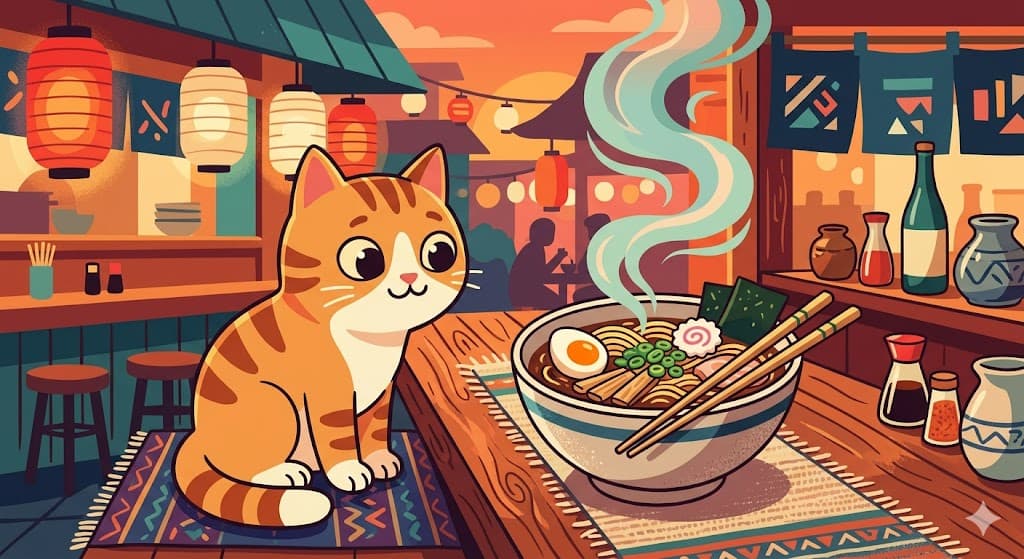
In the first episode of KILL BLUE, an assassin sits down at a counter shop with his partner after finishing a job. The bowl arrives. He leans over the steam, lifts the spoon, and does what every Japanese person has done a thousand times: blows on it. Fūfū, fūfū, fūfū. Then he looks at the bowl and mutters one word — 猫舌 (Nekojita: cat's tongue) — about himself, the way you might say "lefty" or "early bird," a small fact about his body that needs no further explanation.
 A bowl arrives steaming at a counter shop — the moment when 猫舌 (Nekojita) becomes a word you need.
For me, that scene landed before any of the action did. I am not, as it happens, what Japanese people would call 猫舌 (Nekojita). I grew up able to drink hot coffee and miso soup straight off the stove without flinching, and I never thought about it once. Then in adulthood I read that letting boiling-hot liquid hit your throat day after day is rough on the esophagus, and I began — quietly, almost grudgingly — letting things cool a few seconds before I drank. I had become, by choice rather than nature, a half-猫舌. The line between the people who can take the heat and the people who can't is not as fixed as the word suggests, and yet the word is doing real work. It tells the room, instantly, what you need.
The Body, Named After an Animal
What I find linguistically remarkable about 猫舌 (Nekojita) is not that the word exists, but how compressed it is. Two kanji. One concept that English cannot match in fewer than seven words. When I first learned that English has no equivalent — that you have to say "someone who is sensitive to hot food and drink" — I was honestly surprised. I had taken the word for granted my whole life.
 The cat that gave the idiom its name — pausing, waiting, refusing to rush the heat.
The Animal-Body Idiom in Japanese
Japanese has a deep habit of naming bodily traits by attaching an animal to a body part. 鳥肌 (Torihada: "bird skin") is goosebumps. 鯖読み (Sabayomi: "mackerel counting") is fudging numbers, especially one's age, the way fish vendors used to miscount mackerel. 馬面 (Umazura: "horse face") is a long face. 蛇腹 (Jabara: "snake belly") is a bellows fold. The pattern is not metaphor reaching for poetry — it is everyday grammar reaching for the nearest creature in the visual field. The cat's reputation for sniffing at hot food, walking away from it, waiting, then coming back, became the shorthand for any human who does the same thing.
Why the Cat and Not Another Animal
Cats sit at a particular angle in Japanese daily life. They are domestic, watchable, ubiquitous, and famously unhurried. A dog will eat anything and burn its tongue cheerfully; a cat will not. The choice of cat for this idiom is not random — it picks the animal that visibly performs the behavior of waiting for hot food to cool. I have spent years watching how language compresses observation into single units, and 猫舌 (Nekojita) is one of the cleanest examples I know: somebody, generations ago, watched a cat refuse the bowl and named a human condition after it.
The Sound of Cooling: フーフー (Fūfū)
The companion word to 猫舌 (Nekojita) is フーフー (Fūfū), the onomatopoeia for blowing on hot food. Japanese onomatopoeia is unusually granular — there are different words for different qualities of blowing, sucking, slurping, and chewing — and フーフー (Fūfū) specifically marks the gentle, repeated breath aimed at cooling something down. Parents say it to small children: "fūfū shite ne" (blow on it, okay?). It is a verb you can perform on someone else's behalf: blowing on a child's spoonful before handing it over. The KILL BLUE scene, with its three explicit fūfū sounds in the subtitle line before the word 猫舌 (Nekojita) is muttered, is doing a tiny piece of cultural shorthand that any Japanese viewer reads in half a second.
The Etiquette Layer: Tea, Bowls, and the Rules No One Writes Down
The cat's tongue idiom sits inside a larger set of habits around hot food and drink in Japan, most of them unwritten.
 Rotating the 茶碗 (Chawan) to find a cooler patch of rim — a small piece of household engineering passed along by watching.
The Teacup Trick
When I was young and someone poured me very hot 緑茶 (Ryokucha: green tea) directly from the pot, I was told — by family, casually, the way you are told most useful things — to rotate the 茶碗 (Chawan: tea bowl) slowly while drinking, so that my lips kept finding the cooler part of the rim. The rim cools faster than the body of the bowl; rotating the cup gives you a fresh patch of cool ceramic with each sip. This is not formal etiquette. It is a small piece of household engineering that has been passed along quietly for generations because hot tea is served in Japan every single day.
Sadō: Where Temperature Becomes Discipline
The formal tea ceremony, 茶道 (Sadō), takes this everyday awareness and codifies it. The water temperature for 抹茶 (Matcha: powdered green tea) is held within a narrow range — too hot and the bitterness overwhelms, too cool and the powder doesn't whisk into proper foam. The bowl is rotated before drinking, but here the rotation is ceremonial: you turn the bowl so the "front" — its decorated face — faces away from your mouth, out of respect for the maker's design. The tea master's choreography is not about hiding from heat. It is about acknowledging that temperature is part of the experience and must be met with attention.
The Loud Slurp and the Quiet Sip
Eating noodles in Japan involves a sound that foreigners often find startling: the deliberate slurp. すする (Susuru) — slurping — is not bad manners in Japan; for ramen and soba, it is part of the eating itself, said to enhance flavor by aerating the broth and noodles as they enter the mouth. But this is one of those habits I have had to consciously suppress when I am not in Japan. Years of living abroad have trained me to eat noodles silently in front of non-Japanese friends, because the sound, beautiful at a Tokyo counter, reads as unmannerly elsewhere. The slurp also has a thermal function I rarely see discussed — pulling in air with the noodle is a way of cooling each mouthful at the moment of entry. It is an audible 猫舌 (Nekojita) defense, performed by people who would never call themselves one.
What a Single Word Carries, and What It Lets You Skip
Living outside Japan for many years has made me notice when Japanese has a word for something English doesn't, and the experience is rarely about pride. It is more often about realizing how much social labor a single word can do.
If I am at a counter in Tokyo and the bowl arrives steaming and I say 猫舌だから (nekojita da kara — "because I'm cat-tongued"), the cook nods, the people around me nod, and the conversation moves on. No one asks me to explain. No one offers a glass of cold water with an apology. The label is recognized, mildly affectionate, slightly comic in its imagery, and entirely socially functional. In English-speaking settings I have to say "I have to wait, hot drinks really get to me," and the conversation becomes about my throat for thirty seconds longer than anyone wanted.
The KILL BLUE scene — a hardened assassin admitting, of all things, that he has a cat's tongue — works precisely because the word is so domestic. It is the kind of thing your grandmother says about herself. Hearing it from a man who has just walked out of a gunfight is a small, deliberate softening. The writer is using a piece of everyday vocabulary to humanize a character without writing a single line of explicit backstory. That economy is hard to translate, and the English subtitle "cat tongue" doesn't quite carry it. It is a word that does cultural work the moment it is spoken.
What I notice, watching from a long distance, is how much of Japanese hot-food etiquette has been absorbed into the language itself rather than written into rule books. There is no manual for rotating the teacup. There is no etiquette guide that says "if your guest is 猫舌 (Nekojita), pour the tea five seconds earlier so it has time to cool in the cup." It is all transmitted by watching, by the cook glancing at you when the bowl is ready, by a parent blowing on a spoonful before passing it over. The single word 猫舌 (Nekojita) is one of the few visible markers in a vast invisible system.
FAQ
Q: Is 猫舌 (Nekojita) considered an insult or a polite admission?
A: Neither, really. It is closer to a neutral self-description, slightly affectionate because of the cat imagery. People say it about themselves freely, and saying it about someone else is gentle observation rather than criticism.
Q: Why do Japanese people make a sound when slurping noodles?
A: The slurp — すする (Susuru) — is part of the eating culture for noodles like ramen and soba. It is said to enhance flavor and also pulls in cooling air, which helps with the heat of the broth. Outside Japan it is often read as bad manners, but inside Japan it is the sound of someone enjoying their meal properly.
Q: Does the formal tea ceremony actually use very hot water?
A: It uses water within a fairly specific range, often slightly below boiling, depending on the type of tea. The temperature is treated as part of the practice rather than a personal preference, and the rotation of the bowl before drinking is about respect for the bowl's design, not about cooling the rim.
Key Insights to Remember
- The existence of 猫舌 (Nekojita) as a single, common word reveals something about how Japanese organizes information: a recurring social situation gets a name, and the name then does the explaining for you. Languages without such a word make the same observation possible but require more sentences and more social negotiation each time the situation comes up.
- Japan's hot-food etiquette is layered: the casual household trick of rotating a teacup for its cooler rim, the disciplined choreography of 茶道 (Sadō), and the audible slurp at a noodle counter are all responses to the same underlying problem — food and drink served close to the limit of what the mouth can take. Each layer carries its own expectations and its own small rules.
- A throwaway line in an anime — one assassin calling himself 猫舌 (Nekojita) over a steaming bowl — can carry as much cultural compression as a paragraph of exposition. Watching with an awareness of these tiny verbal markers turns subtitled scenes into doors into the everyday Japan that surrounds the story but rarely gets explained.
Sources & References
About the author

Spoiler-free cultural deep-dives into anime, manga & live-action Japanese drama
- ●Tokyo-born, 3rd-generation Edokko (江戸っ子)
- ●Lifelong manga reader & anime viewer since the kaiju era
- ●Writes from outside Japan — distance as a cultural lens
- ●Spoiler-free · sourced · Kanji + Romaji + English
A Tokyo-born, 3rd-generation Edokko writer who has spent years living outside Japan. I use the anime, manga, and live-action Japanese drama you already love as a doorway into the folklore, language, religion, and everyday history behind them — written so even first-time fans can follow along, with sources for every claim.
Enjoy this article?
Get the next spoiler-free cultural deep-dive straight to your inbox.
Related Articles
Chihayafuru and the World of Competitive Karuta: The Speed, Silence, and Poetry Behind Japan's Fiercest Card Game
How Chihayafuru reveals competitive karuta, where poems from the 13th-century Hyakunin Isshu meet athletic reflexes and matches turn on hundredths of a second.
7/28/2026
Chainsaw Man and Why Every Japanese Dog Is Named Pochi: The Hidden History Behind Pochita
How Chainsaw Man's Pochita carries the history of Pochi, the Meiji-era nickname that became Japan's default dog name — and what that says about loyalty.
7/11/2026

Naruto and Yakuwarigo: The Real Meaning of Dattebayo and Why Translators Invented Believe It!
How Naruto's famous verbal tic dattebayo opens the door to yakuwarigo, Japan's role language system, and why English translators had to invent Believe it!
7/4/2026

Evangelion's Angels and Japan's Decorative Christianity
How Neon Genesis Evangelion's enemies are 使徒 (apostle) in Japanese but Angel in English — and how Japan wears Christianity as aesthetic, not faith.
7/3/2026

Solo Leveling and Te-ate: Why the Japanese Word for Treatment Means Placing the Hand
How Solo Leveling's healing magic opens onto te-ate, the Japanese word for treatment whose root is the simple act of placing a hand on a wound.
6/26/2026
Detective Conan and the -kun You Didn't Expect: How Japanese Honorifics Really Work
How Detective Conan reveals that the honorific -kun is not male-only — an inspector calls teenage Ran 'Ran-kun', a hierarchy English subtitles quietly drop.
6/11/2026