Overlord and the Great Tomb of Nazarick: Why a Japanese Guild Built Its Throne Inside a Grave
Why Overlord's guild headquarters is the Great Tomb of Nazarick, and how that fits Japan's ancient view of burial sites as sacred seats of authority.

Tokyo-born, 3rd-generation Edokko · writing on Japanese culture from outside Japan
Spoiler-Free Cultural Analysis
This piece looks at the cultural and historical reason a Japanese story would set its hero's seat of power inside a tomb. There are no plot spoilers — only the older Japanese ideas about burial mounds, ancestral spirits, and political authority that sit underneath the imagery of the work.
Key Takeaways
- In Japan, the tomb has historically been a seat of authority, not a symbol of death. From the 古墳(Kofun: ancient burial mound) era onward, the resting place of a ruler was treated as the center of political and religious power, not its end point.
- The Western default reading of "tomb = death, horror, decay" does not map onto Japanese tradition. A 御陵(Goryō: imperial mausoleum) is closer to a throne room than to a graveyard, which is why a guild headquarters called a tomb does not feel macabre to a Japanese audience.
- The distinction matters for reading Overlord's setting carefully: the Great Tomb of Nazarick is not chosen as edgy gothic dressing, but as a culturally legible image of stored power, ancestral presence, and legitimate rulership.
Key Terms Explained
- 古墳 (Kofun) / Ancient Burial Mound — Massive keyhole-shaped or round earthen tombs built across Japan from roughly the 3rd to 7th centuries for rulers and powerful clan heads.
- 御陵 (Goryō) / Imperial Mausoleum — The formal term for the tomb of an emperor or empress, treated as a sacred site under direct administration of the Imperial Household Agency.
- 霊廟 (Reibyō) / Spirit Shrine, Mausoleum — A structure built to enshrine the soul of a powerful figure, where rituals continue long after death.
- 祖霊 (Sorei) / Ancestral Spirit — The spirit of a deceased forebear, believed to remain as a protective presence over descendants and territory.
- 祟り (Tatari) / Spiritual Curse, Wrath — The retaliatory power of a spirit, especially one who died unjustly; a concept that turns dangerous dead figures into objects of worship to appease them.
A Childhood Without Graves
When I think back to my own childhood in Tokyo, I notice something that complicates the usual picture of "the Japanese and their ancestors." My family did not really do お墓参り(Ohaka Mairi: visiting the family grave). I do not have strong memories of going to a graveyard at お盆(Obon: midsummer festival for the spirits of the dead) or at 彼岸(Higan: the spring and autumn equinox observances) holding incense and a bucket of water. As a 江戸っ子(Edokko: a true Tokyoite) of the third generation, I grew up assuming the family I came from was an ordinary Japanese family, but the rituals that other people described as universally Japanese were largely absent from my house.
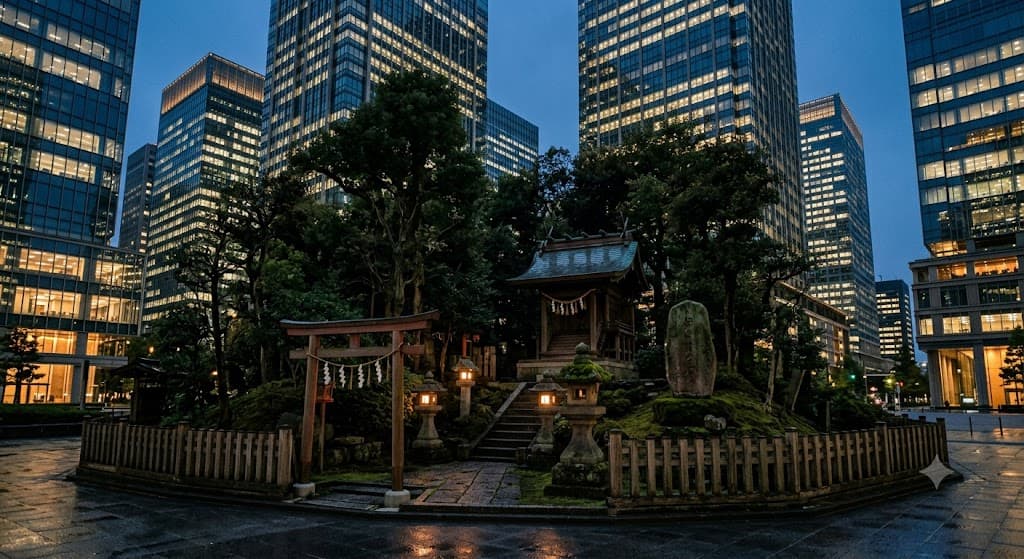
 A shrine approach in Tokyo, the kind of "sightseeing destination" a child sees long before understanding what the site actually is.
There was no 仏壇(Butsudan: household Buddhist altar) in our living room. There was no 神棚(Kamidana: household Shinto shrine) on a high shelf. When I visited a relative's house and saw their butsudan for the first time — the gold leaf glowing in the dim recess, the smell of incense, the small black tablets lined up like silent witnesses — my honest reaction as a child was that it looked unsettling. Not holy. Closer to a doorway I should not stand in front of.
I was taken to 明治神宮(Meiji Jingū: the shrine to the deified Emperor Meiji), to 靖国神社(Yasukuni Jinja: the shrine for the war dead), to 伊勢神宮(Ise Jingū: the supreme Shinto shrine), and to 日光東照宮(Nikkō Tōshōgū: the mausoleum of Tokugawa Ieyasu). I remember the torii. I remember the gravel underfoot. What I did not understand at the time is that these sites occupy different points along the same Japanese spectrum of "places where a powerful spirit is enshrined and continues to be honored." Nikkō Tōshōgū is, in the literal sense, a 霊廟(Reibyō: mausoleum) built over the burial of a ruler. Meiji Jingū enshrines the spirit of an emperor — his actual mausoleum is elsewhere, but the shrine functions as a ritual seat for that spirit. Yasukuni enshrines the souls of the war dead. Ise enshrines a deity rather than a deceased ruler and is not a tomb at all. The category I needed as a child was not "they are all tombs," but "Japanese tradition routinely treats the enshrined spirit of a powerful figure as still active, still consulted, still in office."
That gap between what I saw as a child — a sightseeing destination — and what those sites actually do — anchor the continuing presence of an enshrined spirit, sometimes over an actual burial and sometimes not — turned out to be the gap I needed to cross before I could understand why a Japanese story would call its hero's headquarters a tomb.
The Tomb as a Throne in Japanese Tradition
In the standard Western imagination, the tomb belongs to the gothic. Crypts. Vampires. Mummy curses. Indiana Jones in a chamber that is going to fill with sand. The dead are dangerous, and their resting place is something the living should leave alone. A Western audience encountering a story whose protagonist commands a place called the Great Tomb of Nazarick may read the title in that register first — necromancy, a hero who has crossed into something forbidden — and feel a friction that a Japanese audience does not.
The Japanese tradition starts from a different premise.
The Kofun Period and the Birth of Sacred Burial Authority
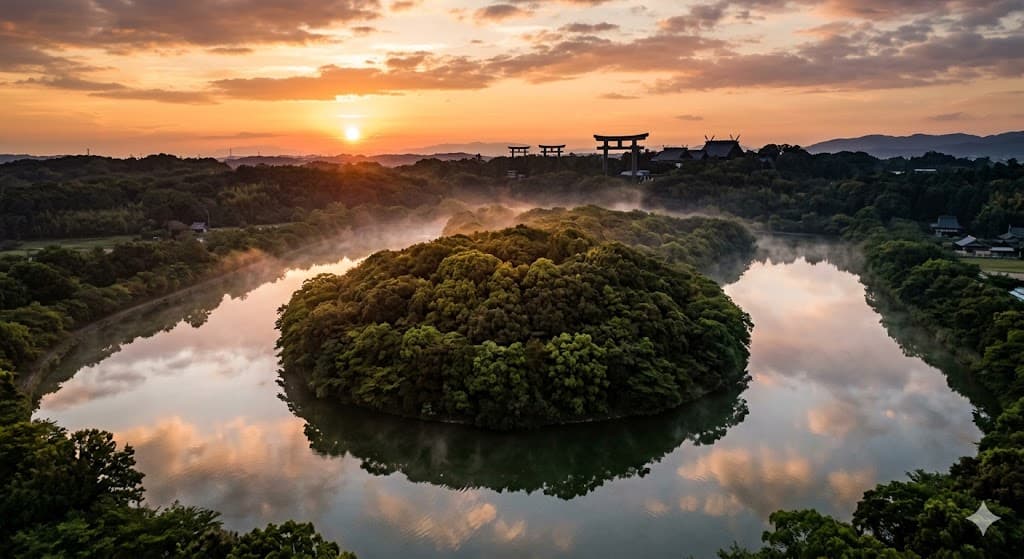
Between roughly the 3rd and 7th centuries, the islands now called Japan went through what archaeologists name the 古墳時代(Kofun Jidai: the Tumulus Period). In this era, regional rulers and clan heads were buried not in modest plots but inside enormous keyhole-shaped earthen mounds, sometimes hundreds of meters long, surrounded by moats and lined with 埴輪(Haniwa: terracotta figurines). The largest of these — the tomb traditionally attributed to Emperor Nintoku in modern Sakai — is one of the largest tombs by area on the planet.
 The keyhole silhouette of a Kofun mound — a ruler's tomb built at a scale that doubled as the credential of state power.
These structures were not hidden. They were not warnings to stay away. They were monumental statements of political legitimacy. Building one required moving earth on a scale that only an organized state could accomplish, and the act of construction itself proved that the ruler buried there had commanded that level of power. The tomb was the credential.
After interment, the mound did not become inert. The 祖霊(Sorei: ancestral spirit) of the buried ruler was understood to remain, watching over the territory and legitimizing the descendants who continued to rule it. To stand at the foot of the mound was to stand in the presence of a still-active political authority that simply happened to no longer have a body.
The Goryō and the Imperial Line
This logic did not end with the Kofun period. It threaded directly into the Imperial institution. The tomb of an emperor is called a 御陵(Goryō), and even today these sites are administered separately from ordinary cemeteries, by the Imperial Household Agency, and treated as sacred. They are not tourist destinations in the casual sense. They are functioning ritual sites, where the emperor's lineage is reaffirmed by the continued presence of his predecessors.
Worth distinguishing here: the actual 御陵(Goryō: imperial tomb) and the Shinto 神社(Jinja: shrine) that may enshrine the same emperor's spirit are not the same building. Meiji Jingū in Tokyo is a shrine to the spirit of Emperor Meiji; his Goryō, the literal tomb, is in Kyoto. In Japanese practice the spirit can be ritually present at the shrine without the body being underneath it. The continuity of authority is what matters, not the geography of the bones.
The 御霊信仰(Goryō Shinkō: belief in vengeful spirits-turned-deities) that developed in the Heian period extended this further. A figure who died with grievances — most famously 菅原道真(Sugawara no Michizane: a court scholar exiled and posthumously deified) — could be enshrined as a god precisely because his spirit was powerful enough to harm the living if not appeased. The shrine-as-seat-of-spirit was a way of converting raw spiritual force into legitimate authority.
Tokugawa Ieyasu's Mausoleum at Nikkō
The political use of the tomb-as-throne reached one of its most theatrical expressions at Nikkō Tōshōgū. After the death of 徳川家康(Tokugawa Ieyasu: the founder of the Tokugawa shogunate), his successors built him a mausoleum so elaborate that the visitor's first impression is of a palace, not a grave. Gold leaf, carved animals, layered gates — the architecture asserts that the founder is still presiding, still legitimizing every shogun who comes after him. The Tokugawa rulers in Edo could draw their authority from a man who had been dead for generations because the tomb at Nikkō kept that authority alive in a literal architectural form.
 Nikkō Tōshōgū reads as a palace before it reads as a grave — the architectural argument that a founder still presides.
So when a Japanese writer hands a fictional ruler a structure called a tomb and uses the word 大墳墓(Daifunbo: great burial mound) for the headquarters of a powerful guild, the audience is not reading necromancy. They are reading legitimacy. The hero is positioned at the structural location where Japanese tradition has always located a sovereign: on top of, and inside, the seat where the founders rest.
This is why Nazarick reads the way it does. It is not a haunted ruin the protagonist has invaded. It is the stronghold the forty-one guild members conquered and rebuilt together, and the protagonist is the guildmaster who has remained to maintain it. He is, in the older Japanese sense, the heir who continues to administer the rituals — except that in this story the founders happen to be other players who have logged out.
What Outside Distance Lets You Notice
I did not understand any of this when I was a child looking up at the gates of Nikkō. I understood it slowly, after years of living outside Japan and seeing how other cultures arrange their dead.
The Catholic cemeteries here, with their above-ground tombs lined up like small white houses, treat each burial as a discrete personal monument: this is where a specific named person ended. American lawn cemeteries, which I have only seen in photographs, lay the markers flat into the grass, as if the goal were to keep the landscape calm. Both arrangements share an underlying premise that death is a closing parenthesis. The tomb marks where the story stops.
A Japanese cemetery, with its mossy stones crowded together and the family names carved vertically, does not feel like a closing parenthesis. It feels like a place where presence has accumulated. The smell of incense, the small wooden 卒塔婆(Sotōba: memorial wooden tablets) leaning behind each stone, the practice of pouring water over the marker — all of it treats the buried not as gone, but as still receiving.
Living far from Japan also lets me see how strange the Western reaction to the word "tomb" can sound from inside Japanese tradition. A viewer raised on a Christian frame may read "Great Tomb of Nazarick" as ominous by default, taking the dead to be either saved or damned and in either case no longer in the building. Japanese tradition has never quite agreed to that frame. The buried can still hold court. This is a difference in starting assumptions, not a universal reaction — plenty of Western viewers come to Overlord with the genre savvy to read past the surface — but the friction is real often enough to be worth naming.
I should be honest that even I do not feel fully at home with this. My own childhood, without grave visits and without a butsudan, left me with the sense that tombs are uncomfortable places. The intellectual understanding that a Japanese tomb is a seat of authority did not erase the childhood feeling that they are a little spooky. Both of those things can be true at once, and I think they often are, even for many Japanese viewers who understand Nazarick on the cultural level but still find its imagery a touch eerie.
What outside distance has taught me is that the eeriness is not the main point. The main point is that the tomb is where power lives, where the founders are still present, and where the guildmaster's authority comes from. Strip the fantasy game framing from Overlord and you are left with a very old Japanese arrangement: a hall of ancestors who continue to legitimize the one who remains.
FAQ
Q: Is the Great Tomb of Nazarick based on a specific real Japanese tomb?
A: No. It is a fictional structure that combines fantasy game architecture with the broader cultural logic of the Japanese tomb-as-seat-of-power. The resemblance is to the underlying tradition (Kofun, Goryō, Reibyō), not to one specific historical site.
Q: Do most Japanese viewers consciously think of Kofun and Goryō when they see the title "Great Tomb of Nazarick"?
A: Probably not consciously, no. But the cultural premise that a tomb can be a seat of authority rather than a place of horror is so embedded in Japanese tradition that the title does not produce the same gothic shock it produces for many Western viewers. The reading is intuitive even when it is not explicit.
Q: Why does the Imperial Household Agency still administer ancient tombs?
A: Because in Japanese tradition the tomb of a ruler is not simply a historical artifact — it is a continuing ritual site tied to the legitimacy of the Imperial line. Excavation of the largest imperial tombs has been restricted for this reason, which is itself a sign that these places are still treated as sacred political space, not as archaeology alone.
Key Insights to Remember
- The Japanese tomb tradition collapses a distinction that Western culture treats as fundamental: the line between death and authority. From the Kofun period through the Tokugawa mausoleums, a ruler's burial site has functioned as an active seat of legitimacy, with the ancestral spirit understood to remain in office. Reading Overlord's headquarters as gothic horror misses the much older meaning sitting inside the word "tomb."
- Stories travel imperfectly across cultural frames. A title that reads as ominous to one audience reads as legitimate to another. This is not a flaw in the work — it is a reminder that fantasy storytelling carries its native culture's metaphysics with it, and that paying attention to those metaphysics is the difference between watching a show and reading it.
- The personal and the cultural do not always line up neatly. I grew up in Tokyo without the grave-visiting rhythm that supposedly defines Japanese ancestor culture, and I still find tombs slightly uncomfortable. Understanding the tradition intellectually does not require feeling it perfectly. The honest position is to hold both — the tradition's logic, and one's own actual reaction to it — without pretending they collapse into one.
Sources & References
- Kofun period — overview and context — The Metropolitan Museum of Art, Heilbrunn Timeline of Art History
- Mozu-Furuichi Kofun Group — UNESCO World Heritage Centre
- The Imperial Household Agency and the administration of imperial mausoleums — Imperial Household Agency, Japan
- Goryō Shinkō and the deification of vengeful spirits — Encyclopaedia Britannica entry on Sugawara no Michizane
- Nikkō Tōshōgū as a mausoleum complex — UNESCO World Heritage Centre, Shrines and Temples of Nikkō
About the author
Spoiler-free cultural deep-dives into anime, manga & live-action Japanese drama
- ●Tokyo-born, 3rd-generation Edokko (江戸っ子)
- ●Lifelong manga reader & anime viewer since the kaiju era
- ●Writes from outside Japan — distance as a cultural lens
- ●Spoiler-free · sourced · Kanji + Romaji + English
A Tokyo-born, 3rd-generation Edokko writer who has spent years living outside Japan. I use the anime, manga, and live-action Japanese drama you already love as a doorway into the folklore, language, religion, and everyday history behind them — written so even first-time fans can follow along, with sources for every claim.
Enjoy this article?
Get the next spoiler-free cultural deep-dive straight to your inbox.
Related Articles

Vinland Saga and the Paradise Beyond the Western Sea: What Vinland Shares with Japan's Tokoyo and Fudaraku Tokai
How Vinland Saga's warm land beyond the western sea echoes Japan's Tokoyo belief and the Fudaraku tokai monks who once sailed toward a paradise across the water.
7/18/2026
Jujutsu Kaisen and Goryō Shinkō: Why Japan Turns a Vengeful Curse Into a God
How Jujutsu Kaisen dramatizes goryō shinkō — the Japanese belief that turns a wronged spirit's resentment into a curse, then enshrines it as a worshipped god.
6/27/2026
Delicious in Dungeon and Itadakimasu: The Mealtime Word That Means I Receive This Life
How Delicious in Dungeon makes Itadakimasu visible — the Buddhist and Shinto idea of receiving life behind a phrase foreign viewers mistake for let's eat.
6/15/2026

Yu Yu Hakusho and the River Sanzu: The Ferry-Toll, the Stripping Crone, and the Three Crossings of the Dead
How Yu Yu Hakusho's ferrywoman Botan opens a door onto the River Sanzu, where six coins and a clothes-stripping crone decide how the Japanese dead cross over.
6/14/2026
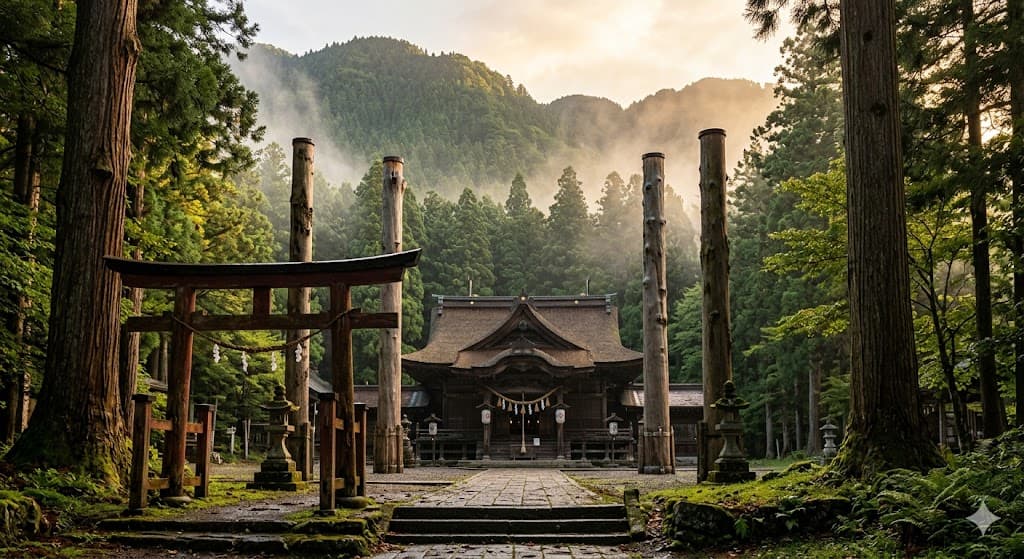
The Elusive Samurai and the Suwa Faith: The Shrine Where the Priest Was Also a Warlord
How The Elusive Samurai uses the priest Suwa Yorishige to open up the Suwa faith — the living-god high priests, the honden-less shrine, and the war god medieval samurai prayed to.
6/8/2026
Frieren and the Drinking Monk: Heiter, the 'Corrupt Priest'
How Heiter's running Corrupt Priest joke in Frieren: Beyond Journey's End opens a door into hannyatō and Japan's long, gently bent rule against monks drinking.
5/26/2026