Mob Psycho 100 and the Sacred Salt: Why Reigen's Salt Splash Is a Joke Only Japan Fully Hears
How Mob Psycho 100 dramatizes 盛り塩 (Morijio) — the everyday Japanese habit of using salt to purify space, and why Reigen's table-salt exorcism lands as a joke.

Tokyo-born, 3rd-generation Edokko · writing on Japanese culture from outside Japan
Spoiler-Free Cultural Analysis
This article looks at the real cultural history behind one small gag in the first episode of Mob Psycho 100 — the use of salt as a purifier. No plot spoilers; only the folklore, ritual, and everyday Japanese habits that make the joke work.
Key Takeaways
- In Japan, salt has been treated as a purifying substance for centuries, used at funerals, in Shinto rites, at sumo matches, and in the small conical piles called 盛り塩 (Morijio: ceremonial salt mounds at doorways) that still appear at the entrances of restaurants and homes.
- The comedy of 霊幻新隆 (Reigen Arataka)'s salt-throwing attack works because Japanese viewers instantly recognize that household table salt is not the same as ritual purifying salt — even though, in practice, most modern Japanese households use exactly that for their own 盛り塩.
- The gap between how Japan thinks salt should be used and how Japan actually uses salt is itself the joke, and it captures something true about modern Japanese spiritual life: tradition survives mostly as habit, not as belief.
Key Terms Explained
- 盛り塩 (Morijio) / Ceremonial Salt Mound — A small cone of salt placed at entrances of homes, restaurants, and businesses to ward off bad spirits and invite good fortune.
- 清め塩 (Kiyome-jio) / Purifying Salt — Salt used in rites of purification, including the small packet handed out after Buddhist funerals.
- 禊 (Misogi) / Ritual Purification — A Shinto practice of washing away spiritual impurity, traditionally with water but conceptually linked to salt purification.
- 穢れ (Kegare) / Ritual Impurity — The Shinto concept of pollution accumulated through contact with death, blood, or other defiling forces; what salt is meant to dispel.
- 伯方の塩 (Hakata no Shio) / Hakata Salt — A famous Japanese household table salt brand, the very one Reigen pulls out of his bag in the gag.
The Salt Cones I Walked Past Without Thinking
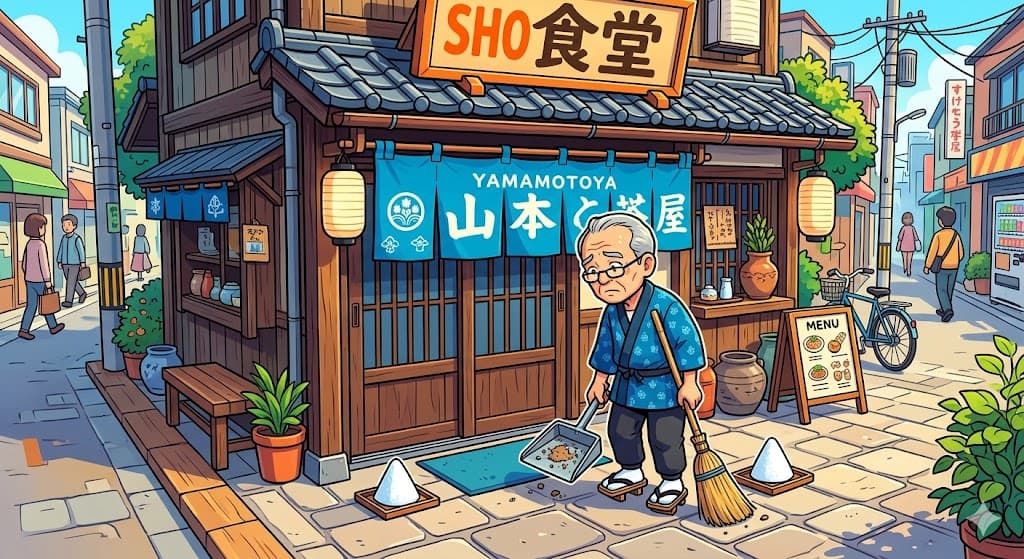
Growing up, 盛り塩 (Morijio: ceremonial salt mounds at doorways) was simply part of the daily landscape. The clearest mental image I carry is of small white cones placed on either side of the entrance to a 飲食店 (Inshokuten: eating-and-drinking establishment) — most often a 居酒屋 (Izakaya: Japanese pub), a 寿司屋 (Sushi-ya: sushi restaurant), or a 料亭 (Ryōtei: traditional Japanese restaurant). The cones were so neatly shaped, so regularly maintained, that they looked like part of the shop's morning preparation, the same way the 暖簾 (Noren: shop entrance curtain) was hung out and the lanterns were switched on. I never asked what they were for. They were just there, the way the red 提灯 (Chōchin: paper lantern) was there, the way the chalkboard menu was there.
 Morijio cones at a restaurant entrance — a daily landscape so ordinary that most passersby never stop to ask what they are for.
I also saw salt used in other small, unremarked moments. At 神社 (Jinja: Shinto shrine) festivals there was salt scattered to clean the ground. On television, sumo wrestlers tossed handfuls of it into the ring. After someone moved house, a relative would mention sprinkling salt around the doorway. After an unwelcome customer left, someone would joke "塩まいとけ" — "throw salt on it" — half in jest, half not. The phrase "塩で清める" (cleansing with salt) had soaked into my body before I had any framework for understanding it.
Years later, watching the first episode of Mob Psycho 100 — the Bones-produced anime adapted from ONE's manga of the same name — I saw 霊幻新隆 (Reigen Arataka) fling a fistful of supermarket 伯方の塩 (Hakata no Shio: a famous Japanese table salt brand) into the face of an evil spirit while shouting "Salt Splash" in the voice of a heroic exorcist. I laughed before I had time to think about why. The joke, I realized later, depends on every viewer carrying that childhood image of the sushi-shop salt cone — or its equivalent — somewhere in their cultural memory.
The Long History of Salt as a Purifier in Japan
Salt in 神道 (Shintō) and the Concept of 穢れ (Kegare)
To understand why Reigen reaches for salt at all, we have to start with the purity logic of 神道 (Shintō: Japan's indigenous religion). In Shinto thought, the world is divided not so much into good and evil as into pure and polluted. The concept of 穢れ (Kegare: ritual impurity) covers everything from contact with death and blood to ordinary spiritual fatigue. Pollution is not sin — it is a substance, almost, that clings and must be physically washed off.
 A rikishi scattering salt across the dohyō — not theatre, but theological housekeeping rooted in Shinto purity logic.
The classic answer is 禊 (Misogi: ritual purification with water), the immersion practice that gives Japanese culture its long love affair with rivers, waterfalls, and the small 手水舎 (Chōzuya: shrine purification basin) at every shrine entrance. But salt occupies a parallel track. Where water is the purifier of body and place, salt is the purifier of space and threshold. Salt absorbs. Salt repels. Salt marks a boundary between the inside and the unwanted outside.
This is why the 大相撲 (Ōzumō: professional sumo) wrestler tosses a fistful of salt into the ring before each bout. The 土俵 (Dohyō: sumo ring) is sacred ground, and the 力士 (Rikishi: sumo wrestler) is performing not just a sport but a small ritual of clearing the space before combat. The salt is not theatre. It is theological housekeeping.
Salt at the Funeral Threshold
The other place salt enters most Japanese lives is at the gate after a funeral. For my generation, the strongest memory is not of consciously sprinkling 清め塩 (Kiyome-jio: purifying salt) on ourselves at the front door, but of the small white packet of salt tucked into the 会葬礼状 (Kaisō-reijō: funeral thank-you card). You opened the envelope, you saw the little square of salt, and even if you did not perform the rite with full attention, the message was received: death is 穢れ (Kegare), and you bring some home with you, and you should not bring it inside without first cleaning yourself off.
Some Buddhist sects today object to this practice — they argue that death itself is not impure and that the salt packet is a Shinto idea grafted awkwardly onto a Buddhist ceremony. The objection is theologically sound. The packet has continued to appear anyway. Habit, in Japan, often outlives the doctrine that justified it.
The Restaurant 盛り塩
The salt cone at a restaurant entrance has two readings, depending on whom you ask. The defensive reading: it wards off evil influences, malicious customers, bad luck. The inviting reading: it draws good customers in — an old explanation links the practice to the idea of salt attracting oxen, and so attracting the people whose carriages those oxen pulled. In modern practice, both readings live in the same cone. The owner does not have to choose. The cone simply does its job by being there.
What Reigen's Hakata Salt Tells Us About Modern Japan
The visual joke in Mob Psycho 100 is precise. Reigen yells the name of his attack in the voice of a serious exorcist. The label on the bag says 伯方の塩 (Hakata no Shio) — a brand whose jingle every Japanese person of a certain generation can sing on demand, because the commercial has run on Japanese television for decades. The bag is the same bag in your kitchen. The salt is the same salt on your morning egg.
 The same supermarket Hakata salt that seasons morning eggs is the salt most households actually use for morijio.
Watching the scene as someone who has lived outside Japan for many years now, what struck me was not the gag itself but the recognition behind it. The "purifying salt" most Japanese households actually keep on hand for 盛り塩 is exactly this kind of supermarket table salt. I have done it myself. The serious version of the practice would involve salt blessed at a shrine, or at minimum unrefined sea salt purchased specifically for the purpose. The everyday version involves opening the cupboard.
There is no contradiction in the Japanese mind about this. Or rather, there is one, but it has been worn smooth by repetition. The same household that lights incense for the family Buddhist altar in the morning will eat KFC on Christmas Eve and visit a Shinto shrine on New Year's Day. Sacred and profane are not enemies in Japanese practice; they are neighbors who share a wall.
The distance of years away from Japan has sharpened my sense of what this means. In countries with one dominant religion, the gap between "ritual salt" and "kitchen salt" is enforced by clear theological rules. In Japan, the gap exists in the abstract — every culture-savvy person knows there is supposed to be a difference — but in the concrete, the gap closes the moment you actually need salt. You use what you have. The gesture matters more than the substance.
This is why Reigen's salt-throwing attack lands as comedy rather than blasphemy. He is not insulting the tradition. He is exposing a small, tender hypocrisy that everyone in the audience has already committed in their own kitchen, and the recognition is the laugh. The fraud is funny because the fraud is partly us.
I tried 盛り塩 properly once, years ago — I went room by room, placed a cone in not just the usual spots like the entrance and kitchen but in every corner of every room I could find, and gave up within weeks because the salt absorbed humidity, lost its shape, and needed replacing on a schedule I could not maintain. The intention had been there. The follow-through had not. That, too, is the joke. Reigen's shortcut is an exaggerated version of the shortcut most of us have already taken.
FAQ
Q: Is the salt in Mob Psycho's exorcism gag a real Japanese practice?
A: The use of salt to repel evil spirits is genuinely embedded in Japanese folk belief, drawn from Shinto purification practice. What makes it a gag in Mob Psycho 100 is the gap between the ritual ideal — properly purified or shrine-blessed salt — and Reigen using a bag of supermarket Hakata table salt while shouting an English-loanword attack name.
Q: Do Japanese people still actually put 盛り塩 at their doors?
A: It is far more common at restaurants — especially traditional 寿司屋 (Sushi-ya), 居酒屋 (Izakaya), and 料亭 (Ryōtei) — than at private homes today. Some households still place salt cones on move-in day or after a funeral, but as a daily practice it is mostly something one notices at the threshold of older businesses rather than in modern apartments.
Q: Is the post-funeral salt packet still standard at Japanese funerals?
A: It used to be near-universal in 昭和 (Shōwa: 1926–1989 era) funeral kits — a small sachet of salt tucked into the thank-you card given to mourners. Today some Buddhist sects discourage it on the grounds that death is not "impure" in their doctrine, but many funeral homes still include the packet by default, because tradition tends to outlast theology in Japan.
Key Insights to Remember
- Salt in Japan is a tool of spatial hygiene, not just culinary seasoning. The cone at the sushi-shop door, the packet from the funeral, the fistful in the sumo ring — these are not separate customs but the same underlying belief that salt cleans the boundary between pure and polluted space. Once you see the pattern, you see it everywhere in Japanese daily life.
- The joke in Mob Psycho 100 depends on a quiet hypocrisy the audience already shares. Reigen using table salt for ritual purposes is exposed as fraudulent precisely because every Japanese viewer has either done the same thing or watched a relative do it. The humor is recognition, not satire — the show is laughing with the practice, not at it.
- Modern Japan keeps the gestures of purification long after the doctrines that justified them have faded. The 盛り塩 at a restaurant entrance is rarely placed by someone who could explain its theology in detail, and the post-funeral salt packet is opened by people who would not call themselves Shinto. What survives is the muscle memory of a culture, the ritual stripped down to a habit, and that may be the most honest spiritual life there is.
Sources & References
About the author

Spoiler-free cultural deep-dives into anime, manga & live-action Japanese drama
- ●Tokyo-born, 3rd-generation Edokko (江戸っ子)
- ●Lifelong manga reader & anime viewer since the kaiju era
- ●Writes from outside Japan — distance as a cultural lens
- ●Spoiler-free · sourced · Kanji + Romaji + English
A Tokyo-born, 3rd-generation Edokko writer who has spent years living outside Japan. I use the anime, manga, and live-action Japanese drama you already love as a doorway into the folklore, language, religion, and everyday history behind them — written so even first-time fans can follow along, with sources for every claim.
Enjoy this article?
Get the next spoiler-free cultural deep-dive straight to your inbox.
Related Articles

Vinland Saga and the Paradise Beyond the Western Sea: What Vinland Shares with Japan's Tokoyo and Fudaraku Tokai
How Vinland Saga's warm land beyond the western sea echoes Japan's Tokoyo belief and the Fudaraku tokai monks who once sailed toward a paradise across the water.
7/18/2026
Jujutsu Kaisen and Goryō Shinkō: Why Japan Turns a Vengeful Curse Into a God
How Jujutsu Kaisen dramatizes goryō shinkō — the Japanese belief that turns a wronged spirit's resentment into a curse, then enshrines it as a worshipped god.
6/27/2026
Delicious in Dungeon and Itadakimasu: The Mealtime Word That Means I Receive This Life
How Delicious in Dungeon makes Itadakimasu visible — the Buddhist and Shinto idea of receiving life behind a phrase foreign viewers mistake for let's eat.
6/15/2026

Yu Yu Hakusho and the River Sanzu: The Ferry-Toll, the Stripping Crone, and the Three Crossings of the Dead
How Yu Yu Hakusho's ferrywoman Botan opens a door onto the River Sanzu, where six coins and a clothes-stripping crone decide how the Japanese dead cross over.
6/14/2026
The Elusive Samurai and the Suwa Faith: The Shrine Where the Priest Was Also a Warlord
How The Elusive Samurai uses the priest Suwa Yorishige to open up the Suwa faith — the living-god high priests, the honden-less shrine, and the war god medieval samurai prayed to.
6/8/2026
Frieren and the Drinking Monk: Heiter, the 'Corrupt Priest'
How Heiter's running Corrupt Priest joke in Frieren: Beyond Journey's End opens a door into hannyatō and Japan's long, gently bent rule against monks drinking.
5/26/2026