Naruto and the Nine-Tailed Fox: Why Japan's Most Sacred Animal Is Also Its Most Feared
How Naruto's Nine-Tailed Fox draws on Japan's centuries-old kitsune folklore — where the same fox can be a divine messenger of Inari and a terrifying shape-shifting yōkai.

Tokyo-born, 3rd-generation Edokko · writing on Japanese culture from outside Japan
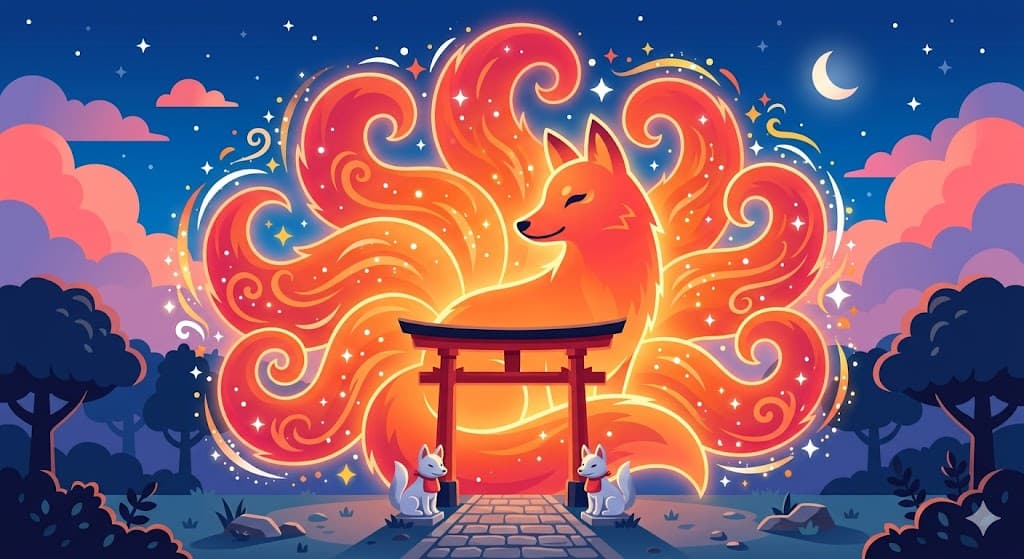
Spoiler-Free Cultural Analysis
This article explores the Japanese folklore and religious thought behind the 九尾の狐(Kyūbi no Kitsune: Nine-Tailed Fox) sealed inside the protagonist of ナルト(Naruto: a long-running shōnen manga and anime series by Masashi Kishimoto). No plot spoilers — only the centuries of belief, mythology, and everyday culture that the character draws on.
Key Takeaways
- The 狐(Kitsune: fox) in Japanese tradition is one of the few animals that holds two opposite spiritual roles simultaneously — sacred messenger of the harvest deity 稲荷(Inari) on one hand, and a dangerous shape-shifting trickster on the other. The Nine-Tailed Fox in Naruto is built directly on this duality.
- 玉藻前(Tamamo-no-Mae), the legendary nine-tailed fox who allegedly seduced an emperor, is the most famous predecessor to the Nine-Tails sealed in the protagonist of Naruto. Her story shaped the cultural template of "ancient, beautiful, terrifyingly powerful fox" that the manga inherits.
- Japan's relationship with the supernatural rarely separates "good" from "evil" in the way Western monotheistic traditions do. A fearsome being can be honored as a god, and a benevolent god can turn vengeful — which is exactly why a feared force and a sacred power can coexist within the same character.
Key Terms Explained
- 狐 (Kitsune) / Fox — In folklore, a spiritually charged animal believed to live for centuries and grow additional tails as it ages, ultimately reaching nine.
- 稲荷 (Inari) / Harvest Deity — The Shinto kami of rice, agriculture, and prosperity, whose messengers are white foxes. Inari shrines, marked by red torii gates, are the most numerous in Japan.
- 妖怪 (Yōkai) / Supernatural Creature — A broad term for spirits, monsters, and shape-shifters in Japanese folklore. Foxes are among the most prominent yōkai.
- 玉藻前 (Tamamo-no-Mae) / The Jewel-Algae Maiden — A legendary nine-tailed fox who took the form of a beautiful court woman during the Heian period; the archetype for malevolent kyūbi tales.
- 化ける (Bakeru) / To Shape-Shift — The verb used for supernatural transformation, especially when foxes assume human form to deceive.
A Small Red Torii at the End of the Block
Growing up in Tokyo, there was a small 稲荷の祠(Inari no Hokora: a tiny Inari shrine) on a corner near my childhood home. Not a grand precinct with stone steps and gravel paths — just a modest shelter with a red 鳥居(Torii: shrine gateway) and a pair of weathered fox statues flanking it. I never made offerings or prayed there. It was simply part of the streetscape, the way a vending machine or a postbox is part of a streetscape. And yet, walking past it day after day, I absorbed something without knowing I was absorbing it: that foxes belonged to a quieter, older layer of the city than the one we lived on.
 A modest Inari shrine tucked into an everyday Tokyo streetscape — the kind of quiet sacred presence woven into ordinary city life.
When the word 「お稲荷さん」(O-Inari-san: a familiar way of referring to Inari) came up in conversation at home, the first thing it conjured wasn't theology. It was food. 油揚げ(Aburaage: deep-fried tofu pouches), いなり寿司(Inarizushi: rice stuffed inside sweet aburaage), きつねうどん(Kitsune Udon: udon topped with aburaage). Foxes love fried tofu, the old saying went, so we name the dishes after them. Belief and dinner blurred together with no friction at all.
But the foxes I encountered on the page and the screen were a different breed. Old Japanese folktale picture books — including the well-known まんが日本昔ばなし(Manga Nihon Mukashibanashi: an animated TV series adapting classic Japanese folktales) — were full of foxes who tricked travelers on dark roads, foxes who pretended to be brides in candle-lit processions, foxes whose 狐火(Kitsunebi: fox-fires) drifted through the woods at night. Older relatives spoke about 化かされる(Bakasareru: to be tricked by a supernatural creature) as if it were something that had genuinely happened to people they once knew. So I held two foxes in my head: the one with the red torii at the end of the block, and the one waiting in the dark.
When I first watched the early episodes of Naruto and learned that the boy carried the Nine-Tailed Fox sealed inside him — a creature feared, hated, and yet a source of immense power — I didn't experience it as an unusual fictional invention. I experienced it as something that had always been true.
The Two Faces of the Fox in Japanese Belief
To understand what the Nine-Tails represents, you have to understand that the Japanese fox has never been a single thing. Foxes occupy a crossroads in Japanese spiritual thought, and they have stood at that crossroads for well over a thousand years.
The Fox as Divine Messenger: Inari and the Red Torii
The 稲荷信仰(Inari Shinkō: Inari belief) is one of the most widespread folk traditions in Japan. Within 神道(Shintō: Japan's indigenous polytheistic tradition), Inari shrines outnumber every other type of shrine in the country, and at every one of them, you will find pairs of fox statues — usually white, often with a key, a jewel, or a scroll in their mouths — standing guard at the entrance. These foxes are not Inari themselves. They are 神の使い(Kami no Tsukai: messengers of the deity), the spiritual go-betweens linking worshippers and the kami of rice, harvest, and prosperity.
 White fox statues stand watch as messengers of Inari, the kami of rice and prosperity, at one of Japan's countless Inari shrines.
This is the bright face of the fox. Sacred. Helpful. Tied to abundance, to the household economy, to the fields that feed the village. When merchants opened a shop in old 江戸(Edo: the former name of Tokyo, used during the Tokugawa shogunate), they often built a tiny Inari shrine on the rooftop or in the back lot, asking the foxes to guard the business. That practice continues today on the rooftops of department stores and corporate headquarters, even if most passersby never look up to notice.
The Fox as Yōkai: Tricksters, Possessors, and Tamamo-no-Mae
Set against this is the fox as 妖怪(Yōkai: supernatural creature). In folktales, foxes deceive lonely travelers, cast illusions, possess young women in a phenomenon called 狐憑き(Kitsunetsuki: fox-possession), and in their most powerful form, accumulate tails as they age — one tail at first, two, then five, then finally nine. A 九尾の狐(Kyūbi no Kitsune: nine-tailed fox) is a fox so old, so powerful, and so versed in supernatural craft that it has surpassed the ordinary natural order entirely.
 Tamamo-no-Mae, the legendary nine-tailed fox of the Heian court, became the cultural archetype for every dangerous kyūbi in modern Japanese fiction.
The most famous such fox in Japanese legend is 玉藻前(Tamamo-no-Mae). According to the story, she appeared at the court of Emperor Toba in the late 平安時代(Heian Jidai: the Heian period, roughly 794–1185 CE) as a woman of incomparable beauty and intellect. The emperor fell ill, and a court diviner revealed that his sickness was being caused by Tamamo-no-Mae herself — a nine-tailed fox spirit in human form. She fled to the plains of Nasu, where she was eventually hunted down and slain, her body said to have transformed into a poisonous stone, the 殺生石(Sesshōseki: Killing Stone). For centuries, Japanese theater, 浮世絵(Ukiyo-e: woodblock prints from the Edo period), and storytelling traditions returned to her again and again. She is the cultural ancestor of every dangerous nine-tailed fox in modern Japanese fiction, and her shadow falls clearly on the Nine-Tails of Naruto.
Why Both Faces Coexist: Japan's Multifaceted Religious Mind
Here is the part that often surprises readers from monotheistic traditions: in Japanese spiritual thought, the sacred messenger and the dangerous trickster are not separate entities sharing a single name by coincidence. They are recognized as the same animal expressing different aspects of a single, ambiguous spiritual nature.
The clearest historical example of this logic is 天神様(Tenjin-sama: the deified spirit of Sugawara no Michizane). The scholar 菅原道真(Sugawara no Michizane), exiled and dead in disgrace in the early tenth century, was blamed after his death for plagues, lightning strikes, and political disasters in the capital. The response was not to suppress his memory or label him a demon. The response was to enshrine him as a god — to honor and pacify the very force that had been feared. Today he is venerated across Japan as the kami of scholarship, and students pray to him before exams.
The same logic underlies the fox. A force powerful enough to harm is, by that very fact, powerful enough to bless. You don't choose between the two; you acknowledge both, and you build the shrine. This is why a feared Nine-Tailed Fox sealed inside a child can also be the source of his most extraordinary power. In the Japanese spiritual imagination, this is not a paradox. It is the natural shape of a powerful being.
What Modern Audiences Lose, and What Naruto Quietly Preserves
Living outside Japan for many years now, I notice how often Western audiences read the Nine-Tails through a lens that doesn't quite fit the source material. The instinct in many storytelling traditions is to ask: is this creature good or evil? Should the hero embrace it, or cast it out? In a Christian-influenced narrative imagination, the demon inside is the part to be exorcised.
But that framing tends to miss something. The Nine-Tails enters the story as a feared and destructive presence — that part is clear from the opening — yet the cultural template behind it is older and more layered than a simple demon-to-be-defeated. It is the structure of a spiritual force to be reckoned with: feared, yes, and dangerous, but also potentially honored, potentially negotiated with. That structure is older than Naruto by a thousand years. It is the same structure that built the small Inari shrine at the end of my childhood block, where a sacred messenger stood guard with the same animal face that, in another story, would lure a man off the road at midnight.
What I find quietly striking is how naturally a contemporary 少年漫画(Shōnen Manga: boys' adventure manga) inherits this. There is no lecture in the story about Shinto, no exposition about Inari or Tamamo-no-Mae. The creator simply assumes that a Japanese reader will understand that a fearsome creature can be a sacred power, and that the boy carrying it is not damned but burdened with something complicated. The cultural literacy is built in. Outside Japan, that literacy has to be reconstructed — which is part of why anime, watched carefully, becomes such a useful door into older layers of Japanese thought.
There is something I would not have noticed when I was younger, walking past that little red torii without looking. The reason the Japanese fox holds both faces so easily is that Japanese religious culture has always been, at heart, a culture that takes in everything that has weight. Buddhism arrived from the continent and was woven into existing Shinto practice. Christmas and Halloween and Valentine's Day arrived from the West and were woven into the calendar. Funerals are Buddhist, weddings can be Shinto or Christian, New Year's brings the family to the shrine. A friend in a strictly monotheistic tradition once asked me which religion I believed in, and the honest answer was that the question itself didn't quite translate. We hold many things at once, and we don't ask them to agree.
The Nine-Tails inside Naruto is, in a quiet way, an expression of exactly this. A force that can destroy, also a force that can save. A creature that can be feared, also a creature that can be honored. Two faces of one animal, walking through the same forest at dusk.
FAQ
Q: Is the Nine-Tailed Fox in Naruto based on a specific real legend?
A: The most direct ancestor is 玉藻前(Tamamo-no-Mae), a Heian-era legendary nine-tailed fox who allegedly disguised herself as a court beauty to harm the emperor. Her tale, along with broader 妖怪(Yōkai) fox lore, forms the cultural template that the Nine-Tails draws on, even though the version in Naruto is its own creation.
Q: Why are foxes connected to Inari shrines?
A: Foxes have been considered messengers of 稲荷(Inari), the kami of rice and harvest, since at least the early medieval period. The connection likely grew from foxes being seen near rice paddies hunting rodents that threaten the crop, which villagers interpreted as the fox protecting the harvest. The white fox in particular became the visible symbol of Inari's protective power.
Q: Do most Japanese people today actually believe in fox spirits?
A: Active belief in literal fox-possession and shape-shifting has faded considerably in modern urban Japan, but the cultural imagery remains everywhere — in food names, place names, festivals, manga, anime, and the small Inari shrines still standing on countless street corners. The folklore is no longer treated as journalism, but it is still treated as part of who Japan is.
Key Insights to Remember
- The Nine-Tailed Fox of Naruto is not a creative invention dropped into a vacuum. It sits at the end of a long Japanese tradition in which foxes have always been double-natured beings — at once divine messengers and dangerous tricksters. Reading the character as simply a "demon" misses the older spiritual logic the figure is built on.
- 玉藻前(Tamamo-no-Mae) and 天神様(Tenjin-sama) together illustrate the principle that a being feared for its destructive power can also be the being honored for its sacred power. Japanese religious thought tends not to separate these into clean opposites but to recognize them as facets of the same overwhelming force.
- The reason a Japanese audience absorbs the dual nature of the Nine-Tails without explanation is that the underlying cosmology is ambient — taught not through doctrine but through neighborhood shrines, food names, picture books, and the casual stories of older relatives. For readers outside that ambient context, anime can serve as a doorway back into the older layers of belief that the works quietly assume.
Sources & References
About the author

Spoiler-free cultural deep-dives into anime, manga & live-action Japanese drama
- ●Tokyo-born, 3rd-generation Edokko (江戸っ子)
- ●Lifelong manga reader & anime viewer since the kaiju era
- ●Writes from outside Japan — distance as a cultural lens
- ●Spoiler-free · sourced · Kanji + Romaji + English
A Tokyo-born, 3rd-generation Edokko writer who has spent years living outside Japan. I use the anime, manga, and live-action Japanese drama you already love as a doorway into the folklore, language, religion, and everyday history behind them — written so even first-time fans can follow along, with sources for every claim.
Enjoy this article?
Get the next spoiler-free cultural deep-dive straight to your inbox.
Related Articles

Spirited Away and Kamikakushi: The Folklore Behind the Title
Spirited Away's Japanese title ends in kamikakushi. Learn who villages said took children away, why dusk was the dangerous hour, and how they searched for them.
10/25/2026
Fruits Basket and the Zodiac Cat: The Real Japanese Folktale of the Cat Who Missed the Banquet
How Fruits Basket builds its outsider cat on the real Japanese folktale of the rat tricking the cat out of the zodiac, and what eto still means in Japan today.
10/20/2026

March Comes in Like a Lion and Tsukimi: Why Japan Watches the Moon With Rice Dumplings and Pampas Grass
How March Comes in Like a Lion opens onto tsukimi, Japan's moon-viewing harvest observance, and why dumplings, pampas grass and a shifting date belong to it.
8/17/2026

Summer Time Rendering and the Shoryo-uma: The Cucumber Horse That Carries the Dead Home
How Summer Time Rendering's Obon homecoming opens onto shoryo-uma, the cucumber horse for returning ancestors, and why it is only one of many regional forms.
8/16/2026

GeGeGe no Kitaro and Hyakumonogatari: Why Japan Saves Its Ghost Stories for Summer
How GeGeGe no Kitaro connects to hyakumonogatari, the hundred-candle ghost game, and the Edo custom of staging horror in summer to chill the audience.
8/11/2026

Demon Slayer Infinity Castle and the Biwa: Heike and Hōichi
How the biwa that opens Demon Slayer's Infinity Castle leads to blind Heike reciters and Hōichi, who played night after night for a court that was not there.
8/7/2026