Haikyu!! and Japan's GROW GROW MILK Carton: How a Postwar School Ritual Shaped a Nation's Relationship with Height
How Haikyu!! Episode 1 quietly nods to Japan's school-milk ritual — and the postwar nutrition policy that turned a daily 200ml carton into a national promise of growing tall.

Tokyo-born, 3rd-generation Edokko · writing on Japanese culture from outside Japan
Spoiler-Free Cultural Analysis
This article looks at the cultural and historical context behind a single piece of background art in Haikyu!! — the carton labeled "GROW GROW MILK" that appears in Episode 1 — and the long Japanese tradition of believing that milk makes children taller. No plot spoilers; only the food culture, the postwar policy, and the body-image anxieties that built the world Hinata steps into.
Key Takeaways
- The carton labeled "GROW GROW MILK" that appears behind Hinata in Haikyu!! Episode 1 is not random set dressing — it points to one of the most consequential nutrition policies in modern Japanese history, the school-lunch milk program known as 給食牛乳(Kyūshoku Gyūnyū: school-lunch milk), which became a daily ritual for nearly every Japanese child for decades.
- The postwar Japanese government, with American aid, used 脱脂粉乳(Dasshi Funnyū: skimmed milk powder) and later carton milk as part of a broad nutritional recovery effort. Over roughly seventy years, alongside rising living standards and dietary change, the average height of Japanese men climbed by more than ten centimeters, and "drink milk to grow tall" took root as a folk belief that anime audiences absorb without ever being told.
- Haikyu!!'s emotional engine — the small protagonist staring up at "a tall wall" — gains another layer once you understand Japan's complicated relationship with stature: a country that treated child growth as a public concern for half a century, and still produces story after story about short heroes who refuse to be shorter than their ambition.
Key Terms Explained
- 給食(Kyūshoku) / School Lunch — The standardized meal program served in Japanese elementary and junior high schools, almost always including a 200ml carton of milk regardless of whether the day's meal is rice, bread, or noodles.
- 脱脂粉乳(Dasshi Funnyū) / Skimmed Milk Powder — The reconstituted powdered milk distributed in postwar Japanese schools, infamous among Showa-generation Japanese for its smell and taste, and the symbolic starting point of "school milk."
- 成長期(Seichōki) / Growth Period — The developmental window of childhood and adolescence that Japanese marketing, parenting, and food packaging treat as a near-sacred phase requiring calcium, protein, and "the right foods."
- 牛乳神話(Gyūnyū Shinwa) / The Milk Myth — The widely held Japanese folk belief that drinking milk every day makes children taller; a cultural conviction stronger than the underlying nutritional science.
- 食育(Shokuiku) / Food Education — A formal Japanese policy concept tying daily eating habits to physical and moral development, embedded in school lunches as a quiet form of national health engineering.
A Silver-Capped Glass Bottle and the Sound of Tray Returns
Long before I ever watched Haikyu!!, I drank the moment that carton represents.
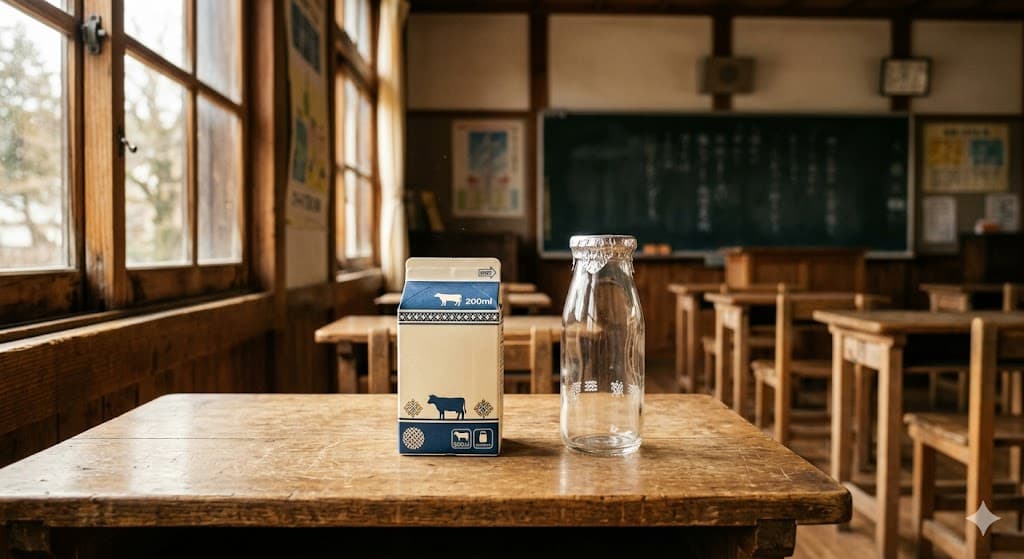
 Silver-capped glass milk bottles, the everyday companion of Showa-era school lunches across Japan.
When I was in elementary school in Tokyo, school-lunch milk arrived in glass bottles with silver foil caps. Every empty bottle had to come back to the kitchen at the end of lunch, and the sound of bottles being slotted back into their wooden crate is one of those small auditory memories that the body never quite throws away. I liked milk. I looked forward to that one bottle every single day.
At home, the 牛乳箱(Gyūnyū-bako: a small wooden milk-delivery box) sat right beside the front door of our single-story 足立区(Adachi-ku: a working-class ward in northeast Tokyo) house. The 牛乳屋(Gyūnyū-ya: the local milk delivery man) came before sunrise and left fresh bottles in the box. Someone in the family — usually whoever was up first — brought them inside. Around the time I started junior high, my parents cancelled the contract and we switched to paper cartons from the supermarket, and that quiet ritual of the morning bottle just… ended. I didn't think much of it at the time. Looking back, the daily milk delivery to the doorstep was already the tail end of a decades-long campaign, and I happened to be one of the last children who lived inside it.
When Haikyu!! Episode 1 frames Hinata against a vending machine carton labeled "GROW GROW MILK", that carton is not background decoration. It's a quiet wink at every Japanese viewer who ever stood in a school hallway holding an empty bottle, hoping the next centimeter was already on its way.
The Postwar Engineering of Japanese Height
To understand why a sports anime about a short volleyball player is, structurally, also a story about milk, you have to go back to the year of national hunger.
 Postwar Japanese school lunches paired bread with milk, anchoring a national nutrition project that lasted decades.
From Skimmed Powder to a National Policy
By 1945, Japan's wartime food shortages had left children visibly underdeveloped. In the immediate aftermath of the war, roughly 40% of Tokyo children hardly ate at all on a given day, and another 40% managed only one meal. Children were physically weaker than their prewar peers, and the political pressure to do something was enormous.
The first school milk in Japan came in the form of skim milk powder, distributed around the Tokyo area in 1946 through American non-government aid agencies. Bread and powdered skim milk soon spread to school lunches more widely with help from the United States and other partners; UNICEF began supporting the program in 1949; and by 1950 American occupation-era relief funds were sustaining school feeding in major cities.
The texture of those early years matters. The reconstituted powder had a distinctive smell and a chalky aftertaste that an entire generation of Japanese still remembers without fondness, but in a country where food was scarce, it was treated as a precious daily nutrient. The wordplay schoolchildren invented for it — turning the imported English "skim" into a phrase that sounded like "loved by no one" — captures the emotional ambivalence neatly: hated and welcomed at the same plastic cup.
The institutional turn came next. The 1954 School Lunch Law put the program on a permanent legal footing. Then in 1959, two ministries — agriculture and education — agreed that locally produced liquid milk would replace the imported powder in schools, with subsidies flowing to domestic dairy farmers. Carton milk followed soon after, standardizing both food safety and nutritional rations.
In one stroke, school milk became three things at once: a nutrition program, a domestic dairy subsidy, and a daily ritual that bound every Japanese child to the same 200ml unit of "growing up."
Meiji's Body Project and the Birth of "Tall = Modern"
The policy didn't appear from nowhere. It sat on top of an older project that began with the 明治維新(Meiji Ishin: Meiji Restoration). After 1868, the Japanese state started treating the body of the citizen — its size, strength, and posture — as a measurable index of modernity. The Emperor himself was photographed eating beef. Schools, hospitals, and the army became the early experimental sites for Western-style nutrition.
The numbers reveal how slowly the experiment paid off, and how dramatically it accelerated after the war. Average male height in Japan rose from roughly 160 cm in 1950 to about 171 cm by 2020, with a similar arc — from around 149 cm to nearly 159 cm — for women. This generational growth tracked closely with broad postwar improvements in nutrition, healthcare access, and household income.
Japan's postwar shift from a rice-heavy plate toward more protein — meat, eggs, dairy — supported faster physical development. School lunches were the engine that delivered that shift to every child, regardless of family income, every weekday for nine compulsory years.
Glico, Calcium, and the "Growth Period" Marketing Empire
The state ran the schools. The food companies ran the imagination.
The confectionery giant 江崎グリコ(Ezaki Guriko: Glico) was, from its earliest days in the 1920s, explicitly built around child growth. The company's founder, Riichi Ezaki, had become interested in glycogen — a nutrient he had identified in oyster broth — after the death of one of his own children. He had also been struck, on a trip to a fishing village, by how robust the local children looked. From those two observations he developed the idea that confectionery, the food children actually wanted to eat, could be turned into a vehicle for child nutrition. The very first Glico caramel was, in his framing, a growth food in candy form.
The phrase 成長期(Seichōki: growth period) became, over the next century, a marketing catchphrase glued to candies, biscuits, drink mixes, formula milk, and calcium-fortified yogurt drinks. By the time my own Showa childhood arrived, "成長期に良い(Seichōki ni yoi: good for the growth period)" was a phrase you could hear in TV commercials, on packaging, and from your own mother in the same afternoon. ミロ(Miro: Nestlé's Milo, sold by Meiji in Japan), マミー(Mami: Morinaga's drinkable yogurt-style milk drink), ヤクルト(Yakuruto: Yakult), カルピス(Karupisu: Calpis lactic-acid drink), and the everyday 煮干し(Niboshi: dried baby sardines) on the dinner table — all of them carried, explicitly or implicitly, the same promise: drink this, eat this, grow tall.
When I later trained at 日本体育大学(Nihon Taiiku Daigaku: Nippon Sport Science University) and took the licensure courses to teach physical education, "growth period and nutrition" was a formal lecture topic. Future P.E. teachers were taught when bones lengthen, what window calcium intake should hit, and how school lunches were calibrated to that window. The connection between policy, classroom, and family kitchen wasn't accidental. It was institutional.
The Milk Myth, Examined Politely
Does drinking milk actually make children taller? The honest scientific answer is: somewhat, in populations with prior protein and calcium deficiencies. The cultural Japanese answer, embedded in 牛乳神話(Gyūnyū Shinwa: the milk myth), is far more absolute. Milk = height. Milk = strong bones. Milk = modern body.
The myth survives partly because the postwar evidence felt so dramatic. A society that watched its average male height jump more than ten centimeters in two generations had a very natural explanation pre-installed: the white liquid that arrived with the school tray every single day.
A Vending Machine, an Outsider's Eye, and the Stories Japan Still Tells
Watching Haikyu!! now, with a long stretch of years living outside Japan behind me, I notice something I never noticed as a child.
 Even as menus shifted back to rice, the daily 200ml carton stayed — the structural echo behind Haikyu!!'s "GROW GROW MILK" gag.
Japan's anime and manga are full of short heroes. Hinata in Haikyu!!. Edward in Fullmetal Alchemist. Generations of shōnen protagonists who first appear smaller than their rivals and grow into something the world didn't expect. From the inside, this looks like a charming convention. From a distance, it looks like the cultural fingerprint of a society that spent decades treating child growth as a public concern, building daily institutions around it, and that still hasn't quite resolved its feelings about size.
When the camera lingers on the "GROW GROW MILK" vending machine at exactly the moment Hinata is being teased about being on the "girls' team" and being short, the framing is doing real cultural work. The carton is the thing every Japanese kid was promised would help with precisely the problem Hinata is grappling with. The joke, if you grew up inside the system, is that he is presumably already drinking it.
The outsider's lens also makes me notice the inverse. Few other countries built a comparable everyday infrastructure around child height — the calcium-fortified everything, the "for the growth period" caramels, the morning home delivery, the schoolwide vending machines. The whole apparatus, taken together, is a structure most cultures simply do not build at this density.
What has Japan kept? The carton in the school lunch tray, every day. The phrase 成長期 in the supermarket aisle. The reflex to associate milk with verticality. What has it quietly let go? The home delivery boxes by the front door, the silver-capped glass bottles, and, perhaps slowly, the absolute confidence that more milk equals more centimeters.
Hinata stares up at a tall wall and asks what the view looks like from the other side. Haikyu!! puts that wall in front of him because it's the central question Japan has been asking, in its quiet institutional way, since 1946.
FAQ
Q: Is "GROW GROW MILK" a real product in Japan?
A: No. It's a fictional brand name created for Haikyu!!'s background art. But the joke only lands because it parodies a real, deeply familiar category — Japanese dairy companies have spent decades marketing "growth period" milk products to schoolchildren and their parents, so a viewer reads the carton instantly without being told what it is.
Q: Why is milk served with rice, curry, ramen, and other clearly non-Western Japanese school meals?
A: Because the school milk program was originally a postwar nutrition policy, not a culinary one. Milk was treated as a fixed daily nutrition unit rather than a complement to a particular cuisine. By the time Japanese school lunches shifted back from bread to rice in the 1970s, the daily milk carton was already institutionally locked in, and it stayed.
Q: Did Japanese people really grow taller because of school milk specifically?
A: The broad postwar improvement in protein, calorie intake, healthcare, and living standards is the more accurate explanation than milk alone. School milk was one component of a much larger nutritional shift. The cultural memory inside Japan, however, often condenses that whole shift into the single image of the daily school carton — which is exactly the cultural shorthand Haikyu!! is leaning on.
Key Insights to Remember
- Anime background art in Japan is rarely just decoration. The "GROW GROW MILK" carton in Haikyu!! compresses the entire postwar nutritional history of Japan — skimmed milk powder aid, the 1954 School Lunch Law, dairy subsidies, and the calcium-marketing economy — into a single visual gag. Reading anime culturally means learning to spot these compressions, because Japanese viewers absorb them without conscious effort.
- The Japanese fascination with the short hero who refuses to stay short is not random. It sits on top of a society that treated "grow taller" as a public health priority for the better part of a century, and produced two generations of children who measured themselves daily against an officially sanctioned ideal of vertical growth. Hinata's complex is a personal version of a national one.
- Cultural memory and nutritional science do not run on the same clock. Japan continues to associate milk with height long after the easy nutritional gains of the 1950s and 60s plateaued. That gap — between the lived feeling of "milk makes you tall" and the more nuanced underlying reality — is where the most interesting cultural storytelling lives, Haikyu!!'s vending-machine joke included.
Sources & References
- Feeding the Nation: How Japan's School Lunches Changed Through the Twentieth Century — Nippon.com
- Milk: An Essential Part of the Japanese School Lunch Program — International Dairy Federation
- History and Tradition of School Milk in Japan — Tetra Pak Insights
- History of Nutritional Improvement in Japan — Springer Nature
- A Brief History of the Evolution of Japanese School Lunches — Japan Today
- "Humans bring food to their mouths, animals bring their mouths to food" — The Morality Politics of School-Lunch Sporks in 1970s Japan — Taylor & Francis
- Average Height in Japan — Doctor Taller
- Understanding Average Japanese Height — Japan Language Factory
- Secular Trend in Height of Japanese in the Past Century — American Journal of Biomedical Science & Research
- Ezaki Glico Company History — Encyclopedia.com
- Ezaki Kinenkan: The Story of Riichi Ezaki — QR Translator
- Glico Group's 100 Years History: Milk and Dairy Beverages — Glico Group
About the author

Spoiler-free cultural deep-dives into anime, manga & live-action Japanese drama
- ●Tokyo-born, 3rd-generation Edokko (江戸っ子)
- ●Lifelong manga reader & anime viewer since the kaiju era
- ●Writes from outside Japan — distance as a cultural lens
- ●Spoiler-free · sourced · Kanji + Romaji + English
A Tokyo-born, 3rd-generation Edokko writer who has spent years living outside Japan. I use the anime, manga, and live-action Japanese drama you already love as a doorway into the folklore, language, religion, and everyday history behind them — written so even first-time fans can follow along, with sources for every claim.
Enjoy this article?
Get the next spoiler-free cultural deep-dive straight to your inbox.
Related Articles

Hyouka and the Kakigori Flag: The Thousand-Year-Old Word for Frozen Sweets Behind Japan's Shaved Ice
How Hyouka's title word hyoka connects to kakigori, the Heian court's shaved ice, and the Meiji regulation that turned an inspection badge into Japan's summer flag.
8/10/2026

Why Does Denji Dream of Toast With Jam? Chainsaw Man and Japan's Quiet Cult of 食パン (Shokupan)
How Chainsaw Man turns toast with butter and jam into an impossible dream, and what 食パン, the kissaten morning set, and margarine reveal about Japan's breakfast table.
7/14/2026
SHOSHIMIN and the Spring-Limited Craze: Why a Tart Sells Out
How SHOSHIMIN: How to Become Ordinary turns a spring-limited strawberry tart into a window on shun and kisetsu gentei, Japan's culture of the fleeting.
5/28/2026

Delicious in Dungeon and the Proverb Hara ga Hettewa Ikusa wa Dekinu: Why Japan Treats Supply as Strategy
How Delicious in Dungeon dramatizes the Japanese proverb hara ga hette wa ikusa wa dekinu, and why Japanese warfare long treated food as seriously as the sword.
5/27/2026
Let This Grieving Soul Retire! and the Culture of 闇鍋 (Yami-nabe): The Japanese Dinner Party Played as Roulette
How Let This Grieving Soul Retire! mirrors Japan's 闇鍋 (Yami-nabe) tradition — a cultural history of the dark-pot dinner from Edo dorms to modern variety TV.
5/11/2026