Black Summoner and the Shikigami Tradition: Why Japan's Summoners Bond Instead of Bind
How Black Summoner's Kelvin and Clotho echo onmyōdō's shikigami pact — Japan's summoning lineage of consent, naming, and master-servant feeling.

Tokyo-born, 3rd-generation Edokko · writing on Japanese culture from outside Japan
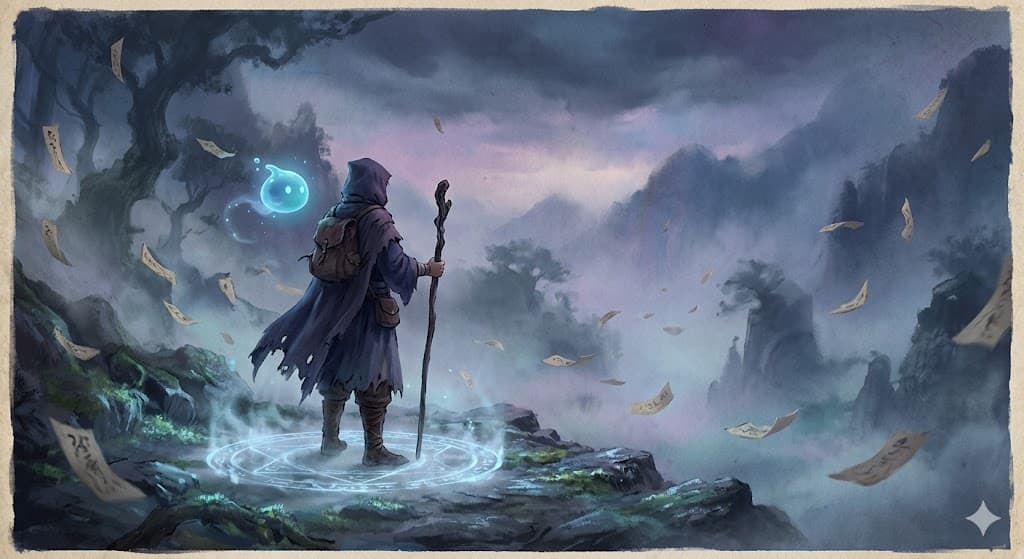
Spoiler-Free Cultural Analysis
This article unpacks the Japanese cultural roots behind the summoner figure — onmyōdō, shikigami, naming, and the master-servant bond — using the first episode of Black Summoner as an entry point. No plot reveals beyond the opening setup; only themes, atmosphere, and the long history sitting underneath.
Key Takeaways
- Japan's summoner figure draws less from Western magical-pact traditions and more from 陰陽道(Onmyōdō: a Heian-era esoteric system blending Chinese cosmology and native Japanese spirit belief), where the practitioner does not coerce a spirit but enters a relationship with it.
- The act of giving a summoned creature a name — Kelvin naming the slime Clotho — sits inside an old Japanese belief in 言霊(Kotodama: the spiritual power carried by spoken words), where naming is a binding, animating gesture rather than a label.
- Western RPG summoners often lean toward contract-and-control language; Japanese summoners drift toward 主従(Shujū: master and servant) softened by 情(Jō: warmth, feeling, attachment) — a structure that shows up everywhere in Japanese life, from craft apprenticeships to comedy duos.
Key Terms Explained
- 陰陽道(Onmyōdō) / The Way of Yin and Yang — A Japanese esoteric tradition formalized in the Heian court, mixing Chinese yin-yang and five-element thought with native ritual to read fate, repel calamity, and command spirits.
- 安倍晴明(Abe no Seimei) / The Most Famous Onmyōji — A late-Heian period court diviner who became the patron-saint figure of onmyōdō in later legend, and the archetype every modern shikigami story quietly leans on.
- 式神(Shikigami) / Ritual Familiar Spirit — A spirit bound to serve an onmyōji, sometimes appearing as a paper figure, an animal, or an unseen presence, deployed to investigate, defend, or carry out errands.
- 言霊(Kotodama) / Word-Spirit — The belief that spoken language, especially names and incantations, carries real spiritual force — to name a thing is to fix it in place.
- 主従(Shujū) / Master and Servant Relationship — A vertical bond that, in the Japanese register, is rarely purely transactional; it expects loyalty going up and care going down.
The Kokkuri-san on the Classroom Floor
The first time I ever "summoned" anything, I was sitting on a classroom floor with three other kids and a ten-yen coin. We were playing コックリさん(Kokkuri-san: a Japanese ouija-style game where a coin moves across letters under fingertips), and the unspoken rule of the game was the part nobody could explain — you had to dismiss the spirit politely at the end. You had to send it home. Skipping that step was supposed to invite something to follow you.
 A coin, a sheet of paper, and the unspoken rule of sending the spirit home — a Showa childhood's first encounter with summoning.
That memory came rushing back the moment I watched Kelvin in Black Summoner Episode 1 stand in front of a wobbling blue slime, palm outstretched, channeling a Binding Contract. The setup is dressed in JRPG menu screens — appraisal skills, MP gauges, level numbers — but underneath the interface, the gesture is older than any console. A practitioner extends a hand, an agreement is reached, a name is given, and a creature now belongs to your circle. None of this is European magical pact thinking. This is the long shadow of 陰陽道(Onmyōdō: the Heian-era way of yin and yang), where the bond between human and spirit was always supposed to begin with consent, continue through naming, and live or die on the warmth of the relationship that followed.
I should be honest about something else, though. Despite being born and raised in Tokyo as a third-generation 江戸っ子(Edokko: a true Tokyoite), I did not grow up steeped in onmyōji lore the way some Japanese viewers did. The boom around 夢枕獏(Yumemakura Baku: a contemporary novelist) and his Onmyōji series, the Okano Reiko manga adaptation, the Nomura Mansai film — those passed me by during the years they were the talk of every bookstore. Like a lot of Showa kids in working-class Tokyo, my summoning vocabulary came from somewhere else entirely: Doraemon pulling tools out of a four-dimensional pocket, Ultra Seven's capsule monsters waiting to be thrown into battle, sentai shows where a giant robot would arrive precisely when needed. The word 召喚(Shōkan: summoning) only became formal language for me later. As a child it was simply what heroes and friends did for each other when the situation called for it.
Onmyōdō, Shikigami, and the Architecture of the Summoner
To understand why Black Summoner's contract feels the way it does — gentle, mutual, almost domestic — it helps to walk back through where this whole architecture comes from.
From Continental Cosmology to a Japanese Court Office
陰陽道(Onmyōdō) was not folk magic. It was a state-recognized discipline. Imported from Tang-era China alongside Buddhism and other knowledge systems, yin-yang cosmology was absorbed into Japan's Heian court and given an actual government bureau — the 陰陽寮(Onmyōryō: the Bureau of Yin-Yang). Onmyōji served as ritual specialists for the imperial household, charged with calendar-keeping, divination, exorcism, and the management of spiritually dangerous moments — a child's birth, a building's groundbreaking, the appearance of a comet. They were closer to court technicians than to wandering wizards.
 The onmyōji served the Heian court as a ritual technician, not a wandering wizard — calendar-keeper, diviner, and manager of the unseen.
The most enduring face of the tradition is 安倍晴明(Abe no Seimei: the legendary Heian-period onmyōji), who lived in the late tenth and early eleventh centuries. The historical Seimei was a competent court official; the legendary Seimei is a different creature entirely — accumulated, century by century, through tales like the 今昔物語集(Konjaku Monogatarishū: an early-twelfth-century anthology of Buddhist and secular tales) and later puppet plays, kabuki, novels, manga, and films. By the time he reached the modern era, he had become the patron archetype: a calm, slightly otherworldly figure who solves court mysteries by reading the structure of the unseen world.
Shikigami: Familiar, but Not a Slave
The 式神(Shikigami) is the piece of onmyōdō that most directly maps onto the modern summoner. In legend, Seimei kept shikigami in his service — sometimes described as paper figures animated by ritual, sometimes as small invisible spirits, sometimes as imposing forms hidden under the bridge of his residence because his wife was frightened of them.
The crucial point for cultural translation is this: a shikigami in classical accounts is not a slave hauled out of an underworld and forced to obey. The relationship is structured around ritual, agreement, and ongoing maintenance. The onmyōji has obligations too — protective rites, correct invocations, respect for the boundaries of the spirit's nature. Mistreat the shikigami, neglect the ritual scaffolding, and the relationship breaks. The spirit is not yours by right of conquest. It is yours because the arrangement holds.
This is exactly the texture of Kelvin's Binding Contract scene. The slime is weakened, yes, but the binding only completes when the creature gives consent. Then comes the naming. Then comes a flow of feeling along what the goddess Melfina jokingly calls a "Subordinate Net." Strip the JRPG vocabulary and you are left with a recognizably Japanese spiritual gesture: the pact is honored, the name is fixed, the bond now carries warmth.
Kotodama and the Weight of a Name
The naming step deserves its own attention because it is doing more cultural work than viewers raised on Western fantasy might assume. Japanese folk belief has long held that words are not neutral signs. They carry 言霊(Kotodama: the spiritual power of spoken words). To name a thing is to settle it into place. Wedding speeches in Japan still avoid certain "cutting" or "splitting" words; sailors avoided certain words at sea; pregnant women have been told not to speak certain things aloud. These habits all share the same underlying assumption — saying it makes it real.
When Kelvin gives the slime the name Clotho, he is not picking a label off a shelf. In the logic the show inherits, he is performing the binding itself. The contract may begin with a hand gesture, but the name is what locks it. After that, the slime has a self that is partly his — an identity it did not have a moment before. This is why so many Japanese stories about 妖怪(Yōkai: supernatural creatures), 神(Kami: gods or spirits), and bound familiars treat naming as the moment of real consequence. The name is the leash, but it is also the bridge.
Master and Servant, Softened by Feeling
Here is where I find the comparison with Western "summoner" archetypes most revealing. In a lot of Western magical literature — grimoire traditions, Faustian pacts, demon-binding texts — the relationship between practitioner and summoned entity is adversarial at its core. The entity wants out. The practitioner forces it to stay. Power flows downward through coercion and is leaked through every loophole the entity can find.
Japanese summoning narratives keep drifting away from that frame and toward something I would describe as 主従(Shujū: master and servant) layered with 情(Jō: warmth, attachment). I feel this lineage in the most ordinary corners of Japanese life — the way comedy duos protect their senior-junior dynamic, the way 落語(Rakugo: traditional Japanese comic storytelling) apprentices live in their master's house for years, the way a sports club captain looks after the first-years. None of these relationships are equal contracts. But none of them are pure command-and-obedience either. Care moves downward. Loyalty moves upward. The space between is filled by small acts — a meal bought, a mistake covered, a quiet word at the right moment.
The summoner-and-summon pairing in Japanese fiction inherits this same emotional grammar. Kelvin and Clotho are not master and slave. They are something closer to 師匠と弟子(Shishō to deshi: master and apprentice) crossed with traveling companions. The contract is the scaffolding; the feeling is the load-bearing wall.
What "Consent" Means When the Paperwork Is in the Other World
There is a small line in the Black Summoner episode that tends to slide past viewers but worth holding up to the light: the slime can only be bound if it gives its consent. If it cannot understand you, you weaken it until it can be brought into the contract — but the moment of binding still requires assent. This is not lazy writing. It is the show pulling onmyōdō's logic into game-system grammar.
Living outside Japan for many years now, I have come to see that "consent in the contract" plays out very differently across cultures, and Japan has its own complicated history with it. In a Japanese employment contract or rental agreement, the formal moment of consent — the seal stamped, the line signed — is often weirdly out of proportion with the responsibility that follows. People agree to terms whose actual weight only reveals itself months or years later. In my own work as an AI engineer running Next.js development projects, I have learned to be almost obsessive about defining scope on paper, because "we agreed verbally" has ended more partnerships than missed deadlines ever have. The fact of consent matters less than whether both parties were looking at the same picture when they consented.
This is why the shikigami framework is more emotionally adult than it first appears. The classical ritual structure forces a moment of acknowledged agreement, but it also assumes that the relationship will require ongoing maintenance. You cannot just stamp the contract and walk away. You have to keep feeding the bond — with rites, with attention, in fiction as in life with telepathic reassurance and shared meals.
What Modern Stories Keep Reaching For — and What Has Been Quietly Lost
After more than a decade away from Japan, what strikes me most about the summoner trope's persistence is how clearly it serves as compensation. It offers something Japanese society has been steadily trading away.
 The summoner-and-summon pairing dramatizes a vertical bond softened by warmth — a shape modern Japanese life has been quietly letting go.
The traditional 主従(Shujū) bond — apprentice to master, junior to senior, household to patron — has thinned considerably in modern Japanese workplaces, and arguably had to. The old structure carried real abuses inside its warmth. But its disappearance has left a specific emptiness: the felt sense that someone above you in a hierarchy is also looking out for you, and someone below you is your responsibility, not just your subordinate. Japan exported the 先輩後輩(Senpai-kōhai: senior-junior) vocabulary to the world but is in many corners of its own labor market quietly letting the substance of it dissolve.
Summoner stories step into that gap with surprising precision. Kelvin and Clotho. The countless other contemporary anime where a protagonist forms an unbreakable bond with a 神霊(Shinrei: divine spirit), a yōkai, a bestial companion. These pairings dramatize a kind of relational wholeness that the Showa kid in me recognizes from old hero shows — the trusted partner who arrives when called and stays after the fight is over. I do not think modern Japanese viewers seek out this archetype because they consciously remember Heian onmyōdō. I think they reach for it because the emotional architecture of "vertical bond softened by feeling" still feels like home, even when the home itself has been remodeled into open-plan offices and gig contracts.
There is a faint melancholy in this, and I am not immune to it. As a Japanese person who has spent his adult life watching his own culture from a distance, I notice how the same culture that gave the world the rigorous etiquette of 阿吽の呼吸(A-un no kokyū: the wordless mutual understanding between paired figures) also keeps producing fiction in which two beings are bonded so completely they no longer need words. The fiction, I suspect, is partly mourning the everyday version. Onmyōdō dressed up as JRPG mechanics is not just nostalgia for ritual. It is nostalgia for a kind of relationship.
FAQ
Q: Is Black Summoner directly about onmyōdō or shikigami?
A: Not explicitly — the surface dressing is Western fantasy with JRPG menus. But the underlying logic of consent-based binding, naming as activation, and master-companion emotional bond traces directly back to Japanese onmyōdō and shikigami tradition rather than to European pact magic.
Q: Was Abe no Seimei a real person?
A: Yes. He was a Heian-period court onmyōji who actually existed in the late tenth and early eleventh centuries. The figure most modern stories draw on, however, is the legendary Seimei built up over a thousand years of folklore, anthologies, theater, and modern fiction — far more elaborate than the historical man.
Q: Why do Japanese summoners feel emotionally different from Western ones?
A: Western magical pact traditions often frame the summoned entity as adversarial and coerced. Japanese tradition frames the bond as a master-servant relationship softened by feeling, where the human owes the spirit ongoing care, ritual, and respect. The emotional grammar comes from the same vertical-but-warm relationships that structure Japanese apprenticeship, mentorship, and senior-junior bonds.
Key Insights to Remember
- The "consent before binding" rule in Japanese summoning fiction is not a modern softening for sympathetic audiences. It is the inheritance of an old onmyōdō logic in which a shikigami is an honored partner in a ritual arrangement, not a captured enemy. Once you see this, the gentleness of stories like Black Summoner stops feeling sentimental and starts feeling structural.
- Naming a summoned creature does heavier cultural work in Japanese stories than the same act does in Western fantasy. Under the influence of 言霊(Kotodama), the name is not metadata. It is the binding itself. Strip the name and the bond loosens; bestow it and the relationship becomes real in a way that no contract clause can match.
- The summoner trope is one of the clearest examples of fiction preserving what daily life is letting go. The vertical bond layered with warmth — apprentice and master, senior and junior, summoner and summon — used to be the default texture of Japanese institutional life and is now most reliably encountered on screen. Anime in this register is doing quiet cultural archive work, whether viewers notice or not.
Sources
About the author
Spoiler-free cultural deep-dives into anime, manga & live-action Japanese drama
- ●Tokyo-born, 3rd-generation Edokko (江戸っ子)
- ●Lifelong manga reader & anime viewer since the kaiju era
- ●Writes from outside Japan — distance as a cultural lens
- ●Spoiler-free · sourced · Kanji + Romaji + English
A Tokyo-born, 3rd-generation Edokko writer who has spent years living outside Japan. I use the anime, manga, and live-action Japanese drama you already love as a doorway into the folklore, language, religion, and everyday history behind them — written so even first-time fans can follow along, with sources for every claim.
Enjoy this article?
Get the next spoiler-free cultural deep-dive straight to your inbox.
Related Articles

Spirited Away and Kamikakushi: The Folklore Behind the Title
Spirited Away's Japanese title ends in kamikakushi. Learn who villages said took children away, why dusk was the dangerous hour, and how they searched for them.
10/25/2026
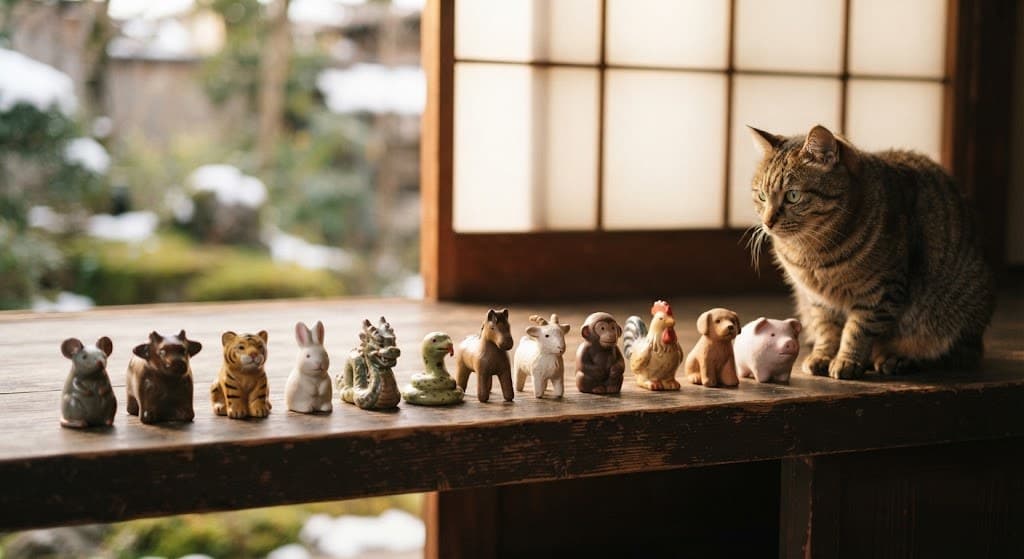
Fruits Basket and the Zodiac Cat: The Real Japanese Folktale of the Cat Who Missed the Banquet
How Fruits Basket builds its outsider cat on the real Japanese folktale of the rat tricking the cat out of the zodiac, and what eto still means in Japan today.
10/20/2026

March Comes in Like a Lion and Tsukimi: Why Japan Watches the Moon With Rice Dumplings and Pampas Grass
How March Comes in Like a Lion opens onto tsukimi, Japan's moon-viewing harvest observance, and why dumplings, pampas grass and a shifting date belong to it.
8/17/2026

Summer Time Rendering and the Shoryo-uma: The Cucumber Horse That Carries the Dead Home
How Summer Time Rendering's Obon homecoming opens onto shoryo-uma, the cucumber horse for returning ancestors, and why it is only one of many regional forms.
8/16/2026

GeGeGe no Kitaro and Hyakumonogatari: Why Japan Saves Its Ghost Stories for Summer
How GeGeGe no Kitaro connects to hyakumonogatari, the hundred-candle ghost game, and the Edo custom of staging horror in summer to chill the audience.
8/11/2026

Demon Slayer Infinity Castle and the Biwa: Heike and Hōichi
How the biwa that opens Demon Slayer's Infinity Castle leads to blind Heike reciters and Hōichi, who played night after night for a court that was not there.
8/7/2026