Natsume's Book of Friends and the Fūrin: The Japanese Wind Chime Was a Charm Against Spirits Before It Was the Sound of Summer
How Natsume's Book of Friends illuminates the furin, the Japanese wind chime that hung on temple eaves as a ward against misfortune long before it meant summer.

Tokyo-born, 3rd-generation Edokko · writing on Japanese culture from outside Japan

Spoiler-Free Cultural Analysis
This article contains no plot spoilers. It uses the atmosphere of 夏目友人帳(Natsume Yūjinchō: Natsume's Book of Friends) as a doorway into the real religious and craft history behind the Japanese wind chime — where it came from, what it was originally for, and what it still quietly does.
Key Takeaways
- The Japanese wind chime did not begin as a summer decoration. It began as a bronze temple bell believed to ward off misfortune, and the protection was understood to extend exactly as far as the sound carried.
- The shift from sacred object to seasonal ornament happened through glass. When Nagasaki artisans toured Japan in the early eighteenth century demonstrating glassblowing as public spectacle, a temple fitting became a household one.
- The wind chime survives in stories like Natsume's Book of Friends because it does something no other summer object does: it marks a boundary you can hear but not see, which is exactly how spirits are understood to move in Japanese folklore.
Key Terms Explained
- 風鈴 (Fūrin) / Wind Chime — The small glass or metal bell hung at a window or eave in summer, with a paper strip beneath it that catches the wind.
- 風鐸 (Futaku) / Temple Eave Bell — The larger bronze bell hung at the four corners of Buddhist temple roofs, understood as protection against calamity rather than as decoration.
- 占風鐸 (Senfūtaku) / Wind-Divination Bell — The Chinese ancestor of both: bronze bells hung in bamboo groves whose ringing was read for omens of fortune and misfortune.
- 妖怪 (Yōkai) / Supernatural Beings — The broad category of spirits, monsters, and strange presences in Japanese folklore. Not demons in the Western sense; often local, often bound to a specific place.
- 結界 (Kekkai) / Warded Boundary — A bounded space sealed against spiritual intrusion. Usually marked physically, by rope or gate or salt — but sometimes, as with the futaku, by sound.
The Colour I Did Not See Until I Was Far Away From It
I have lived outside Japan for a long time now, and I have absorbed a great deal from it. Ways of thinking, ways of arguing, ways of being direct that my Tokyo upbringing never taught me. But something I notice more sharply every year is that the deepest layer never swapped out. My sense of punctuality, my instinct for how much distance to keep from another person, my attention to the turn of the seasons — those stayed exactly where they were.
One of the odder ways this surfaced was colour. It was only after years away that I began to feel that 藍色(Aiiro: indigo blue) is the Japanese colour. At home it had been unremarkable. Shop curtains, hand towels, bowls — the deep blue was simply there, too close to be seen. From a distance it separated out from everything around it and became legible as Japanese in a way it never was when I was standing inside it.
I grew up in a 平屋(Hiraya: a single-storey house) in 足立区(Adachi-ku: a working-class ward in the north-east of Tokyo), which is not the Tokyo that appears in tourist photographs. It is low, flat, and close-packed, and in a neighbourhood built like that, sound behaves differently than it does in a city of towers. There is no height for noise to disperse into. What happens at one house is audible at the next. That is a fact about the architecture rather than a sentimental memory, and it matters here, because the object I want to write about does its work through exactly that property.
The wind chime is a blue object that makes a sound that travels. I had thought of it, for most of my life, as decoration. It is not. Or rather, it did not start out that way, and the reason it looks the way it does is much stranger and much older than summer.
Related: Ghost in the Shell and the Japanese Autumn Sky: Why Akikaze Signals Change Before the Leaves Do explains this in detail.
From a Bamboo Grove in China to the Eaves of a Japanese Temple
The bell that was read, not enjoyed
The line starts with a Chinese object called 占風鐸(Senfūtaku: a wind-divination bell). These were bronze bells hung in bamboo groves, and the point of them was not pleasure. It was prediction. The way the wind moved them — direction, frequency, the character of the ringing — was read as an omen, a way of telling whether what was coming would be fortunate or not. The bell was an instrument, in the technical sense. Somebody was listening to it for data.
That is a very different relationship to a sound than the one we have now. Nobody hangs a wind chime today in order to find out something.
Brought back with the sutras
These bells came to Japan alongside Buddhism, carried back by monks and envoys who had gone to Tang China. In Japan they became 風鐸(Futaku: the bronze bell hung at temple eaves), and they were installed at the four corners of Buddhist temple roofs.
Here the function shifted. The futaku was no longer being read for omens. It was doing something more active: warding off evil, holding disaster away. And the belief attached to it contains a detail that I find genuinely remarkable, because it is so specific. The protection was not understood to cover the temple building. It was understood to cover the area within which the bell could be heard. Misfortune would not fall on the households inside that radius.
Think about what that means as a piece of design. The boundary of the sacred space is not drawn on the ground. It is drawn by acoustics. It expands and contracts with the wind. It passes through walls, because sound does. You could not see where it ended, and you could not fence it, but you knew when you were inside it, because you could hear it.
This is a 結界(Kekkai: a warded boundary) made of sound rather than rope or gate.
By the 平安時代(Heian Jidai: the Heian period, 794–1185), aristocrats had begun hanging futaku on their own residences as protective charms. The object had left the temple. It was on its way to becoming domestic.
The glass that changed everything
The thing that turned a bronze ward into a household ornament was a material change, and it happened in public.
Glass wind chimes appear in the written record in the 享保(Kyōhō: an Edo-period era, 1716–1736) years, when glass artisans from Nagasaki toured Osaka, Kyoto, and Edo, demonstrating the making of what were then called ビードロ風鈴(Bīdoro Fūrin: glass wind chimes) as a public spectacle. ビードロ(Bīdoro) is an old Japanese word for glass, taken from the Portuguese vidro — a small linguistic fossil marking where the technology entered the country.
So the wind chime became a common household object partly because watching it being made was entertainment. That is a very Edo way for something to spread.
The craft survives. 江戸風鈴(Edo Fūrin: hand-blown Tokyo wind chimes) are still made without moulds, blown free in the air, which is why no two are the same size or thickness and therefore no two sound alike. Two details of the method are worth knowing. The painting is done on the inside of the glass, with the brush reaching in through the opening — because a design painted on the outside would be worn off by rain and wind, and these are objects that live outdoors. And the rim at the bottom, the 鳴り口(Narikuchi: the sounding mouth), is deliberately left jagged rather than ground smooth. A smooth rim would only ring when struck properly. A rough one catches the glass striker on the slightest movement of air, so the chime speaks even when the wind is barely there.
The craftsmen made the object more sensitive on purpose. They wanted it to respond to almost nothing.
There is a separate northern line, too: 南部風鈴(Nanbu Fūrin: cast-iron wind chimes from Iwate), which trace back to a casting culture in the Mizusawa area going back to the end of the Heian period. Iron rings longer and darker than glass. If you have only heard the glass kind, the iron kind is a genuinely different instrument.
What Natsume Hears That Nobody Else Does
Now put that history next to 夏目友人帳(Natsume Yūjinchō: Natsume's Book of Friends).
Yuki Midorikawa's series, serialised by Hakusensha from 2005 and adapted into an anime that ran across seven seasons between 2008 and 2024, is built on a premise that is quiet rather than dramatic: a young man can perceive 妖怪(Yōkai: the spirits and strange presences of Japanese folklore) that the people around him cannot. Midorikawa has said the work grew out of the stories about yōkai and local gods that stirred her imagination growing up in a rural area, and that rural texture is everywhere in it — fields, old houses, the specific emptiness of a country afternoon.
What makes the series feel true, to me, is that its supernatural world is not a separate realm you travel to. It is layered directly over the ordinary one and separated from it only by perception. Some people register it. Most do not. The boundary is real, and it is invisible, and it runs straight through the middle of everyday life.
That is precisely the logic of the futaku. A protective edge that has no physical marker. A zone you are either inside or outside without any way of seeing which. The wind chime is the only common household object in Japan that was designed around that idea, and I think that is why it sits so naturally in stories of this kind. It is not there as set dressing for summer. It is the one thing in the room that is already doing the same job the story is doing.
There is something else the two share. Both are about attention. Natsume's ability is essentially a matter of noticing what is there to be noticed. The Edo craftsman's jagged rim exists so the chime will report a movement of air too small for a person to feel. Both are instruments for registering something below the threshold of ordinary awareness.
What the Sound Costs Now
I want to be honest about the present, because the affectionate version of this story is not the whole of it.
A wind chime is a device for broadcasting sound into a shared space. That was the entire point when the protection extended as far as the ringing carried — the reach was the function. But a device that deliberately makes noise across a property line is now a harder thing to own than it used to be. Sensitivity to neighbourhood noise has risen considerably in Japan, and the wind chime, being a small machine that rings without asking, sits awkwardly inside that shift. In a dense low-rise neighbourhood, the same acoustics that once distributed a blessing now distribute an intrusion.
I do not think this is a story about a culture losing something through carelessness. It is a story about a technology outliving the belief that justified it. When the sound was protection, its spread through the neighbourhood was the good part. When the belief thinned out and the sound remained, the spread became the problem. The object did not change. The frame around it did.
Some of it has moved into organised settings instead. Temples hold wind chime markets — 川崎大師(Kawasaki Daishi: a major Buddhist temple in Kawasaki) runs one gathering hundreds of regional varieties — where you can hear the difference between an iron chime from the north and a glass one from Tokyo in a single afternoon. That is a real preservation, and it is also a change in kind: from something that hung at one house and rang at the neighbours, to something you go and visit.
And the blue is still there. The classic Edo chime is painted inside the glass, and the motifs that recur most are 金魚(Kingyo: goldfish) and morning glories and running water, most of them worked in that same indigo I could not see until I was standing far enough back. A protective bronze bell from a Tang bamboo grove ended up as a small blue glass object with a fish painted on the inside of it. I am not sure I could design a better example of how Japan absorbs a thing and keeps almost none of the original except the part that matters.
FAQ
Q: Are Japanese wind chimes actually meant to make you feel cooler? A: That is the common modern explanation, and there is a real conditioned association at work — many people in Japan do register the sound as cooling. But it is not the original purpose. The chime descends from a Buddhist temple bell used to hold misfortune away, and the summer-cooling role is a much later reading of an object that already existed for other reasons.
Q: Why is the bottom of a glass wind chime rough instead of smooth? A: It is left that way deliberately. When the bell is cut from the blown glass, the rim is jagged, and Edo Fūrin makers grind it only enough to shape it, not enough to smooth it. The rough edge catches the striker on the faintest air movement, so the chime sounds in a much lighter wind than a clean rim would allow.
Q: What is the difference between a futaku and a fūrin? A: They are the same lineage at different points. The futaku is the large bronze bell at the eaves of a Buddhist temple, understood as protection against calamity. The fūrin is its domesticated descendant — smaller, usually glass, hung at a house, and now understood mainly as a seasonal object.
Key Insights to Remember
-
The most interesting thing about the futaku is where its power was thought to stop. Not at the wall, not at the gate, but at the edge of audibility. A sacred boundary defined by how far a sound travels is a fundamentally different spatial idea from a fence, and it produces a protected zone that is porous, weather-dependent, and impossible to survey. Very little else in Japanese religious practice is bounded that way.
-
Objects usually lose their meaning slowly and keep their shape. The wind chime is a clean case: nearly every physical feature of a modern glass fūrin can be traced to a function nobody now believes in, and the features survived because they turned out to be pleasant for unrelated reasons. Craft is often the last part of a belief system left standing.
-
Natsume's Book of Friends works as well as it does because it takes seriously an idea that Japanese material culture already encoded: that the world has edges you cannot see and can only detect by paying a particular kind of attention. The series did not invent that structure. It inherited it, the same way the chime hanging in the window did.
Sources
- Fūrin — Wikipedia
- 風鈴の起源と歴史|音で涼を届ける日本の工芸文化 — 日本工芸堂
- 風鈴とは?~風鈴の歴史と種類、体への効果~ — ワゴコロ
- 江戸風鈴とは — 篠原まるよし風鈴
- 江戸風鈴|地域資源紹介記事 — 東京都 地域資源
- Kawasaki Daishi Furin-Ichi: Exploring 800 Types of Japanese Wind Chimes — Musubi Kiln
- Natsume's Book of Friends — Wikipedia
About the author

Spoiler-free cultural deep-dives into anime, manga & live-action Japanese drama
- ●Tokyo-born, 3rd-generation Edokko (江戸っ子)
- ●Lifelong manga reader & anime viewer since the kaiju era
- ●Writes from outside Japan — distance as a cultural lens
- ●Spoiler-free · sourced · Kanji + Romaji + English
A Tokyo-born, 3rd-generation Edokko writer who has spent years living outside Japan. I use the anime, manga, and live-action Japanese drama you already love as a doorway into the folklore, language, religion, and everyday history behind them — written so even first-time fans can follow along, with sources for every claim.
Enjoy this article?
Get the next spoiler-free cultural deep-dive straight to your inbox.
Related Articles
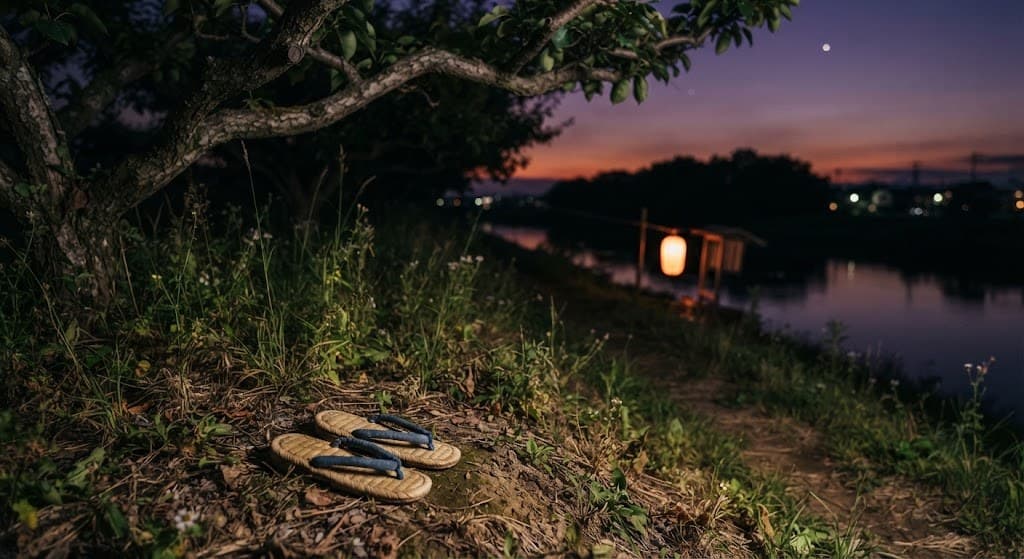
Spirited Away and Kamikakushi: The Folklore Behind the Title
Spirited Away's Japanese title ends in kamikakushi. Learn who villages said took children away, why dusk was the dangerous hour, and how they searched for them.
10/25/2026
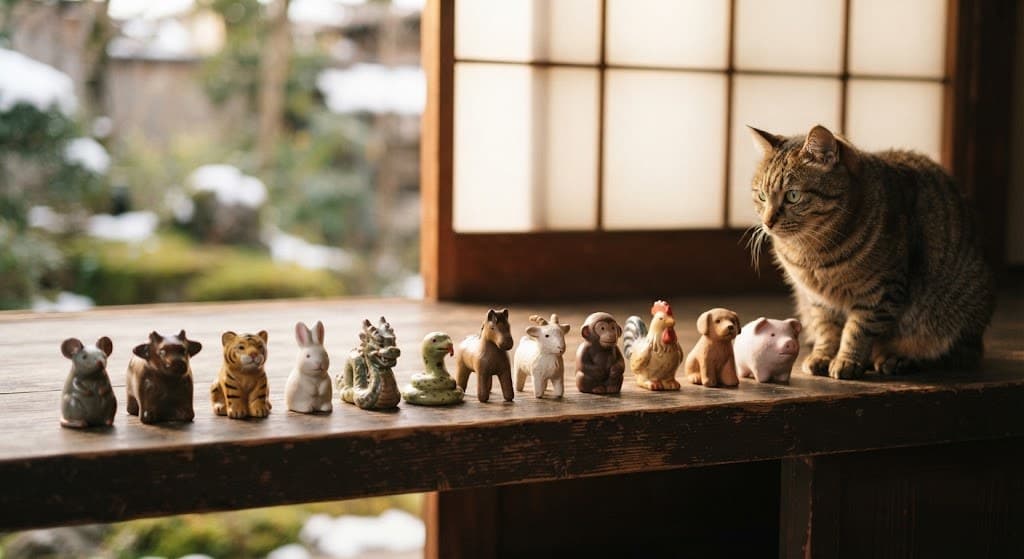
Fruits Basket and the Zodiac Cat: The Real Japanese Folktale of the Cat Who Missed the Banquet
How Fruits Basket builds its outsider cat on the real Japanese folktale of the rat tricking the cat out of the zodiac, and what eto still means in Japan today.
10/20/2026

March Comes in Like a Lion and Tsukimi: Why Japan Watches the Moon With Rice Dumplings and Pampas Grass
How March Comes in Like a Lion opens onto tsukimi, Japan's moon-viewing harvest observance, and why dumplings, pampas grass and a shifting date belong to it.
8/17/2026

Summer Time Rendering and the Shoryo-uma: The Cucumber Horse That Carries the Dead Home
How Summer Time Rendering's Obon homecoming opens onto shoryo-uma, the cucumber horse for returning ancestors, and why it is only one of many regional forms.
8/16/2026

GeGeGe no Kitaro and Hyakumonogatari: Why Japan Saves Its Ghost Stories for Summer
How GeGeGe no Kitaro connects to hyakumonogatari, the hundred-candle ghost game, and the Edo custom of staging horror in summer to chill the audience.
8/11/2026

Demon Slayer Infinity Castle and the Biwa: Heike and Hōichi
How the biwa that opens Demon Slayer's Infinity Castle leads to blind Heike reciters and Hōichi, who played night after night for a court that was not there.
8/7/2026