PLUTO and the Art of Mourning Machines: Why a Nation Grieves for a Broken Robot
How PLUTO's memorial for a destroyed robot dramatizes tsukumogami folklore — the real Japanese funerals held for needles, dolls, and robot dogs.

Tokyo-born, 3rd-generation Edokko · writing on Japanese culture from outside Japan
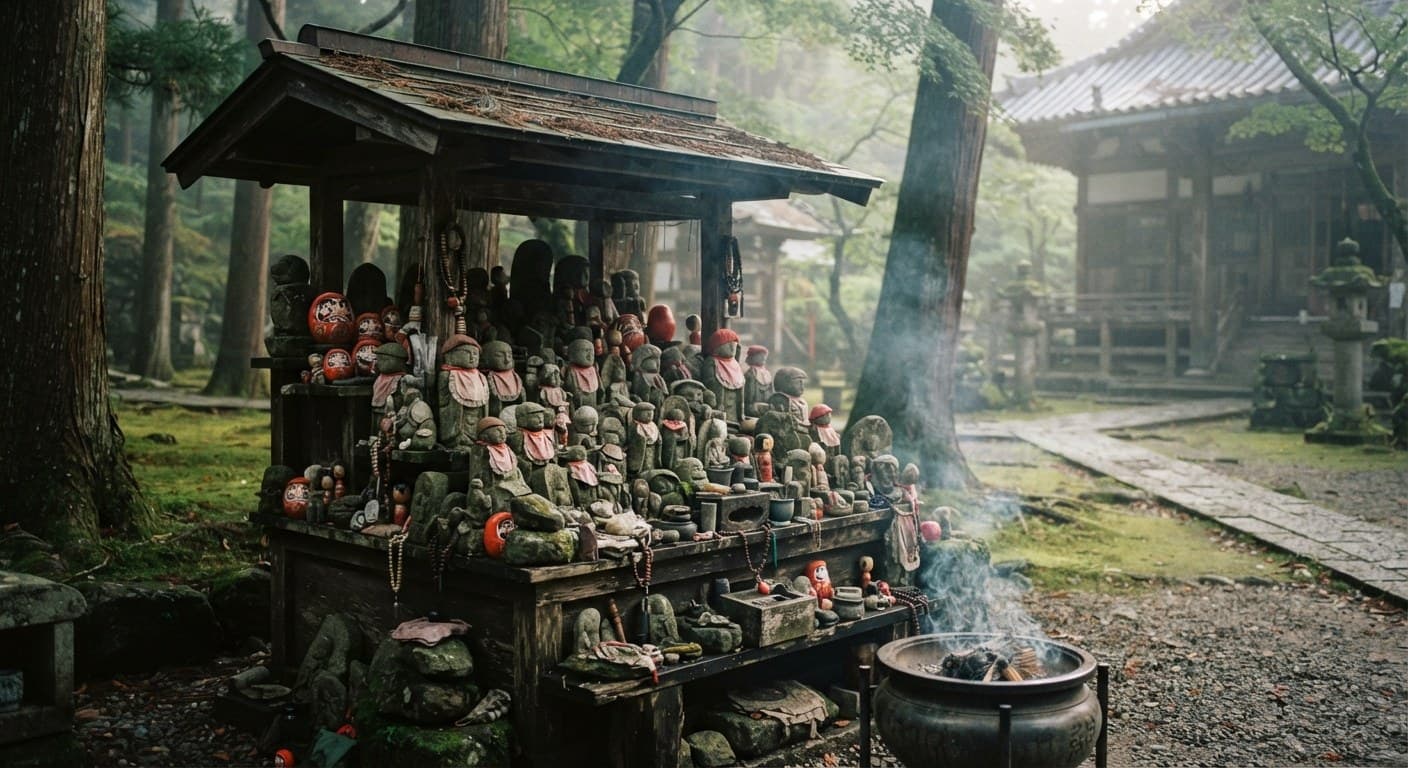
Spoiler-Free Cultural Analysis
This article stays within the publicly known premise of PLUTO Episode 1 — the destruction of a beloved robot and the memorial that follows — and reveals nothing about later plot developments, mysteries, or twists. What follows is real Japanese cultural and religious history, not fiction analysis.
Key Takeaways
- Japan has long-standing, real memorial rituals for inanimate objects — needles, dolls, tools — rooted in an animist worldview where objects can carry spirit or memory after long use.
- These traditions explain why a scene of an entire society mourning a destroyed robot feels emotionally coherent to Japanese audiences rather than sentimental exaggeration.
- The custom is alive today in unexpected modern forms, including actual Buddhist funerals held for retired robot dogs, showing how old frameworks absorb new technology without much friction.
Key Terms Explained
- 付喪神 (Tsukumogami) / Object Spirits — Folkloric belief that tools and household objects can awaken a spirit after roughly a century of use, especially if neglected or discarded carelessly.
- 針供養 (Hari Kuyō) / Needle Memorial — An annual ritual, often held in February, where worn-out sewing needles are respectfully retired by resting them in soft tofu or konnyaku instead of being thrown away.
- 人形供養 (Ningyō Kuyō) / Doll Memorial — A temple or shrine ceremony where old dolls, no longer wanted but considered too imbued with presence to discard as ordinary trash, are ritually blessed and cremated.
- 八百万の神 (Yaoyorozu no Kami) / Eight Million Gods — The Shinto idea that divinity is distributed across countless things — mountains, rivers, tools, even machines — rather than concentrated in a single deity.
- 形見 (Katami) / Keepsake — An object kept specifically because it carries the memory or presence of someone who is gone, central to how mourning attaches to physical things in Japan.
The News Segment I Grew Up With
I never once attended a 針供養 (Hari Kuyō: needle memorial) ceremony in person. For me, it existed the way certain seasonal customs exist for a lot of people who grow up in Tokyo — as a fixture of the evening news, appearing every winter with the same reliable rhythm as cherry blossom forecasts in spring. The camera would show a shrine attendant lining up rows of bent, rusted sewing needles and gently pressing them into a block of tofu or konnyaku, so their last act would be something soft instead of something that hurt. Nearby, at other temples, the segment would cut to tables piled with old dolls — some missing an eye, some with faded kimono fabric — waiting their turn to be blessed and cremated in 人形供養 (Ningyō Kuyō: doll memorial) services.
I absorbed this the way you absorb your own language: without ever being taught it directly. Nobody sat me down and explained why a needle deserved a send-off. It was simply there, every year, on the same channel, at the same time of evening, until the idea sank in on its own — that certain objects, once they have served long enough, are not quite the same as garbage.
That background is exactly what made PLUTO's opening chapter land so hard for me. Naoki Urasawa's series, a reimagining of Osamu Tezuka's classic Astro Boy story arc known as "The Greatest Robot on Earth," opens with the destruction of Mont Blanc, a mountain-guide robot beloved across the world, and the enormous public memorial that follows. Robot detective Gesicht is brought in to investigate, and the show lingers — deliberately, unhurriedly — on the scale of the public mourning. For a Western audience, a nation grieving a machine might read as an exaggerated thought experiment about how far artificial intelligence has come. For me, it read as something closer to home: an extension of a habit of feeling I'd already been trained into by decades of February news segments.
The Long Life of Objects in Japanese Belief
付喪神 and the Idea That Things Wake Up
The oldest thread running through all of this is 付喪神 (Tsukumogami: object spirits), a folk belief documented as far back as the Muromachi period in illustrated scrolls such as the 付喪神絵巻 (Tsukumogami Emaki). The idea is straightforward but strange to explain in English: an object that has been used for roughly one hundred years can develop a spirit of its own. If it is cared for, the spirit tends to be benign, even helpful. If it is discarded carelessly or forgotten, the spirit can turn resentful — a kind of folkloric warning against treating long-serving things as disposable.
This is not the same as Western animism, where a spirit inhabits an object from the start, like a haunted painting. In the Japanese version, the spirit is something that accumulates gradually, through use, attention, and time. A tool becomes worth respecting not because it was born special, but because it has quietly served for a very long time. That distinction matters, because it means the emotional debt runs in a specific direction — from the user, who benefited from the object's service, back to the object itself.
針供養 and 人形供養: Retirement, Not Disposal
Needle memorials trace back centuries, connected to Buddhist 事納め (Koto-osame: the closing of yearly work) traditions, when tools used for the year's labor were ritually rested rather than simply put away. Sewing needles were an obvious candidate — small, sharp, used daily by hand, and easy to lose track of once broken. Resting a spent needle in tofu, rather than throwing it in the trash, is a small physical gesture: after a life of piercing tough fabric, its last touch is something yielding and gentle.
人形供養 (Ningyō Kuyō: doll memorial) follows a similar emotional logic but on a larger, more visibly personal scale, since dolls have faces, and faces are hard to un-see as presence. Temples across Japan, including well-known sites like 淡島神社 (Awashima Jinja) in Wakayama, hold annual ceremonies where families bring dolls that have outlived their usefulness — a child long grown, a marriage doll from a wedding decades past — for a blessing before cremation. It is technically a small disposal problem being solved. Emotionally, it functions as a farewell.
I understand this on a level below argument. I am not someone who names stuffed animals or forms deep attachments to objects — a young relative of mine, a nine-year-old girl, names every single stuffed animal she owns and gives each one a distinct personality, which is a kind of relationship to objects I have simply never had. And yet even I cannot put a doll with a face directly into a garbage bag. It isn't sentimentality on my part, since there's no specific doll I'm attached to. It's something closer to etiquette — a sense that handling it carelessly would be a small wrongdoing, even if I couldn't explain exactly why in a court of logic.
When the Object Is a Robot
The natural next step for this belief system, once robots entered daily life, was barely a step at all. Sony's robotic dog AIBO, discontinued and later unsupported for repairs, left thousands of owners with companions that had quite literally lived in their households for years, learning routines, responding to voices, aging alongside the family. Starting in 2015, 光福寺 (Kōfukuji), a Buddhist temple in Isumi, Chiba, began holding joint funeral services for retired AIBO units — complete with a priest, incense, and a formal 戒名 (Kaimyō: a Buddhist name given after death) style send-off, though adapted for a machine rather than a person.
When I first heard about this, my reaction wasn't surprise. It was recognition. Of course a country that has quietly rested worn needles in tofu for the better part of a century would eventually find a Buddhist temple willing to hold a joint funeral for a decommissioned robot dog. The frameworks were already sitting there, fully built, waiting for a new kind of object to walk in through the door.
What the Old Framework Still Explains
PLUTO leans on exactly this inherited emotional grammar when it stages a public memorial for Mont Blanc — and later, quietly, shows a robot widow holding onto her husband's memory chip the way a human widow might keep a photograph or a wedding ring, a private 形見 (Katami: keepsake) rather than a functioning part. None of this needed to be explained to a Japanese audience, because the emotional infrastructure for it was already installed by generations of needle memorials, doll funerals, and — more recently — actual robot funerals. The show isn't asking viewers to imagine a strange future. It's asking them to apply a familiar past to an unfamiliar object.
Having lived for many years outside Japan, in a place where the dominant religious tradition is Catholic, I've noticed the difference up close. People there repair tools carefully and keep them running for decades — that habit of thrift and craftsmanship is very much alive. But the repair is about economy and skill, not about the tool's dignity. Prayer is directed at God and at other people; a wrench or an old sewing machine doesn't get a blessing when it finally breaks. Watching that contrast for years made me realize how specific — and how quietly persistent — the Japanese instinct really is: the sense that a long-serving object deserves a proper goodbye, not because it earns the same status as a living thing, but because ignoring its service feels like a small failure of character on the part of the person who used it.
I don't think most people practicing 針供養 or attending an AIBO funeral would describe themselves as believing in object spirits in any literal sense. It functions less like belief and more like inherited manners — the same way you might stand up when an elder enters a room without consciously deciding respect is owed. PLUTO's mourning robot world isn't science fiction reaching for pathos. It's an old Japanese habit, simply given a new kind of object to attach itself to.
FAQ
Q: Is 針供養 (needle memorial) still practiced in Japan today? A: Yes, it continues annually at various shrines and temples, typically in February, though it's more visible now as a media tradition than a widely attended personal ritual for most younger people.
Q: Are the AIBO funerals mentioned in this article a real event, or an internet myth? A: They are real. Kōfukuji temple in Isumi, Chiba has held documented joint funeral services for decommissioned AIBO units since 2015, complete with Buddhist ritual elements.
Q: Does PLUTO directly reference these real memorial customs, or is the connection something viewers infer themselves? A: PLUTO never explicitly names 針供養 or 人形供養; the show simply stages a large-scale public mourning for a robot, and the emotional logic behind that scene lines up naturally with these existing Japanese customs around objects and memory.
Key Insights to Remember
- The Japanese instinct to mourn objects isn't really about believing machines are alive — it's a habit of respect for long service, inherited from centuries of treating tools, needles, and dolls as things that deserve a dignified ending rather than careless disposal.
- Tsukumogami folklore quietly reframes the relationship between people and their possessions: the debt of care runs from the user back to the object, based on accumulated time and use rather than any inherent specialness the object was born with.
- Modern technology hasn't disrupted this framework; it has simply been absorbed into it, as shown by real Buddhist funerals for robot dogs — evidence that old cultural structures can flex to fit new kinds of companions without needing to be reinvented.
Sources
- In Japan, Old Robot Dogs Get a Buddhist Send-Off — NPR — Coverage of the AIBO joint funeral services at Kōfukuji temple in Isumi, Chiba
- In Japan, a Buddhist Funeral Service for Robot Dogs — National Geographic — Photo report on the AIBO funerals and the priests who conduct them
- Tsukumogami — Wikipedia — Overview of the Muromachi-period object-spirit folklore and the Tsukumogami Emaki scrolls
- Hari-Kuyō — Wikipedia — The annual Japanese memorial ceremony for broken sewing needles
- Awashima Shrine — Wikipedia — The Wakayama shrine known for its annual doll memorial rites
About the author

Spoiler-free cultural deep-dives into anime, manga & live-action Japanese drama
- ●Tokyo-born, 3rd-generation Edokko (江戸っ子)
- ●Lifelong manga reader & anime viewer since the kaiju era
- ●Writes from outside Japan — distance as a cultural lens
- ●Spoiler-free · sourced · Kanji + Romaji + English
A Tokyo-born, 3rd-generation Edokko writer who has spent years living outside Japan. I use the anime, manga, and live-action Japanese drama you already love as a doorway into the folklore, language, religion, and everyday history behind them — written so even first-time fans can follow along, with sources for every claim.
Enjoy this article?
Get the next spoiler-free cultural deep-dive straight to your inbox.
Related Articles

Spirited Away and Kamikakushi: The Folklore Behind the Title
Spirited Away's Japanese title ends in kamikakushi. Learn who villages said took children away, why dusk was the dangerous hour, and how they searched for them.
10/25/2026
Fruits Basket and the Zodiac Cat: The Real Japanese Folktale of the Cat Who Missed the Banquet
How Fruits Basket builds its outsider cat on the real Japanese folktale of the rat tricking the cat out of the zodiac, and what eto still means in Japan today.
10/20/2026

March Comes in Like a Lion and Tsukimi: Why Japan Watches the Moon With Rice Dumplings and Pampas Grass
How March Comes in Like a Lion opens onto tsukimi, Japan's moon-viewing harvest observance, and why dumplings, pampas grass and a shifting date belong to it.
8/17/2026

Summer Time Rendering and the Shoryo-uma: The Cucumber Horse That Carries the Dead Home
How Summer Time Rendering's Obon homecoming opens onto shoryo-uma, the cucumber horse for returning ancestors, and why it is only one of many regional forms.
8/16/2026

GeGeGe no Kitaro and Hyakumonogatari: Why Japan Saves Its Ghost Stories for Summer
How GeGeGe no Kitaro connects to hyakumonogatari, the hundred-candle ghost game, and the Edo custom of staging horror in summer to chill the audience.
8/11/2026

Demon Slayer Infinity Castle and the Biwa: Heike and Hōichi
How the biwa that opens Demon Slayer's Infinity Castle leads to blind Heike reciters and Hōichi, who played night after night for a court that was not there.
8/7/2026