Demon Slayer: Kimetsu no Yaiba and Japan's Heian Oni-Slayers
How Demon Slayer: Kimetsu no Yaiba echoes Japan's real oni-slaying legends — the Heian heroes Minamoto no Raiko and Watanabe no Tsuna behind the folklore.

Tokyo-born, 3rd-generation Edokko · writing on Japanese culture from outside Japan
Spoiler-Free Cultural Analysis
This article looks only at the real folklore and history that sit behind the world of Demon Slayer: Kimetsu no Yaiba — the design of the oni, and the centuries-old tradition of heroes who hunted them. It discusses the atmosphere of the opening episode and the culture around it, with no plot revelations.
Key Takeaways
- The idea that man-eating demons come out after dark and that a line of slayers has always existed to fight them is not an invention of the anime — it reaches back to Heian-period legends about real warrior-heroes and the demons they hunted.
- The classic oni's body is a kind of map: its ox horns and tiger-skin loincloth encode a compass direction, the unlucky northeast called the "demon gate."
- Long before the fictional Demon Slayer Corps, Japan told stories of Minamoto no Raikō and his Four Heavenly Kings destroying the demon king of Mount Ōe, and of Watanabe no Tsuna severing a demon's arm at a haunted gate — the bloodier ancestors of every modern oni-hunter.
Key Terms Explained
- 鬼 (Oni) / Demon, Ogre — A horned, fanged supernatural being of Japanese folklore, often man-eating, but also appearing as a guardian, a seasonal figure, and sometimes a tragic one.
- 鬼門 (Kimon) / Demon Gate — The northeast direction, traditionally considered an unlucky gateway through which evil passes.
- 丑寅 (Ushitora) / Ox-Tiger — The old zodiac name for the northeast, the source of the oni's horns (ox) and tiger-skin loincloth (tiger).
- 酒呑童子 (Shuten-dōji) / "Sake-Drinking Boy" — The demon king of Mount Ōe, the most famous oni in Japanese legend, defeated by Minamoto no Raikō.
- 節分 (Setsubun) / Seasonal Division — The early-spring bean-throwing rite for driving oni out of the home.
The Peach Boy Was the Only Demon-Slayer I Knew
When I was a child in Tokyo, the phrase 鬼退治(oni-taiji: quelling demons) pointed to exactly one hero. It was 桃太郎(Momotarō: the Peach Boy), the round-faced child born from a peach who sails off to 鬼ヶ島(Onigashima: Demon Island) with a dog, a monkey, and a pheasant and comes home with the demons' treasure. That was the whole map of oni-slaying as far as I knew it.
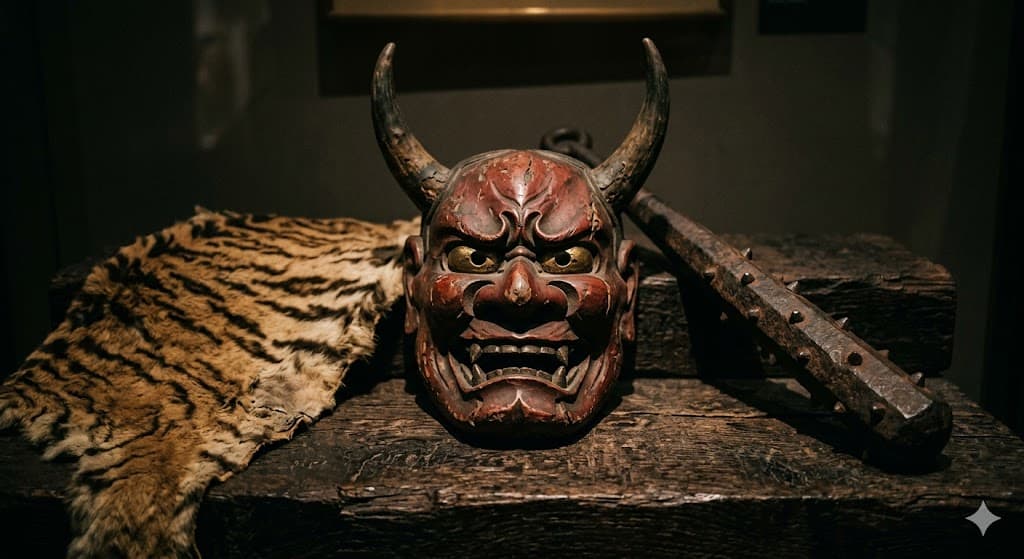
 The classic oni form — ox horns and tiger pelt — that every Japanese child first meets in the tale of Momotarō.
The older, bloodier heroes were invisible to me. The story of 源頼光(Minamoto no Raikō: a mid-Heian warrior commander) and his elite retainers storming the lair of the demon king of 大江山(Ōeyama: Mount Ōe), and the tale of 渡辺綱(Watanabe no Tsuna: one of Raikō's retainers) hacking off a demon's arm at a ruined gate in the capital — I only met these as an adult. I suspect that is true for a lot of Japanese people. As children we are handed Momotarō, and the grimmer, far older oni-slayer legends arrive much later, if at all.
That gap is exactly what makes the opening of Demon Slayer: Kimetsu no Yaiba land the way it does. Before anything terrible happens, a kind old man warns the young charcoal-seller Tanjiro that man-eating demons come out once the sun is down, and that there have long been slayers whose work is to cut them down. Watching it, I felt the floor of a much older Japan open beneath the scene. The line is not pure fantasy. There really were demon slayers, and people really did believe the dark belonged to the oni — and the tradition the anime taps into is roughly a thousand years deep.
The Demon's Body, the Demon's Gate, and the Heroes Who Hunted Them
The Oni's Body Is a Compass
Here is something I stared at my whole childhood without seeing. An oni has horns on its head and wears a loincloth of tiger fur. As a kid I read both as nothing more than "scary monster design." The truth surprised me as an adult.
In the old reckoning that borrowed the twelve zodiac animals to name directions, the northeast was the 丑寅(Ushitora: the Ox-Tiger direction) — ushi the ox, tora the tiger. That same northeast was feared as the 鬼門(Kimon: the demon gate), the unlucky quarter through which evil was thought to slip into a house or a city. One widely told explanation is that the oni took its ox horns and its tiger-skin loincloth straight from that compass point. The monster, in other words, is a walking personification of a direction.
This was no idle superstition. The capital itself leaned on it: great temples were placed to the northeast of the city to guard the demon gate, and some houses were even built with a notch cut into their northeastern corner to keep oni out. Once you know this, the oni stops looking like a random ogre and starts looking like something carefully reasoned — a creature assembled out of fear, geography, and the zodiac. Its iron club, the 金棒(Kanabō: iron bludgeon), gives us the proverb about an oni with a kanabō, meaning unstoppable.
Minamoto no Raikō, the Four Heavenly Kings, and the Demon King of Mount Ōe
The grandest oni-slaying legend belongs to Minamoto no Raikō (also read Yorimitsu), a historical Heian commander who became a folk hero. In the tales, the capital is losing people — especially young women — and the court diviner 安倍晴明(Abe no Seimei: the famous onmyōji of the imperial court) determines that a demon is behind the abductions. The culprit is 酒呑童子(Shuten-dōji: the "Sake-Drinking Boy"), the oni king who rules a fortress of monsters on Mount Ōe.
 Minamoto no Raikō and his Four Heavenly Kings infiltrate Mount Ōe to bring down Shuten-dōji, the most feared oni in Japanese legend.
Raikō goes after him with his 四天王(Shitennō: the Four Heavenly Kings), four legendary retainers whose names every fan of Japanese folklore eventually learns: Watanabe no Tsuna, Sakata no Kintoki, Urabe no Suetake, and Usui Sadamitsu. They cannot win by brute force, so they win by guile. Disguised as humble 山伏(Yamabushi: wandering mountain ascetics), they talk their way into the demon's hall and present him with an enchanted drink — a divine, demon-poisoning sake. The oni king, charmed and unsuspecting, drinks deep and falls helpless.
Then comes the detail that gives the whole legend its shiver. Raikō beheads Shuten-dōji, and even severed, the demon's head lunges up to bite — failing only because the hero is wearing stacked helmets. The blade credited with the killing, 童子切(Dōjigiri: "Demon-Slayer"), survives as a real, celebrated sword. Compared to friendly Momotarō, this is a different order of story altogether: deception, poison, decapitation, a head that keeps killing after death. When I finally read it, the polite children's version of "demon slaying" rearranged itself in my mind.
Watanabe no Tsuna and the Arm at the Gate
The second great oni-slayer tale belongs to one of those Four Heavenly Kings. After the victory at Mount Ōe, the heroes are feasting when word comes that an oni now haunts 羅城門(Rashōmon: the great southern gate of the old capital). Watanabe no Tsuna, doubting any demon could have survived, rides out alone.
At the gate a violent wind rises, and out of the dark a huge hand seizes his helmet. Tsuna swings his sword and cuts the demon's arm clean off. The wounded oni — usually named 茨木童子(Ibaraki-dōji: Shuten-dōji's chief lieutenant) — flees, leaving the severed arm behind. Tsuna locks it away, and a diviner warns him to admit no one for several days. On the final night an elderly woman, claiming to be his aunt, comes calling. She coaxes him into showing her the arm, then reveals herself as the demon in disguise, snatches back the limb, and vanishes.
I first absorbed scenes like these — the arm hacked off in a gale, the demon king's head still snapping after the blade falls — not from classical texts but through manga, anime, and games. The image of oni-slaying that lives in me is that one: gruesome and a little frightening, yet thrilling and oddly heroic. I think most Japanese people today meet these legends the same way, in adapted, dramatized form, long before they ever meet the originals. There is even a lovely footnote to the Tsuna legend: because oni are said to give the hero's clan a wide berth, some families surnamed Watanabe have traditionally skipped throwing beans at Setsubun — the demons, the saying goes, already stay away.
"Demons Out, Fortune In"
That bean-throwing is where the oni first entered my own life, and it is the gentlest face of the whole tradition. Every 節分(Setsubun: the early-spring seasonal division), we scattered roasted beans and chanted 鬼は外、福は内(Oni wa soto, fuku wa uchi: "Demons out, fortune in"). The oni of my childhood was not a creature of horror at all but a seasonal role you half-laughed at while pretending to drive it off. It returned every year like a familiar guest.
 At Setsubun, families chant "Demons out, fortune in" — the gentlest, most domestic face of Japan's long struggle against the oni.
Setsubun sits at the meeting point of everything above. It is the calendar's hinge into spring, the moment to expel the bad luck of the old season — the same anxious logic that named the northeast the demon gate. The household oni you pelt with beans and the demon king whose head keeps biting are two ends of one long rope: the deep, old Japanese sense that misfortune has a face, and that the face can be confronted and pushed back out the door.
What a Tokyo Childhood Kept, and What It Quietly Dropped
Living outside Japan for many years has given me a strange double vision about all this. From a distance I can see how thoroughly my own demon-knowledge had been narrowed down to Momotarō and a handful of bean-throwing chants — a tidy, child-safe slice of a far larger and darker inheritance. The Heian heroes, the poisoned sake, the severed arm at the gate: a whole literature of oni-slaying was sitting just out of frame, and it took adulthood and curiosity to walk over and look at it.
What strikes me most is that the tradition was never only about extermination. Alongside the heroes who cut demons down, Japan kept telling stories that make you pity the oni. The one that undid me as a child was 泣いた赤鬼(Naita Akaoni: "The Red Oni Who Cried") — a red demon who only wants to be friends with humans, and a blue demon who deliberately plays the villain so his friend can be accepted, then quietly disappears. After that story, "oni" could never again mean simply "monster to be slain."
This, I think, is the older root that Demon Slayer reaches down into and grips so tightly. Its emotional core is not just that demons must be destroyed, but that a slayer might also protect a demon, might refuse to see only a monster. That impulse is not new. It runs from the sympathetic oni of old folktales straight through to the anime's first hour. The work feels fresh, and it is — but it is also doing something Japan has done for a very long time: hunting the demon while never quite forgetting that the demon might be grieving too.
FAQ
Q: Is the "demon slayer" idea in Kimetsu no Yaiba based on real Japanese folklore?
A: The specific organization in the anime is fiction, but the underlying tradition is real and old. From at least the Heian period, Japan told stories of heroes who hunted man-eating oni — Minamoto no Raikō and his Four Heavenly Kings against the demon king of Mount Ōe, Watanabe no Tsuna at the gate, and the children's favorite, Momotarō.
Q: Why do oni have horns and tiger-skin loincloths?
A: One widely held explanation ties them to direction. The unlucky northeast was the "ox-tiger" quarter (ushitora) and was feared as the "demon gate" (kimon). The oni's ox horns and tiger-skin loincloth are read as a visual play on that compass point, making the monster a personification of the dangerous direction.
Q: What is Setsubun, and why throw beans at demons?
A: Setsubun marks the seasonal turn into spring. Households scatter roasted beans while chanting "Demons out, fortune in" to expel the bad luck of the old season. It is the everyday, domestic version of the same belief that produced the grand oni-slaying legends: misfortune has a face, and it can be pushed back out.
Key Insights to Remember
- The classic oni is not a random ogre but a reasoned construction. Its horns and tiger pelt encode the ox-tiger northeast, the "demon gate," so the creature is essentially a fear about a direction given a body. Knowing this changes how you read every oni you meet on screen.
- Japan's demon-slayer heroes form a long, layered tradition, not a single tale. Momotarō is only the gentle, child-facing tip; beneath him lie the far older and bloodier Heian legends of Raikō's poisoned sake and Tsuna's severed arm. A modern oni-hunter stands at the end of that thousand-year line.
- The tradition always held two impulses at once — exterminate the demon, and pity it. The sympathetic-oni thread that runs from tales like "The Red Oni Who Cried" is as native to Japan as the slaying itself, which is why a story that protects a demon rather than only destroying it feels both new and deeply familiar.
Sources & References
About the author

Spoiler-free cultural deep-dives into anime, manga & live-action Japanese drama
- ●Tokyo-born, 3rd-generation Edokko (江戸っ子)
- ●Lifelong manga reader & anime viewer since the kaiju era
- ●Writes from outside Japan — distance as a cultural lens
- ●Spoiler-free · sourced · Kanji + Romaji + English
A Tokyo-born, 3rd-generation Edokko writer who has spent years living outside Japan. I use the anime, manga, and live-action Japanese drama you already love as a doorway into the folklore, language, religion, and everyday history behind them — written so even first-time fans can follow along, with sources for every claim.
Enjoy this article?
Get the next spoiler-free cultural deep-dive straight to your inbox.
Related Articles
Spirited Away and Kamikakushi: The Folklore Behind the Title
Spirited Away's Japanese title ends in kamikakushi. Learn who villages said took children away, why dusk was the dangerous hour, and how they searched for them.
10/25/2026
Fruits Basket and the Zodiac Cat: The Real Japanese Folktale of the Cat Who Missed the Banquet
How Fruits Basket builds its outsider cat on the real Japanese folktale of the rat tricking the cat out of the zodiac, and what eto still means in Japan today.
10/20/2026

March Comes in Like a Lion and Tsukimi: Why Japan Watches the Moon With Rice Dumplings and Pampas Grass
How March Comes in Like a Lion opens onto tsukimi, Japan's moon-viewing harvest observance, and why dumplings, pampas grass and a shifting date belong to it.
8/17/2026

Summer Time Rendering and the Shoryo-uma: The Cucumber Horse That Carries the Dead Home
How Summer Time Rendering's Obon homecoming opens onto shoryo-uma, the cucumber horse for returning ancestors, and why it is only one of many regional forms.
8/16/2026

GeGeGe no Kitaro and Hyakumonogatari: Why Japan Saves Its Ghost Stories for Summer
How GeGeGe no Kitaro connects to hyakumonogatari, the hundred-candle ghost game, and the Edo custom of staging horror in summer to chill the audience.
8/11/2026

Demon Slayer Infinity Castle and the Biwa: Heike and Hōichi
How the biwa that opens Demon Slayer's Infinity Castle leads to blind Heike reciters and Hōichi, who played night after night for a court that was not there.
8/7/2026