Demon Slayer and the Lost Craft of Sumiyaki: What the Kamado Name Really Hides
How Demon Slayer dramatizes sumiyaki, Japan's oldest mountain craft — and why the Kamado family name quietly hides the meaning of charcoal, fire, and home.

Tokyo-born, 3rd-generation Edokko · writing on Japanese culture from outside Japan
Spoiler-Free Cultural Analysis
This article looks only at the real cultural and linguistic world behind Demon Slayer: Kimetsu no Yaiba — the charcoal-making craft that frames its quiet opening and the meaning folded into its hero's name. There are no plot revelations here, only the history, the trade, and the language behind the work.
Key Takeaways
- Charcoal-making, 炭焼き(Sumiyaki: traditional charcoal production), is one of the oldest mountain livelihoods in Japan, woven into the managed-woodland economy of the 里山(satoyama: the cultivated hills at a village's edge).
- The protagonist's name is not decoration. The character 炭(sumi: charcoal) and the surname 竈門(Kamado: cooking hearth) both point straight at his family's trade and at the fire that sat in the middle of an old Japanese home.
- The craft that opens the story is also a craft in retreat: the postwar shift to gas and electricity quietly cooled the kilns that once dotted the hills, and the surrounding woodland faded along with them.
Key Terms Explained
炭焼き (Sumiyaki) / Charcoal-Making — The mountain craft of slow-burning wood inside an earthen kiln until it carbonizes into charcoal; one of Japan's oldest rural trades.
備長炭 (Binchōtan) / White Charcoal — A very hard, high-grade charcoal from Wakayama made of ubame oak, prized for a long, steady, high-temperature burn and almost no smoke.
里山 (Satoyama) / Village Woodland — The managed hills between farmland and deep forest, where people coppiced wood, burned charcoal, and gathered food in a renewable cycle.
竈門 (Kamado) / Hearth Gate — The hero's surname. 竈 is the traditional wood- or charcoal-fired cookstove and 門 means gate, together evoking a guardian of the family fire.
炭手前 (Sumidemae) / Charcoal Laying — The formal procedure of arranging burning charcoal in the hearth during the tea ceremony, treated as an art in its own right.
A Brazier, an Open Window, and the Smell of Burning Wood
My earliest memory of charcoal is not a romantic one. In the house where I grew up, part of the winter warmth came from pressed charcoal — 練炭(rentan: cylindrical pressed charcoal pierced with airholes) and 豆炭(mametan: small bean-shaped charcoal briquettes) glowing in a brazier. The lesson that stuck with me was a warning, repeated every cold season: burn it in a sealed room and you risk carbon-monoxide poisoning, so always crack a window open. Charcoal heat was gentle, but it asked for respect.
 The gentle, careful warmth of a charcoal brazier was once an ordinary part of the Japanese winter.
Years later the same word meant something completely different to me, standing at the counter of a 焼き鳥(yakitori: grilled skewered chicken) shop. The chicken there was grilled slowly over 備長炭(Binchōtan: very hard white charcoal), and the fragrance was something ordinary heat could never produce. Same charcoal, two faces — one a careful household fuel, the other the secret behind a flavor I still remember.
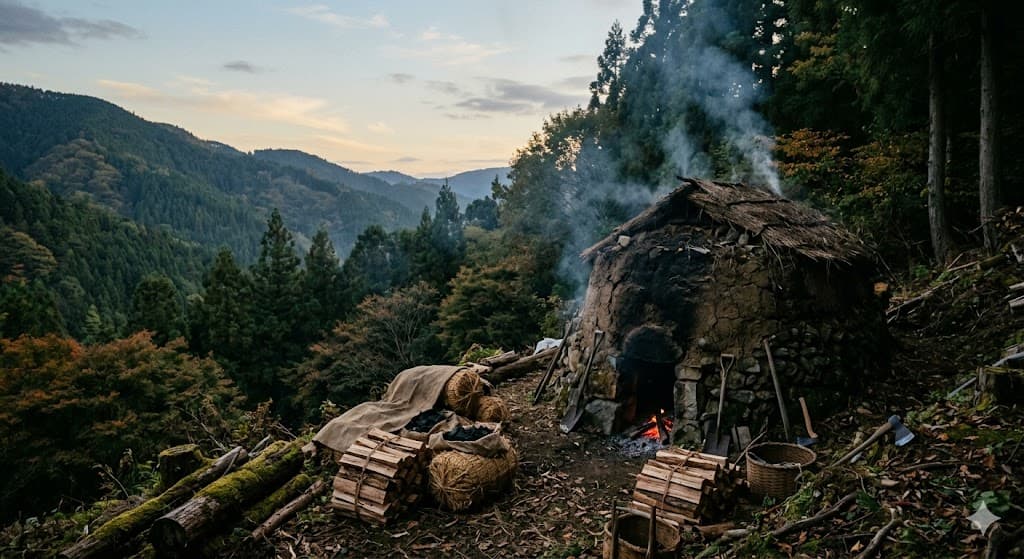
That whole vanished world is exactly where Demon Slayer begins. Before any monster appears, we follow a boy carrying charcoal down a snowbound mountain to sell in town, greeted warmly by townsfolk who want to buy from him. The story opens not on a battlefield but inside a mountain trade — and that quiet first scene turns out to be the key to everything, including the family's name.
The Mountain Trade Behind a Hero's Name
From the Prehistoric Fire Pit to the Mountain Kiln
 Binchotan, the prized white charcoal of Wakayama, burns long, hot, and almost smokeless.
Charcoal-making in Japan runs genuinely deep. Making and using charcoal as a household fuel is thought to have spread roughly two thousand years ago, and the line reaches back toward the 縄文(Jōmon: Japan's prehistoric period, c. 14,000–300 BCE) era of pit dwellings with open hearths. Over the centuries it threaded through almost every craft that mattered — cooking, sake brewing, sword forging, medicine, even cosmetics. For most of Japanese history it was simply a necessity of daily life, not a specialty product.
By the 江戸(Edo: the 1603–1868 period) era the craft had matured into a skilled mountain trade. Burners often worked as near-itinerant labor, hired by a forest owner to build a hut and a clay kiln on his land, work the trees for a season or two, and then move on to the next stand of wood. The hills were not empty scenery; they were a workplace, and the smoke of the kilns marked where people made their living.
The White Charcoal of Kishū
The hardest and most prized charcoal came from 紀州(Kishū: the old provincial name for Wakayama), made from ウバメ樫(ubame-gashi: ubame oak, now Wakayama's official tree). The name binchōtan honors Bicchūya Chōzaemon, an Edo-period charcoal wholesaler in Tanabe who began producing this white charcoal in the late seventeenth century — the name is a contraction of his shop's name.
The method is exacting. The wood is carbonized slowly, then the kiln is opened to air and driven to around 1,000°C to burn off impurities, a high-heat finishing stage the makers call ねらし(nerashi: the high-heat refining step before the charcoal is pulled). The charcoal is then raked out and smothered under a damp mix of ash and sand, which cuts off the air and leaves a pale, ash-white surface — hence white charcoal. The result is so hard it rings with a metallic note when struck, near-pure carbon, burning long and steady and hot. Wakayama's techniques were recognized as an intangible folk cultural property in 1974, a sign of how close the craft came to being lost.
Fire at the Center of the Home
Before gas and electric heat, charcoal warmed and fed the household. The 火鉢(hibachi: a portable charcoal brazier) heated rooms and kept water hot; the 炬燵(kotatsu: a low heated table), originally warmed by charcoal beneath it, gathered the whole family in winter; the 七輪(shichirin: a small charcoal cooking stove) grilled fish and skewers with a precise little flame. In the tea ceremony, even building the fire became a discipline, the 炭手前(Sumidemae: the formal charcoal-laying procedure). And charcoal reached market packed inside woven straw bales, 炭俵(sumidawara: charcoal bales).
All of this rested on the satoyama. Villagers coppiced oak and pine on a cycle of perhaps ten to twenty years, burned the wood into charcoal, and gathered leaf litter for compost and mushrooms from the thinned forest floor. It was a worked landscape, kept alive precisely because people kept using it.
The Secret Folded into the Name
Now the name itself. The hero's given name opens with 炭(sumi / tan: charcoal) — a plain, almost humble character, not at all the kind usually chosen to make a protagonist sound grand. The same charcoal character recurs across his ancestors and descendants, quietly marking the family trade down the generations. The second character of his given name, 治, carries a sense of healing and governing, which suits his gentle, caring nature.
The surname does the rest of the work. 竈門(Kamado) folds together 竈, the traditional wood- or charcoal-fired cookstove, and 門, meaning gate — a guardian standing watch over the hearth. There is even a deeper layer for anyone steeped in folklore: 竈神(kamado-gami: the god of the stove), a household deity of the hearth fire. A boy whose given name means charcoal, born into a family named for the hearth, set against monsters who prey on home and family — the naming is not coincidence but architecture.
What the Gas Flame Quietly Replaced
Charcoal stayed central to Japanese life until around the 1950s. Then production fell away sharply as electrification and propane gas spread through the countryside during the postwar economic boom. Many foresters switched to fast-growing conifers to feed the construction industry, and young people drained out of the hills toward the cities. As the kilns went cold, the satoyama itself began to decline — the two losses were really one loss, since the woodland had depended on the very cutting and burning that charcoal-making required. The fuel revolution of the 1950s and 60s undid a coppice cycle that had maintained those forests for centuries.
 As the charcoal kilns went cold, the managed satoyama woodlands that fed them declined too.
I felt that change in miniature without ever naming it. In my own childhood charcoal was still close at hand, and then at some point it simply wasn't — replaced by gas and electricity so gradually that I barely registered the moment it disappeared. I still think the warmth of a charcoal fire is different from gas or electric heat: same word, but a softer, slower kind of heat. Living abroad for many years, I noticed that "charcoal" mostly meant the barbecue — big cuts of meat seared over a roaring fire — a long way from the small, patient flame of a shichirin or a single stick of binchōtan. The same material, used in an entirely different spirit.
The craft has not vanished completely. Binchōtan survives as a protected heritage skill, and interest has returned with the modern taste for craftsmanship and natural materials; in the Minabe-Tanabe region of Wakayama, charcoal-making is even braided together with plum farming as a recognized agricultural heritage system. But for most households the everyday charcoal fire is gone, which is part of why a story that opens with a boy selling charcoal lands the way it does. It puts us, for a few minutes, back inside a world most of us only half remember.
FAQ
Q: Is sumiyaki charcoal-making really one of Japan's oldest crafts?
A: Yes. Charcoal as a household fuel is thought to have spread around two thousand years ago, and it shaped cooking, metalworking, brewing, and more for centuries before gas and electricity displaced it in the postwar decades.
Q: What makes binchōtan different from ordinary charcoal?
A: It is a very hard "white" charcoal, made mostly from ubame oak in Wakayama and finished at extreme kiln heat. It burns long, steady, and hot with very little smoke, and it rings with a metallic sound when struck.
Q: Does Tanjiro's name really refer to charcoal?
A: The first character of his given name means charcoal, echoing his family's trade across generations, and his surname Kamado is the word for a traditional cooking hearth. Together they point to fire, home, and the family livelihood that frames the whole story.
Key Insights to Remember
- The opening of Demon Slayer is quietly doing cultural work. Before any demon appears, it plants the audience inside a real and disappearing mountain economy, so that the charcoal the boy carries is not a prop but a livelihood with two millennia behind it. The peace that the story later shatters is rooted in that ordinary working world.
- Japanese names often encode occupation and place, and this story leans on that habit on purpose. A surname meaning "hearth" and a given name meaning "charcoal" turn a single character into a walking emblem of fire and home — the very things the monsters of the story exist to threaten. The humbleness of the charcoal character is itself the point: an unglamorous name for an unglamorous trade.
- The decline of charcoal is really the decline of a whole way of living in the hills. When the kilns cooled, the satoyama lost the human tending that had kept it diverse and alive, so the craft and the landscape faded together. That is why reviving one usually means reviving the other, and why a fictional charcoal-burner's family can carry so much quiet weight for a Japanese audience.
Sources
- Japan's Charcoal Making Traditions Still Alive — Our World, United Nations University
- Binchōtan — Wikipedia
- From the Kilns of Kishu: The Making of Binchotan Charcoal — The Rikumo Journal
- Satoyama: Living Together with Nature — Nippon.com
- Satoyama — Wikipedia
- Characters in Demon Slayer: Kimetsu no Yaiba — Tanjiro Kamado — TV Tropes
About the author

Spoiler-free cultural deep-dives into anime, manga & live-action Japanese drama
- ●Tokyo-born, 3rd-generation Edokko (江戸っ子)
- ●Lifelong manga reader & anime viewer since the kaiju era
- ●Writes from outside Japan — distance as a cultural lens
- ●Spoiler-free · sourced · Kanji + Romaji + English
A Tokyo-born, 3rd-generation Edokko writer who has spent years living outside Japan. I use the anime, manga, and live-action Japanese drama you already love as a doorway into the folklore, language, religion, and everyday history behind them — written so even first-time fans can follow along, with sources for every claim.
Enjoy this article?
Get the next spoiler-free cultural deep-dive straight to your inbox.
Related Articles

My Neighbor Totoro and the Katori Senko: The Meiji Invention That Gave Japanese Summer Its Smell
How My Neighbor Totoro's summer evokes the katori senko, the Meiji-era mosquito coil whose spiral was imagined in 1895 by the wife of Kincho's founder.
8/8/2026

Anohana and Kingyo-sukui: Why Japan Replaced a Working Net With Paper That Dissolves
How Anohana's summer world explains kingyo-sukui, the festival stall game where Japan swapped a net that worked for a paper scoop designed to fail.
8/2/2026

Chibi Maruko-chan and Rajio Taisō: Why Japanese Kids Spend Summer Mornings Doing Radio Calisthenics in a Car Park
How Chibi Maruko-chan's Shōwa childhood preserves rajio taiso, the summer radio calisthenics Japan imported from an American insurer that dropped it a decade later.
8/1/2026

Rurouni Kenshin and Uchimizu: Why Old Tokyo Cooled Its Streets With a Ladle of Water
How the Meiji-era streets of Rurouni Kenshin open onto uchimizu — a summer custom that began as tea-ceremony courtesy and spread through Edo because of dust.
7/31/2026

Ace of Diamond and the Dirt of Koshien: Why Japan's Losing Teams Scoop Soil Into Their Bags
How Ace of Diamond treats Koshien as a destination, and why eliminated high school players kneel to fill bags with soil that groundskeepers blend by season.
7/30/2026
Neon Genesis Evangelion and the Walkman: Why Shinji Retreats Into His Headphones
Why does Shinji's SDAT cassette player feel so Japanese? From Sony's 1979 Walkman to quiet packed trains and the meiwaku ethic, a Tokyo-born writer unpacks the headphone culture behind Evangelion's most human prop.
7/23/2026