Jujutsu Kaisen and the Cult of the Club: Why a Ghost Member Can't Just Go Home
How Jujutsu Kaisen's first episode dramatizes bukatsu, Japan's near-compulsory club system, through a ghost member who really belongs in track, not the Occult Club.

Tokyo-born, 3rd-generation Edokko · writing on Japanese culture from outside Japan
Spoiler-Free Cultural Analysis
This article looks only at the school setting and the real culture behind the first episode of Jujutsu Kaisen — the social pressure of club activities, the slang for those who opt out, and the history of the system itself. There are no plot revelations here, only the world the characters live inside before anything supernatural begins.
Key Takeaways
- In Japan, joining a school club is often treated as the default rather than a choice, and many junior high schools make it effectively required — which is why a character can be "forced" to belong to a club he never once attends.
- The episode runs on two pieces of school slang: 帰宅部(Kitakubu), the "going-home club" of students who join nothing, and 幽霊部員(Yūrei Buin), a "ghost member" enrolled in name only — then stacks a pun by making that ghost member belong to a club that literally hunts ghosts.
- The clubroom, the faculty advisor, the minimum-member rule, and the senior–junior hierarchy are not storytelling inventions; they are the real administrative skeleton of Japanese secondary school, which is a large part of why so much anime is set inside a single clubroom.
Key Terms Explained
- 部活動 (Bukatsudō) / School Club Activities — Organized after-school clubs, divided broadly into sports clubs and culture clubs. The everyday short form is bukatsu, and for many students it defines school life more than lessons do.
- 帰宅部 (Kitakubu) / "The Going-Home Club" — A half-joking label for students who belong to no club at all, as though heading straight home were itself their chosen activity.
- 幽霊部員 (Yūrei Buin) / "Ghost Member" — A student whose name sits on a club roster but who almost never appears, haunting the membership list without taking part.
- 顧問 (Komon) / Faculty Advisor — The teacher attached to each club. A recognized club generally needs one, along with a clubroom and a minimum number of members.
- 先輩・後輩 (Senpai / Kōhai) / Senior–Junior — The seniority relationship that organizes club life from the inside and later carries straight into the Japanese workplace.
A Track Club I Was Made to Join, and a Baseball Club I Walked Away From
My own school clubs split cleanly down the middle of that pressure. In junior high I ran with the 陸上部(Rikujōbu: the track and field club) — not because I burned to compete, but because the school required every student to belong to some club, and track was simply where I ended up. In high school the rule loosened: joining was plainly optional. I signed up for the 硬式野球部(Kōshiki Yakyūbu: the hardball baseball club), lasted only a short while, quit, and spent the rest of my school years as a 帰宅部(Kitakubu: a member of the "going-home club") — which is to say, in no club at all.
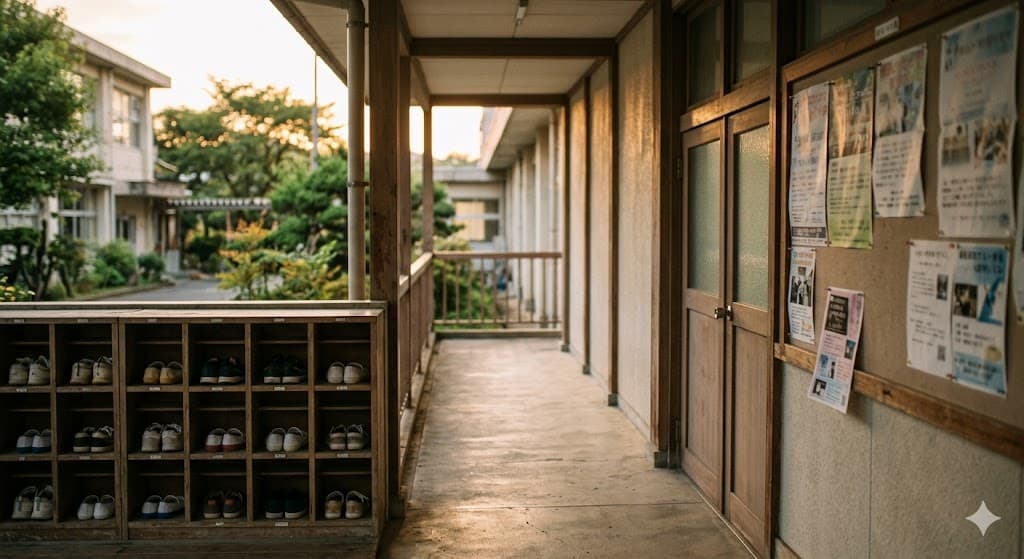
 Many Japanese schools treat joining a club as the default, with students sorting into sports or culture clubs from their first year.
What strikes me looking back is how little fuss any of that caused. In the school I attended there were no cold stares for the kitakubu, no sense that a student who went straight home each day was a failure or a shirker. The same easy air covered the 幽霊部員(Yūrei Buin: a "ghost member" who is enrolled but never attends). The popular image abroad — that every Japanese student is chained to a club and quietly suffering — simply did not match the building I walked through every afternoon.
That gap is worth holding onto, because the same word can mean very different things depending on the school. Later I went on to 日本体育大学(Nippon Taiiku Daigaku: Nippon Sport Science University) and trained for a health-and-physical-education teaching license — studying from the inside the very system I had half-dropped out of as a teenager. Watching the first episode of Jujutsu Kaisen with that double history, both as a one-time ghost-adjacent kitakubu and as someone taught to run a club from the front, the school scenes read less like comedy and more like documentary.
The Machinery of Belonging: How Bukatsu Became a Second School
Before any curse appears, the episode spends its energy on a very ordinary problem: a small club is about to lose its room. That premise only works because club membership in Japan is built into the architecture of school life, not bolted on as a hobby.
 The clubroom, the faculty advisor, and the minimum-member rule form the real administrative skeleton behind the episode's fight to keep an activity room.
Two Halves of the School Day
部活動(Bukatsudō: school club activities), shortened to bukatsu, splits into 運動部(Undōbu: sports clubs) and 文化部(Bunkabu: culture clubs), and the range is enormous — baseball, track, kendo and brass band sit alongside tea ceremony, calligraphy, art, and the anime club. The intensity ranges just as widely, from a gentle once-a-week gathering to a sports club that trains before class, after class, and through the holidays, with students coming to school chiefly to practice. Each club has a 顧問(Komon: a faculty advisor), yet much of the daily running is handed to the students themselves, which is why the teacher so often seems half-absent on screen.
Two administrative details from the episode are entirely real. Clubs commonly need a minimum number of members — often around three to five — to be recognized at all, and they are expected to show genuine activity to keep their 部室(Bushitsu: clubroom). A club that cannot prove it does anything, or that falls below the member line, can have its room reclaimed. The threat hanging over the Occult Research Club is not a writer's contrivance; it is the standard pressure every under-populated club in the country lives under.
The Ghost in the Occult Club
The wordplay at the heart of the episode is sharper than the subtitles can fully carry. The protagonist is officially the third member of the オカルト研究会(Okaruto Kenkyūkai: the Occult Research Club), the bare number it needs to survive — but he actually spends his afternoons with the track team, where a coach has been quietly trying to claim him for a national tournament by rewriting his club paperwork. He explains that he stays on the occult roster only because his school requires everyone to join a club, and that the seniors can keep him as a yūrei buin, a ghost member who does nothing.
There is the joke. A club that exists to chase ghosts and unravel the supernatural is being kept alive on paper by its own "ghost." The same kanji, 幽霊(yūrei: ghost/spirit), names both the thing the club investigates and the empty seat propping it up. Add the coach's attempt to poach the talented athlete by altering the application form, and the whole sequence is a compressed tour of school-club bureaucracy: minimum members, the fight over the clubroom, the recruitment of a sports prospect, and the casual existence of members who belong only in the ledger.
Why Anime Keeps Filming the Clubroom
Overseas fans often ask why anime is so relentlessly full of club activities, and the honest answer is structural. A club hands a story a ready-made cast, a recurring set, a clear goal in the form of a tournament or festival, and a built-in 先輩・後輩(Senpai / Kōhai: senior–junior) hierarchy that generates conflict and warmth without a word of extra setup. Bukatsu works as a kind of apprenticeship community, where younger members learn by imitation and absorb the values of seniority and group spirit. That is also a near-perfect engine for serialized fiction. When a series needs a self-contained social world with stakes, it reaches for the clubroom because the clubroom is where so many real Japanese teenagers actually live.
What an Outsider Notices When the Bell Stops Ringing
Seen from outside Japan after many years away, the all-encompassing club is the part that looks strange. In much of the world, after-school activity is genuinely peripheral — a thing some children do, not a second school that swallows evenings, weekends, and holidays, and not a place where a person's sense of worth quietly gets tied to a team. The Japanese version is unusual in how total it can become, and you mostly stop seeing that while you are inside it.
 As teacher overwork and a falling birthrate push reform, weekend club activities are gradually shifting from schools to community organizations.
The system that produced kitakubu and yūrei buin is also, slowly, being taken apart. Under a national reform first called 地域移行(Chiiki Ikō: regional transition) and rebranded in 2025 as 地域展開(Chiiki Tenkai: regional development), the responsibility for running clubs is being shifted, starting with weekends, from schools onto local sports and culture organizations. Two pressures drive it. One is teacher overwork — most teachers serve as club advisors, many clubs meet four or more days a week, and weekend supervision has become a heavy and poorly paid burden. The other is the falling birthrate; junior-high sports-club membership has dropped by roughly a fifth over the past decade, and some schools can no longer field a team at all. The plan runs through a promotion period that closed in 2025 and into a longer implementation period from 2026 onward.
There is something I find moving and a little melancholy in that. As a graduate of a physical-education university, I can see both faces of bukatsu at once: the real value — a place to throw yourself into something outside grades, a training ground for social life and the rhythms of seniority, a habit of moving your body — and the overheating, the long hours, the win-at-all-costs spirit, and the exhausted advisors. The reform is trying to keep the first and shed the second. Whether the warmth of the clubroom survives being moved off campus and out of a single building is the open question, and from a distance it is hard not to wonder what the next generation's school anime will be set inside, once the after-school world has quietly migrated somewhere else.
FAQ
Q: Is joining a club actually compulsory in Japan?
A: It depends on the school. Many junior high schools make club membership effectively or formally required, while most high schools leave it voluntary. That split is exactly why some students end up as "ghost members," enrolled to satisfy a rule they never chose, and why the number of high-school kitakubu has been rising.
Q: What is the difference between a kitakubu and a yūrei buin?
A: A kitakubu student belongs to no club and heads straight home; a yūrei buin is officially listed on a club's roster but rarely or never attends. One opts out in the open, the other is present only on paper.
Q: Why are so many anime set in school clubs?
A: A clubroom gives a story a ready-made cast, a recurring setting, a clear goal in tournaments or festivals, and a senior–junior hierarchy that creates drama on its own. It is a self-contained social world that needs almost no extra explanation, and it mirrors where a great many Japanese students genuinely spend their afternoons.
Key Insights to Remember
- The joke at the center of the episode only lands because belonging is the baseline, not the exception. A "ghost member" of a club he never visits is funny precisely because, in a system where everyone is expected to join something, even doing nothing requires a club to do it in.
- Club slang is a quiet map of social pressure. Both kitakubu and yūrei buin are words for ways of not-quite-belonging, and a culture only coins careful terms for the people standing slightly outside the group when standing inside it is treated as the norm.
- The reform now moving clubs out of schools is dismantling, in slow motion, the very world these words describe. As teacher overwork and a shrinking student population push activities toward community organizations, the all-in-one school — classroom, team, and second family under one roof — is being unbundled, and the after-school setting that defines so much Japanese fiction may not stay where it has always been.
Sources
- What Is "Bukatsudo"? Club Activities in Japanese Schools — JAPAN Educational Travel (JNTO)
- Bukatsudō: The Educational Role of Japanese School Clubs — ResearchGate
- 部活動改革ポータルサイト(Club Activity Reform Portal) — Japan Sports Agency / MEXT
- 部活動改革の"現状"と"展望"(The Current State and Outlook of Club Activity Reform) — Japan Sports Agency Web Magazine
- 部活動の地域移行とは?(What Is the Regional Transition of Club Activities?) — Benesse Educational Terms
- 学校部活動ありきの地域移行を変えませんか(Rethinking the School-Centered Regional Transition) — Sasakawa Sports Foundation
About the author

Spoiler-free cultural deep-dives into anime, manga & live-action Japanese drama
- ●Tokyo-born, 3rd-generation Edokko (江戸っ子)
- ●Lifelong manga reader & anime viewer since the kaiju era
- ●Writes from outside Japan — distance as a cultural lens
- ●Spoiler-free · sourced · Kanji + Romaji + English
A Tokyo-born, 3rd-generation Edokko writer who has spent years living outside Japan. I use the anime, manga, and live-action Japanese drama you already love as a doorway into the folklore, language, religion, and everyday history behind them — written so even first-time fans can follow along, with sources for every claim.
Enjoy this article?
Get the next spoiler-free cultural deep-dive straight to your inbox.
Related Articles

My Neighbor Totoro and the Katori Senko: The Meiji Invention That Gave Japanese Summer Its Smell
How My Neighbor Totoro's summer evokes the katori senko, the Meiji-era mosquito coil whose spiral was imagined in 1895 by the wife of Kincho's founder.
8/8/2026

Anohana and Kingyo-sukui: Why Japan Replaced a Working Net With Paper That Dissolves
How Anohana's summer world explains kingyo-sukui, the festival stall game where Japan swapped a net that worked for a paper scoop designed to fail.
8/2/2026

Chibi Maruko-chan and Rajio Taisō: Why Japanese Kids Spend Summer Mornings Doing Radio Calisthenics in a Car Park
How Chibi Maruko-chan's Shōwa childhood preserves rajio taiso, the summer radio calisthenics Japan imported from an American insurer that dropped it a decade later.
8/1/2026

Rurouni Kenshin and Uchimizu: Why Old Tokyo Cooled Its Streets With a Ladle of Water
How the Meiji-era streets of Rurouni Kenshin open onto uchimizu — a summer custom that began as tea-ceremony courtesy and spread through Edo because of dust.
7/31/2026

Ace of Diamond and the Dirt of Koshien: Why Japan's Losing Teams Scoop Soil Into Their Bags
How Ace of Diamond treats Koshien as a destination, and why eliminated high school players kneel to fill bags with soil that groundskeepers blend by season.
7/30/2026
Neon Genesis Evangelion and the Walkman: Why Shinji Retreats Into His Headphones
Why does Shinji's SDAT cassette player feel so Japanese? From Sony's 1979 Walkman to quiet packed trains and the meiwaku ethic, a Tokyo-born writer unpacks the headphone culture behind Evangelion's most human prop.
7/23/2026