Neon Genesis Evangelion and the Walkman: Why Shinji Retreats Into His Headphones
Why does Shinji's SDAT cassette player feel so Japanese? From Sony's 1979 Walkman to quiet packed trains and the meiwaku ethic, a Tokyo-born writer unpacks the headphone culture behind Evangelion's most human prop.

Tokyo-born, 3rd-generation Edokko · writing on Japanese culture from outside Japan
Spoiler-Free Cultural Analysis
This article explores the real Japanese history and culture behind one of Neon Genesis Evangelion's most famous props — the portable cassette player its protagonist is rarely seen without. Everything discussed comes from the series' publicly known imagery and premise, with no plot spoilers.
Key Takeaways
- Shinji's ever-present SDAT player is instantly legible to Japanese viewers because Japan invented the ritual it depicts: the Walkman, born in Tokyo in 1979, taught the world to build a private room out of two earpieces.
- Headphone retreat in Japan is not just teenage moodiness — it is a spatial strategy. In a city where physical privacy is scarce and trains are packed, sound became the one wall you could carry.
- Evangelion's choice of cassette-era technology, already dated in 1995, was a mood decision. The warmth and fragility of magnetic tape carries a nostalgia that Japan has never stopped feeling — and has recently begun buying again.
Key Terms Explained
- ウォークマン (Wōkuman) / Walkman — Sony's portable cassette player, launched in Tokyo in 1979, which created personal mobile listening worldwide.
- 満員電車 (Man'in Densha) / Packed Train — The crush-loaded commuter train, the environment that made portable privacy so valuable.
- 迷惑 (Meiwaku) / Bother to Others — The cultural imperative not to impose on people around you, which shaped Japan's quiet, headphoned public spaces.
- 昭和レトロ (Shōwa Retro) / Shōwa-Era Nostalgia — The affectionate revival of mid-20th-century Japanese design and technology, cassettes included.
The Wall of Sound on the Morning Train
I grew up in Tokyo, and some of my earliest commuting memories are of learning the unwritten rules of the 満員電車 (man'in densha: packed train): fold yourself small, guard your bag, and keep your world to yourself. Look down a Tokyo train car in the morning and you see the same posture repeated down the row — eyes lowered, wires or earbuds in, each passenger sealed inside a bubble of sound, centimeters from a stranger's shoulder.
As someone who has played instruments since my self-taught teens — guitar, drums, piano, saxophone — I have never been able to treat listening as background. Music through headphones was never "background" for anyone on those trains either. It was architecture. A pair of headphones was the only door a crowded city let you close.
That is the door Shinji Ikari keeps reaching for.
Related: Neon Genesis Evangelion and the Evacuation Drill: Why Tokyo-3 Empties Without Panic explains this in detail.
The SDAT, the Walkman, and the Private Room You Can Carry
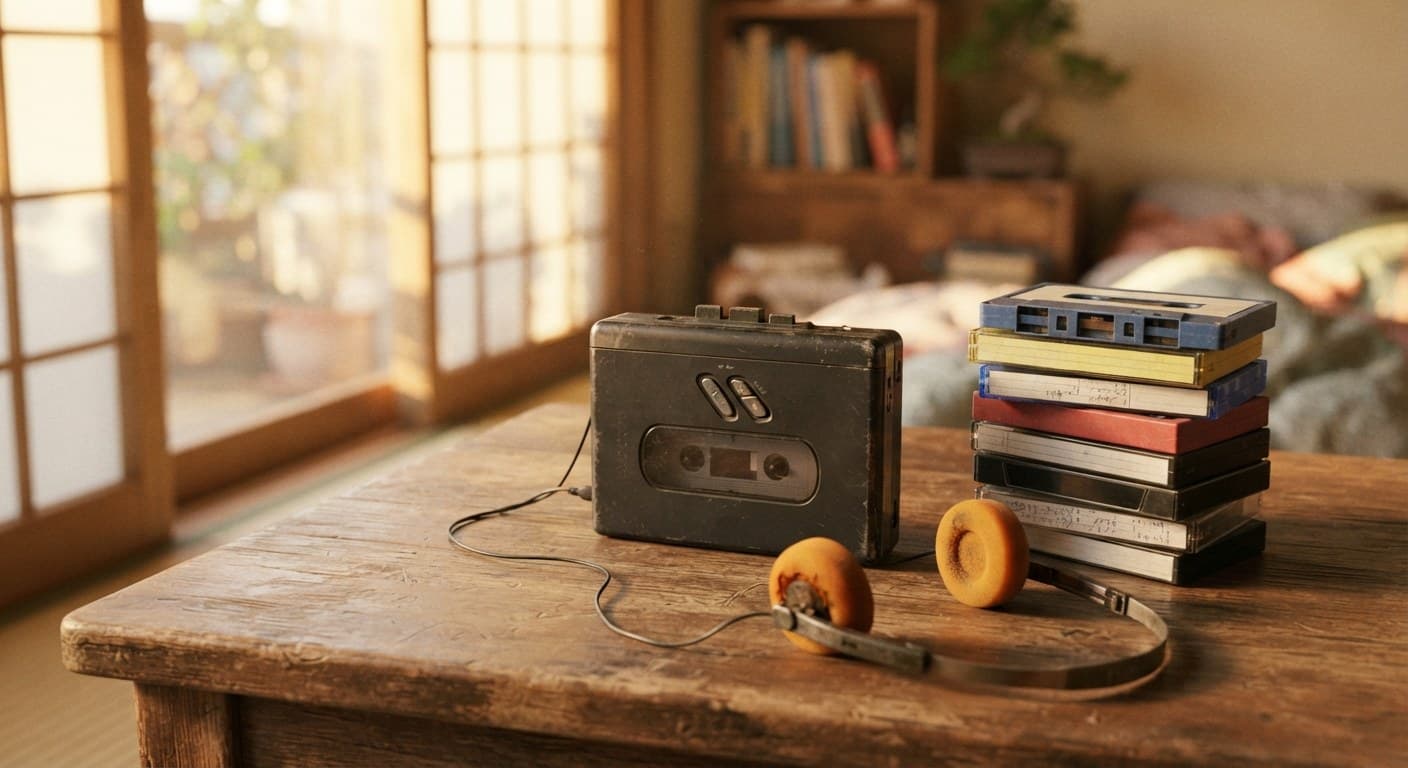
Neon Genesis Evangelion, Hideaki Anno's 1995 series at Studio Gainax, gives its fourteen-year-old protagonist a constant companion: a portable SDAT cassette player, its display looping between tracks 25 and 26, its earpieces going in whenever the world becomes too much. The image needs no dialogue to explain — and its legibility is a Japanese cultural inheritance.
1979: Tokyo invents portable solitude
The Walkman was born in Tokyo in July 1979, when Sony released a small blue-and-silver cassette player called the TPS-L2. It played through lightweight headphones and recorded nothing; contemporaries reportedly doubted anyone wanted a recorder that couldn't record. What Sony had actually built was not a music device but a social device: for the first time, a person in public could be somewhere else. The name became a global generic word, and the sight of a commuter sealed in private sound — invented, tested, and perfected on Tokyo's trains — became ordinary from London to Manila.
Related: Neon Genesis Evangelion and the Danchi: The Loneliness of Japan's Concrete Utopia explains this in detail.
Why Japan needed it first
It is no accident this object appeared in Japan. Tokyo's density made physical privacy a luxury: thin walls, shared rooms, and commutes pressed against strangers. At the same time, the ethic of not causing 迷惑 (meiwaku: bother to others) kept public spaces quiet — to this day, talking on the phone in a train car is a minor scandal, and announcements ask riders to silence their devices. In that environment, headphones solved two problems at once: they gave the listener an interior world, and they did it without leaking a single decibel onto the neighbors. Portable sound was privacy engineered to Japanese manners.
1995: why a cassette, already then?
By the time Evangelion aired in 1995, portable CD and MiniDisc players were commonplace; the series is even set in 2015, where its fictional digital SDAT tape format should be an antique twice over. The choice reads as deliberate texture. Cassette players have weight, hiss, and moving parts; their buttons clunk. Where a sleek future device would signal competence, a worn tape player signals attachment — a boy holding onto something old, familiar, and slightly obsolete. Japanese audiences, raised on the Walkman, felt that at once. And the feeling has outlived the format: in recent years cassette tapes have returned to Japanese shops as part of the broader 昭和レトロ (Shōwa retro: mid-century nostalgia) wave, sold to a generation too young to have rewound one with a pencil.
Related: Neon Genesis Evangelion and the Cicada: Why Japan's Endless Summer Needs a Soundtrack explains this in detail.
What the Headphones Meant From Outside
Living outside Japan for many years changed how I see this everyday object. Where I live now, public space is social by default — people chat with strangers, phones ring openly, music plays out loud. It took me years to notice that my own instinct to plug in and disappear was not universal but learned: a Tokyo habit, drilled by ten thousand train rides. I have absorbed a great deal from the culture around me, yet the foundations — the sense of time, the seasons, and evidently the reflex for carried solitude — never got replaced.
Seen from that distance, Evangelion's headphone imagery holds a gentle double meaning. The private bubble is a refuge, and Japan builds beautiful refuges. But a wall that keeps the crowd out keeps everything out. The show understood, decades before "noise-canceling" became a lifestyle word, that the same two earpieces can be self-care on Monday and self-isolation by Friday. That ambivalence — comfort and cage in one object — is the most Japanese thing about it.
FAQ
Q: What is the SDAT player Shinji uses in Evangelion? A: It is a fictional portable digital-audio tape player, styled after the cassette Walkmans of the 1980s and 90s. Its retro design was already nostalgic when the series aired in 1995, which is precisely the effect the imagery trades on.
Q: Did the Walkman really start headphone culture? A: Portable radios and headphones existed earlier, but Sony's 1979 Walkman was the first mass product built around private mobile listening, and it spread the habit worldwide. The word itself became generic in many languages.
Q: Why are Japanese trains so quiet? A: A mix of etiquette and explicit rules: the meiwaku ethic of not imposing on others, posted requests to set phones to silent "manner mode," and social enforcement by example. Headphones fit this culture perfectly because they keep sound — and the self — contained.
Key Insights to Remember
- The Walkman was a Japanese answer to a Japanese problem: how to be alone in a city that never gives you a room of your own. Evangelion's headphone imagery works globally, but its native grammar — privacy without imposing, interiority in a crowd — was written on Tokyo trains.
- Obsolete technology carries emotional information that current technology cannot. Anno's team chose tape over disc for the same reason filmmakers shoot memories in grain: the medium itself says "held onto," and Japan's ongoing cassette revival shows the feeling is bigger than one anime.
- Every culture builds walls; Japan perfected a portable one. The headphone bubble is neither praised nor condemned in Evangelion — it is simply shown, comfort and isolation in the same gesture, and that honest ambivalence is why the image still lands thirty years later.
Sources
About the author

Spoiler-free cultural deep-dives into anime, manga & live-action Japanese drama
- ●Tokyo-born, 3rd-generation Edokko (江戸っ子)
- ●Lifelong manga reader & anime viewer since the kaiju era
- ●Writes from outside Japan — distance as a cultural lens
- ●Spoiler-free · sourced · Kanji + Romaji + English
A Tokyo-born, 3rd-generation Edokko writer who has spent years living outside Japan. I use the anime, manga, and live-action Japanese drama you already love as a doorway into the folklore, language, religion, and everyday history behind them — written so even first-time fans can follow along, with sources for every claim.
Enjoy this article?
Get the next spoiler-free cultural deep-dive straight to your inbox.
Related Articles

My Neighbor Totoro and the Katori Senko: The Meiji Invention That Gave Japanese Summer Its Smell
How My Neighbor Totoro's summer evokes the katori senko, the Meiji-era mosquito coil whose spiral was imagined in 1895 by the wife of Kincho's founder.
8/8/2026

Anohana and Kingyo-sukui: Why Japan Replaced a Working Net With Paper That Dissolves
How Anohana's summer world explains kingyo-sukui, the festival stall game where Japan swapped a net that worked for a paper scoop designed to fail.
8/2/2026

Chibi Maruko-chan and Rajio Taisō: Why Japanese Kids Spend Summer Mornings Doing Radio Calisthenics in a Car Park
How Chibi Maruko-chan's Shōwa childhood preserves rajio taiso, the summer radio calisthenics Japan imported from an American insurer that dropped it a decade later.
8/1/2026

Rurouni Kenshin and Uchimizu: Why Old Tokyo Cooled Its Streets With a Ladle of Water
How the Meiji-era streets of Rurouni Kenshin open onto uchimizu — a summer custom that began as tea-ceremony courtesy and spread through Edo because of dust.
7/31/2026

Ace of Diamond and the Dirt of Koshien: Why Japan's Losing Teams Scoop Soil Into Their Bags
How Ace of Diamond treats Koshien as a destination, and why eliminated high school players kneel to fill bags with soil that groundskeepers blend by season.
7/30/2026

Neon Genesis Evangelion and the Evacuation Drill: Why Tokyo-3 Empties Without Panic
Why does Tokyo-3 evacuate so calmly in Neon Genesis Evangelion? A Tokyo-born writer traces Japan's evacuation-drill culture — from the 1923 earthquake and Disaster Prevention Day to the okashimo school chant.
7/22/2026