Neon Genesis Evangelion and the Danchi: The Loneliness of Japan's Concrete Utopia
How Evangelion turns the danchi, Japan's postwar housing utopia once won by lottery, into a portrait of modern loneliness through Rei's crumbling block.

Tokyo-born, 3rd-generation Edokko · writing on Japanese culture from outside Japan
Spoiler-Free Cultural Analysis
This article explores the real postwar history behind one of Neon Genesis Evangelion's most quietly devastating locations — the aging apartment block where one of its pilots lives. Everything discussed comes from the series' publicly known settings and imagery, with no plot spoilers.
Key Takeaways
- The crumbling apartment block that Evangelion uses to characterize Rei Ayanami is a 団地 (danchi) — Japan's postwar public housing estates, which were once the most desirable address a young family could dream of.
- The danchi began as a concrete utopia: modern kitchens, flush toilets, and privacy, allocated by lottery to lucky winners. Its slow transformation into a symbol of isolation is one of postwar Japan's great unwritten novels.
- Evangelion's imagery works because Japanese viewers carry both meanings at once — the danchi as the bright future their parents queued for, and the danchi as the loneliest place in the modern city.
Key Terms Explained
- 団地 (Danchi) / Housing Estate — Large planned apartment complexes, mostly public, built en masse from the mid-1950s onward.
- 日本住宅公団 (Nihon Jūtaku Kōdan) / Japan Housing Corporation — The public body founded in 1955 to build modern housing for the urban masses.
- 2DK (Ni-dī-kē) / Two Rooms + Dining-Kitchen — The revolutionary danchi floor plan that gave families a dedicated eating space and separate bedrooms.
- 下町 (Shitamachi) / Old Downtown — Tokyo's older, denser working-class neighborhoods of small houses and shopping streets, the danchi's cultural opposite.
The Future Across the River
I grew up in a small one-story house — a 平屋 (hiraya: single-story home) — in 足立区 (Adachi Ward: a working-class ward in northeastern Tokyo), a classic 下町 neighborhood of narrow lanes and family shops. Our winters smelled like the oden pot at the local greengrocer, where you could hand over a budget — "enough for a family of four, under a thousand yen" — and the shopkeeper would assemble the right bundle of ingredients with a craftsman's speed. Everyone knew everyone. Privacy was the one thing the neighborhood did not stock.
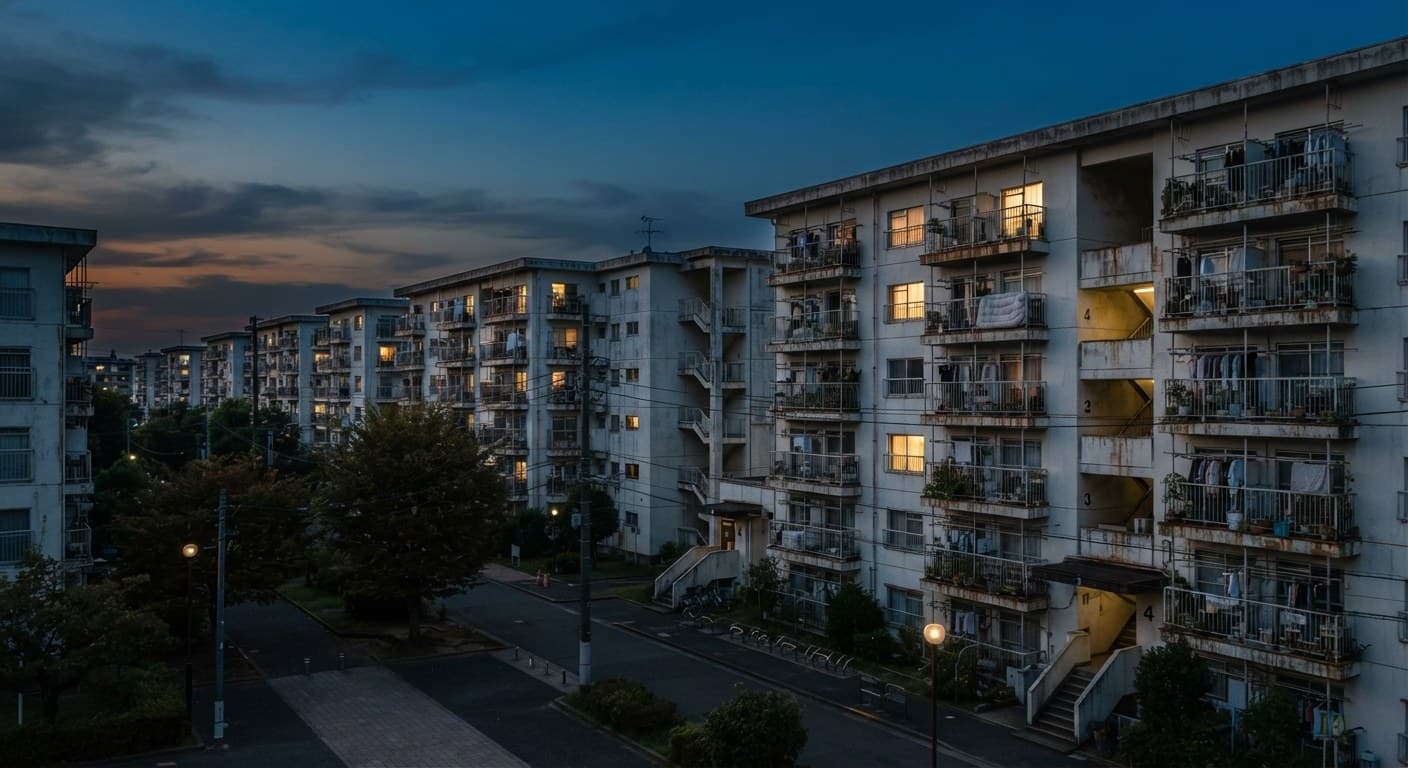
And rising here and there across the ward stood the opposite of all that: the danchi. Rows of identical white slabs, each window the same size, each balcony hung with the same laundry poles. To my child's eye they looked like the future — clean, orderly, faintly foreign. It took me decades, and a long life abroad, to understand that those towers and my cluttered little lane were two competing answers to the same question: how should Japanese people live together after the war?
Evangelion, I think, understood it from the start.
Related: Neon Genesis Evangelion and the Walkman: Why Shinji Retreats Into His Headphones explains this in detail.
The Concrete Dream and Its Long Afterlife
Neon Genesis Evangelion, Hideaki Anno's 1995 series at Studio Gainax, houses its most enigmatic pilot, Rei Ayanami, in a decaying apartment block — peeling walls, humming fluorescent light, mailboxes stuffed with flyers for residents who seem long gone. The show never lectures about the setting. It doesn't need to. The building is a danchi, and for Japanese audiences that single fact carries fifty years of history.
1955: the lottery for modern life
The 日本住宅公団 was founded in 1955 to solve a desperate postwar housing shortage, and its danchi were engineered as showcases of modern living: the 2DK layout that separated eating from sleeping, stainless-steel sinks, flush toilets, and — status of statuses — a bathtub of one's own. Demand was so fierce that units were allocated by lottery, with odds that could run to dozens of applicants per apartment. Winning a danchi flat in 1960 meant your family had boarded the escalator of the economic miracle. The word itself glowed with the same promise as "television" or "refrigerator" — the so-called three sacred treasures of the new consumer life that danchi kitchens were built to hold.
Related: Neon Genesis Evangelion and the Cicada: Why Japan's Endless Summer Needs a Soundtrack explains this in detail.
What the towers traded away
But the danchi's modernity had a price written into the floor plan. The 下町 lane pressed neighbors together — through paper walls, shared alleys, the greengrocer who knew your budget by heart. The danchi, by design, sealed each family behind a steel door. What was sold as privacy slowly revealed its twin: anonymity. Sociologists began writing about the estates' thin social fabric decades ago, and as the buildings aged and the miracle generation grew old inside them, the danchi became the emblematic setting of a sadder vocabulary — aging in place, empty units, and 孤独死 (kodokushi: dying alone and unnoticed), the word Japan coined for the danchi era's loneliest ending.
Why Evangelion chose it
By 1995, when Evangelion aired, the danchi's arc from utopia to melancholy was complete, and Anno's team used it with surgical precision. Placing a character in a threadbare danchi apartment tells a Japanese viewer, without one line of dialogue, exactly what kind of loneliness surrounds her: not romantic solitude but institutional solitude — a person stored rather than home. The steel door, the unanswered mailbox, the corridor of identical doors behind which no one appears: every frame leans on the danchi's real history of promised community that thinned into silence. It remains, to my eye, one of the most economical uses of architecture in all of anime.
Related: Neon Genesis Evangelion and the Evacuation Drill: Why Tokyo-3 Empties Without Panic explains this in detail.
What the Lane Knew
Living outside Japan for many years has softened my childhood envy of those white towers. I have absorbed a great deal from the culture around me, but my roots stayed stubbornly Japanese — and the parts of Japan I find myself missing are precisely the ones the danchi was designed to replace: the crowded lane, the shopkeeper who knew our pot, the impossibility of being anonymous even when you wanted to be.
I don't say this to romanticize the 下町 — it could be nosy, cramped, and exhausting — or to condemn the danchi, which gave millions of families their first warm bath at home. Both were sincere answers to the same postwar question. But rewatching Evangelion now, I notice where the show's sympathies quietly point. Its warmest scenes happen in cluttered, lived-in spaces; its coldest happen behind identical doors. Somewhere in that contrast is a very Japanese lesson about what got won, and what got traded, in the century of concrete.
FAQ
Q: What exactly is a danchi, and does it still exist? A: Danchi are the large planned apartment estates built mainly by public bodies from the mid-1950s onward. Many still stand and remain home to millions, though the buildings and their residents have aged together; some estates are being renovated or rebuilt, and a few have even become objects of retro affection among young Japanese.
Q: Is Rei's apartment building officially described as a danchi? A: The series shows a dilapidated multi-unit concrete block with the unmistakable visual grammar of an aging estate. Whatever label the fiction uses, the imagery Japanese viewers decode — public-housing modernism gone quiet — is the danchi's.
Q: Why were danchi apartments once so hard to get? A: In the 1950s and 60s they represented a leap in living standards — private bathrooms, modern kitchens, the 2DK layout — at subsidized rents. Applications vastly outnumbered units, so allocation ran on lotteries that families entered again and again.
Key Insights to Remember
- Architecture is memory. The danchi compresses an entire national story — postwar scarcity, the lottery for modernity, the miracle years, the lonely aftermath — into one silhouette, and Evangelion spends that memory like currency to characterize a girl without explaining her.
- Every utopia's floor plan encodes a trade. The danchi bought privacy and hygiene at the cost of the accidental intimacy that the shitamachi lane produced for free. Neither arrangement was wrong; each solved the other's problem.
- The loneliness Evangelion portrays is not futuristic but historical. The show's emptied corridors already existed in 1995 Japan and exist today, which is why the imagery has not dated: it was never science fiction, only observation with better lighting.
Sources
About the author

Spoiler-free cultural deep-dives into anime, manga & live-action Japanese drama
- ●Tokyo-born, 3rd-generation Edokko (江戸っ子)
- ●Lifelong manga reader & anime viewer since the kaiju era
- ●Writes from outside Japan — distance as a cultural lens
- ●Spoiler-free · sourced · Kanji + Romaji + English
A Tokyo-born, 3rd-generation Edokko writer who has spent years living outside Japan. I use the anime, manga, and live-action Japanese drama you already love as a doorway into the folklore, language, religion, and everyday history behind them — written so even first-time fans can follow along, with sources for every claim.
Enjoy this article?
Get the next spoiler-free cultural deep-dive straight to your inbox.
Related Articles
Your Name and Kumihimo: The Real Japanese Craft Behind Mitsuha's Braided Cord
How Your Name dramatizes kumihimo as a picture of musubi, and the real braided-cord craft behind it, from samurai armor to the modern kimono obijime.
10/12/2026

Touch and the Alps Stand of Koshien: Why Japan Unbolts Stadium Seats for a School Brass Band
How Touch's high-school baseball world leads to Koshien's Alps Stand, named by a cartoonist, and why seats are removed each August for school brass bands.
8/14/2026

Summer Wars and Hanafuda: The Flower Cards That Built Nintendo Before Video Games
How Summer Wars puts a deck designed to survive a gambling ban on the table, and why Nintendo spent its first 86 years making those flower cards by hand.
8/13/2026

In This Corner of the World and Japan's Noon Silence on August 15: The Minute a Whole Country Stops
How In This Corner of the World, set in wartime Kure, connects to Japan's mokutō, the noon silence each August 15 timed to the 1945 surrender broadcast.
8/12/2026

Sailor Moon and the Sailor Fuku: Why Japan Put a Skirt on a British Naval Uniform
How the sailor uniform behind Sailor Moon reached Japan — a British naval design adopted in 1920 so girls could do gymnastics, and the school that first paired the top with a skirt.
8/6/2026

Silver Spoon and Japan's Agricultural High Schools: The Real Nōgyō Kōkō Behind Ooezo
How Silver Spoon draws on Japan's real agricultural high schools — around 300 of them — and why their student farming clubs were deliberately modelled on an American organisation after the war.
8/5/2026