Neon Genesis Evangelion and the Cicada: Why Japan's Endless Summer Needs a Soundtrack
How Neon Genesis Evangelion turns Japan's beloved cicada chorus into a sign of a broken world — and why anime summer always sounds like semi, from semishigure to the mournful higurashi.

Tokyo-born, 3rd-generation Edokko · writing on Japanese culture from outside Japan
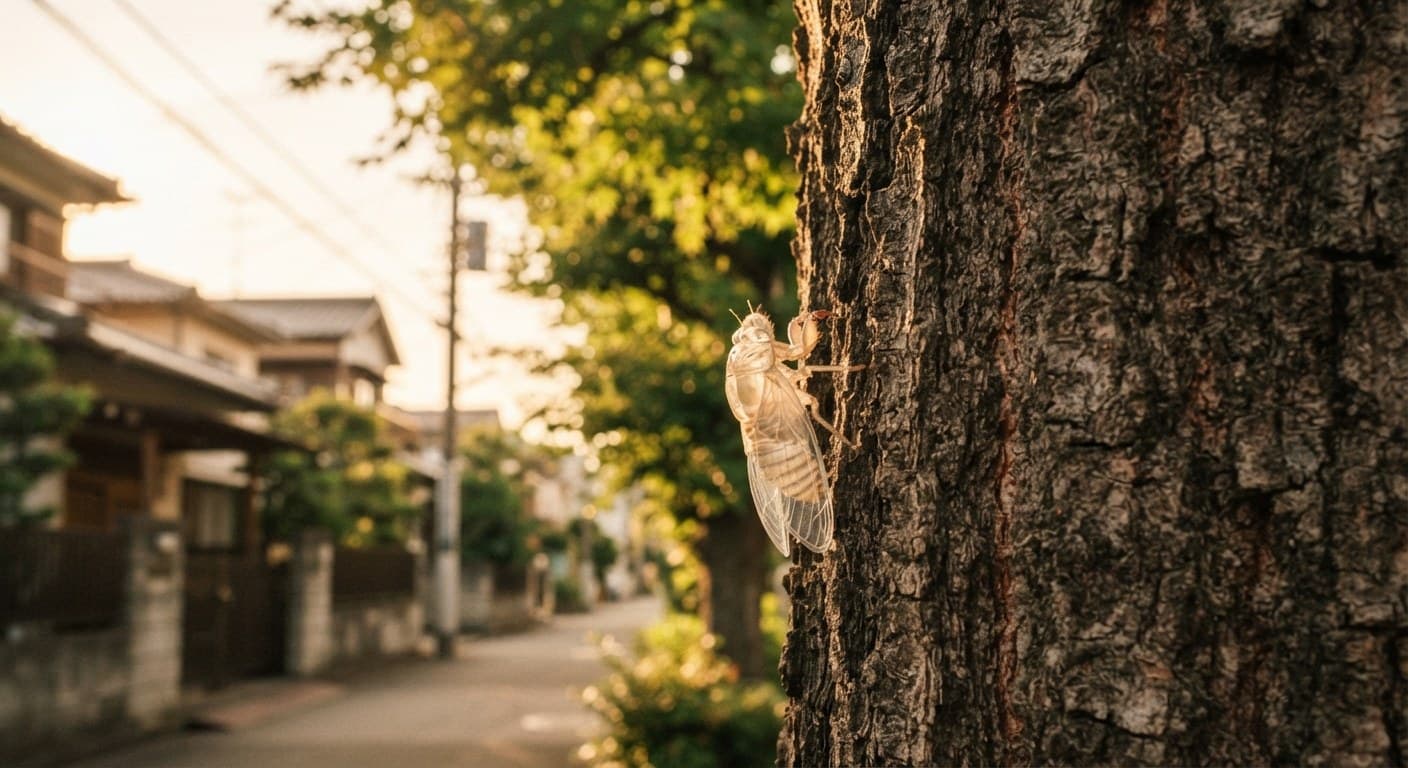
Spoiler-Free Cultural Analysis
This article explores the real cultural and natural history behind one detail of Neon Genesis Evangelion's setting — the ever-present cicadas — with no plot spoilers. Everything discussed comes from the series' publicly known premise and atmosphere, not its story.
Key Takeaways
- In Evangelion's world, Japan is trapped in an endless summer, and the constant chirr of cicadas is how the show tells you — through your ears — that the seasons themselves are broken. Anime routinely uses cicada song as a season marker, which is why anime summer "sounds like that."
- Japanese culture hears cicadas not as noise but as voices with meanings: different species carry different emotional registers, from the heat-haze sizzle of midsummer to the melancholy evening call that signals a day — or a childhood — ending.
- The cicada has been a symbol of impermanence in Japan for over a thousand years, from the cast-off shell imagery of classical literature to Buddhist reflections on a creature that waits years underground for a few loud weeks of life.
Key Terms Explained
- 蝉 (Semi) / Cicada — The insect whose massed song defines the sound of Japanese summer.
- 蝉時雨 (Semishigure) / Cicada Rain — A poetic word likening the overwhelming chorus of cicadas to a passing rain shower of sound.
- ヒグラシ (Higurashi) / Evening Cicada — The species whose clear, bell-like call at dusk carries a uniquely nostalgic, sorrowful mood.
- 空蝉 (Utsusemi) / Cast-Off Cicada Shell — A classical word meaning both the empty shell a cicada leaves behind and, by extension, this transient earthly world.
- 無常 (Mujō) / Impermanence — The Buddhist idea that nothing lasts, a current that runs beneath much of Japanese aesthetics.
The Sound Wall of an Adachi Summer
I grew up in a single-story house — a 平屋 (hiraya: one-story home) — in 足立区 (Adachi Ward: a working-class ward in northeastern Tokyo). In summer, with the windows open because that was how you survived summer, the cicadas were not background sound. They were the room tone of the entire season. The chorus started before I was properly awake and pressed in from every tree on the block, so continuous that after a while you stopped hearing it — until it stopped, and the silence felt like something had been switched off.
Years of living outside Japan taught me something I could not have learned at home: summer without that wall of sound feels strangely empty to me. I have absorbed a great deal from the culture around me, but the parts of me that keep time by the seasons never got replaced. When a film or an anime wants me to feel August in Japan, it does not need to show me a calendar. Two seconds of cicada chorus and I am eight years old again, sweating on a tatami floor.
That is exactly the lever Neon Genesis Evangelion pulls — and then twists.
Related: Neon Genesis Evangelion and the Danchi: The Loneliness of Japan's Concrete Utopia explains this in detail.
The Broken Calendar of Tokyo-3
Neon Genesis Evangelion, Hideaki Anno's 1995 series at Studio Gainax, is set in a Japan that no longer has seasons. Its publicly stated premise: after a global cataclysm called the Second Impact shifted the Earth's axis, Japan settled into a permanent summer. From the very first episode, the soundtrack under the fortified city of Tokyo-3 is thick with cicadas — in scenes where, by the story's own calendar, the sound has no business being comforting.
A Season Marker With Nothing to Mark
To understand why this choice lands so hard on Japanese ears, you need to know what cicadas normally do in Japanese storytelling: they mark time. Anime and film use the cicada chorus the way Western media might use sleigh bells for winter — an instant, wordless date stamp that says high summer. Sound designers even choose species by scene. The lazy sizzle of the アブラゼミ (aburazemi: the "oil cicada," whose call sounds like frying oil) says humid afternoon. The insistent ミンミンゼミ (minminzemi: a cicada named for its "min-min" cry) says blazing noon. The ツクツクボウシ (tsukutsukubōshi: a cicada whose call is heard from late summer) whispers that vacation is almost over, and the evening ヒグラシ carries a loneliness so specific that its call has become shorthand for nostalgia and gentle grief.
In Evangelion, the marker has nothing left to mark. If it is always summer, the cicadas never stop. What is normally a warm seasonal cue becomes a low, wrong hum of a world that cannot turn the page — vitality and unease in the same breath. It is one of the great uses of an everyday sound in anime, and the show barely draws attention to it.
Related: Neon Genesis Evangelion and the Walkman: Why Shinji Retreats Into His Headphones explains this in detail.
A Thousand Years of Listening
Japan has been listening to cicadas this closely for a very long time. The word 蝉時雨 treats the chorus as weather — a shower you stand inside. Classical poetry is dense with cicadas: 松尾芭蕉 (Matsuo Bashō: the 17th-century haiku master) famously wrote of a cicada's voice sinking into silent rock at a mountain temple, a poem so well known that many Japanese can summon its stillness from memory. In 俳句 (haiku: Japan's seventeen-syllable poetic form), the cicada is a formal 季語 (kigo: season word), and different species mark different points on the calendar.
Even deeper is 空蝉. The word literally names the translucent shell a cicada nymph leaves clinging to a tree trunk when it molts — a perfect, hollow copy of itself. Classical writers borrowed it to mean this fleeting world, and it titles a chapter of 源氏物語 (Genji Monogatari: The Tale of Genji), where a woman slips away leaving only her robe behind, like the insect leaving its shell. Children still collect those shells from tree bark every August; I find it quietly astonishing that a summer-holiday plaything shares its name with one of the oldest melancholy words in the language.
Related: Neon Genesis Evangelion and the Evacuation Drill: Why Tokyo-3 Empties Without Panic explains this in detail.
The Buddhist Undertone
Why did the cicada, of all insects, become Japan's memento mori? Biology wrote the sermon. A cicada spends years underground as a nymph — several years for most Japanese species — then climbs into the light, sings at full volume, and dies within weeks. To a culture steeped in 無常, the Buddhist teaching that all things pass, that life cycle reads as a parable requiring no translation: the long unseen preparation, the brief loud season, the sudden quiet. The cicada chorus is joyous and funereal at once, which is precisely the double note Evangelion's endless summer plays.
What an Expat Ear Learns
Living abroad recalibrated my hearing. Where I have spent my adult years, summer has its own sounds, but nothing like the totalizing wall of a Tokyo cicada chorus — and I notice its absence the way you notice a missing tooth. As a self-taught multi-instrumentalist — guitar, drums, piano, saxophone — I tend to listen to anime the way I listen to a mix: the cicada track sits in the arrangement like a drone note under a melody, and directors ride its fader with real intention. Cut it abruptly and the scene holds its breath. Swap the midday sizzle for the evening ヒグラシ and the same street corner turns wistful without a line of dialogue.
There is also a small irony worth recording. The classic soundscape I remember is itself changing: in recent decades the クマゼミ (kumazemi: a large, loud cicada once associated with western Japan) has been expanding into Tokyo as cities heat up, nudging the capital's summer chord toward a different key. The sound I am nostalgic for was never permanent either. The cicadas, of course, had been telling us that all along.
FAQ
Q: Why do so many anime have cicada sounds in the background? A: Cicadas are an instant seasonal and emotional cue for Japanese audiences. Their chorus says "high summer" without any dialogue, and specific species add shades of meaning — midday heat, late-summer wistfulness, or evening melancholy.
Q: Is the endless summer in Neon Genesis Evangelion an official part of the setting? A: Yes. The series' publicly known premise states that after the Second Impact cataclysm, Japan was left in permanent summer — which is why cicadas are heard year-round in the show's world.
Q: What is the difference between higurashi and other cicadas in Japanese media? A: The higurashi, or evening cicada, calls at dawn and dusk with a clear, ringing tone. In film and anime it signals endings — of a day, a summer, or an era — whereas daytime species like the aburazemi and minminzemi signal heat and vitality.
Key Insights to Remember
- Evangelion weaponizes an everyday comfort. By letting the normal sound of summer play over a world where summer never ends, the show turns a nostalgic cue into a quiet alarm — proof that sound design can carry worldbuilding that no line of dialogue states outright.
- Japan's cicada vocabulary — semishigure, utsusemi, the species names themselves — shows a culture that files insect song under voices rather than noise. Learning even a few of these words changes what you hear in any anime summer scene.
- The cicada earned its place in Japanese aesthetics by embodying 無常: years of hidden waiting, weeks of loud life, then silence. That double note of vitality and transience is why the same sound can score both a beach episode and a funeral scene — and why it fits a broken world so unnervingly well.
Sources
About the author

Spoiler-free cultural deep-dives into anime, manga & live-action Japanese drama
- ●Tokyo-born, 3rd-generation Edokko (江戸っ子)
- ●Lifelong manga reader & anime viewer since the kaiju era
- ●Writes from outside Japan — distance as a cultural lens
- ●Spoiler-free · sourced · Kanji + Romaji + English
A Tokyo-born, 3rd-generation Edokko writer who has spent years living outside Japan. I use the anime, manga, and live-action Japanese drama you already love as a doorway into the folklore, language, religion, and everyday history behind them — written so even first-time fans can follow along, with sources for every claim.
Enjoy this article?
Get the next spoiler-free cultural deep-dive straight to your inbox.
Related Articles

Ghost in the Shell and the Japanese Autumn Sky: Why Akikaze Signals Change Before the Leaves Do
Why autumn wind, not falling leaves, marks the turn of the year in Japanese poetry — and how Ghost in the Shell applies that inherited convention to a question about bodies that can be replaced.
8/18/2026

Mushishi and the Japanese Ear for Insect Song: Why Autumn Arrives as a Sound
How Mushishi builds its seasons from mushi no ne, the autumn insect song Edo listeners travelled to named hills to hear, and what losing that ear means.
8/15/2026
Frieren: Beyond Journey's End and Obon: Why Japan's Dead Come Home in August
How Frieren: Beyond Journey's End dramatizes the spirit of Obon — Japan's August season of welcoming ancestral spirits home with fires, lanterns, and dances — and why its view of grief as an ongoing relationship feels so deeply Japanese.
7/25/2026