Frieren: Beyond Journey's End and Obon: Why Japan's Dead Come Home in August
How Frieren: Beyond Journey's End dramatizes the spirit of Obon — Japan's August season of welcoming ancestral spirits home with fires, lanterns, and dances — and why its view of grief as an ongoing relationship feels so deeply Japanese.

Tokyo-born, 3rd-generation Edokko · writing on Japanese culture from outside Japan
Spoiler-Free Cultural Analysis
This article explores the real Japanese tradition of Obon — the August season when ancestral spirits are welcomed home — as a cultural key to the themes of grief and memory in Frieren: Beyond Journey's End. No plot spoilers beyond the official premise; only themes, atmosphere, and history.
Key Takeaways
- お盆 (Obon: the Buddhist festival of ancestral spirits) is Japan's midsummer season of the returning dead: for a few days in mid-August, families light fires and lanterns to guide their ancestors home, feed them, dance with them, and then send them back. It is the closest thing Japan has to a nationwide appointment with the departed.
- The premise of Frieren — an elf who outlives her companions and travels to understand them after death — dramatizes an idea Obon has rehearsed for centuries: that the dead are not gone so much as elsewhere, and that the relationship with them continues and even deepens after they die.
- Obon is not a mournful holiday. Its fires, dances, and cucumber-horse offerings are practical, even cheerful acts of hospitality — a distinctly Japanese view in which grief and festivity share the same table.
Key Terms Explained
- お盆 (Obon) / Festival of the Ancestors — The midsummer Buddhist observance, typically August 13–16, when ancestral spirits are believed to return to the family home.
- 迎え火 (Mukaebi) / Welcoming Fire — A small fire lit at the gate or doorstep on the first evening of Obon to guide the spirits home.
- 送り火 (Okuribi) / Sending-Off Fire — The fire lit at Obon's end to see the spirits safely back; Kyoto's mountainside Daimonji blaze is the most famous example.
- 盆踊り (Bon Odori) / Obon Dance — The communal circle dance held on summer evenings, historically understood as a dance of welcome shared with the returning dead.
- 精霊馬 (Shōryō-uma) / Spirit Mounts — A cucumber horse and an eggplant ox, made with chopstick legs: a fast horse so the ancestors hurry home, a slow ox so they leave at a lingering pace.
The Smell of Smoke in an August Alley
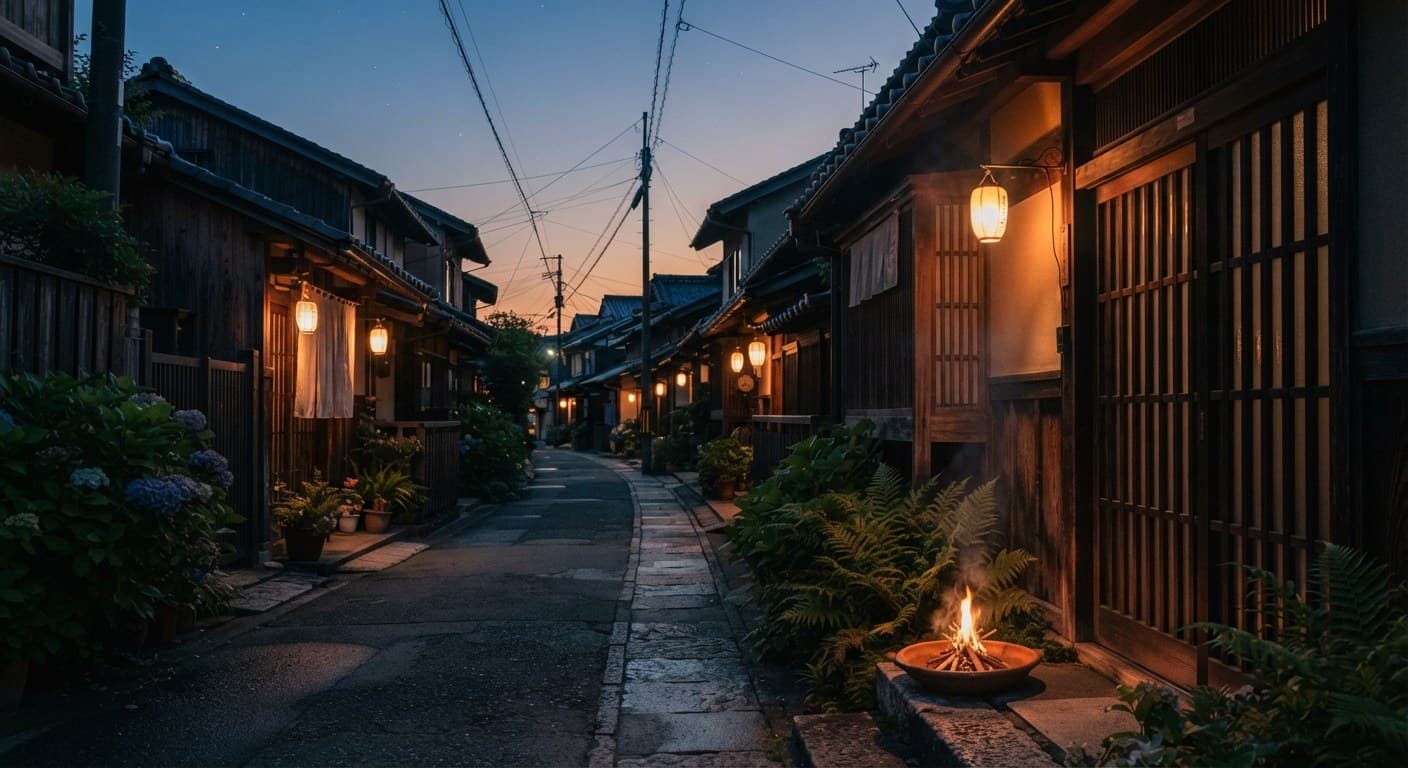
My family was never a devout one. We did not visit the family grave with any diligence, and no one in our Tokyo household could have explained the doctrinal fine print of a Buddhist sutra. And yet, when August came, the feeling arrived on schedule anyway: the sense that for a few days our ancestors had come back from somewhere far away, and that when the season ended we would send them off again. Nobody sat me down and taught me this. It soaked in — from the smell of smoke in the alley where a neighbor lit a small welcoming fire, from the paper lanterns, from the adults' unhurried way of treating those few days as different from ordinary days.
I never worked out, as a child, where exactly the spirits were commuting from. That was not the point. The point was the traffic itself — the coming and the going. This world and some distant other place were connected by a round trip, the way a genkan connects a house to the street. Watching Frieren: Beyond Journey's End decades later, far from Tokyo, I was startled to feel that same childhood sensation return: here was a story built entirely on the idea that the dead have merely gone somewhere, and that somewhere might still be reached.
Related: Summer Time Rendering and the Shoryo-uma: The Cucumber Horse That Carries the Dead Home explains this in detail.
The Season of the Returning Dead
From the Ullambana Sutra to the Family Gate
Obon descends from 盂蘭盆会 (Urabon-e: the Ullambana observance), a Buddhist rite of making offerings for the dead that reached Japan from the continent around the seventh century. The legend behind it concerns a disciple of the Buddha who saves his deceased mother from torment through offerings made on behalf of the dead — a story of a living person doing something, concretely, for someone already gone. Japan folded this Buddhist frame around a much older native intuition: that ancestral spirits do not depart to some sealed-off afterlife but remain nearby, returning at fixed seasons to watch over the household. The result is the Obon most Japanese people practice today — Buddhist in vocabulary, ancestral in feeling, and domestic in scale. It is held around August 13 to 16 in most of the country, and the days before it are marked by one of the world's great homecoming migrations, as city dwellers flood back to their hometowns.
Related: Frieren: Beyond Journey's End and the Weight of Time: Why the Anime Measures Life in Decades, Not Days explains this in detail.
Fires, Lanterns, and Vegetable Horses
What I love about Obon, and what I find hardest to convey to overseas friends, is how practical it is. The dead are not contemplated in the abstract; they are hosted. On the first evening, families light the 迎え火 (Mukaebi: welcoming fire) so the spirits can find the door. Inside, a small altar carries food, water, and flowers. At the entrance stand the 精霊馬 (Shōryō-uma: spirit mounts) — a cucumber with chopstick legs for a horse, an eggplant for an ox. The logic is tender and completely matter-of-fact: come quickly on the fast horse; go home slowly on the plodding ox, because we want the goodbye to take as long as possible.
When the season ends, the 送り火 (Okuribi: sending-off fire) reverses the welcome. In Kyoto this becomes the spectacular 五山送り火 (Gozan no Okuribi: the Five Mountain Sending-Off Fires), when giant characters of flame burn on the hillsides to light the spirits' way back. Elsewhere, families float lanterns down rivers in the rite of 灯籠流し (Tōrō-nagashi: lantern floating), the lights drifting toward the sea — toward that unnamed far shore I never quite located as a child.
Related: In This Corner of the World and Japan's Noon Silence on August 15: The Minute a Whole Country Stops explains this in detail.
Dancing With the Dead
Then there is 盆踊り (Bon Odori: the Obon circle dance), the summer-evening dance held in parks, temple grounds, and schoolyards. Today it feels like a festival for the living — yukata, taiko, food stalls — but its older sense was a dance of welcome performed together with the returning spirits. The circle turns around a central tower, ancestors and descendants notionally sharing the same ring. I find this the most eloquent piece of the whole season: Japan's appointed meeting with its dead is not a vigil but a dance. Grief and festivity are not opposites here; they take turns leading.
What an Elf Teaches About the Long Goodbye
The official premise of Frieren: Beyond Journey's End is simple and devastating: an elven mage, nearly immortal, outlives the human companions of her adventuring days, and only after their deaths begins to understand what they meant to her. Her long journey is, in effect, a pilgrimage toward the place where souls rest — an attempt to keep the conversation going after the other party has left the room.
Seen from inside Japanese culture, this is not an exotic fantasy conceit. It is Obon, stretched across an elf's lifespan. The anime's central consolation — that the dead remain knowable, that you can still learn things about a person after they are gone, that the relationship continues to grow — is exactly the emotional grammar of a holiday in which the dead come home every August and are fed, entertained, and seen off with instructions to travel slowly. I suspect this is one quiet reason the series resonated so deeply in Japan before it conquered audiences abroad: it takes a feeling the culture already rehearses annually and gives it a face, a staff, and a journey.
Living outside Japan for many years now, I notice the absence of that rehearsal most sharply in August. Where I live, there is no season when the whole society agrees, for four days, that the dead are in the room. Grief in many places is treated as a private project with a finish line — something to process and complete. Obon proposes the opposite: an unfinished, renewable relationship, maintained with cucumbers, fire, and dancing. When August comes, wherever I am, something in me still lights the welcoming fire.
FAQ
Q: When is Obon, exactly? A: Most of Japan observes it around August 13–16, though Tokyo and some regions hold it in mid-July owing to the old calendar conversion. The August version, sometimes called 旧盆 (Kyūbon: old-calendar Obon), is when the great homecoming travel rush occurs.
Q: Is Obon a solemn religious holiday or a festival? A: Both, without contradiction. Households perform quiet acts of remembrance at the family altar and grave, while communities hold lively Bon Odori dances with food stalls and music. The blend of reverence and festivity is the point, not a dilution of it.
Q: Can travelers experience Obon in Japan? A: Yes — Bon Odori dances welcome anyone into the circle, and events like Kyoto's Gozan no Okuribi are public spectacles. Be aware that Obon week is peak domestic travel season, so trains and hotels fill early.
Key Insights to Remember
- Obon treats death as distance rather than disappearance. The dead live somewhere far, but the road between here and there stays open, and twice a year the traffic runs. Frieren's journey toward the resting place of souls dramatizes precisely this geography of the afterlife — remote, but reachable.
- The hospitality of Obon — fires to navigate by, vegetable mounts to ride, a dance to join — reveals a culture that manages grief through concrete, repeatable acts rather than through introspection alone. Doing something for the dead, however small, is itself the consolation.
- The eggplant ox may be Obon's deepest lesson: the goodbye is deliberately engineered to be slow. In a culture often stereotyped as reserved about emotion, the wish that a departing spirit take the slowest possible mount home is as openly loving a gesture as any tearful farewell.
Sources
About the author

Spoiler-free cultural deep-dives into anime, manga & live-action Japanese drama
- ●Tokyo-born, 3rd-generation Edokko (江戸っ子)
- ●Lifelong manga reader & anime viewer since the kaiju era
- ●Writes from outside Japan — distance as a cultural lens
- ●Spoiler-free · sourced · Kanji + Romaji + English
A Tokyo-born, 3rd-generation Edokko writer who has spent years living outside Japan. I use the anime, manga, and live-action Japanese drama you already love as a doorway into the folklore, language, religion, and everyday history behind them — written so even first-time fans can follow along, with sources for every claim.
Enjoy this article?
Get the next spoiler-free cultural deep-dive straight to your inbox.
Related Articles

Ghost in the Shell and the Japanese Autumn Sky: Why Akikaze Signals Change Before the Leaves Do
Why autumn wind, not falling leaves, marks the turn of the year in Japanese poetry — and how Ghost in the Shell applies that inherited convention to a question about bodies that can be replaced.
8/18/2026

Mushishi and the Japanese Ear for Insect Song: Why Autumn Arrives as a Sound
How Mushishi builds its seasons from mushi no ne, the autumn insect song Edo listeners travelled to named hills to hear, and what losing that ear means.
8/15/2026
Neon Genesis Evangelion and the Cicada: Why Japan's Endless Summer Needs a Soundtrack
How Neon Genesis Evangelion turns Japan's beloved cicada chorus into a sign of a broken world — and why anime summer always sounds like semi, from semishigure to the mournful higurashi.
7/21/2026