SAKAMOTO DAYS and the Dagashiya: The Vanishing World of Japan's Penny-Candy Shops
How SAKAMOTO DAYS turns a retired hitman's neighborhood shop into its emotional core, and what Japan's fading dagashiya penny-candy shops once meant to children.

Tokyo-born, 3rd-generation Edokko · writing on Japanese culture from outside Japan
Spoiler-Free Cultural Analysis
This article stays with the atmosphere, setting, and real cultural history behind SAKAMOTO DAYS — the world of Japan's small neighborhood candy shops — and reveals nothing about the plot beyond the opening premise already given in official synopses.
Key Takeaways
- The humble shop where a retired hitman sells snacks and lets a local kid try to win a free drink is not just a backdrop. It draws on the 駄菓子屋 (Dagashiya) tradition, a child-scaled retail world that shaped how generations of Japanese kids learned to spend, choose, and gather.
- The improvised prize game the boy plays at the storefront — a suction-cup dart thrown at a target drawn on the glass — echoes the older tradition of 射的 (Shateki), the cork-gun prize game of candy shops and festival stalls, built on cheap thrills, near-impossible prizes, and the pleasure of trying anyway.
- For many children, the penny-candy shop was a first economy: a place where a handful of coins forced real decisions, under the loose watch of an elderly shopkeeper — a model that has been quietly disappearing for decades.
Key Terms Explained
駄菓子屋 (Dagashiya) / Penny-Candy Shop — A small neighborhood shop selling cheap sweets, snacks, toys, and simple games aimed at children, often run out of the front room of a family home.
射的 (Shateki) / Cork-Gun Target Shooting — A game in which you fire corks from a toy rifle to knock prizes off a shelf; a fixture of festival stalls and old candy shops alike.
駄菓子 (Dagashi) / Cheap Penny Candy — Inexpensive sweets and snacks, historically made from low-cost ingredients and priced so children could buy them with pocket money.
店番 (Miseban) / Minding the Shop — The everyday act of watching over the counter; here, the ever-present grandmother or grandfather who knew every child in the neighborhood.
昭和 (Shōwa) / The Shōwa Era — The reign of Emperor Shōwa (1926–1989), whose postwar decades are remembered as the golden age of the dagashiya.
A Few Coins, a Dart, and the Walk Home from School
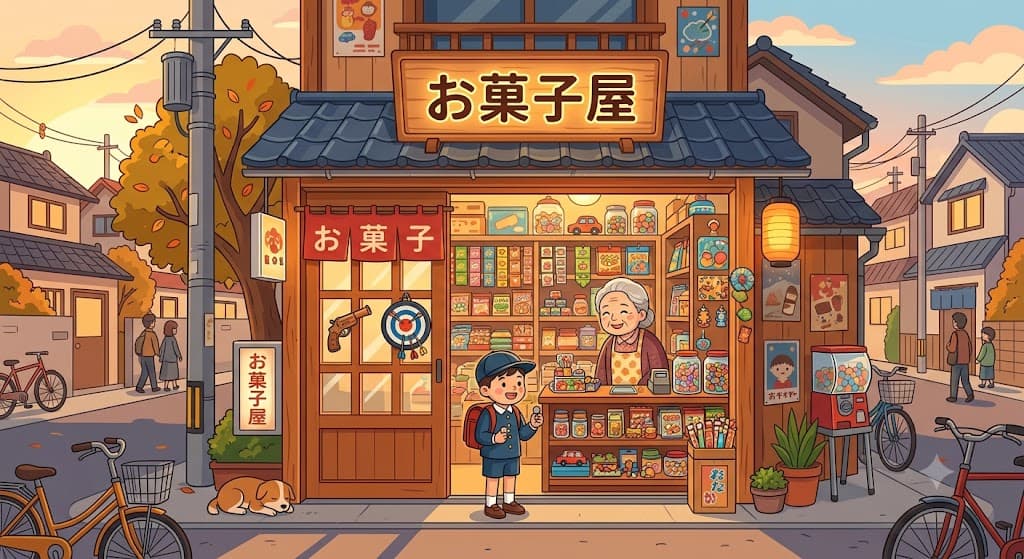
When I watch the opening of SAKAMOTO DAYS, the thing that catches me is not the retired assassin behind the counter but the boy in front of it — the one who chalks a little target onto the shop's glass door, throws a suction-cup dart at it, and bets the shopkeeper a free drink that he can land it dead center. I grew up in the 下町 (Shitamachi: the old working-class downtown of Tokyo), a 江戸っ子 (Edokko: a Tokyoite whose family has lived in the city for generations), and that small wager is the most familiar thing in the whole show.
 A traditional dagashiya packed shelf to shelf with penny candy and toys — the everyday after-school destination of a Showa childhood.
For me, the 駄菓子屋 (Dagashiya: a neighborhood penny-candy shop) was not a treat for special occasions. It was part of ordinary life. After school and on the way home, almost every single day, I would walk over with a few dozen yen clutched in my hand and drift along the narrow, crammed shelves of 駄菓子 (Dagashi: cheap penny candy) and small toys, weighing what to buy.
At the storefront there was often a small game — sometimes 射的 (Shateki: cork-gun target shooting) — and I could never quite leave it alone. You loaded a cork into a toy rifle and tried to knock a prize clean off the shelf, and there were only so many shots. The rush when a cork finally connected, or when a lottery gave me one more free try, is a feeling I still remember precisely. The person doing the 店番 (Miseban: minding the shop) was usually an elderly woman or man who, over months of visits, became a familiar face. The boy in the anime throws a dart rather than fires a cork, but the bargain is identical — aim at a target, win a prize — and watching it, I don't see a gimmick. I see the exact texture of my own afternoons.
The Long Road from Edo Sugar to the Showa Candy Counter
Sakamoto's shop is usually described as a small neighborhood store on the outskirts of Tokyo — something between a コンビニ (Konbini: convenience store) and an old-fashioned candy stand. But the moment a child chalks a target onto the glass and throws a dart for a free juice box, the register of the scene shifts entirely into dagashiya territory. To understand why that single image carries so much warmth, it helps to trace where these shops came from.
 Cheap, brightly wrapped dagashi, priced so children could buy them with a handful of coins.
Cheap Sweets for Common Children
The word itself is unglamorous by design. Dagashi joins da, meaning something negligible or trifling, with kashi, meaning sweets. It was the commoner's answer to 上菓子 (Jōgashi: fine, high-grade confections), which were made with expensive refined white sugar and stayed out of reach for ordinary families. Dagashi, by contrast, leaned on cheaper ingredients like starch and unrefined brown sugar, so that even children could afford them.
The roots reach back into the Edo period (1603–1868), when shops specializing in these low-cost sweets began appearing in towns. The 駄菓子 (Dagashi) most people picture today, though, is really a postwar creation. Once sugar became cheaper after the Second World War, sweeter snacks entered the lineup, and the shops flourished. Their peak stretched across the postwar 昭和 (Shōwa: the Shōwa era, 1926–1989), roughly from the 1950s into the 1980s. Many opened near elementary schools and operated out of the front of a family home, which is exactly why they felt less like businesses and more like extensions of the neighborhood itself.
The Shopkeeper and the Child-Sized Commons
What made the dagashiya more than a shelf of candy was the person at the counter. Children stopped by after school not only to buy but to linger, to talk, and to be around each other. The shop became a たまり場 (Tamariba: a gathering spot) — a low-stakes social hub where kids could operate on their own terms while a gentle adult eye kept loose watch from behind the register.
That balance is unusual and worth naming. It was a space run for children, scaled to children, yet not fully controlled by them. The shopkeeper knew the regulars, knew who was short a few yen this week, and knew when to look the other way. When SAKAMOTO DAYS places a retired killer in exactly that role — the neighborhood fixture who greets the local kids and referees a target game — it is borrowing one of the most quietly reassuring figures in modern Japanese memory.
Shateki, Lotteries, and the Almost-Impossible Prize
The 射的 (Shateki) at a candy shop or a festival stall runs on a small, honest bit of showmanship. You get a pot of corks and a popgun, and the prizes sit propped on a shelf. The cheap ones are easy enough to topple; the good ones are angled and weighted so a cork can barely nudge them. The real trick, as any veteran will tell you, is to push the cork all the way down the barrel and get the muzzle as close as the rules allow, because a cork loses its power fast.
 A shateki stall lines up prizes just out of easy reach, rewarding a careful aim with a well-placed cork.
Shooting was only one flavor of the same pleasure. Much of the candy came 当たり付き (Atari-tsuki: sold with a prize draw), where a winning wrapper earned you a second snack for free. This is gambling shrunk to the size of a coin — a jolt of chance folded into a purchase, teaching the delicious lesson that sometimes you win and mostly you don't. The boy in SAKAMOTO DAYS, chalking a target on the glass and flinging a dart for a prize, is running a homespun version of that same shop-front bargain: line up your one throw, aim for the reward, and live with the result.
A Handful of Coins as a First Economy
More than anything, the dagashiya was where I first learned what it means to spend. With only a few dozen yen, every choice was a real trade-off: skip this to afford that, gamble a coin on a game or bank it for candy. Working out how to squeeze the most joy from a tiny budget was, in its own small way, an education in economics — and a rare taste of autonomy in a world otherwise run by adults. Long before anyone hands a child a bank account, the candy counter had already taught them to weigh, to want, and to decide.
The Quiet Disappearance of the Child-Sized Shop
The decline came gradually and then decisively. As the コンビニ (Konbini: convenience store) spread into every corner of the country, the economics that sustained a tiny family-run candy stand fell away, and the shops thinned out. Only a small number of true dagashiya still operate in the Tokyo area today, and they survive largely as objects of nostalgia rather than as daily necessities.
What remains is affection. There is a strong current of "Shōwa retro" feeling in Japan now, and the penny-candy shop sits close to its heart. Surviving shops are treated as cultural landmarks; whole townscapes are recreated inside museums, complete with cluttered candy counters you can actually buy from; and the candy itself has been revived through bulk stores and online shops. The 駄菓子 (Dagashi) is not endangered. You can still buy every treat I grew up on. It is the dagashiya — the place — that has grown scarce.
Having lived outside Japan for many years now, I feel that loss from a particular angle. Where I live, there is simply no equivalent: no small shop a child can walk to alone, coins in hand, to spend an unhurried afternoon under the loose gaze of someone who has run the same counter for decades. That combination — child-scaled, cheap, social, and gently supervised — turns out to have been the actual thing of value, more than the sweets ever were.
Which is why I think SAKAMOTO DAYS reaches for this setting so deliberately. Its hero has walked away from a life of violence to stand behind a small counter and let a neighborhood kid try, and fail, and try again to win a free drink. The shop is not where the story happens by accident. The shop is what he is protecting.
FAQ
Q: Is Sakamoto's shop in SAKAMOTO DAYS a dagashiya or a convenience store?
A: Officially it reads as a small neighborhood general store on the edge of Tokyo, closer to a convenience store than a pure candy shop. But the improvised prize game a boy plays at the door — a suction-cup dart thrown at a target drawn on the glass — and the kids who come to hang around give it the unmistakable warmth and texture of a traditional dagashiya, which is a large part of why the setting lands emotionally.
Q: What is shateki and how do you actually play it?
A: Shateki is cork-gun target shooting, a classic of festival stalls and old candy shops. You get a toy rifle and a small pot of corks and aim at prizes propped on a shelf; anything you knock off, you keep. The cheap prizes tip over easily while the good ones are set up to resist a light hit, so the fun lies in judging your angle, pushing the cork fully into the barrel, and getting as close to the target as the rules allow.
Q: Do dagashiya still exist in Japan today?
A: Yes, but far fewer than at their postwar peak. Only a small number of genuine shops remain in the Tokyo area, and they are now cherished mostly for their nostalgia. The experience has also been preserved in Shōwa-retro museums and recreated townscapes, while the candy itself lives on in bulk retailers and online stores.
Key Insights to Remember
- The dagashiya's real innovation was social, not culinary. It gave children a space that was theirs to navigate — cheap enough to enter with pocket change, and loosely watched rather than tightly controlled. That specific balance of freedom and gentle supervision is harder to find today than the candy ever was.
- Aim-for-a-prize games and prize-draw candy folded chance, risk, and small disappointment into everyday play. Long before a child understood budgets or odds, the candy counter had already introduced both, which is why a scene of a kid betting a single dart-throw on a free drink feels so instantly legible to Japanese viewers.
- SAKAMOTO DAYS uses the shop as a moral center, not a set. By making its protagonist the keeper of a child-friendly neighborhood store, the work quietly stakes out what an ordinary, protected daily life looks like — and it borrows that meaning directly from a fading piece of real Shōwa-era culture.
Sources
- Dagashi — Wikipedia
- A Guide to Dagashiya — Japan Travel
- Dagashi Culture: Japan's Retro Candy You'll Want to Try — Bokksu
- A Guide To Dagashi – Traditional Japanese Penny Snacks — Japanese Taste
- The summer 'must do' list: "shateki" — City-Cost
- Playful Traditions: Japanese Summer Games You'll Want to Try — Bokksu
- Sakamoto Days — Wikipedia
- Sakamoto Days episode 1 recap — Sportskeeda
About the author

Spoiler-free cultural deep-dives into anime, manga & live-action Japanese drama
- ●Tokyo-born, 3rd-generation Edokko (江戸っ子)
- ●Lifelong manga reader & anime viewer since the kaiju era
- ●Writes from outside Japan — distance as a cultural lens
- ●Spoiler-free · sourced · Kanji + Romaji + English
A Tokyo-born, 3rd-generation Edokko writer who has spent years living outside Japan. I use the anime, manga, and live-action Japanese drama you already love as a doorway into the folklore, language, religion, and everyday history behind them — written so even first-time fans can follow along, with sources for every claim.
Enjoy this article?
Get the next spoiler-free cultural deep-dive straight to your inbox.
Related Articles

My Neighbor Totoro and the Katori Senko: The Meiji Invention That Gave Japanese Summer Its Smell
How My Neighbor Totoro's summer evokes the katori senko, the Meiji-era mosquito coil whose spiral was imagined in 1895 by the wife of Kincho's founder.
8/8/2026

Anohana and Kingyo-sukui: Why Japan Replaced a Working Net With Paper That Dissolves
How Anohana's summer world explains kingyo-sukui, the festival stall game where Japan swapped a net that worked for a paper scoop designed to fail.
8/2/2026

Chibi Maruko-chan and Rajio Taisō: Why Japanese Kids Spend Summer Mornings Doing Radio Calisthenics in a Car Park
How Chibi Maruko-chan's Shōwa childhood preserves rajio taiso, the summer radio calisthenics Japan imported from an American insurer that dropped it a decade later.
8/1/2026

Rurouni Kenshin and Uchimizu: Why Old Tokyo Cooled Its Streets With a Ladle of Water
How the Meiji-era streets of Rurouni Kenshin open onto uchimizu — a summer custom that began as tea-ceremony courtesy and spread through Edo because of dust.
7/31/2026

Ace of Diamond and the Dirt of Koshien: Why Japan's Losing Teams Scoop Soil Into Their Bags
How Ace of Diamond treats Koshien as a destination, and why eliminated high school players kneel to fill bags with soil that groundskeepers blend by season.
7/30/2026
Neon Genesis Evangelion and the Walkman: Why Shinji Retreats Into His Headphones
Why does Shinji's SDAT cassette player feel so Japanese? From Sony's 1979 Walkman to quiet packed trains and the meiwaku ethic, a Tokyo-born writer unpacks the headphone culture behind Evangelion's most human prop.
7/23/2026