Black Butler and Japan's Butler-Café Culture: The Real-World Fantasy of the Perfect Servant
How Black Butler became a doorway into Japan's real butler-café culture, where Ikebukuro's Otome Road sells the fantasy of being served by the perfect, devoted servant.

Tokyo-born, 3rd-generation Edokko · writing on Japanese culture from outside Japan
Spoiler-Free Cultural Analysis
This article looks at the real Japanese subculture standing behind the title of Black Butler — the butler and maid cafés of Ikebukuro and Akihabara, and the long history of longing for an imagined West that shaped them. It deals only with setting, atmosphere, and cultural background, and contains no plot revelations.
Key Takeaways
- The "butler" in the title is more than a piece of Victorian set dressing. For a Japanese audience, it points straight at a homegrown subculture where you can pay to be served, for an hour, as a young lord or lady.
- Butler cafés and maid cafés are two halves of one idea: a hospitality-as-theater business built around an idealized, utterly devoted servant who exists to make you feel cherished.
- Beneath the tailcoats and the lace sits a much older Japanese habit — borrowing the West as a daydream — that reaches back through the cafés of the early twentieth century to the Westernization fever of the Meiji era.
Key Terms Explained
- 執事喫茶 (Shitsuji Kissa) / Butler Café — A themed café where male staff in formal tailcoats serve mostly female guests, treating them as the returning mistress or master of a grand house.
- メイド喫茶 (Meido Kissa) / Maid Café — Its better-known counterpart, where waitresses in frilled maid uniforms treat guests as the master of the household.
- 乙女ロード (Otome Rōdo) / "Maiden's Road" — A stretch of Ikebukuro in Tokyo lined with shops and cafés aimed at female fans, often called the "female Akihabara."
- 西洋への憧れ (Seiyō e no Akogare) / Longing for the West — The diffuse cultural yearning for an idealized Europe that has colored Japanese taste since the nineteenth century.
- 文明開化 (Bunmei Kaika) / "Civilization and Enlightenment" — The Meiji-era slogan and movement that drove Japan to remake its institutions, food, dress, and manners along Western lines.
The Flyers I Never Took on the Akihabara Sidewalk
There was a stretch of my life when I lived near 秋葉原(Akihabara: Tokyo's electronics and otaku district). Walking those streets, you would pass women in maid costumes handing out café flyers on nearly every block. Staff in full cosplay standing at street corners as if it were the most ordinary thing in the world — that was a sight you got only in Akihabara, and nowhere else.
 The streets of Akihabara, where maid-costumed staff once handed out café flyers on nearly every block.
I never went in. It was not that I had zero curiosity. I was simply too embarrassed to push through the door, and in the end I passed the whole era of those streets without once stepping inside. Places like maid cafés — and their counterpart, the 執事喫茶(Shitsuji Kissa: butler café) — cleanly divide people into two kinds: those who take a breath and dive in, and those who hang back and watch from a polite distance. I was firmly the second kind, glancing sideways at the flyers as I walked on by, filing the whole thing away as a local curiosity.
Years later, when I started revisiting anime and manga with adult eyes, the title Black Butler stopped me. To a Western reader the phrase suggests Victorian England, a country house, a footman with a silver tray. To me it pointed somewhere much closer to home: back to those flyers, and to a question I had never thought to ask. Why is "the servant" — of all the roles a fantasy could choose — the one Japan turned into an entire café industry?
From Meiji Drawing Rooms to a Basement on Otome Road
It is tempting to treat butler cafés as a recent gimmick, born yesterday out of anime merchandising. The roots run a good deal deeper, and they begin long before anyone dressed a waiter in a tailcoat for fun.
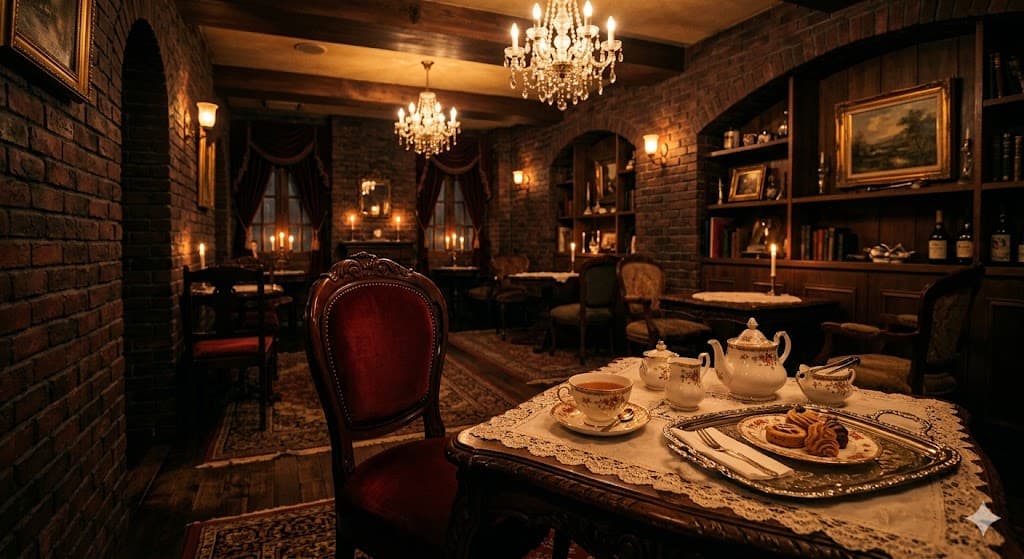
 Butler cafés reconstruct an idealized English mansion interior in a Tokyo basement, an afternoon-tea fantasy with deep historical roots.
The kissaten that learned to play dress-up
Japan's café culture grew out of the 喫茶店(Kissaten: a traditional coffee house) that took hold as coffee drinking spread during the Meiji and Taisho periods. Some of these early cafés already understood that the service could be the product as much as the coffee: in the Taisho era, Ginza establishments experimented with waitresses in Western-style uniforms as a deliberate draw for customers. The idea that a café could sell an atmosphere and a relationship, not just a drink, was in place a full century ago.
What the modern themed café added was a script. The guest is no longer a customer but a character, and the staff perform a role around them. That move — from serving a drink to staging a small play in which the guest is the protagonist — is the real invention, and everything else is variation on it.
Akihabara's maids and Ikebukuro's butlers
The maid café as we now know it began in 2001, when Cure Maid Café opened in Akihabara with a quiet, almost Victorian elegance rather than the loud, singing style that later became the stereotype. Through the early 2000s the format exploded across Akiba, and at its peak the district held hundreds of such shops. The customer base leaned male, the aesthetic leaned toward 萌え(Moe: a warm, protective affection for cute fictional characters), and the maid greeted you with the now-famous "welcome home" rather than "welcome in."
The butler café is the mirror image, and it has a clear birthplace. In 2006, a secondhand otaku-goods chain opened Swallowtail in a basement on Ikebukuro's 乙女ロード(Otome Rōdo: "Maiden's Road"), widely described as the world's first butler café. The company had done its market research and asked a simple question: what kind of themed café would draw women? The answer was a dim, brick-walled room styled like an old English mansion, where butlers in tails welcome each guest home as their returning lady or young master over afternoon tea. Where Akihabara is the men's capital, Otome Road became known as the "female Akihabara," a district built around shops for female fans, including a large 腐女子(Fujoshi: female fans of male-male romance) readership.
Why the servant, of all roles?
Here is the cultural knot worth untangling. In both cafés the fantasy is not to have power in the ordinary sense, but to be perfectly served — to be addressed as someone of rank, anticipated, attended to, and treated as the most important person in the room. The maid and the butler are not authority figures; they are the embodiment of devotion. Japan has a deep, lived familiarity with the idea that a relationship between a higher and a lower party can run on something warmer than a contract — the long apprenticeship, the senior who looks after the junior, the master and disciple bound by feeling rather than law. The themed café takes that intuition and pours it into a borrowed Western mold: the great house and its impeccable staff.
That mold is itself an inheritance. During 文明開化(Bunmei Kaika: the Meiji push toward "civilization and enlightenment"), Japan rebuilt the upper reaches of its society around Western forms — most famously at the 鹿鳴館(Rokumeikan: a Western-style social hall built in 1883), where the elite gathered under chandeliers over a French menu to perform a kind of "polite Europe." The butler café, a basement in Ikebukuro serving British-style afternoon tea, is the pop-culture descendant of that same gesture: an idealized West, reconstructed on Japanese soil, available for the price of admission. Black Butler, set in a Victorian mansion run by a flawless servant, sits comfortably inside this long tradition — which is exactly why its title opens a door onto something very Japanese.
What We Are Really Ordering with the Afternoon Tea
When I look at the butler café now, after many years of living outside Japan, the thing that strikes me is not the costume but the longing underneath it — and how particular that longing is.
 What the butler café truly serves is undivided, gentle attention, wrapped in the form of British afternoon tea.
The Western culture that marked me in my own youth was Hollywood films and Western rock, the Beatles and Deep Purple. For me, the West was not a refined, out-of-reach object to be revered; it was novel, electric, exciting — a fresh wind blowing into a young person's life through music and film. That is a different flavor of 西洋への憧れ(Seiyō e no Akogare: longing for the West) than the one the butler café trades in. The café is selling the other register: the West as formality, hierarchy, and gentility, the hush of a great house, the dignity of a servant who never breaks character. Both are real, and both are imagined — neither is the actual West so much as a screen onto which a wish is projected.
What the café sells, finally, is not Europe at all. It is the feeling of being held in someone's complete and gentle attention for an hour. The Victorian wrapping makes that wish socially safe and a little theatrical, but the appetite is universal, and the staging is the genuinely Japanese part — the same instinct that built a French pavilion in Meiji Tokyo, now miniaturized into a teacup on Otome Road. Standing outside it, I think of those Akihabara flyers I never accepted. I watched from the sidewalk then, and in a sense I am still watching, which may be the most honest way to understand a fantasy: from the doorway, fond of it, a little outside it.
FAQ
Q: Is a butler café the same thing as a maid café?
A: They share a structure — themed staff who treat you as the master or mistress of a household — but they target different audiences and moods. Maid cafés grew up in Akihabara catering largely to a male clientele and a cute, moe aesthetic, while the butler café was created in Ikebukuro with female guests in mind and a more restrained, elegant tone built around afternoon tea.
Q: Are these cafés about romance or sexual service?
A: No. They are role-play hospitality, closer to dinner theater than to anything illicit. The appeal is being addressed as nobility and receiving polished, attentive service in an elaborate setting; the relationship is performed and bounded, and the better-known venues lean heavily on atmosphere, food, and courtesy rather than flirtation.
Q: Does Black Butler depict a real historical Japan?
A: The series is set in an imagined Victorian England, not in Japan, so it is not a portrait of Japanese history. Its cultural interest for a Japanese audience lies elsewhere — in how the figure of the devoted butler resonates with a homegrown café subculture and with Japan's long fascination with an idealized West.
Key Insights to Remember
- The butler café is not a one-off novelty but the latest layer in a century-long Japanese practice of turning service into theater, where the staged relationship between guest and server is itself the product being sold.
- What both maid and butler cafés market is the experience of being perfectly attended to — devotion rather than dominance — which is why an "idealized servant" rather than an idealized ruler became the centerpiece of the fantasy.
- The Western dress of these spaces is a continuation of Meiji-era Westernization, not an import of the real West; the "Europe" on offer is a Japanese projection, which is what makes a title like Black Butler a clean entry point into Japanese, not British, culture.
Sources
- Become a Lady or Lord for the Day at Butler Cafe "Swallowtail" — tsunagu Japan
- Otome Road — MATCHA Japan Travel Guide
- Maid Cafes in Japan: Their History and Evolution — Unseen Japan
- Maid Cafés — Nippon.com
- Bunmei-kaika — Wikipedia
- Bunmei Kaika: Japan's Balance between Westernization and Traditional Values (Rokumeikan) — Japan's Samurai Revolution
About the author

Spoiler-free cultural deep-dives into anime, manga & live-action Japanese drama
- ●Tokyo-born, 3rd-generation Edokko (江戸っ子)
- ●Lifelong manga reader & anime viewer since the kaiju era
- ●Writes from outside Japan — distance as a cultural lens
- ●Spoiler-free · sourced · Kanji + Romaji + English
A Tokyo-born, 3rd-generation Edokko writer who has spent years living outside Japan. I use the anime, manga, and live-action Japanese drama you already love as a doorway into the folklore, language, religion, and everyday history behind them — written so even first-time fans can follow along, with sources for every claim.
Enjoy this article?
Get the next spoiler-free cultural deep-dive straight to your inbox.
Related Articles

My Neighbor Totoro and the Katori Senko: The Meiji Invention That Gave Japanese Summer Its Smell
How My Neighbor Totoro's summer evokes the katori senko, the Meiji-era mosquito coil whose spiral was imagined in 1895 by the wife of Kincho's founder.
8/8/2026

Anohana and Kingyo-sukui: Why Japan Replaced a Working Net With Paper That Dissolves
How Anohana's summer world explains kingyo-sukui, the festival stall game where Japan swapped a net that worked for a paper scoop designed to fail.
8/2/2026

Chibi Maruko-chan and Rajio Taisō: Why Japanese Kids Spend Summer Mornings Doing Radio Calisthenics in a Car Park
How Chibi Maruko-chan's Shōwa childhood preserves rajio taiso, the summer radio calisthenics Japan imported from an American insurer that dropped it a decade later.
8/1/2026

Rurouni Kenshin and Uchimizu: Why Old Tokyo Cooled Its Streets With a Ladle of Water
How the Meiji-era streets of Rurouni Kenshin open onto uchimizu — a summer custom that began as tea-ceremony courtesy and spread through Edo because of dust.
7/31/2026

Ace of Diamond and the Dirt of Koshien: Why Japan's Losing Teams Scoop Soil Into Their Bags
How Ace of Diamond treats Koshien as a destination, and why eliminated high school players kneel to fill bags with soil that groundskeepers blend by season.
7/30/2026
Neon Genesis Evangelion and the Walkman: Why Shinji Retreats Into His Headphones
Why does Shinji's SDAT cassette player feel so Japanese? From Sony's 1979 Walkman to quiet packed trains and the meiwaku ethic, a Tokyo-born writer unpacks the headphone culture behind Evangelion's most human prop.
7/23/2026