Solo Leveling and the Dan/Kyū System: Why Japan Reads Hunter Ranks Differently
How Solo Leveling's S-to-E hunter ranks land for Japanese viewers raised on the 段・級(Dan/Kyū) system — a ladder of accumulated effort, not a label of innate power.

Tokyo-born, 3rd-generation Edokko · writing on Japanese culture from outside Japan

Spoiler-Free Cultural Analysis
This article explores the Japanese 段・級(Dan/Kyū: grading) system that quietly sits behind how viewers in Japan absorb the hunter-rank hierarchy introduced in the first episode of Solo Leveling. No plot points beyond the opening setup are discussed — only the cultural lattice the show's S-to-E ranking sits on top of.
Key Takeaways
- The S, A, B, C, D, and E ranks that Solo Leveling introduces in its first episode are not a foreign invention dropped onto Japanese-speaking audiences — they slot neatly into a centuries-old domestic habit of grading human ability on a visible, step-by-step ladder.
- In the 段・級(Dan/Kyū) system used across 柔道(Jūdō: the way of softness), 剣道(Kendō: the way of the sword), 書道(Shodō: calligraphy), そろばん(Soroban: abacus arithmetic), and 囲碁(Igo: the board game Go), rank is something you accumulate slowly through effort, not something handed to you by an awakening event.
- Solo Leveling's premise — that once your magical rank is set at awakening, no further growth is possible — runs against the grain of the Japanese grading tradition, and that friction is part of what gives the show its unease for viewers raised inside the Dan/Kyū framework.
Key Terms Explained
- 段(Dan) / Higher Grade — The advanced tier of the Japanese grading ladder, beginning at 初段(Shodan: first dan) and continuing upward. In martial arts, this is the level associated with the black belt.
- 級(Kyū) / Lower Grade — The beginner-to-intermediate tier below dan. Numbering runs in reverse: a high-numbered kyū is a novice, and the number decreases as the practitioner improves.
- 段位制度(Dan'i Seido) / Grading System — The formal ladder that organizes practitioners from beginner to master, used in martial arts, board games, calligraphy, abacus, and tea ceremony.
- 黒帯(Kuro Obi) / Black Belt — The visible marker of having reached 初段(Shodan). Often misread overseas as the end of the journey; in Japan it is recognized as the entrance to it.
- 昇段審査(Shōdan Shinsa) / Promotion Examination — The formal test through which a practitioner is evaluated for promotion. Higher ranks add scrutiny of conduct, etiquette, and character alongside technical skill.
The Hierarchy That Was Never Mine
I never earned a rank. Not a 級(Kyū), not a 段(Dan), not in 柔道(Jūdō), not in 書道(Shodō), not in そろばん(Soroban: abacus arithmetic). The classmates around me who walked to weekend 道場(Dōjō: training hall) and came back with new belt colors were doing something my parents never signed me up for, and by the time I was old enough to sign myself up, I had already drifted onto other paths. So when I say the 段・級(Dan/Kyū) system is something I understand, I have to be honest: I understand it the way a city kid understands the sea — from photographs, from neighbors' stories, from the printed paper notices taped to the wall of the local 道場(Dōjō), from the television footage of promotion ceremonies on the evening news.
 The colored belts of Japanese martial arts make rank visible at a glance, a habit of mind that shapes how Japanese viewers read any ranking system.
That outsider angle inside my own culture turned out to be useful when I sat down with Solo Leveling's first episode. The show, adapted from a Korean web novel, walks the viewer carefully through its central mechanic: hunters are graded S, A, B, C, D, and E based on the magical power that awakens within them. The narration is patient. It is written for a global audience that may not know the rules. And yet, watching it as someone raised on Japanese television and Japanese schoolyard rumor about who had which color belt, I noticed that the explanation lands very differently on a Japanese-speaking viewer than it might on someone hearing about graded ranks for the first time. The grammar of the ranking was already familiar. The thing that felt strange — and I will get to it — was the small print underneath.
The Ladder Japan Built for Itself
To understand why a Japanese viewer absorbs Solo Leveling's hunter ranks so quickly, it helps to look at the ladder that already exists in the culture before the show arrives.
 The 段・級(Dan/Kyū) ladder reaches far beyond martial arts, organizing disciplines from 書道(Shodō) to そろばん(Soroban) on the same step-by-step structure.
The architecture of 段(Dan) and 級(Kyū)
The 段位制度(Dan'i Seido: grading system) was formalized in modern Japan by 嘉納治五郎(Kanō Jigorō: the founder of Jūdō) in the late nineteenth century. He needed a way to organize his students that was clearer than vague descriptions of skill. The solution was a two-tier ladder. Below the line sat the 級(Kyū), numbered downward toward zero — a practitioner might begin at sixth or fifth kyū and work down to first kyū. Above the line sat the 段(Dan), numbered upward — first dan, second dan, on toward the high reaches of the discipline.
What Kanō did was so practical that other arts adopted the same skeleton within a generation. 剣道(Kendō), 空手(Karate: empty-hand martial art), 合気道(Aikidō: the way of harmonizing energy), and eventually disciplines that had nothing to do with combat — 囲碁(Igo), 将棋(Shōgi: Japanese chess), 書道(Shodō), そろばん(Soroban), 茶道(Sadō: tea ceremony) — all settled onto variations of the same lattice. The 段・級(Dan/Kyū) became a generic civic technology in Japan: a shared way of saying, "this person has spent this many years getting this good at this thing, and we have looked at them and confirmed it."
Why the visible marker matters
What strikes me most as someone who watched the system from outside is how much of it is built to be read at a glance. The 黒帯(Kuro Obi: black belt) of 柔道(Jūdō) is the obvious example, but the principle runs through every discipline. In 囲碁(Igo) you can ask a player their dan and adjust the handicap stones on the board before the first move. In 書道(Shodō) your rank appears on the certificate hanging by the entrance of the classroom. The point of the visible marker is not to brag. It is to let everyone — teacher, peers, newcomers — know immediately how to relate to each other. Who bows first. Who teaches whom. Who sits where.
This is the part of the Japanese grading tradition that I think Western viewers most often miss. The rank is not really about the rank-holder. It is a piece of public infrastructure that lets the group function without anyone having to interrupt and ask. Solo Leveling's S-to-E ranking, with its color-coded hunter licenses and its instantly legible hierarchy at the raid gate, slips into this same socket. A Japanese viewer does not need the show to explain why everyone in the assembly hall already knows where Sung Jinwoo stands. We have been reading rooms by visible rank since we were children.
The slow accumulation underneath
Here is what is harder to convey to someone who only sees the black belt on screen. In the 段・級(Dan/Kyū) tradition, you cannot leap. There is no awakening event that hands you a fifth dan. Even prodigies must move through the lower kyū grades, sit for each 昇段審査(Shōdan Shinsa: promotion examination), and accumulate time-in-rank. The number on your certificate is, among other things, a measurement of how many years you have kept showing up. At higher dan grades, examiners begin looking past technique entirely and start grading your conduct, your composure, your treatment of juniors. The ladder is built on the assumption that character grows alongside skill, and that if the two have not grown together, you have not actually advanced.
This is the quiet contract underneath every Japanese grading discipline. It is also the contract Solo Leveling's premise breaks. The show tells us that once a hunter awakens at, say, E-rank, that hunter cannot grow past E-rank no matter how hard they work. Talent is fixed at the moment of revelation. For a Japanese audience trained on the 段・級(Dan/Kyū) habit of mind, that single sentence in the narration carries a weight that may not register the same way elsewhere. It is not just an unlucky premise for the protagonist. It is a refusal of the grading worldview itself — a world where the ladder has been sealed shut, and the years of effort that would normally move a person up the rungs have been declared meaningless.
What the Ladder Still Teaches, and What Gets Lost in Translation
I have lived outside Japan long enough now to have watched the 段・級(Dan/Kyū) idea travel into rooms where it was never meant to go. In conversations about Japanese martial arts with people I have met over the years, the word black belt almost always lands as a synonym for "best." The Hollywood inheritance is hard to shake. To get a black belt is to have arrived. In the Japanese understanding, the black belt is the door, not the destination — 初段(Shodan) is, quite literally, "first step." Above it stand seven, eight, nine more steps, each one demanding more years and, increasingly, more of the practitioner as a person.
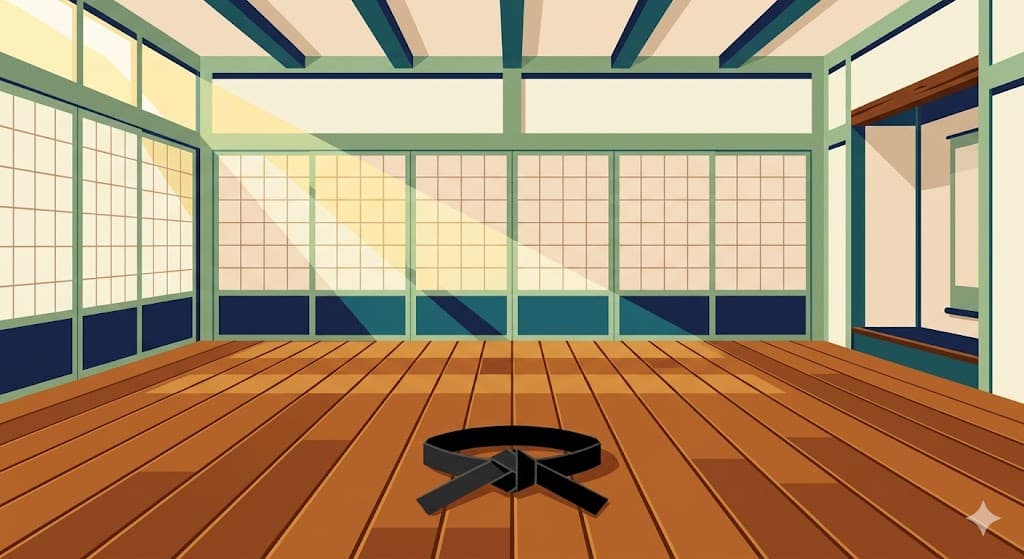 In the Japanese understanding, the black belt is the doorway into the dōjō's deeper study, not the trophy at its end.
When I try to explain this to someone overseas, the conversation often stalls at the same place: the listener wants to know how long it takes to reach the top. I have learned not to give a number, because the number misses the point. The 段・級(Dan/Kyū) tradition does not really have a top in the sense the question implies. It has a direction. The direction is upward, and the path is composed of small, slow, witnessed steps. The further along you are, the more of you the system is looking at — not just your hands and feet but your bearing, your patience, your willingness to bow to the person who taught you when you yourself have grown gray-haired.
There is something in this that modern life, in Japan and elsewhere, has been quietly letting go of. The grading ladder asks for years before it asks for anything else, and years are the one resource we are most impatient with now. I notice it when I watch shows like Solo Leveling become global hits. The premise — instant awakening, fixed rank, no growth possible — is, in a strange way, more compatible with the rhythm of a world that wants to know your value now, today, by your first test score, your first algorithm-detected aptitude, your first attempt. The slow ladder Kanō built, the one that grades you over decades and includes your character in the final mark, sits to one side of all that, harder to film, harder to broadcast, but still, somewhere, holding its shape.
FAQ
Q: Is the 段・級(Dan/Kyū) system used only in martial arts?
A: No. It originated in martial arts in the late nineteenth century but spread across non-combat disciplines including 囲碁(Igo), 将棋(Shōgi), 書道(Shodō), そろばん(Soroban), and 茶道(Sadō). Today it functions as a general-purpose Japanese way of grading skill across many fields.
Q: Does the black belt mean a person has mastered their art?
A: No. The black belt indicates 初段(Shodan), the first dan grade. In Japanese understanding it marks the beginning of serious study, not the end of it. Above first dan there are typically several further dan grades that take many more years to reach.
Q: How does Solo Leveling's hunter rank system differ from the 段・級(Dan/Kyū) system?
A: The two share a visible, hierarchical structure, but they part ways on a central point. The Dan/Kyū ladder assumes that rank is built up over time through training and that character is graded alongside skill. Solo Leveling's premise is that a hunter's rank is fixed at the moment of awakening and cannot be improved through effort.
Key Insights to Remember
- The Japanese habit of grading human ability on a visible, public ladder did not arrive with anime or video games. It is a piece of civic infrastructure built over more than a century, and it shapes how a Japanese audience instinctively reads any ranking system a story presents to them, including the one in Solo Leveling. When the show announces S, A, B, C, D, E, it is speaking a grammar the audience already knows.
- The most quietly radical thing about the 段・級(Dan/Kyū) tradition is that it grades character as part of skill, especially at the higher dan ranks. The promotion is not just for what you can do but for who you have become while learning to do it. Few modern measurement systems carry that double demand, and it is one of the things Japanese viewers may unconsciously miss when watching a story where rank is awarded by raw power alone.
- Solo Leveling's premise that awakened rank cannot grow is, viewed from inside Japanese culture, a deliberate inversion of an old domestic worldview. The ladder of accumulated effort has been replaced by a single, sealing moment of revelation. Whether the show is endorsing that inversion or quietly setting up a story that challenges it is part of what gives the first episode its tension for a viewer raised on the older idea.
Sources
- Jūdō Rank — Kōdōkan Judo Institute — Kōdōkan Judo Institute
- Dan (rank) — Wikipedia
- Kyū — Wikipedia
- Kanō Jigorō and the Founding of Modern Judo — Encyclopædia Britannica
- All Japan Kendo Federation — Grading System — All Japan Kendo Federation
- Solo Leveling (anime) — Wikipedia
About the author

Spoiler-free cultural deep-dives into anime, manga & live-action Japanese drama
- ●Tokyo-born, 3rd-generation Edokko (江戸っ子)
- ●Lifelong manga reader & anime viewer since the kaiju era
- ●Writes from outside Japan — distance as a cultural lens
- ●Spoiler-free · sourced · Kanji + Romaji + English
A Tokyo-born, 3rd-generation Edokko writer who has spent years living outside Japan. I use the anime, manga, and live-action Japanese drama you already love as a doorway into the folklore, language, religion, and everyday history behind them — written so even first-time fans can follow along, with sources for every claim.
Enjoy this article?
Get the next spoiler-free cultural deep-dive straight to your inbox.
Related Articles

My Neighbor Totoro and the Katori Senko: The Meiji Invention That Gave Japanese Summer Its Smell
How My Neighbor Totoro's summer evokes the katori senko, the Meiji-era mosquito coil whose spiral was imagined in 1895 by the wife of Kincho's founder.
8/8/2026

Anohana and Kingyo-sukui: Why Japan Replaced a Working Net With Paper That Dissolves
How Anohana's summer world explains kingyo-sukui, the festival stall game where Japan swapped a net that worked for a paper scoop designed to fail.
8/2/2026

Chibi Maruko-chan and Rajio Taisō: Why Japanese Kids Spend Summer Mornings Doing Radio Calisthenics in a Car Park
How Chibi Maruko-chan's Shōwa childhood preserves rajio taiso, the summer radio calisthenics Japan imported from an American insurer that dropped it a decade later.
8/1/2026

Rurouni Kenshin and Uchimizu: Why Old Tokyo Cooled Its Streets With a Ladle of Water
How the Meiji-era streets of Rurouni Kenshin open onto uchimizu — a summer custom that began as tea-ceremony courtesy and spread through Edo because of dust.
7/31/2026

Ace of Diamond and the Dirt of Koshien: Why Japan's Losing Teams Scoop Soil Into Their Bags
How Ace of Diamond treats Koshien as a destination, and why eliminated high school players kneel to fill bags with soil that groundskeepers blend by season.
7/30/2026

Neon Genesis Evangelion and the Walkman: Why Shinji Retreats Into His Headphones
Why does Shinji's SDAT cassette player feel so Japanese? From Sony's 1979 Walkman to quiet packed trains and the meiwaku ethic, a Tokyo-born writer unpacks the headphone culture behind Evangelion's most human prop.
7/23/2026