Naraku Meaning: The Buddhist Hell and Kabuki Trapdoor in Gachiakuta
How Gachiakuta uses naraku (奈落), a word for both a Buddhist hell and the dark space under a kabuki stage, to name its modern garbage pit.

Tokyo-born, 3rd-generation Edokko · writing on Japanese culture from outside Japan
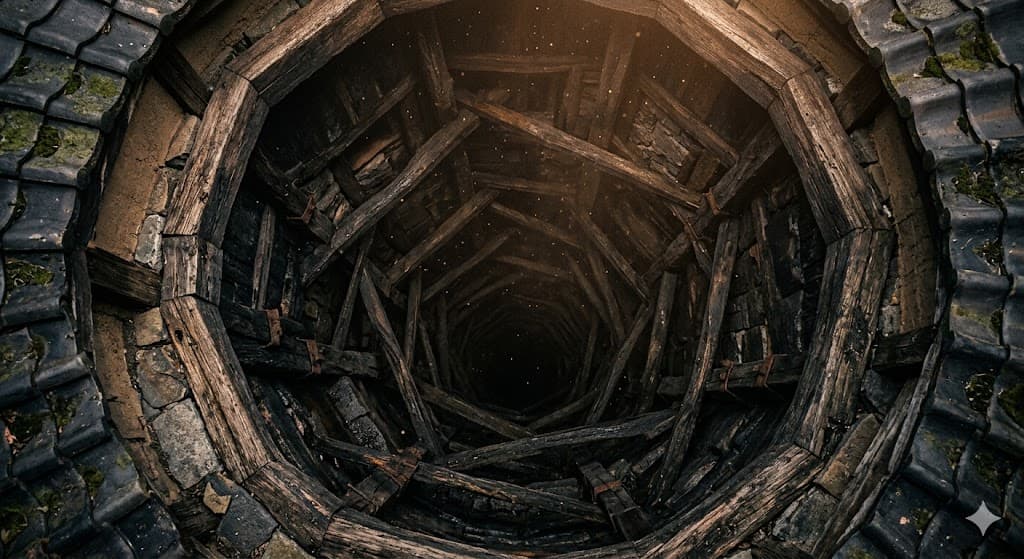
Spoiler-Free Cultural Analysis
This article explores the real linguistic and cultural history behind the word 奈落(Naraku) as it appears in the world-building of Gachiakuta's first episode. There are no plot spoilers — only the religious roots, theatrical vocabulary, and everyday idiom that converge on a single Japanese word.
Key Takeaways
- The Japanese word 奈落(Naraku) carries two completely separate meanings in the same two-kanji word: a Buddhist hell descended from Sanskrit naraka, and the underground machinery beneath a kabuki stage where actors vanish through trapdoors. Gachiakuta uses both layers at once.
- Despite a surface resemblance to 黄泉(Yomi) from older anime like Metallic Rouge, Naraku and Yomi belong to entirely different religious systems — Buddhist versus Shinto — and produce different bodily sensations: Naraku is sharply vertical and punitive, Yomi is horizontal and ancestral.
- The idiom 奈落の底(Naraku no soko: the bottom of Naraku) is how most modern Japanese speakers actually encounter the word — not as a temple lecture, but as a phrase for catastrophic financial, professional, or emotional collapse.
Key Terms Explained
- 奈落 (Naraku) / Buddhist Hell, also Kabuki Stage Trap — A loanword from Sanskrit naraka meaning a realm of punishment; later borrowed into kabuki vocabulary to name the dark space beneath the stage floor where actors disappear via a lift called せり(seri).
- 地獄 (Jigoku) / Hell — The general Japanese word for Buddhist hell, more common in everyday speech than 奈落 for the religious meaning.
- 黄泉 (Yomi) / The Land of the Dead — A Shinto concept of the dark realm of the dead, from the Kojiki creation myth. Not synonymous with Naraku — different religion, different geography, different feeling.
- せり (Seri) / Stage Lift — The platform mechanism in a kabuki theatre that raises or lowers actors and props between the stage and the space below (the Naraku).
- 奈落の底 (Naraku no Soko) / The Bottom of Naraku — An everyday idiom for a hopelessly deep low point in life, business, or fortune. Largely drained of religious meaning in modern usage.
A Security Guard's First Real Naraku
The first time I stood inside an actual 奈落(Naraku: the space beneath a theatre stage), I was working a security shift as a part-time job at 東京都文化会館(Tokyo Bunka Kaikan: a major performing arts hall in Ueno, Tokyo). A senior guard walked me down a narrow staircase behind the wings and into a dim, cavernous room beneath the boards. He pointed at the platforms, the counterweights, the trapdoor mechanisms, and said something I have never forgotten: "This is the real naraku."
 The dark space beneath a theatre stage — the literal naraku where actors and sets disappear through trapdoors.
I had known the word my whole life by that point. I had used it in conversation, read it in novels, watched newscasters speak of bankrupt companies plunging into the 奈落の底(Naraku no soko: the bottom of Naraku). But until I stood under those wooden boards looking up at the underside of a stage, I had never thought of Naraku as a place. It was an idiom, a feeling, a shape in the air when bad news arrived. Suddenly it had walls, dust, machinery, and a smell of old wood and motor oil.
That underground room reframed everything. The kanji 奈 and 落 had been bolted together in my head as a single block — a metaphor for falling. Now the block had cracked open into two distinct things: a Buddhist concept centuries older than the building above me, and a piece of stagecraft hardware specific to one of Japan's most famous theatre traditions. Watching Gachiakuta's first episode many years later, I realised the show was doing exactly what that older guard had done for me — quietly forcing both meanings into the same frame.
Related: Metallic Rouge and the Land of Yomi: Why Jaron of Yomi Is Not Just a Cool Villain Name explains this in detail.
The Twin Roots of a Single Word
The world of Gachiakuta is built around a literal pit. Garbage is thrown into it. Criminals are thrown into it. The town's social order rests on the threat of being cast down into the dark below. The show calls this pit 奈落(Naraku) — and that single naming choice is doing more cultural work than any English subtitle can carry. Before getting into how the show uses the word, it helps to look at the two separate histories that the word fuses.
The Sanskrit Inheritance: From Naraka to Naraku
The older of the two meanings is religious. 奈落 is one of several Japanese transliterations of the Sanskrit term naraka, the Buddhist (and pre-Buddhist Indian) word for a hell realm. In Buddhist cosmology, the naraka realms are domains where beings suffer the karmic consequences of unwholesome actions, but unlike the eternal hell of some other religions, residence is finite — when negative karma is exhausted, beings are reborn elsewhere.
 A traditional depiction of Buddhist hell, where the karmic body falls downward into naraka — the verticality the kanji has carried for over a thousand years.
When this concept travelled along the Silk Road into Chinese Buddhist texts and then into Japan, the Sanskrit naraka was rendered in kanji as 那落迦 or 奈落迦(Naraka: a sound-for-sound transliteration of Sanskrit naraka), later shortened to 奈落. The more common Japanese word 地獄(Jigoku: hell) eventually took over for everyday religious discussion, but 奈落 survived as a literary, more imposing variant — the word a sutra would use, the word a temple sermon might intone. Japanese Buddhism traditionally describes a system of multiple hells, including the so-called 八大地獄(Hachidai Jigoku: Eight Great Hells), each calibrated to specific categories of wrongdoing, with the lowest reserved for the gravest karmic offences.
For Gachiakuta's purposes, the crucial inherited feature is verticality. Buddhist hells are down. They are below the human world. You fall into them. They are not parallel realms or distant shores — they are pits, and the body falling into them moves on a downward axis. Everything in the show's visual grammar — the framing of the central hole, the cliff-edge gallows over it, the long drop into darkness — leans on this downward intuition that the kanji 奈落 has been carrying for over a thousand years.
The Kabuki Inheritance: The Trapdoor Beneath the Stage
The second meaning is far younger and entirely secular. By the Edo period, kabuki theatre had developed sophisticated stage machinery, including the すっぽん(Suppon: small trapdoor lift used for ghostly entrances) and various せり(seri: lifts) that allowed actors playing ghosts, demons, or supernatural beings to rise from beneath the stage or sink slowly out of sight. The space beneath the boards where this machinery lived — where stagehands cranked the counterweights, where actors waited in the dark to be hoisted up — came to be called, with a theatrical sense of humour and dread, the 奈落.
 A kabuki stage seen from above — beneath these polished boards lies the naraku, where stagehands wait in the dark to hoist actors skyward.
The borrowing is metaphorical but pointed. The space under a kabuki stage is dark, hidden from the audience, the architectural opposite of the bright lacquered surface above. When a wicked character is dragged downward through a trapdoor mid-scene, the visual logic mirrors the Buddhist cosmology exactly: the wrongdoer falls down, into the dark, out of the world of the living audience. The theatre vocabulary borrowed from religious vocabulary because the religious vocabulary already provided the shape of the gesture.
This is the meaning I was shown standing under the stage at Tokyo Bunka Kaikan — though that hall is a modern western-style theatre rather than a true kabuki house, the 奈落 terminology had bled into Japanese theatre vocabulary at large. The space below the stage in any theatre, in informal Japanese, is the Naraku.
The Idiom That Outlived Both Sources
For most modern Japanese speakers, neither the Buddhist nor the kabuki meaning is where the word lives. It lives in the idiom 奈落の底に落ちる(Naraku no soko ni ochiru: to fall to the bottom of Naraku) — used when a stock portfolio collapses, when a successful career suddenly implodes, when a public figure is disgraced overnight, when a relationship ends in a way that makes the ground feel like it has opened up.
I have used this phrase my whole adult life without once consciously summoning either a Buddhist hell or a kabuki trapdoor. The religious freight has been sanded down by centuries of idiomatic use. What remains is the vertical motion — the falling, the bottomlessness, the sense that climbing back up may not be possible. The kanji do the work even when the speaker has forgotten what they originally meant.
Why This Is Not 黄泉 (Yomi)
A note worth making: 黄泉(Yomi) and 奈落(Naraku) are not synonyms, and English subtitles sometimes blur the distinction. Yomi is Shinto, comes from the Kojiki creation myth, and is horizontal — Izanagi walks to and from it through the 黄泉比良坂(Yomotsu Hirasaka: the slope to Yomi). It is the ancestral realm of the dead, not a place of punishment. Naraku is Buddhist, descended from Sanskrit, and vertical — you fall into it as a karmic consequence. The two words come from different religious systems, different etymological roots, and produce different bodily intuitions. When Gachiakuta reaches for Naraku rather than Yomi for its central pit, it is reaching for the punitive, vertical, Buddhist register — not the elegiac Shinto one.
What Naraku Becomes in a World That Has Forgotten Its Origins
Watching Gachiakuta's first episode after many years living outside Japan, I noticed something that probably would have escaped me if I had stayed inside the language all along. The show isn't just borrowing the word 奈落 as a name — it is literalising all three meanings at once.
The pit at the centre of the town is, simultaneously, a Buddhist hell (criminals are condemned to fall into it as punishment), a kabuki-style trapdoor (the social spectacle of execution happens at its edge, with the condemned dropped vertically out of sight of the living), and a modern garbage dump (refuse from the gleaming city above is jettisoned downward). Three meanings of one word compressed into one location. As a piece of world-building, this is denser than the subtitles can carry.
But this density also speaks to something I've felt during long years away from Japan — the slow erosion of awareness about what the country's own vocabulary used to contain. When I use 奈落の底 in conversation now, I notice that younger speakers respond to it as pure idiom, with the underlying images of pit and stagecraft and karmic falling no longer attached. The word still works. It still conveys catastrophic collapse. But it has become flat — a single layer where three used to live.
Living in a place with no equivalent word — no single term that fuses religious punishment, theatrical machinery, and modern waste disposal into one term — has made me more attentive to what Japanese has historically been able to do with a single word. There is no easy parallel to 奈落 in the local vocabulary around me. "Hell" carries the religious load. "Trapdoor" carries the theatrical. "Dump" carries the disposal. Three separate words for what Japanese binds into one. Gachiakuta's gift, I think, is that it reminds Japanese viewers — and gives non-Japanese viewers a first chance to notice — that this binding is not accidental. The word remembers things even when the speakers do not.
There is also something honest about a show built around a pit. The Edo-period kabuki audience knew that beneath the polished stage, the Naraku was full of dust, ropes, sweating stagehands, and mechanisms held together by improvisation. The town in Gachiakuta keeps its surface clean by pretending the Naraku beneath it is somewhere else, somewhere it doesn't need to think about. Anyone who has watched a modern city function knows the gesture. The waste is always going somewhere. The vocabulary of Naraku, with all three of its meanings stacked together, refuses to let the surface forget the pit.
FAQ
Q: What does 奈落 (Naraku) mean?
A: 奈落 has three overlapping meanings in Japanese. (1) Buddhist hell — a Sanskrit-derived term (naraka) for the lowest realm of suffering. (2) The trapdoor space beneath a kabuki stage, where stagehands hide and props vanish. (3) By extension, the abyss or pit — and in Gachiakuta, literally the garbage dump where the lowest class is sent. The word carries all three layers at once, which is exactly why the name hits so hard.
Q: Is 奈落 (Naraku) the same as 地獄 (Jigoku)?
A: They overlap but are not interchangeable. Both can refer to Buddhist hell, but 地獄 is the everyday word used in casual speech, religious instruction, and most pop culture depictions of hell. 奈落 is more literary and archaic in its religious sense, and uniquely carries the secondary meaning of the space beneath a kabuki stage — a meaning 地獄 does not have.
Q: Did the kabuki theatre invent the word 奈落, or borrow it?
A: Kabuki borrowed it. The Buddhist meaning came first, transliterated from Sanskrit naraka centuries before kabuki existed as an art form. Edo-period theatre culture appropriated the word metaphorically for the dark space below the stage, because the religious vocabulary of a dark realm of falling already matched what was happening when actors descended through trapdoors.
Q: How is 奈落 different from 黄泉 (Yomi)?
A: They come from different religious systems entirely. Yomi is Shinto, native to Japan, and appears in the Kojiki creation myth as a horizontal realm of the dead reached by walking down a slope. Naraku is Buddhist, originally Indian, and is vertical — a pit you fall into as karmic punishment. Yomi is ancestral and mournful; Naraku is punitive and downward. The two should not be translated with the same English word.
Key Insights to Remember
- A single Japanese kanji compound can carry layered histories that English needs three separate words to render. 奈落 fuses Sanskrit Buddhist cosmology, Edo-period theatre engineering, and a modern idiom of collapse into one expression — and Gachiakuta's first episode activates all three layers simultaneously without explanation, trusting Japanese viewers to feel the resonances even when they cannot name them.
- The geography of the afterlife in Japanese is not monolithic. Yomi (Shinto, horizontal, ancestral) and Naraku (Buddhist, vertical, punitive) belong to two religious systems that arrived in Japan centuries apart and were never fully synthesised. Anime that draw on one or the other are reaching for very different emotional registers, and conflating them in translation flattens distinctions that the original language carefully preserves.
- Idiom is where dead etymology lives on. Most Japanese speakers using 奈落の底 today are not consciously summoning a Buddhist hell or a kabuki trapdoor, but the vertical falling motion the word carries — its sense of bottomlessness — is the inherited residue of those older meanings. Watching a work like Gachiakuta literalise the idiom back into an actual pit is one of the small pleasures of seeing how anime can re-enchant words that everyday speech has worn smooth.
Sources & References
- Naraka (Buddhism) — Wikipedia entry on the Buddhist concept of Naraka, its Sanskrit origins, and its cosmological structure.
- Jigoku (Japanese Buddhist Hell) — Background on Japanese Buddhist conceptions of hell and the system of multiple hot and cold hells.
- Kabuki Stage Mechanisms — Official kabuki resource on stage architecture, including seri lifts and the underground naraku space.
- Kojiki and the Yomi Myth — Britannica overview of the Shinto land of the dead and its relationship to the Izanagi-Izanami creation narrative.
- Sanskrit Loanwords in Japanese Buddhist Vocabulary — International Research Center for Japanese Studies materials on the transmission of Buddhist terminology into Japanese.
About the author

Spoiler-free cultural deep-dives into anime, manga & live-action Japanese drama
- ●Tokyo-born, 3rd-generation Edokko (江戸っ子)
- ●Lifelong manga reader & anime viewer since the kaiju era
- ●Writes from outside Japan — distance as a cultural lens
- ●Spoiler-free · sourced · Kanji + Romaji + English
A Tokyo-born, 3rd-generation Edokko writer who has spent years living outside Japan. I use the anime, manga, and live-action Japanese drama you already love as a doorway into the folklore, language, religion, and everyday history behind them — written so even first-time fans can follow along, with sources for every claim.
Enjoy this article?
Get the next spoiler-free cultural deep-dive straight to your inbox.
Related Articles
Chihayafuru and the World of Competitive Karuta: The Speed, Silence, and Poetry Behind Japan's Fiercest Card Game
How Chihayafuru reveals competitive karuta, where poems from the 13th-century Hyakunin Isshu meet athletic reflexes and matches turn on hundredths of a second.
7/28/2026
Chainsaw Man and Why Every Japanese Dog Is Named Pochi: The Hidden History Behind Pochita
How Chainsaw Man's Pochita carries the history of Pochi, the Meiji-era nickname that became Japan's default dog name — and what that says about loyalty.
7/11/2026

Naruto and Yakuwarigo: The Real Meaning of Dattebayo and Why Translators Invented Believe It!
How Naruto's famous verbal tic dattebayo opens the door to yakuwarigo, Japan's role language system, and why English translators had to invent Believe it!
7/4/2026

Evangelion's Angels and Japan's Decorative Christianity
How Neon Genesis Evangelion's enemies are 使徒 (apostle) in Japanese but Angel in English — and how Japan wears Christianity as aesthetic, not faith.
7/3/2026

Solo Leveling and Te-ate: Why the Japanese Word for Treatment Means Placing the Hand
How Solo Leveling's healing magic opens onto te-ate, the Japanese word for treatment whose root is the simple act of placing a hand on a wound.
6/26/2026

Detective Conan and the -kun You Didn't Expect: How Japanese Honorifics Really Work
How Detective Conan reveals that the honorific -kun is not male-only — an inspector calls teenage Ran 'Ran-kun', a hierarchy English subtitles quietly drop.
6/11/2026