Metallic Rouge and the Land of Yomi: Why Jaron of Yomi Is Not Just a Cool Villain Name
How Metallic Rouge's Jaron of Yomi draws on the Kojiki's underworld — a Shinto death realm distinct from Buddhist hell and Greek Hades.

Tokyo-born, 3rd-generation Edokko · writing on Japanese culture from outside Japan

Spoiler-Free Cultural Analysis
This article explores the Shintō underworld behind a single villain epithet in Metallic Rouge Episode 1 — no plot beats, no character arcs, no story spoilers. Only the cultural and mythological background that gives the name its weight in Japanese.
Key Takeaways
- The Japanese word 黄泉(Yomi: the realm of the dead in Shintō myth) is not a Buddhist hell, not a Greek Hades, and not a Christian Hell. It is a much older, gloomier, and morally neutral place described in the 古事記(Kojiki: Japan's oldest surviving chronicle, 712 CE).
- The Kojiki's account of Izanagi fleeing Yomi — throwing peaches at his pursuers, sealing the border with a great rock — quietly shaped a thousand years of Japanese imagination, including the magic peach in Momotarō and a long line of "boundary between worlds" tropes in anime.
- An epithet like 黄泉のジャロン(Yomi no Jaron: "Jaron of Yomi") in Metallic Rouge is not a generic "lord of darkness" tag. It points specifically to a Shintō death realm associated with shapeshifting, decay, and the breaking of promises — which is why the name fits a body-mimicking assassin.
Key Terms Explained
- 黄泉 (Yomi) / The Land of the Dead — The dim, polluted realm where the dead reside in Shintō cosmology, described in the Kojiki as a place beneath or beyond the world of the living.
- 黄泉比良坂 (Yomotsu-Hirasaka) / The Even Pass of Yomi — The slope or border between the world of the living and the world of the dead, sealed by Izanagi with a massive boulder.
- 黄泉戸喫 (Yomotsu-hegui) / Eating the Food of Yomi — A taboo concept: once you eat food cooked at the hearth of Yomi, you belong to that world and cannot return to the living.
- 根の国 (Ne no Kuni) / The Root Country — A related "lower world" sometimes equated with Yomi, sometimes treated as a distinct underworld linked to the god Susanoo.
- 穢れ (Kegare) / Ritual Pollution — The Shintō concept of spiritual impurity; contact with death, including with Yomi itself, makes one kegare and requires ritual cleansing.
A Villain Name That Slid Past Me
When Metallic Rouge Episode 1 introduced its smiling, body-mimicking antagonist as 黄泉のジャロン(Yomi no Jaron: "Jaron of Yomi"), I will admit something a little embarrassing for a Tokyo-born writer: my first reaction was simply, "that sounds like a cool 中二(chuuni: adolescent edginess)-style epithet." The Shintō weight of the word 黄泉(Yomi) didn't ring any bells for me in real time. It just registered as villain branding.
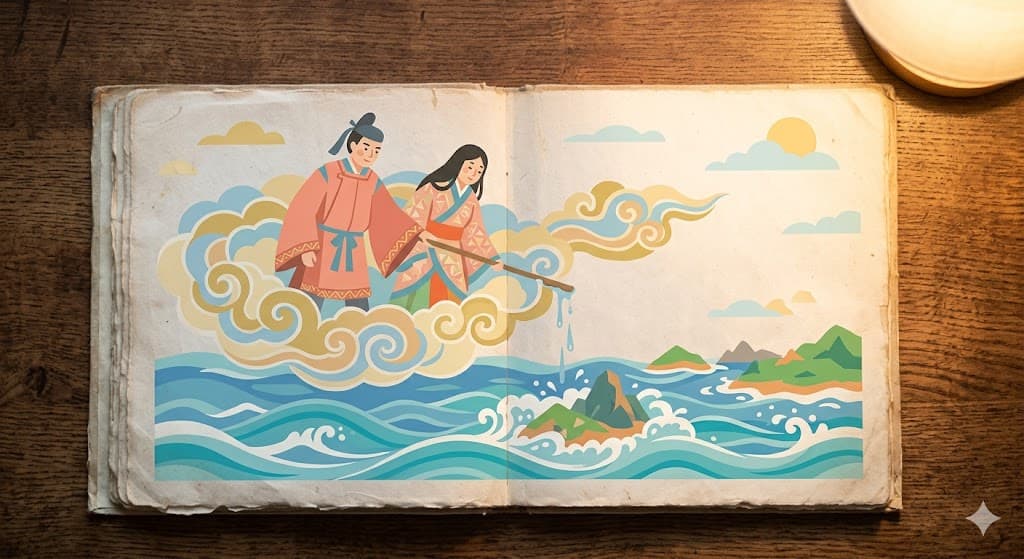 A 江戸っ子(Edokko) childhood was full of Kojiki picture books — but the strange details of the Yomi descent rarely stuck.
That gap is itself the story I want to tell. I grew up in Tokyo as a 江戸っ子(Edokko: a third-generation native of the old downtown). I read 古事記(Kojiki) episodes in children's picture books and 学研(Gakken: a major Japanese educational publisher) historical manga as a kid. I almost certainly read the Izanagi-Izanami sequence — the descent into Yomi, the rotting bride, the chase, the peach. And I remembered almost none of it. For most of my life I half-believed Yomi was somewhere bright, up in the sky — the kanji 黄(yellow) and 泉(spring/fountain) somehow suggested a golden, heavenly fountain to me, the exact opposite of what the text actually describes.
It was only as an adult, rereading Japanese mythology in book form, that I realized: Yomi is dark, underground, polluted, and old — much older than Buddhism's neat circles of hell, much stranger than the tidy good-versus-evil afterlife of Western fiction. And once I saw that, the name "Jaron of Yomi" stopped being a generic spooky tag and started pointing at something very specific.
Related: Naraku Meaning: The Buddhist Hell and Kabuki Trapdoor in Gachiakuta explains this in detail.
What the Kojiki Actually Says About Yomi
The Descent of Izanagi
The 古事記(Kojiki: compiled in 712 CE) tells of two creator deities, イザナギ(Izanagi) and イザナミ(Izanami), who together gave birth to the islands of Japan and to many of the kami. Izanami dies giving birth to the fire god, and Izanagi — heartbroken — descends into 黄泉(Yomi) to retrieve her.
What he finds there is not a serene afterlife. Yomi is described as a place reached by passage, lit dimly, where the dead are already changed. Izanami greets him from inside a hall and warns him: she has already eaten food cooked at the hearth of Yomi — 黄泉戸喫(Yomotsu-hegui) — and so she belongs to this world now. She begs him not to look at her while she petitions the gods of Yomi for permission to leave.
Izanagi cannot wait. He lights a tooth from his comb as a torch and looks. What he sees is his wife's body in advanced decay, with eight thunder gods born from her corruption. He runs.
The Peach at the Border
What follows is one of the most quietly influential chase scenes in all of Japanese literature. Izanami sends the 予母都志許売(Yomotsu-shikome: the hags or ugly women of Yomi) after him, then the thunder gods, then a host of warriors. Izanagi flings off his hair ornament, which becomes wild grapes; he throws his comb, which becomes bamboo shoots — each delays the pursuers, who stop to eat. At last, at the foot of the slope called 黄泉比良坂(Yomotsu-Hirasaka: the "Even Pass of Yomi"), he finds three 桃(momo: peach) fruits growing on a tree and hurls them at his pursuers. The peaches drive them back.
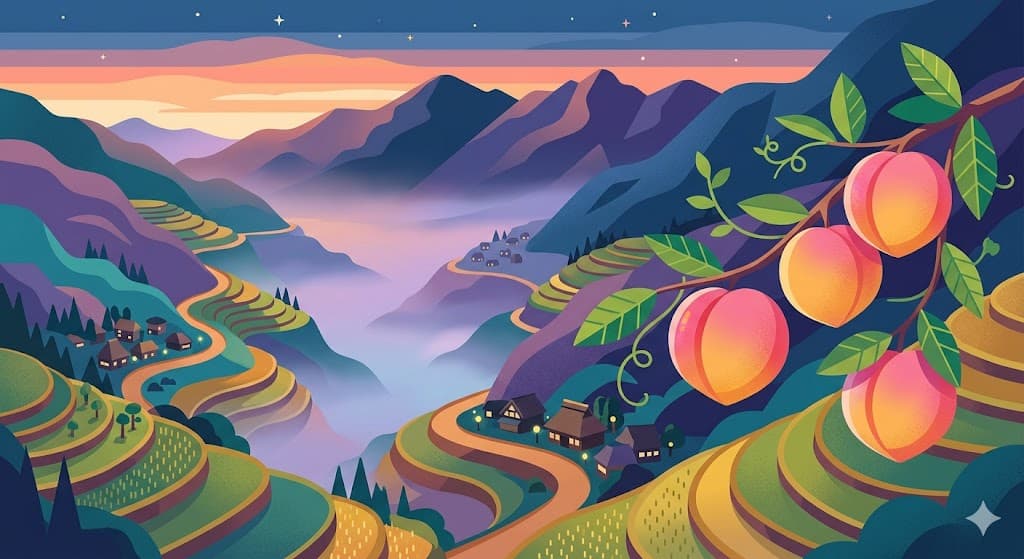 At 黄泉比良坂(Yomotsu-Hirasaka), three peaches become the first weapon ever blessed against the dead in Japanese myth.
Izanagi then blesses the peach itself, naming it 意富加牟豆美命(Ohokamuzumi-no-Mikoto: the Great Divine Fruit deity) and asking it to do for human beings, in their times of suffering, what it has just done for him. He seals the slope with a boulder so vast it would take a thousand men to move. On one side of that rock stands Izanami, mistress of Yomi. On the other stands Izanagi, who immediately performs 禊(Misogi: ritual purification by water) to wash off the kegare of his journey.
That is the scene. It is short, but almost every element in it matters.
Yomi Is Not Hell
Reading this carefully, a few things become obvious — and they are exactly the things that get lost when Yomi is translated as "Hell" or "underworld" in English.
First, Yomi is not a place of punishment. Nobody is being tortured. Izanami is there because she died, not because she sinned. Shintō does not have a concept of original sin or of postmortem judgment in the Christian sense. The dead simply go to Yomi.
Second, Yomi is defined by 穢れ(Kegare: ritual pollution), not by evil. The horror Izanagi feels is not moral horror at wickedness — it is physical and spiritual horror at decay, at the sight of his wife transformed by death. When he escapes, he does not pray for forgiveness. He bathes. The problem is contamination, not guilt.
Third, the boundary is real and physical. 黄泉比良坂(Yomotsu-Hirasaka) is not a metaphor; it is a place, traditionally identified with a real location in 島根県(Shimane-ken: Shimane Prefecture). The dead are not "elsewhere" in some abstract sense. They are right there, just past a sealed slope.
This is why Yomi sits in such a strange position when compared with the Buddhist 地獄(jigoku: hell) that arrived later from China and India, or with the Greek Hades, or with Christian Hell. It predates all of them in the Japanese imagination. It belongs to a layer of belief that is older than the moral architecture most modern audiences expect from "the land of the dead."
The Peach Connection That Hides in Plain Sight
There is a second thing the Kojiki passage quietly does, and it took me until adulthood to notice. The 桃(momo: peach) has held a magical, demon-repelling reputation in East Asian thought for a very long time, and the Kojiki gives the Japanese version its origin myth.
When I was a child, I knew 桃太郎(Momotarō: the boy born from a peach who defeats the ogres of 鬼ヶ島(Onigashima: Demon Island)). I did not connect that peach to the peaches Izanagi threw at the hags of Yomi. To me, Momotarō was just a strange, charming story about a boy emerging from a giant fruit pulled out of a river. The link between "the fruit that drove back the dead" and "the fruit that produced an 鬼(oni: ogre/demon)-slayer" was completely invisible.
Once you see it, though, you cannot unsee it. The peach in Japanese folklore is not just any fruit. It is, by mythological pedigree, the fruit that closes the door between worlds.
What "Yomi no Jaron" Is Quietly Doing
Why the Epithet Fits This Particular Villain
Now circle back to Metallic Rouge. The character introduced as 黄泉のジャロン(Yomi no Jaron) is established in Episode 1 as someone who mimics other people, who turns up wearing borrowed faces, who unsettles the rules about what is alive and what is not. Pair that with what the Kojiki tells us about Yomi — a realm of decay, of changed forms, of broken promises (Izanami's promise not to be looked at; Izanagi's promise to wait) — and the epithet stops being decorative.
A villain "of Yomi," in the Shintō sense, is not "of darkness" in the Western dramatic sense. He is "of the place where bodies do not stay the same shape," "of the place that contaminates whatever it touches," "of the place behind the sealed boulder that keeps trying to push back through." That is a much more specific accusation than "evil guy."
Why I Missed It the First Time, and Why That Matters
I want to be honest about something, because this site is meant for readers who are interested in the cultural layer behind anime. When I first watched Episode 1, the Yomi reference did not register on me at all. I had to pause, go back to the Kojiki, and rebuild the connection. I am Japanese, born and raised in Tokyo, and the resonance was not automatic.
There is a reason for that, and it is worth naming. For most modern Japanese people, including me, the default mental image of "the boundary to the next world" is not 黄泉比良坂(Yomotsu-Hirasaka) at all. It is 三途の川(Sanzu-no-Kawa: the "River of Three Crossings"), which is a Buddhist import. We hear about Sanzu-no-Kawa at funerals, at memorial services, in countless ghost stories. Yomotsu-Hirasaka, by contrast, lives almost entirely in the textbook. It is older, more original to Japan, and yet less alive in daily speech than the imported Buddhist version.
So when an anime series like Metallic Rouge reaches past the Buddhist layer and grabs something specifically from the Shintō layer — Yomi rather than jigoku, the Kojiki rather than Buddhist sutras — it is doing something more deliberate than picking a spooky-sounding word. It is reaching for the older, weirder Japan that lives underneath the Japan of funerals.
What Outside Distance Lets Me See
Living outside Japan for many years has done one strange thing for me: it has made the very distinction between 黄泉(Yomi: Shintō), 地獄(jigoku: Buddhism), and Hell (Christianity) much sharper in my head than it ever was when I lived in Tokyo. Inside Japan, those three blur together easily. New Year shrine visit, August 盆(Bon: the summer festival honoring ancestral spirits), December Christmas cake — nobody is keeping a clean ledger. The afterlife concepts blur right along with the calendar.
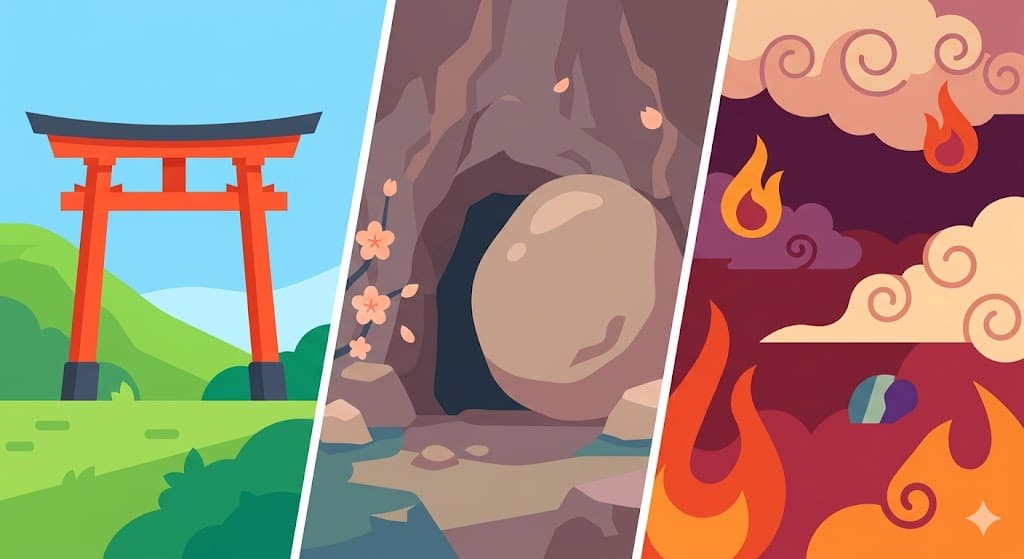 Yomi, jigoku, and Hell sit on three different mythological layers — and the differences only sharpen from a distance.
From outside, where most people I meet were raised inside one of the three systems and not the other two, the differences become visible by contrast. Yomi has no devil. Yomi has no judgment. Yomi has no fire. Yomi has decay, and a sealed boulder, and a peach. That is a very different myth, and it is one of the things modern Japan has very nearly let slide out of its everyday imagination, kept alive almost entirely by the writers and animators who keep reaching back for it.
Which means that when a series puts the word 黄泉 right into a villain's name, in a world full of cyberpunk replicants and corporate conspiracies — that's not laziness. That's a small, deliberate act of cultural retrieval. Someone in the writers' room knew exactly what older layer they were tapping into, even if a viewer like me, half-watching on a quiet evening, slid right past it the first time.
FAQ
Q: Is Yomi the same as the Buddhist hell (jigoku)?
A: No. 黄泉(Yomi) is the older Shintō realm of the dead described in the Kojiki — a place of pollution and decay, but not of punishment for sin. 地獄(jigoku) is a Buddhist concept that arrived in Japan later, with explicit hells for specific sins and a system of judgment. They sit on different mythological layers, even though modern Japanese speakers sometimes use the words loosely.
Q: Why does Izanagi throw peaches at the pursuers from Yomi?
A: In East Asian folk belief, the peach has long been considered effective against malign spirits. The Kojiki gives the Japanese version of that belief its founding moment: Izanagi throws three peaches at the hags of Yomi at the boundary slope, drives them back, and formally blesses the peach to do the same for human beings in distress. This same peach symbolism echoes later in the folktale of 桃太郎(Momotarō: the peach-born boy who defeats the ogres).
Q: Is Yomotsu-Hirasaka, the "Even Pass of Yomi," a real place?
A: Tradition identifies it with a specific location in 島根県(Shimane-ken: Shimane Prefecture), near 松江(Matsue: a city in Shimane Prefecture), where a site is shown as the legendary boundary. Whether you take that as historical or symbolic is up to you — but the Japanese imagination has attached the myth to a real geography, which is part of why Yomi feels so concretely "next door" rather than abstractly "elsewhere."
Key Insights to Remember
-
The Shintō underworld is structurally unlike Christian Hell or even Buddhist 地獄(jigoku). It is older, morally neutral, defined by 穢れ(Kegare: ritual pollution) rather than by sin, and bordered by a physical slope rather than by a moral judgment. Reading Japanese myth as if it were a translation of Western afterlife concepts strips out almost everything that makes it distinctive.
-
Anime epithets that reach for Shintō-specific vocabulary — 黄泉(Yomi), 根の国(Ne no Kuni), 黄泉戸喫(Yomotsu-hegui) — are doing something more pointed than generic "dark fantasy" branding. They are reaching past the imported Buddhist afterlife (which dominates Japanese funerary culture) into a much older mythological substrate that survives mostly in literature and creative work, not in everyday speech.
-
The peach in Japanese culture is not a generic fruit. It is, by Kojiki pedigree, the fruit that drove back the dead at the border of worlds. The straight line from Izanagi's three peaches to Momotarō's giant peach to the peach motifs scattered across modern manga and anime is one of those threads that becomes visible only after you reread the source — and once it's visible, an enormous amount of Japanese folk imagery suddenly clicks into place.
Sources & References
- Kojiki — English translation by Basil Hall Chamberlain — Sacred-Texts archive
- Encyclopedia of Shinto — Kokugakuin University
- Izanagi and Izanami — Encyclopedia Britannica
- Metallic Rouge — Official site — BONES / Metallic Rouge Production Committee
About the author

Spoiler-free cultural deep-dives into anime, manga & live-action Japanese drama
- ●Tokyo-born, 3rd-generation Edokko (江戸っ子)
- ●Lifelong manga reader & anime viewer since the kaiju era
- ●Writes from outside Japan — distance as a cultural lens
- ●Spoiler-free · sourced · Kanji + Romaji + English
A Tokyo-born, 3rd-generation Edokko writer who has spent years living outside Japan. I use the anime, manga, and live-action Japanese drama you already love as a doorway into the folklore, language, religion, and everyday history behind them — written so even first-time fans can follow along, with sources for every claim.
Enjoy this article?
Get the next spoiler-free cultural deep-dive straight to your inbox.
Related Articles
Spirited Away and Kamikakushi: The Folklore Behind the Title
Spirited Away's Japanese title ends in kamikakushi. Learn who villages said took children away, why dusk was the dangerous hour, and how they searched for them.
10/25/2026
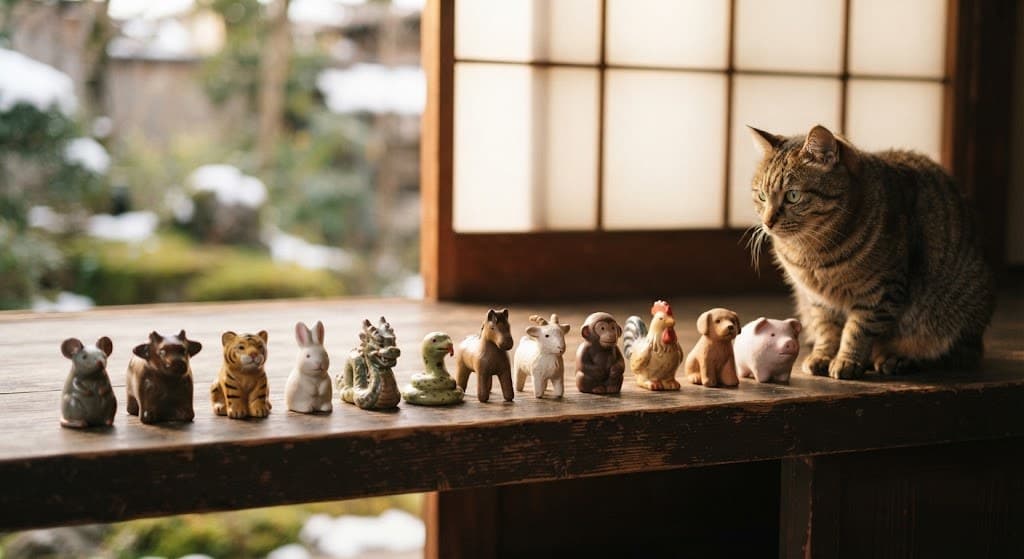
Fruits Basket and the Zodiac Cat: The Real Japanese Folktale of the Cat Who Missed the Banquet
How Fruits Basket builds its outsider cat on the real Japanese folktale of the rat tricking the cat out of the zodiac, and what eto still means in Japan today.
10/20/2026

March Comes in Like a Lion and Tsukimi: Why Japan Watches the Moon With Rice Dumplings and Pampas Grass
How March Comes in Like a Lion opens onto tsukimi, Japan's moon-viewing harvest observance, and why dumplings, pampas grass and a shifting date belong to it.
8/17/2026

Summer Time Rendering and the Shoryo-uma: The Cucumber Horse That Carries the Dead Home
How Summer Time Rendering's Obon homecoming opens onto shoryo-uma, the cucumber horse for returning ancestors, and why it is only one of many regional forms.
8/16/2026

GeGeGe no Kitaro and Hyakumonogatari: Why Japan Saves Its Ghost Stories for Summer
How GeGeGe no Kitaro connects to hyakumonogatari, the hundred-candle ghost game, and the Edo custom of staging horror in summer to chill the audience.
8/11/2026

Demon Slayer Infinity Castle and the Biwa: Heike and Hōichi
How the biwa that opens Demon Slayer's Infinity Castle leads to blind Heike reciters and Hōichi, who played night after night for a court that was not there.
8/7/2026