Let This Grieving Soul Retire! and the Culture of 闇鍋 (Yami-nabe): The Japanese Dinner Party Played as Roulette
How Let This Grieving Soul Retire! mirrors Japan's 闇鍋 (Yami-nabe) tradition — a cultural history of the dark-pot dinner from Edo dorms to modern variety TV.

Tokyo-born, 3rd-generation Edokko · writing on Japanese culture from outside Japan
Spoiler-Free Cultural Analysis
This article uses the first-episode setup and the next-episode subtitle of Let This Grieving Soul Retire! — the formation of a hastily assembled four-person party — as a doorway into the real Japanese tradition of 闇鍋(Yami-nabe: the "dark pot"). No plot beyond the opening is discussed; the focus is on the cultural history of a strange shared meal.
Key Takeaways
- 闇鍋(Yami-nabe) is a Japanese communal hotpot in which each participant secretly contributes one ingredient, the lights are killed, and everyone fishes blindly into the pot — half meal, half dare, and entirely a social ritual about trust and chance.
- The custom traces back to late Edo and Meiji-era student lodgings and 武家奉公人(buke-hōkōnin: samurai-house servants), where a low-budget evening of pooled scraps doubled as a test of courage among peers stuck living together.
- Postwar Japan kept Yami-nabe alive inside university clubs, sports-team training camps, and company dorms, before TV variety shows in the 1990s and 2000s turned it into a national punishment-game spectacle that today's anime — including the "闇鍋パーティ(Yami-nabe Party)" subtitle of Let This Grieving Soul Retire! — still references as shorthand for "people who barely know each other risking something together."
Key Terms Explained
- 闇鍋 (Yami-nabe) / Dark Pot — A communal hotpot eaten in darkness, with each diner secretly adding an ingredient and pulling something out at random.
- 鍋 (Nabe) / Pot, Hotpot — Both the cooking vessel and the genre of Japanese one-pot meals built around it; the social grammar of Japanese winter eating.
- 寄せ鍋 (Yose-nabe) / Gathered Pot — A standard mixed hotpot where ingredients are openly chosen for balance; the "civilised" cousin of Yami-nabe.
- 罰ゲーム (Batsu-gēmu) / Punishment Game — A staple Japanese variety-show device where a loser must eat or do something unpleasant; the natural modern home of Yami-nabe.
- 余興 (Yokyō) / Side Entertainment — The category of after-dinner amusements at gatherings, where Yami-nabe historically belonged: not the meal itself, but the show around it.
A Mystery Pot Watched From the Other Side of the Screen
The honest truth is that I have never actually eaten 闇鍋(Yami-nabe: dark pot). My entire mental image of it was built sitting in front of a television. Late-night Japanese variety programs — ガキの使い(Gaki no Tsukai: a long-running Japanese variety show), the various とんねるず(Tonneruzu: a Japanese comedy duo) specials, the long lineage of comedians being filmed gagging on something unidentifiable — taught me what Yami-nabe was supposed to look like long before I ever saw the word printed in a book.
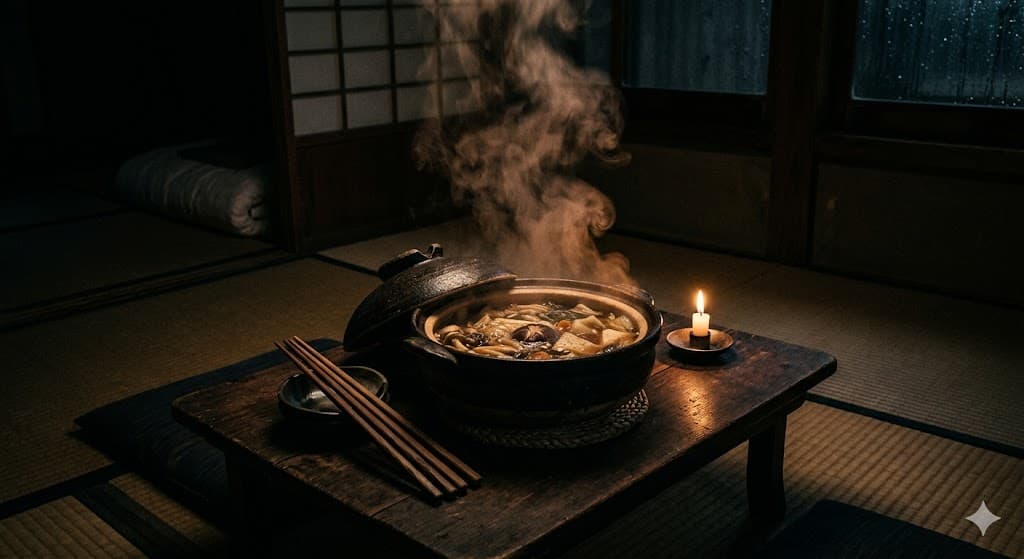
 A simmering communal pot — the everyday vessel that Yami-nabe quietly weaponises against its own diners.
I never came across it in my own life. Even during my years at 日本体育大学(Nippon Sport Science University: a sports-focused university in Tokyo), where the cultural script for "athletes living together at a 合宿(gasshuku: training camp) sharing one giant pot" would supposedly write itself, no one around me did this. There were big pots in winter, yes — my family ate from a single 土鍋(donabe: clay pot) once or twice a week through the cold months — but a pot you could not see into, eaten in the dark on a dare, was never on the menu. Yami-nabe sat in the same drawer as the 駄菓子屋(dagashi-ya: penny candy shop) lottery ticket and the お正月の福袋(o-shōgatsu no fukubukuro: New Year's mystery bag) — a category of "Japanese amusements built on not knowing what you are about to get" — but it was always one shelf higher up, where I could see it but not quite reach it.
So when the next-episode preview of Let This Grieving Soul Retire! drops the words 「闇鍋パーティ(Yami-nabe Party)」on screen as the subtitle for a story about four near-strangers being shoved together onto a single dangerous job, I recognised the move instantly. The anime is not promising a literal hotpot. It is borrowing a piece of Japanese cultural shorthand: a pot of unknown ingredients, eaten by people who didn't pick each other, in the dark. That phrase, in Japanese, does a lot of work in a single breath.
The Cultural History Behind the Dark Pot
What Yami-nabe Actually Is
 The Edo and Meiji student lodgings where the dark pot first took shape — cheap fuel, cramped quarters, and forced company after dark.
The rules of 闇鍋(Yami-nabe) are simple and a little cruel. Several people gather around a single 鍋(nabe: pot) of broth set over a portable burner. Each person has brought one or more ingredients of their own choosing, kept hidden. The ingredients are dropped into the pot together. The room lights are switched off. Everyone reaches in with chopsticks and eats whatever they pull out.
The cooking part is almost beside the point. The whole experience is a social compression chamber. You don't know what you are eating; you don't know who brought it; you are eating it because you trust — or have to pretend to trust — the other people in the room. The pleasure of a normal 寄せ鍋(Yose-nabe: gathered pot) is harmony: the ingredients chosen for balance, simmered openly, ladled into individual bowls. Yami-nabe is the deliberate destruction of that harmony. It keeps the form of the communal pot and empties it of the things that make a communal pot comforting.
Edo and Meiji Origins: Students, Servants, and an Empty Pocket
The cleanest account of where Yami-nabe comes from puts its first wave in the closing decades of the 江戸時代(Edo Jidai: Edo period as a whole, 1603–1868) and on into the 明治時代(Meiji Jidai: Meiji period, 1868–1912) — that is, the nineteenth century up to the Meiji Restoration and the decades immediately after. The setting was two specific living arrangements: the rooming-house worlds of male students moving to the cities for study, and 武家奉公人(buke-hōkōnin: servants attached to samurai households), who slept in shared quarters and had little personal property.
Both groups had two things in common: very little money, and a great deal of forced time together in the same room after dark. A 鍋(nabe) is the cheapest way to feed several people from scraps — anything that can be cut and boiled goes in — and it scales naturally to whoever shows up. Add the darkness, add the rule that nobody declares what they brought, and the meal turns into a 余興(yokyō: side entertainment): something to do, something to laugh about, something to dare each other through, on an evening when there was no other entertainment to be had. The "dark" part was practical as much as theatrical. Lamp oil was money. A pot eaten in the dark cost less than a pot eaten by the light of a candle.
Why It Worked as a Group Ritual
Even at the practical level, the format does something specific to a group of people who didn't necessarily choose one another. It flattens hierarchy: in the dark, the senior student and the new arrival reach into the same broth. It tests nerve, gently — you can refuse to eat the strange shape, but everyone will know. It forces a small act of mutual trust: you accept that nobody brought anything actually dangerous, because if anyone did, the whole game falls apart. And it leaves stories. The single weirdest item pulled out of a Yami-nabe on a given night becomes the anecdote the group still tells one another years later.
This is why the format survived past the world that produced it. The Edo-era rooming house is long gone. The communal "trust your housemates with a pot in the dark" exercise turns out to be portable.
Postwar Travel: Clubs, Camps, and Company Dorms
Yami-nabe moved through the twentieth century mostly inside enclosed institutions: university 部活(bukatsu: school clubs), 合宿(gasshuku: training camps) for sports and arts circles, 寮(ryō: dormitories) attached to both universities and large companies. Anywhere a group of relatively young people was made to live together under a shared roof, on a budget, with a hierarchy to negotiate, the dark pot kept turning up.
My own absence of a personal Yami-nabe story actually fits the pattern. The custom was never universal. It clusters around specific kinds of group life — the sports club at one university, not the next; the men's dorm at one company, not the women's — and around specific personalities willing to organise it. By the late twentieth century, even within institutions that could have hosted it, it was already drifting from "thing we did last winter" into "thing we used to do." The drift is the story.
From Communal Stunt to Broadcast Spectacle
What kept the word 闇鍋(Yami-nabe) alive in everyday Japanese, even as the practice itself thinned, was Japanese television. The 罰ゲーム(batsu-gēmu: punishment game) format on variety shows of the 1990s and 2000s found in Yami-nabe an almost perfect prop. It was visually clear (a bubbling pot, lights down), structurally tense (someone is about to put something in their mouth), instantly readable to a Japanese audience (everyone already knew the word from school anecdotes or older relatives), and infinitely scalable in absurdity (the ingredients could escalate from "an unusual vegetable" to "things that should not legally be food").
In the variety-show version, the original logic flips. The Edo students put strange things in the pot because the pot was the meal. The variety-show producers put strange things in the pot because the meal was the show. But the shell of the ritual — the secret ingredient, the shared pot, the moment of "what is this in my chopsticks" — held its shape across the centuries.
The Yami-nabe Party as a Modern Storytelling Shorthand
When a Japanese audience sees the subtitle 「闇鍋パーティ(Yami-nabe Party)」attached to a story about a tossed-together four-person team walking into a job none of them fully understands, almost no explanation is needed. The phrase carries the entire history above as compressed metadata. The new party is a pot. The members were dropped in by other people's hands. The contents are mixed and the lights are off. Somebody is about to find out what they actually brought.
 Four near-strangers, one pot, no light — the structural shape behind the next episode's "闇鍋パーティ(Yami-nabe Party)" subtitle.
This is the part that struck me watching the opening episode of Let This Grieving Soul Retire! The 即席(sokuseki: instant, improvised) party of four — the reluctant leader, the nervous newcomer, the loud rival, the apprentice who attached herself to the leader for her own reasons — is structurally a Yami-nabe. None of them chose each other. The job they are about to walk into is the broth they are all going to be cooked in. The story is going to be, in part, about whether anyone in the pot turns out to be poisonous.
Living far from Japan for many years now has sharpened how clearly this kind of cultural compression travels — or doesn't. In the country I have lived in for over a decade, food is served the opposite way: portioned per person, on individual plates, from the first course on. There are shared soups, even some mixed dishes, but the specific Japanese arrangement of "one pot, several pairs of chopsticks, going in at once" is uncommon enough that the symbolic charge of the Yami-nabe variation does not translate by analogy. From inside Japan, the dark pot looks like a slightly unhinged old joke. From outside, you can see more clearly what it actually is: a small ritualised way of testing whether a group of people who are now stuck together can in fact eat from the same pot in the dark without ruining it.
The most useful one-line gloss I've found for explaining Yami-nabe to non-Japanese viewers is "a Japanese dinner played as Russian roulette." It is wrong in the details — nobody is meant to actually be harmed — but it captures the temperature in a way that "communal hotpot variant" never will. And once that gloss lands, the title card of the next episode — 闇鍋パーティ(Yami-nabe Party) — stops being a quirky translation problem and becomes what the writers clearly meant it to be: a one-word weather report for the social storm the protagonists are walking into.
FAQ
Q: Is 闇鍋 (Yami-nabe) actually eaten in Japan today?
A: Rarely, and almost never seriously. Outside of niche university clubs and the occasional themed event, modern Japanese encounter Yami-nabe mostly through television variety shows and through fictional references like the Let This Grieving Soul Retire! episode subtitle. The word is alive; the practice has thinned.
Q: Is Yami-nabe dangerous?
A: In its traditional student form, the implicit rule is that nothing actually inedible or harmful goes into the pot — the dare is about strangeness, not real risk. In TV variety versions, producers deliberately push toward "things that should not be food" for comedic effect, which is why the format has acquired a reputation it didn't originally have.
Q: Why does an anime use 闇鍋パーティ as a subtitle for a story that isn't about food?
A: In Japanese, 闇鍋(Yami-nabe) has become shorthand for any group of people thrown together without choosing one another, attempting something with unknown consequences. Calling a hastily assembled adventuring party a "Yami-nabe Party" tells a Japanese audience exactly what kind of social dynamic is about to be tested, without spelling it out.
Key Insights to Remember
- The cultural force of 闇鍋(Yami-nabe) is not the food but the geometry of the gathering. A pot, several people who didn't pick each other, the lights off, a shared act of trust performed as a joke. Once you see that geometry, you start seeing it under stories that have nothing literally to do with eating — including the formation of improvised adventuring parties in anime.
- Japanese popular culture is unusually willing to leave practices half-alive. Yami-nabe is no longer a thing most Japanese adults have done, but the word survives at full strength because television kept the imagery in rotation. The result is a phrase that operates as cultural shorthand even for viewers who would never sit down to a real one — a useful reminder that "tradition" inside a literate, media-saturated society can be sustained as much by depiction as by practice.
- For non-Japanese viewers, the most rewarding way into Yami-nabe is not through the food but through the social dare. Translating the term as "dark hotpot" loses what makes it carry weight; treating it as a Japanese version of dinner-as-Russian-roulette, played among people who now have to coexist, recovers the part of the meaning that lets a subtitle like 闇鍋パーティ work in a fantasy anime without a single ingredient in sight.
Sources & References
About the author

Spoiler-free cultural deep-dives into anime, manga & live-action Japanese drama
- ●Tokyo-born, 3rd-generation Edokko (江戸っ子)
- ●Lifelong manga reader & anime viewer since the kaiju era
- ●Writes from outside Japan — distance as a cultural lens
- ●Spoiler-free · sourced · Kanji + Romaji + English
A Tokyo-born, 3rd-generation Edokko writer who has spent years living outside Japan. I use the anime, manga, and live-action Japanese drama you already love as a doorway into the folklore, language, religion, and everyday history behind them — written so even first-time fans can follow along, with sources for every claim.
Enjoy this article?
Get the next spoiler-free cultural deep-dive straight to your inbox.
Related Articles

Hyouka and the Kakigori Flag: The Thousand-Year-Old Word for Frozen Sweets Behind Japan's Shaved Ice
How Hyouka's title word hyoka connects to kakigori, the Heian court's shaved ice, and the Meiji regulation that turned an inspection badge into Japan's summer flag.
8/10/2026

Why Does Denji Dream of Toast With Jam? Chainsaw Man and Japan's Quiet Cult of 食パン (Shokupan)
How Chainsaw Man turns toast with butter and jam into an impossible dream, and what 食パン, the kissaten morning set, and margarine reveal about Japan's breakfast table.
7/14/2026

SHOSHIMIN and the Spring-Limited Craze: Why a Tart Sells Out
How SHOSHIMIN: How to Become Ordinary turns a spring-limited strawberry tart into a window on shun and kisetsu gentei, Japan's culture of the fleeting.
5/28/2026

Delicious in Dungeon and the Proverb Hara ga Hettewa Ikusa wa Dekinu: Why Japan Treats Supply as Strategy
How Delicious in Dungeon dramatizes the Japanese proverb hara ga hette wa ikusa wa dekinu, and why Japanese warfare long treated food as seriously as the sword.
5/27/2026
Haikyu!! and Japan's GROW GROW MILK Carton: How a Postwar School Ritual Shaped a Nation's Relationship with Height
How Haikyu!! Episode 1 quietly nods to Japan's school-milk ritual — and the postwar nutrition policy that turned a daily 200ml carton into a national promise of growing tall.
5/5/2026