How The Angel Next Door Spoils Me Rotten Captures Japan's Quiet Art of お裾分け(Osusowake)
How the small-talk hedges in The Angel Next Door Spoils Me Rotten reveal お裾分け(osusowake), the Japanese art of wrapping kindness in a polite excuse so no one feels indebted.

Tokyo-born, 3rd-generation Edokko · writing on Japanese culture from outside Japan
Spoiler-Free Cultural Analysis
This article looks at a single small-talk pattern from the opening episode of The Angel Next Door Spoils Me Rotten — the habit of softening a kind act with an excuse like "I made too much" — and traces it back to the deeper Japanese custom of お裾分け(Osusowake). No major plot points are revealed; only the tone of one early scene and the cultural reflex behind it.
Key Takeaways
- The phrase "I made too much just for myself" is not casual filler. It is a formal social cushion that allows a kind act to land without putting the receiver in debt.
- お裾分け(Osusowake) — literally "sharing from the hem" — is a centuries-old neighborhood custom whose grammar of mild self-deprecation still shapes how modern Japanese people offer help, food, and favors.
- Anime characters who hedge their kindness with excuses are not being shy or evasive in a Western sense. They are performing a recognizable piece of social choreography that keeps the gift economy of daily life in balance.
Key Terms Explained
- お裾分け (Osusowake) / Sharing from the Hem — The act of passing along a portion of what one has received or made to neighbors, friends, or coworkers, usually with a softening excuse.
- 裾 (Suso) / Hem of a Garment — The lower edge of a kimono; the metaphorical "tail end" of something abundant, used to suggest that what is being shared is a small, leftover portion.
- 遠慮 (Enryo) / Reserved Restraint — The cultural habit of holding back from imposing on others, which the giver's "excuse" is designed to dissolve.
- 義理 (Giri) / Social Obligation — The unwritten debt created by receiving a gift; the reason givers frame their kindness as an accident rather than a favor.
- お返し (Okaeshi) / Return Gift — The delayed, indirect repayment that closes the loop of a received お裾分け(osusowake), usually given on a later occasion with something different.
A Bowl of Porridge and a Container of Last Night's Dinner
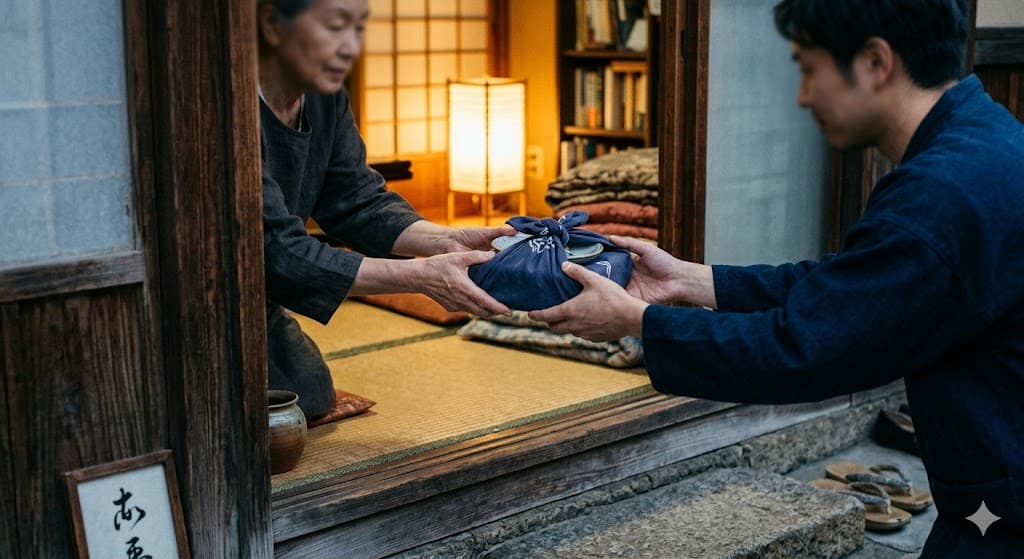
In the first episode of The Angel Next Door Spoils Me Rotten, Mahiru Shiina starts feeding her sick classmate Amane Fujimiya almost by accident. She brings porridge while he is down with a fever. She returns the next evening with a full container of dinner. And when he tries to refuse the second meal, she frames the offer with a line that is doing far more cultural work than it first appears:
 A neighbor's covered dish passed across the threshold with a soft excuse.
"I make too much just for myself. I'd appreciate if you could accept it."
In a Western romantic comedy, this might read as a flimsy excuse — a transparent cover for affection. In a Japanese neighborhood, it is the standard opening move. Mahiru is not lying about portions, nor is she only being shy. She is performing a small, learned ritual that softens the gift, lowers the receiver's social burden, and makes accepting feel almost obligatory rather than indebting. The earlier line, "It's just my leftovers. Please have them," does the same work in shorter form.
This grammar of polite excuses is the audible surface of a much older custom: お裾分け(Osusowake: sharing from the hem of one's garment).
The Hem of the Kimono and the Origin of "Sharing from the Edge"
The word お裾分け(osusowake) is built from three parts: the polite prefix お(o), the noun 裾(suso), meaning the hem of a kimono, and 分け(wake), meaning to divide or share. Literally, it is "sharing from the hem."
 The 裾 (suso) — the kimono hem — gives osusowake both its name and its quiet metaphor.
The image is precise. The 裾(suso) of a kimono is the bottom edge — the part farthest from the wearer's center, the trailing end. To share from the hem is to give away not the heart of one's abundance but its edge, its tail end, its overflow. The verbal architecture of the word itself implies that the giver is parting with something incidental, not something precious. The receiver is therefore not robbing the giver of anything central. That mathematical reassurance is built into the vocabulary before any spoken excuse is added.
Long Houses, Tenement Blocks, and the Geometry of Sharing
The custom matured in the dense neighborhoods of Edo-period Japan. 長屋(Nagaya: row tenement houses) packed many families along a single shared corridor, often around a common well and toilet. In the postwar era, the 団地(Danchi: large public housing blocks) preserved a similar geometry of thin walls and close proximity. When a neighbor cooked a large pot of stew, baked too many sweet potatoes, or received a box of fruit from relatives in the countryside, the surplus naturally flowed to the families a few doors down. Refrigeration was limited, hoarding was impractical, and the social cost of letting food spoil while neighbors went without was high.
Out of that geometry came an etiquette. You did not arrive at a neighbor's door announcing, "I have brought you a generous gift." You arrived saying the equivalent of "I made too much" or "Someone sent us more than we can finish." The excuse was the gift's wrapping paper.
The Quiet Economics of the Return Gift
The other half of お裾分け(osusowake) is お返し(okaeshi: the return gift). A received share is not allowed to sit unbalanced forever, but the response is almost never immediate or equivalent. Returning an identical dish the next day would feel like a transaction, a settling of accounts. Instead, weeks later, when the receiver bakes or harvests something themselves, a portion drifts back in the other direction — wrapped, again, in a small excuse.
This delay matters. By stretching the exchange across time and changing the contents, the relationship stays a relationship rather than collapsing into a ledger. 義理(giri: social obligation) is acknowledged but kept loose. Nobody is keeping score in numbers, but everyone knows roughly where the balance sits.
Why the Excuse Is the Point
Watching Mahiru's scene with an eye on this history changes what the dialogue is doing. Her line is not modesty as a personality trait. It is the giver's half of a two-part bow.
The first part is 遠慮(enryo: reserved restraint) on the receiver's side — Amane's reflex to refuse, to say it would inconvenience her, to insist he is fine. Japanese politeness expects this refusal. A receiver who accepts too readily looks greedy or socially clumsy.
The second part is the giver's job: to disarm that refusal. "I made too much." "It would have gone to waste anyway." "I happen to be cooking for myself, so one more portion is nothing." Each of these phrases tells the receiver, in code: You are not putting me out. You are not creating a debt. You are doing me a small favor by helping me dispose of an overflow.
The kindness, in other words, is wrapped twice — once in food and once in language. Strip away the excuse and the gift becomes too heavy. The receiver, suddenly responsible for an unrequested favor, is forced into formal gratitude and an obligation to repay. Keep the excuse intact, and the same physical act becomes light enough to accept with a simple thank-you. The container can be returned the next day with a casual note, and life continues.
This is why "I make too much just for myself" is not a weak line. In the dialect of Japanese neighborliness, it is the strongest possible move — the one that makes the gift land softly.
What This Custom Looks Like When You Move Away
Living outside Japan for many years now, this is the kind of small social grammar that I notice most when it is missing. In the place where I live, food sharing between neighbors is rare in the apartment-block form Japanese readers might expect; when it happens at all, it tends to be between roommates who have chosen to share a household to save on rent, or between close friends who already treat one another as family. The hedge-and-share dance between strangers across a thin wall does not really translate.
 Edo-era 長屋 row houses were the architecture that shaped Japan's sharing etiquette.
Even within Japan itself, the custom has thinned in places. The shift from long houses and 団地(danchi) to modern condominiums has put steel doors and elevator halls between neighbors who once shared a corridor. The plate of homemade something, passed across the threshold with a quick "I made too much," depends on knowing your neighbor's face well enough to knock. Many city dwellers no longer do.
What survives most cleanly is the linguistic reflex. Even Japanese people who have never lived in a 長屋(nagaya) or a 団地(danchi) still reach for "余ったから(amatta kara: because there was extra)" or "作りすぎちゃって(tsukurisugichatte: I ended up making too much)" when offering food to a colleague or a friend. The neighborhood that shaped the phrase has faded, but the phrase has outlived the neighborhood.
I should be honest that my own childhood in a downtown Tokyo neighborhood did not feature constant お裾分け(osusowake) across the front gate. The exchanges I remember were tied to occasions — 赤飯(sekihan: red-bean rice for celebrations) or お餅(omochi: rice cakes) around the new year — rather than the daily flow of leftovers some books describe. The phrases I heard most often as the wrapping were "いただきものだけど(itadakimono dakedo: this was given to us, but...)" or simply "お裾分けです(osusowake desu)," more than the "I made too much" formula. The custom has many regional dialects, and stories that flatten Japan into a single sharing village miss that variation.
What The Angel Next Door Spoils Me Rotten captures so cleanly is the linguistic move itself — the hedge, the soft excuse, the kindness folded into something that sounds almost like an apology. Mahiru is doing in 2020s anime what a neighbor in a 長屋(nagaya) did in 1820s Edo, and the script writers know exactly which note they are striking.
FAQ
Q: Is "I made too much" always a polite fiction, or do Japanese people really make extra on purpose?
A: Both happen. Sometimes the surplus is genuine. Other times the cook deliberately makes more, knowing they will share. The phrase is used in both cases because its function is social, not factual — it lowers the receiver's burden regardless of how true the "extra" actually is.
Q: Do younger Japanese people still use these phrases, or is it dying out?
A: The phrases are alive, but the contexts have shifted. お裾分け(osusowake) between unacquainted neighbors has thinned in cities, while the same hedge-and-share grammar has migrated into workplaces, friend groups, and online food exchanges. The wrapping survives even when the wall between long-house households does not.
Q: How should a non-Japanese person respond if offered something with one of these excuses?
A: Match the register. A light refusal first ("Oh, are you sure? I don't want to take your portion") followed by gracious acceptance is the expected shape. Excessive thanks or insistence on paying back immediately can feel heavy. A simple thank-you now, and a small return gift later — different item, no occasion required — keeps the rhythm balanced.
Key Insights to Remember
-
The "excuse" that opens a Japanese gift is not a hedge to be edited out — it is the gift's container. Without that wrapping, the same kindness becomes a debt, which is precisely what お裾分け(osusowake) was designed to prevent. Listening for the excuse tells you when a small daily ritual is being performed.
-
お裾分け(Osusowake) is a piece of social technology that grew out of architecture: thin walls, shared corridors, limited refrigeration, and tightly packed lives. When the architecture changes, the custom thins, but its linguistic shape survives in modern Japanese speech and shows up reliably in anime that depicts everyday neighborhood interaction.
-
The Japanese gift economy works on delay and asymmetry, not exchange and equivalence. A received share is balanced not by an immediate equal return but by a different item passed back later, often with its own excuse. This rhythm keeps relationships fluid rather than transactional, and it is one of the quiet reasons "neighborliness" feels different in Japan from the loud, balance-sheet version it sometimes takes elsewhere.
Sources
About the author

Spoiler-free cultural deep-dives into anime, manga & live-action Japanese drama
- ●Tokyo-born, 3rd-generation Edokko (江戸っ子)
- ●Lifelong manga reader & anime viewer since the kaiju era
- ●Writes from outside Japan — distance as a cultural lens
- ●Spoiler-free · sourced · Kanji + Romaji + English
A Tokyo-born, 3rd-generation Edokko writer who has spent years living outside Japan. I use the anime, manga, and live-action Japanese drama you already love as a doorway into the folklore, language, religion, and everyday history behind them — written so even first-time fans can follow along, with sources for every claim.
Enjoy this article?
Get the next spoiler-free cultural deep-dive straight to your inbox.
Related Articles

My Neighbor Totoro and the Katori Senko: The Meiji Invention That Gave Japanese Summer Its Smell
How My Neighbor Totoro's summer evokes the katori senko, the Meiji-era mosquito coil whose spiral was imagined in 1895 by the wife of Kincho's founder.
8/8/2026

Anohana and Kingyo-sukui: Why Japan Replaced a Working Net With Paper That Dissolves
How Anohana's summer world explains kingyo-sukui, the festival stall game where Japan swapped a net that worked for a paper scoop designed to fail.
8/2/2026

Chibi Maruko-chan and Rajio Taisō: Why Japanese Kids Spend Summer Mornings Doing Radio Calisthenics in a Car Park
How Chibi Maruko-chan's Shōwa childhood preserves rajio taiso, the summer radio calisthenics Japan imported from an American insurer that dropped it a decade later.
8/1/2026

Rurouni Kenshin and Uchimizu: Why Old Tokyo Cooled Its Streets With a Ladle of Water
How the Meiji-era streets of Rurouni Kenshin open onto uchimizu — a summer custom that began as tea-ceremony courtesy and spread through Edo because of dust.
7/31/2026

Ace of Diamond and the Dirt of Koshien: Why Japan's Losing Teams Scoop Soil Into Their Bags
How Ace of Diamond treats Koshien as a destination, and why eliminated high school players kneel to fill bags with soil that groundskeepers blend by season.
7/30/2026
Neon Genesis Evangelion and the Walkman: Why Shinji Retreats Into His Headphones
Why does Shinji's SDAT cassette player feel so Japanese? From Sony's 1979 Walkman to quiet packed trains and the meiwaku ethic, a Tokyo-born writer unpacks the headphone culture behind Evangelion's most human prop.
7/23/2026