Witch Hat Atelier and the Monban-Ibara: How Japan Wards a Home with Thorns
How Witch Hat Atelier's gate-guarding thorn spell mirrors Japan's old folk practice of planting holly, nandina, and other thorny shrubs as living spiritual barriers around the home.

Tokyo-born, 3rd-generation Edokko · writing on Japanese culture from outside Japan
Spoiler-Free Cultural Analysis
This article explores the real Japanese folk practice of using plants as spiritual barriers — the cultural roots behind a single line of magical worldbuilding in Witch Hat Atelier. No plot spoilers; only atmosphere, vocabulary, and the long folkloric tradition behind the scene.
Key Takeaways
- Japan has a centuries-old folk practice of planting thorny or sharp-leaved plants — especially 柊(Hiiragi: holly olive) and 南天(Nanten: nandina, also called heavenly bamboo) — around the home to deter spirits, illness, and misfortune.
- The household barrier is not just symbolic; it overlaps with 結界(Kekkai: a spiritual boundary that separates the safe inside from the dangerous outside), a concept that ties together shrine forests, salt mounds, and the planted edge of a home.
- A magical world that protects a witch's home with seeds rather than chains or charms is borrowing the older, more agrarian half of Japanese protection — a half that the modern apartment-dwelling Japan has quietly let go of.
Key Terms Explained
- 結界(Kekkai) / Spiritual Boundary — A drawn or imagined line that separates a protected interior from a dangerous exterior. Used in Buddhism, Shinto, and onmyōdō, and inherited into anime as the "barrier" trope.
- 鬼門(Kimon) / Demon Gate — The northeast direction of a home or town, traditionally believed to be the route through which evil enters. Plantings, shrines, and architectural choices were historically made to seal it.
- 柊(Hiiragi) / Holly Olive — A spiny-leaved evergreen whose leaves were believed to prick the eyes of demons. Planted at the northeast corner of properties and used in the 節分(Setsubun: the seasonal divide before spring) ritual.
- 南天(Nanten) / Heavenly Bamboo (Nandina) — A red-berried shrub whose name puns on 難を転ずる(Nan wo tenzuru: to turn away misfortune). Commonly planted at the southwest, the "back demon gate."
- 鎮守の森(Chinju no Mori) / Guardian Shrine Grove — The wooded enclosure around a local Shinto shrine, treated as a living barrier between the human village and the wild.
A Line About Seeds That Stopped Me Mid-Episode
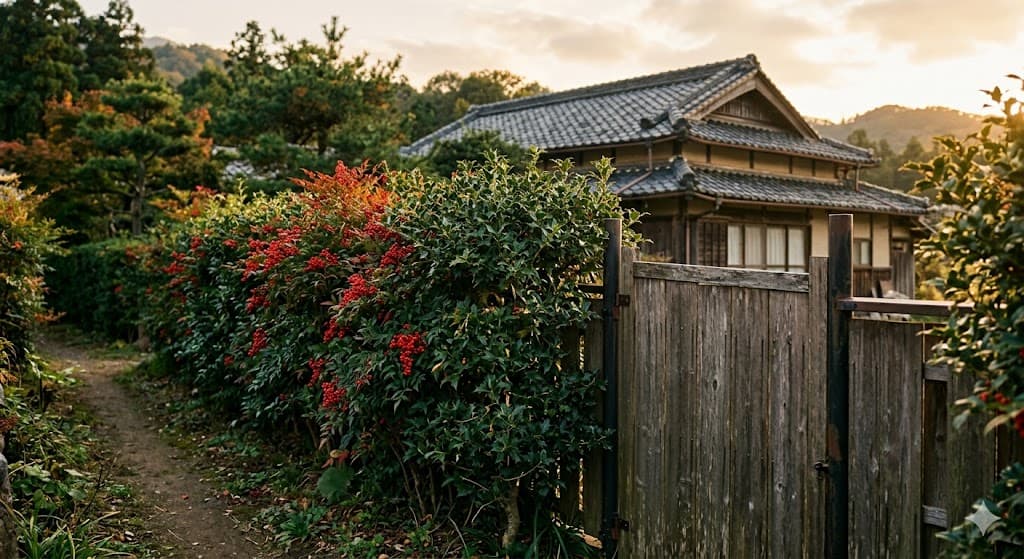
When the master witch in Witch Hat Atelier episode 2 mentions, almost in passing, that he has scattered the seeds of a thorn plant called 門番茨(Monban-Ibara: gate-guard thorn) around the apprentice's old home so that it will quickly grow into a 結界(Kekkai), I rewound the line twice. Not because the spell was elaborate — it isn't — but because the logic was so quietly, specifically Japanese: protection through a living plant, planted at the edge of the home, allowed to grow into a barrier on its own.
 柊 (Hiiragi), the spiny-leaved evergreen traditionally planted at the northeast corner of a Japanese home to repel demons.
To be honest, the line did not come out of anything in my own childhood. I grew up in a working-class neighborhood in 足立区(Adachi-ku: a ward in northeast Tokyo), in a single-story house with no garden to speak of, and I have almost no memory of 柊 or 南天 being planted by anyone I knew. I cannot picture the 柊鰯(Hiiragi-Iwashi: a Setsubun charm of holly and sardine head) on any door I walked past. My family did mamemaki — bean-throwing — at 節分, but the rest of the protective vocabulary of the old farmhouse simply was not in our concrete-and-alley world.
That is the strange angle from which I read the scene. The magic in Witch Hat Atelier is recovering, in fantasy form, a layer of protection that real urban Japan has been slowly forgetting for several generations. The thorn that grows on its own around the witch's house is doing the cultural work that nandina at the back corner of a country house once did.
Related: Witch Hat Atelier and the Culture of Mongai-fushutsu: Why Japanese Masters Hide the Secret explains this in detail.
The Long Folklore of the Living Barrier
The Demon Gate and the Plants Posted at Its Door
Old Japanese cosmology divided the home, the garden, and even the city by direction. The northeast — 鬼門(Kimon) — was the "demon gate," the route by which 鬼(Oni: ogres, malevolent spirits) and pestilence were said to enter. The southwest was 裏鬼門(Ura-Kimon: the back demon gate). Architects, gardeners, and ordinary householders for centuries did small, specific things at those two corners.
One of the most common was to plant a sharp or auspicious shrub there. 柊 at the northeast, with its spiny leaves believed to puncture the eyes of incoming demons. 南天 at the southwest, its name a deliberate homophone for "turning away misfortune." Other plants joined the rotation depending on region — 椿(Tsubaki: camellia), 山茶花(Sazanka: sasanqua), 桃(Momo: peach, mythologically the demon-repelling fruit Izanagi throws in the Kojiki). The plants were not decoration. They were positioned, like watchmen, at the seam between the safe inside and the dangerous outside.
This is the older agrarian half of Japanese protection: not a chain, not a written charm, not a salt mound at the door — though all of those exist too — but a slow, growing, breathing fence.
Related: Witch Hat Atelier and the Politeness Loop: Why Thanks for Your Thanks Is Pure Japanese explains this in detail.
Setsubun and the Holly-Sardine at the Threshold
The most concentrated form of plant-as-barrier in the calendar is 柊鰯(Hiiragi-Iwashi), the Setsubun custom of skewering a roasted sardine head on a holly sprig and tying it to the front door. The sardine's smoke and smell were thought to repel demons; the holly's thorns would prick them if they tried to pass. Together they sealed the threshold on the night the seasons turned, when the membrane between worlds was thinnest.
 柊鰯 (Hiiragi-Iwashi), the Setsubun threshold charm that pairs holly thorns with the smell of grilled sardine to seal the door.
It is, when you look at it from far enough away, exactly the same logic as 門番茨 in Witch Hat Atelier: a barrier made of biological material — leaf, thorn, fish, scent — placed at the edge of the home, working without anyone watching it.
Related: One Piece and the Straw Hat: Why Luffy's Crown Is a Japanese Summer Memory explains this in detail.
The Shrine Grove as a Village-Scale Kekkai
Zoom out from the single house and the same idea operates at village scale. The 鎮守の森(Chinju no Mori), the wooded grove around the local shrine, is not landscaping. It is, ecologically and theologically, a living 結界 separating the village's protected center from the wild beyond. Even now, in cities where everything else has been paved over, the shrine grove tends to be the one patch of forest that has never been cleared. It is the last visible barrier plant in many neighborhoods.
 鎮守の森 (Chinju no Mori), the guardian grove that wraps a local shrine and functions as a village-scale living barrier.
I grew up in dense downtown Tokyo and saw very little of this. Concrete and narrow alleys do not leave room for guardian groves. It was only when I started traveling — country shrines on school trips, my relatives' neighborhood around 根津神社(Nezu Jinja: a historic Shinto shrine in central Tokyo), the open shrines at 草津(Kusatsu: a famous hot-spring town) — that I began to notice how often the trees themselves are doing protective work. The shrine grove is the country cousin of the gate-guard thorn.
Why Plants, Specifically
The Japanese protective vocabulary is wide. 盛り塩(Morijio: small mounded piles of salt) handles the immediate threshold; 御札(Ofuda: paper talismans from shrines) handles the wall; 式神(Shikigami: spirit-servants in onmyōdō) handle the agent dispatched outward. Plants do something the others cannot: they keep working when no one is home, they grow, they have to be tended, and they live longer than the household that planted them. A salt mound has to be replaced. A holly tree at the northeast corner outlives the grandfather who planted it. The barrier becomes inherited, not refreshed.
When a witch in a fantasy series scatters seeds and says they will quickly grow into a 結界, the show is pulling on this exact intuition: a protection that is alive, slow, and self-maintaining.
What Modern Japan Plants Instead
The version of Japan most people now live in does not plant 柊 at the northeast corner of the house. There usually is no northeast corner of the house to plant at — there is a corridor, an elevator, a parking spot. The protective garden vocabulary that survived for centuries in the agrarian and pre-war urban home has thinned out into a few token gestures: the New Year's pine arrangement, the occasional sprig of holly on a 節分 doorway, a potted nandina kept out of habit by an older relative.
Living outside Japan for many years now, in a building where the front door opens straight onto a shared corridor and no plants of any kind separate inside from outside, I find I notice these gaps from a different angle. The modern Japanese apartment did not really kill the practice; the loss of a yard killed it. You cannot plant a barrier at the boundary of your home if your home has no boundary. The thorn has nowhere to grow.
This is also, quietly, why the line in Witch Hat Atelier lands. The show is not just decorating its fantasy world with a Japanese-flavored spell. It is using fiction to restore an entire half of the protective vocabulary that real Japan has, for very practical reasons, set aside. Watching a witch plant a thorn at the edge of a witch's home is, for a Japanese viewer who grew up without any of this, a glimpse of an old daily practice — not as nostalgia, but as a reminder that "barriers" once had soil under them.
There is no preachy lesson in any of this. It is only worth noticing that the protective imagination Japan built up over centuries had a botanical layer, and that the layer has thinned. Anime and manga, increasingly, are where the layer is being preserved.
FAQ
Q: Is 門番茨 (gate-guard thorn) a real plant in Japanese folklore?
A: No — the specific name is invented for Witch Hat Atelier. But the function it performs in the scene is drawn directly from real Japanese practice. Holly olive (柊), nandina (南天), camellia, and other thorny or auspicious shrubs were planted at home boundaries for the same purpose for centuries.
Q: Why holly and nandina specifically, and not roses or other thorny plants?
A: Two reasons. First, the leaves of 柊 are sharp in a way demons were said to fear (the same logic appears in the 柊鰯 charm at Setsubun). Second, 南天 is a homophone in Japanese — its name puns on 難を転ずる(nan wo tenzuru), meaning "to turn misfortune aside." Japanese folk protection often pairs visible features (thorns, evergreen color, red berries) with auditory wordplay.
Q: Does anyone in Japan still do this today?
A: A small number of older households, traditional gardens, ryokan inns, and shrines still maintain the practice. Most modern urban apartments cannot — there is no boundary garden to plant in. The custom survives more strongly in the calendar (Setsubun, New Year's pine) than in everyday gardening.
Key Insights to Remember
- A 結界 in Japanese cosmology is not always a drawn line or a spoken spell. It can be a row of holly at the northeast corner, a grove around a shrine, or the smell of a roasted sardine head pinned to a door. Anime that uses "barrier" as a translation flattens a much richer ecology. The fantasy thorn in Witch Hat Atelier is restoring a botanical reading of the word.
- Direction matters as much as material. Japanese protection has always cared about where a thing is placed: northeast for the demon gate, southwest for the back gate, the threshold for the salt mound. A thorn planted at a random spot is just a thorn. A thorn at 鬼門 is a barrier. When a magical worldbuilding system treats placement as essential, it is borrowing from this geographic intuition.
- The protections most worth preserving are the ones that work when no one is watching. Plants outlive the planter. Shrine groves outlive the priests who tend them. A gate-guard thorn that grows on its own around a house, in a story about apprenticeship and inheritance, is doing a lot of quiet thematic work — Japanese protection, at its root, has always been about handing the wall down rather than refreshing it.
Sources
- Setsubun: Driving away evil with beans, holly, and sardines — Nippon.com
- Kekkai (結界) — Encyclopedia of Shinto, Kokugakuin University
- Kimon: The Demon's Gate in Japanese folklore — Tofugu
- Nandina domestica and its folk uses in Japan — Japanese Garden Society Journal
- Hiiragi (Osmanthus heterophyllus) in Japanese protective tradition — Encyclopedia of Shinto, Kokugakuin University
- Chinju no Mori: The sacred groves of Japan — UNESCO and the Sacred Forests Initiative
About the author

Spoiler-free cultural deep-dives into anime, manga & live-action Japanese drama
- ●Tokyo-born, 3rd-generation Edokko (江戸っ子)
- ●Lifelong manga reader & anime viewer since the kaiju era
- ●Writes from outside Japan — distance as a cultural lens
- ●Spoiler-free · sourced · Kanji + Romaji + English
A Tokyo-born, 3rd-generation Edokko writer who has spent years living outside Japan. I use the anime, manga, and live-action Japanese drama you already love as a doorway into the folklore, language, religion, and everyday history behind them — written so even first-time fans can follow along, with sources for every claim.
Enjoy this article?
Get the next spoiler-free cultural deep-dive straight to your inbox.
Related Articles
Spirited Away and Kamikakushi: The Folklore Behind the Title
Spirited Away's Japanese title ends in kamikakushi. Learn who villages said took children away, why dusk was the dangerous hour, and how they searched for them.
10/25/2026
Fruits Basket and the Zodiac Cat: The Real Japanese Folktale of the Cat Who Missed the Banquet
How Fruits Basket builds its outsider cat on the real Japanese folktale of the rat tricking the cat out of the zodiac, and what eto still means in Japan today.
10/20/2026

March Comes in Like a Lion and Tsukimi: Why Japan Watches the Moon With Rice Dumplings and Pampas Grass
How March Comes in Like a Lion opens onto tsukimi, Japan's moon-viewing harvest observance, and why dumplings, pampas grass and a shifting date belong to it.
8/17/2026

Summer Time Rendering and the Shoryo-uma: The Cucumber Horse That Carries the Dead Home
How Summer Time Rendering's Obon homecoming opens onto shoryo-uma, the cucumber horse for returning ancestors, and why it is only one of many regional forms.
8/16/2026

GeGeGe no Kitaro and Hyakumonogatari: Why Japan Saves Its Ghost Stories for Summer
How GeGeGe no Kitaro connects to hyakumonogatari, the hundred-candle ghost game, and the Edo custom of staging horror in summer to chill the audience.
8/11/2026

Demon Slayer Infinity Castle and the Biwa: Heike and Hōichi
How the biwa that opens Demon Slayer's Infinity Castle leads to blind Heike reciters and Hōichi, who played night after night for a court that was not there.
8/7/2026