Witch Hat Atelier and the Culture of Mongai-fushutsu: Why Japanese Masters Hide the Secret
Why Witch Hat Atelier's mongai-fushutsu rule lands so hard on Japanese readers — the long tradition of secret transmission inside Japanese apprenticeship.

Tokyo-born, 3rd-generation Edokko · writing on Japanese culture from outside Japan
Spoiler-Free Cultural Analysis
This piece explores the Japanese cultural idea of guarded, lineage-based knowledge transmission that sits underneath Witch Hat Atelier, drawing on traditional arts, apprenticeship customs, and the author's own experience in a hands-on Japanese discipline. No plot revelations beyond the premise of Episode 1 are included.
Key Takeaways
- Japanese traditional arts operate on a concept called 門外不出 (Mongai-fushutsu: literally "not allowed outside the gate"), where a craft's core techniques are withheld from the general public and passed only from master to chosen disciple, and this idea is the deep cultural substrate under Witch Hat Atelier's forbidden-magic premise.
- The Japanese apprenticeship system (徒弟制度 / Totei Seido) is less about curriculum than about "learning with the body" — watching, imitating, waiting, and eventually being deemed ready by a master who has been watching the student more closely than the student realizes.
- When a secret is witnessed before the student is prepared, classical Japanese tradition offers only a few paths: refusal, erasure, or initiation. The opening of Witch Hat Atelier stages this exact triad, which is why the story feels culturally specific rather than generic fantasy.
Key Terms Explained
- 門外不出 (Mongai-fushutsu) / Not to Leave the Gate — A doctrine in traditional Japanese arts that specific techniques, recipes, or teachings must never exit the school, family, or lineage that holds them.
- 徒弟制度 (Totei Seido) / Apprenticeship System — The traditional structure in which a live-in or long-term student learns under a master, typically for many years, through observation and physical practice more than verbal instruction.
- 秘伝 (Hiden) / Secret Transmission — The innermost layer of a traditional art, reserved for mature disciples, often recorded only in lineage scrolls or transmitted orally and physically.
- 見て盗め (Mite nusume) / Learn by Watching and "Stealing" — A teaching culture where the master demonstrates without verbal explanation and the disciple is expected to absorb the technique through sustained observation.
- 印可 (Inka) / Seal of Approval — A formal acknowledgement from a master that the student has reached a level permitting them to teach, used most famously in Zen and tea ceremony lineages.
The Evening I Saw a Teacher Turn the Paper Face-Down
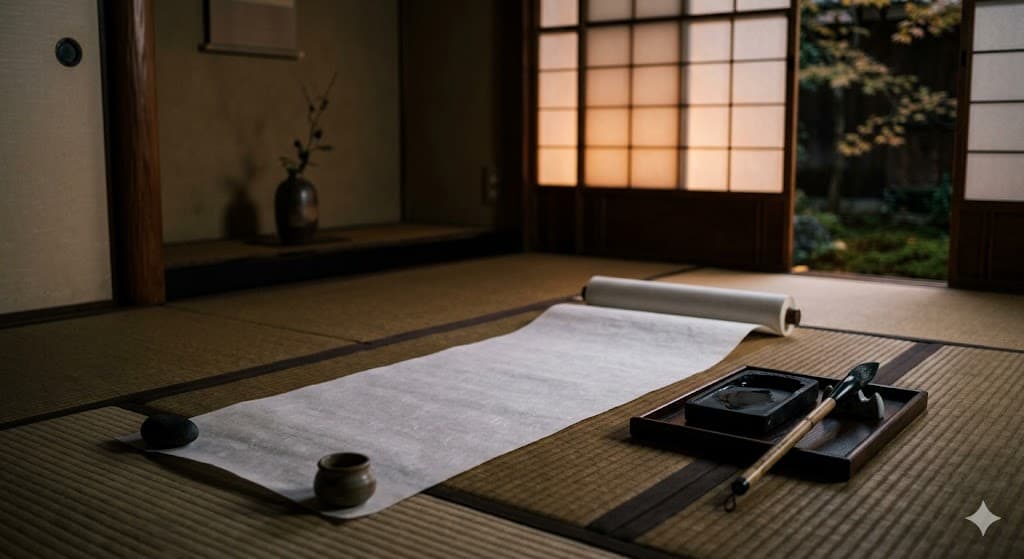
The first time I was formally given a sacred symbol in a traditional Japanese practice, it happened in a quiet 和室 (Washitsu: a tatami-matted traditional room) in central Tokyo. I remember the smell of the 畳 (Tatami: woven straw floor matting) and a faint murmur of evening life coming through the window. My 師範 (Shihan: certified master instructor) was seated in 正座 (Seiza: formal kneeling posture) and placed a single sheet of white paper in front of me with a care I had not expected for a piece of paper.
 A 筆ペン (Fudepen) and blank paper on tatami — the setting of a one-to-one transmission.
"This is the symbol I will give you today," the master said. "Watch closely as I write it."
The instrument was not a pen but a 筆ペン (Fudepen: brush-tipped pen). The hand moved slowly, stroke by stroke, with the order of strokes itself carrying meaning. Then came the part that ambushed me. When the master finished writing, the paper was turned face-down. "Now, write it yourself."
I had been memorizing with my eyes. The master had expected me to memorize with my hand.
"Do not try to remember the shape," I was told. "Wait for the hand to remember."
I felt foolish, because I had been doing exactly the opposite — storing the image in my head like a screenshot. That was the first evening I understood, physically, why Japan's traditional teaching culture uses the phrase 見て盗め (Mite nusume: learn by watching and stealing). The hiding is not cruelty. The hiding is the pedagogy.
Watching Witch Hat Atelier's first episode years later, the moment the wizard Qifrey tells the child narrator to stand guard outside and, whatever happens, not look inside — my body remembered that tatami room before my mind did.
Related: Witch Hat Atelier and the Politeness Loop: Why Thanks for Your Thanks Is Pure Japanese explains this in detail.
Where the Idea of a Guarded Secret Comes From
Japanese traditional arts are not built on the assumption that information should be open. They are built on the assumption that raw technique, handed to an unprepared person, damages both the person and the technique. This is the root of 門外不出 (Mongai-fushutsu), a term that translates almost too flatly into English as "not allowed out of the gate." The gate here is the 流派 (Ryūha: a school or stylistic lineage).
Iemoto and the Architecture of Lineage
The institutional shape of this idea is the 家元制度 (Iemoto Seido: headmaster household system), which organizes many classical disciplines — 茶道 (Sadō: the way of tea), 華道 (Kadō: flower arrangement), 能 (Nō: classical masked theatre), 日本舞踊 (Nihon Buyō: traditional Japanese dance). A single household or lineage-head holds ultimate authority over what is taught, to whom, and at what stage. Teaching certificates, stylistic rulings, and the deepest teachings of 秘伝 (Hiden: secret transmission) flow from that single apex. To an outsider this looks authoritarian. From the inside it is closer to an ecosystem designed to protect a living body of knowledge from dilution across generations.
Related: Witch Hat Atelier and the Monban-Ibara: How Japan Wards a Home with Thorns explains this in detail.
The Martial Arts Inheritance
In 武道 (Budō: traditional martial ways), the tiered release of technique is explicit. A common framework is 守破離 (Shu-ha-ri: obey, break, depart) — the student first obeys the form exactly, later begins to break it with understanding, and only at full maturity departs from it to develop their own path. Premodern schools of swordsmanship often recorded their innermost teachings in 巻物 (Makimono: handscrolls) kept within the family, sometimes passed only to a single successor per generation. Whole stylistic lines were lost when a designated heir died before receiving transmission. The Japanese archives are full of these quiet extinctions, and each one is a small argument about whether "not sharing" was wisdom or tragedy.
 巻物 (Makimono) handscrolls once carried the innermost teachings of a lineage, often to a single heir.
Related: One Piece and the Straw Hat: Why Luffy's Crown Is a Japanese Summer Memory explains this in detail.
Tea, Flowers, and the Craft Trades
Tea ceremony schools famously guard the minute details of their 点前 (Temae: the choreographed procedure of preparing tea), with differences between schools that outsiders cannot see but insiders can identify from a single gesture. 華道 (Kadō) carries similar lineage-specific secrets about angle, ratio, and seasonal logic. The craft trades — swordsmithing, lacquerware, certain styles of ceramics — extend the same principle into materials. A family's particular clay blend, firing schedule, or tempering method could be a trade secret maintained for centuries. When a modern researcher reconstructs a lost technique of Edo-period lacquer or forging, the work reads like forensics precisely because the original holders refused to write it down in a form anyone outside the gate could read.
Why Watching Without Speaking Became the Teaching Method
The cultural logic behind 見て盗め is not that the master is lazy or withholding. It is that verbal explanation, once received, tends to satisfy the student before the body has understood. Years after my own evening with the turned-down paper, teaching on my own side of the relationship, I finally grasped what my Shihan had been doing. If I told a student "hold your palm at forty-five degrees from the floor," they would immediately start behaving like a protractor. If I simply did it beside them, in silence, at some point their hand would settle into the same angle on its own and their face would change. The Japanese tradition isolates that second moment — and builds an entire pedagogy around protecting it from the first.
What the Gate Still Holds, and What Has Slipped Out
Having lived outside Japan for many years now, with only visits home to recalibrate, I notice two things at once about 門外不出 culture. It has been quietly preserved where you would not expect, and it has quietly leaked where you would.
 The gate in 門外不出 is both literal and metaphorical — what stays inside, and what does not.
The preserved side is visible in smaller, less globalized disciplines. Regional craft lineages, certain martial styles, the inner teachings of traditional music — these still run on the old architecture. A disciple waits. A master decides when. The waiting itself is not wasted time; it is the forming of the 器 (Utsuwa: vessel, one's capacity to hold something) that will later receive the teaching. Modern, information-saturated environments rarely budget for this. We treat delay as friction. The traditional arts treat it as essential.
The leaked side is where the internet has done what it does. Search any esoteric symbol, ritual, or technique and you will find photographs, stroke orders, and explanations posted by well-meaning enthusiasts. What is lost in that leakage is not the image. The image transfers perfectly. What is lost is everything that surrounded the original transmission — the tatami under the knees, the breath of the teacher, the specific weight of a morning on which one has been judged ready. The symbol without that atmosphere is, as I once heard it described, "a drawing shaped like a secret."
There is also a generational question that Witch Hat Atelier touches almost without announcing it. When a secret is discovered accidentally by a person who has no teacher, no gate, no lineage behind them, what should tradition do? Classical Japanese answers are narrow: send them home without the teaching, erase the encounter if possible, or — rarest and most consequential — open the gate, take them in, and make them responsible. The third option is the hardest because it commits the master too. The series chooses the third path, and in doing so it is drawing on a recognisable Japanese cultural logic, not inventing one.
For what it is worth, from outside Japan, I have come to believe the "slow" ways are not nostalgia. They are an older solution to a problem we are only now noticing again — that access without preparation corrodes both the thing accessed and the person accessing it.
FAQ
Q: Is Mongai-fushutsu still practiced in modern Japan, or is it only historical?
A: It is still active, especially in classical arts, regional crafts, certain martial lineages, and some religious and healing practices. Many modern schools have softened the rules for beginner and intermediate levels while still reserving the deepest teachings for mature, vetted disciples.
Q: Is the "hide the magic" rule in Witch Hat Atelier based on any specific Japanese tradition, or is it a general mood?
A: It is not a one-to-one reference to a single school, but the underlying cultural assumption — that technique is protected, transmitted personally, and dangerous in the wrong hands — is shared across many Japanese traditions, from tea ceremony and budō to certain Buddhist and Shinto practices.
Q: Does "learning by stealing" mean the master never explains anything?
A: Not literally. Masters do give instruction, corrections, and context. The phrase means that the deepest layer of skill is expected to be absorbed through sustained observation, imitation, and physical practice rather than verbal description, because that layer does not survive being put fully into words.
Key Insights to Remember
- The forbidden-magic premise of Witch Hat Atelier reads as a coherent story to Japanese viewers because it mirrors a real cultural grammar — knowledge is lineage-bound, technique is guarded at the gate, and an accidental witness creates a crisis that tradition already has named responses to. Recognizing this grammar changes how the opening lands emotionally.
- Mongai-fushutsu is not primarily about keeping secrets. It is about matching the speed of transmission to the speed at which a human being can actually become capable of holding what is transmitted. The "hiding" is time discipline disguised as secrecy, and modern information culture has almost no equivalent mechanism.
- When a master chooses to initiate an unprepared witness rather than turn them away, they are accepting shared responsibility for everything that person subsequently does with the teaching. This is the weight that Japanese traditional arts build into apprenticeship from day one, and it is what gives the first episode of Witch Hat Atelier its quiet gravity beneath the fantasy surface.
Sources
- Iemoto — Encyclopedia Britannica
- Shuhari — Wikipedia
- Japanese tea ceremony (Sadō) — Encyclopedia Britannica
- Ikebana — Encyclopedia Britannica
- Apprenticeship and craft transmission in Japan — Japan Foundation cultural resources
- Witch Hat Atelier (Tongari Bōshi no Atelier) official information — Kodansha
About the author

Spoiler-free cultural deep-dives into anime, manga & live-action Japanese drama
- ●Tokyo-born, 3rd-generation Edokko (江戸っ子)
- ●Lifelong manga reader & anime viewer since the kaiju era
- ●Writes from outside Japan — distance as a cultural lens
- ●Spoiler-free · sourced · Kanji + Romaji + English
A Tokyo-born, 3rd-generation Edokko writer who has spent years living outside Japan. I use the anime, manga, and live-action Japanese drama you already love as a doorway into the folklore, language, religion, and everyday history behind them — written so even first-time fans can follow along, with sources for every claim.
Enjoy this article?
Get the next spoiler-free cultural deep-dive straight to your inbox.
Related Articles

Crayon Shin-chan and Nagashi Somen: Why Japan Sends Its Summer Noodles Down a Bamboo Flume
How a Crayon Shin-chan episode turns nagashi somen into salaryman theatre — and the real 1955 origin of Japan's flowing noodles, from Takachiho Gorge to Kagoshima's rotating rival.
8/9/2026

Naruto and the Naruto Strait Whirlpools: The Real Uzushio Behind the Uzumaki Name
How the anime Naruto links to the real Uzushio whirlpools of Tokushima's Naruto Strait — a tidal wonder you can visit, and the spiral motif behind it.
7/17/2026
SPY x FAMILY and O-juken: The Real Exams Behind Eden Academy
How SPY x FAMILY dramatizes O-juken, Japan's high-stakes early-childhood entrance exams, and the parent-child interview that judges the whole family.
7/8/2026

Attack on Titan and On-Gaeshi: Why Hannes's Debt to the Jaeger Family Is More Than a Favor
How Attack on Titan dramatizes on-gaeshi — the lifelong Japanese debt of gratitude behind Hannes's vow, and why the English word favor can't carry its weight.
7/6/2026
Death Note and Hissatsu Shigotonin: Japan's Shadow Justice
How Death Note channels Japan's shadow-justice tradition — the TV drama Hissatsu Shigotonin, whose hidden killers punish evil the law itself cannot touch.
7/1/2026

Kaiju No. 8 and the Ritual of All Night Nippon: The Late-Night Radio Culture Behind Hoshi Night Nippon
How Kaiju No. 8's Hoshi Night Nippon bit recreates Japan's late-night radio ritual, from radio names to the postcard-artisan culture of listener submissions.
6/28/2026