Re:ZERO and the Watergate City of Priestella: Why Subaru Feels at Home in a Japanese-Style Lake Town
Why Re:ZERO's Watergate City of Priestella feels so familiar to Japanese viewers — ryokan grammar, Kansai merchant culture, and the canal towns of old Edo.

Tokyo-born, 3rd-generation Edokko · writing on Japanese culture from outside Japan
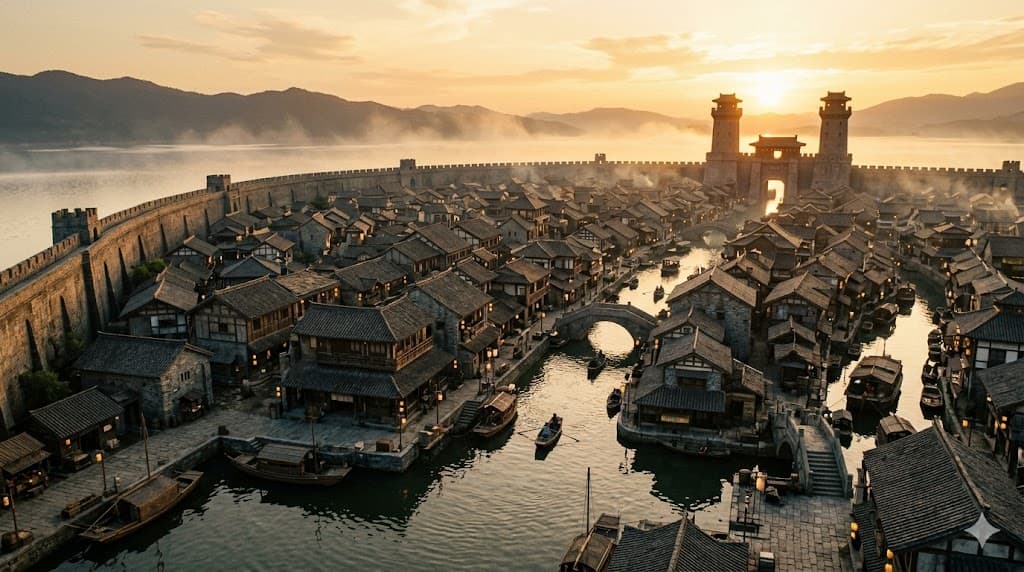
Spoiler-Free Cultural Analysis
This piece explores the cultural, architectural, and historical Japanese elements that quietly shape the Watergate City of Priestella(水門都市プリステラ: the fictional canal city in Re:ZERO) as it first appears in the Director's Cut arc. No plot spoilers — only atmosphere, design choices, and the real-world layers of meaning behind a setting that, for any 江戸っ子(Edokko: a true Tokyoite), feels strangely like stepping onto a familiar old street.
Key Takeaways
- The Watergate City of Priestella is designed around visual cues that any Japanese viewer reads instantly — lattice floors, woven rush matting, ryokan-style inns, waterway traffic — and those cues work emotionally even on a protagonist who has never seen them in-world before.
- The city's founder, ホーシン(Hōshin: the legendary founder of the Kararagi City-States in Re:ZERO), is strongly coded as another displaced Japanese figure, which turns Priestella into a love letter to Edo, Osaka, and their canal-laced ancestors rather than a generic fantasy waterfront.
- The deeper appeal of Priestella isn't "Venice in anime" but a fusion of 水郷(Suigō: a town built among waterways) logic, 関西(Kansai: the western Japan cultural region) merchant culture, and the communal intimacy of the 銭湯(Sentō: a neighborhood public bathhouse) — all compressed into a single fortified lake town.
Key Terms Explained
- 水門都市 (Suimon Toshi) / Watergate City — A city whose survival depends on engineered floodgates regulating water levels, rather than natural drainage.
- 旅館 (Ryokan) / Traditional Japanese Inn — A lodging with tatami rooms, futon bedding, communal baths, and yukata loungewear; the cultural opposite of a hotel chain.
- カラギ / カラーギ (Kararagi) / The Kansai-Coded City-States — In Re:ZERO, a merchant-driven region whose speech patterns and aesthetics mirror real-world Osaka and the broader Kansai mercantile tradition.
- 判官贔屓 (Hōgan Biiki) / Sympathy for the Underdog — A Japanese emotional stance that quietly colors how viewers read Subaru's ongoing arc.
- 水郷 (Suigō) / Waterway Town — A settlement organized around canals and rivers, where boats are more natural than carts; common in parts of old Japan such as 柳川(Yanagawa: a canal town in Fukuoka) and 潮来(Itako: a historic waterway town in Ibaraki).
The Smell of Old Wood and Steam I Thought I'd Left Behind
The first time I watched the scene where Subaru steps into the 水帷子亭(Suikatabira-tei: the "Water Raiment" inn where Anastasia hosts the group), I did something I didn't expect. I paused the episode.
 An old Tokyo sentō — the yellow Kerorin basins and painted Fuji mural that became the sky behind the steam of every childhood evening.
Something in my chest tightened — not because anything dramatic happened, but because the layout of the entrance, the way the characters leave their shoes behind, the suggestion of 畳(Tatami: woven rush mat flooring) underfoot, the promise of yukata and a communal bath, all of it pulled me straight back to 足立区(Adachi-ku: a working-class ward in Tokyo).
I grew up in a small single-story house there. Our house had no bath. Almost every evening of my childhood ended the same way: a two-minute walk with a towel and a bar of soap to 松ノ湯(Matsu-no-Yu: the neighborhood sentō I used growing up). At the entrance to the bathing area there was always a yellow mountain of ケロリン(Kerorin: a brand of analgesic whose plastic basins became iconic at Japanese sentō) basins, stacked impossibly high. The glass-fronted fridge near the front held milk bottles — plain, coffee, fruit — that I could almost never afford. They sat there like luxury goods behind cold glass.
And on the back wall of the bathing room, there was a huge 富士山(Fuji-san: Mount Fuji) mural. Painted, vivid, massive. I didn't think it was special. You don't, when it's the sky behind the steam of every evening of your young life.
Priestella's inn doesn't have a Fuji mural. But it has the same grammar — remove your shoes, trust the wooden floors, share water with strangers, wear soft clothes afterward. Watching Subaru move through that space, I understood immediately why the whole atmosphere reads, for him, as something close to the pull of a childhood home. For a displaced 江戸っ子(Edokko: a true Tokyoite), it would feel exactly that way too.
The Architecture of a Japanese-Coded Fantasy City
Priestella is, on paper, a lake city surrounded by high walls, crossed by canals, and controlled by a network of 水門(Suimon: floodgates). But the specifics of how it's designed are not generically "Asian fantasy." They map onto identifiable threads in real Japanese urban and architectural history.
Kararagi Is Kansai, and the City Knows It
The 城塞都市(Jōsai Toshi: a walled fortified city) sits near the border with the Kararagi City-States, and that isn't a throwaway line. 関西(Kansai: the western Japan cultural region) in the real world is the home of Osaka, historically called 天下の台所(Tenka no Daidokoro: "the kitchen of the realm"), Japan's merchant capital during the 江戸時代(Edo Jidai: the Edo period, 1603–1868). The speech patterns of Anastasia and her attendants lean into 関西弁(Kansai-ben: the Kansai dialect) rhythms in the original Japanese audio — the clipped "やで" endings, the softer cadence, the merchant's instinct for a deal wrapped in warmth.
When Priestella is described as a trading city where 商人(Shōnin: merchants) set the tone, that is Osaka's cultural DNA transplanted into Lugnica.
The Ryokan as Worldbuilding
The inn Subaru and Emilia stay in is not a hotel with some tatami rooms. It is a full 旅館(Ryokan: traditional Japanese inn): shoes off at the threshold, low tables, 布団(Futon: a cotton-stuffed mattress laid directly on tatami) instead of Western beds, 浴衣(Yukata: an unlined cotton kimono-style garment worn at ryokan and summer festivals) handed out as loungewear, and a communal bath.
 A traditional ryokan interior — tatami floors, low tables, and the orchestrated intimacy that Priestella quietly borrows for its inn scenes.
The cultural function of a ryokan is very different from a Western hotel. A Western hotel sells privacy. A ryokan, at its best, sells a kind of orchestrated vulnerability — everyone wears the same yukata, everyone bathes in shared water, hierarchy thins. That is exactly the emotional register Re:ZERO needs for the arc: candidates, knights, and attendants suddenly on equal footing, sitting on the same floor, eating the same breakfast.
Okonomiyaki and the Kansai Breakfast
The breakfast scene — the group making okonomiyaki-style pancakes together in the morning — is pure 大阪(Ōsaka: Japan's second-largest city and the cultural heart of Kansai). お好み焼き(Okonomiyaki: a savory Kansai-style pancake cooked on a flat griddle) is not a Tokyo dish. It's a Kansai dish, a Hiroshima dish, and above all a communal one: you cook it in front of each other, you argue about the sauce, you tease each other's flipping technique. Having Kararagi-coded characters serve it as a traditional breakfast is a precise cultural signal.
Hōshin of the Wastes as a Displaced Japanese Figure
The city's founding is attributed to ホーシン(Hōshin: the legendary founder of the Kararagi City-States in Re:ZERO), a revolutionary from centuries past described as a visionary outsider with unusual ideas. Subaru quickly notices that Hōshin was probably like him — a Japanese person transported to this world.
Once that is on the table, every other Japanese-feeling detail in Priestella stops being a coincidence. The tatami, the ryokan, the okonomiyaki, the sashimi served by Anastasia as a delicacy from 大虎海河(Daikokaiga: a great river in the Re:ZERO setting) — these are all cultural artifacts a displaced Japanese person from centuries earlier would have tried, piece by piece, to rebuild from memory. Priestella isn't Japan. It is what Japan might look like if someone tried to reconstruct it from homesick memory, alone, in another world.
Water as Civic Infrastructure
The floodgate system that gives Priestella its name is rooted in a very real Japanese engineering tradition. 水郷(Suigō: a town built among waterways) cities like 柳川(Yanagawa: a canal town in Fukuoka) and 潮来(Itako: a historic waterway town in Ibaraki) managed water levels with locks, dikes, and gates long before the age of steel pumps. 江戸(Edo: the historical name for Tokyo before 1868) itself was laced with canals — the 日本橋川(Nihonbashi-gawa: the river running through central Edo/Tokyo) and its tributaries were working waterways, not decoration.
 The canal town of Yanagawa in Fukuoka — a real-world water-managed Japanese city whose logic echoes in Priestella's floodgate design.
The idea of a city that could be flooded deliberately if needed — one giant trap, as Beatrice puts it in a different register — isn't fanciful. 大阪城(Ōsaka-jō: Osaka Castle) was defended by deliberately floodable moats. Priestella just extends that logic into an entire urban plan.
What Modern Japan Remembers and What It Quietly Let Go
I've lived outside Japan for many years now. There are no sentō where I live now, at least not in any form that would be recognizable. No yellow Kerorin basins. No neighborhood where the smell of the bathhouse at 6 p.m. is also the smell of dinner being cooked in the houses you walk past.
Watching Priestella from a distance — both physical and temporal — I'm struck by how much of what the city sells as "exotic fantasy" is actually just Japan from a couple of generations ago. Public bathing. Shared meals on the floor. Rooms that change function depending on whether the futon is out or folded away. Doors that slide instead of swing. An architecture that assumes you're never entirely alone.
Modern Japan still has all of this, technically. There are still ryokan, still sentō, still canal towns. But many of them survive now as tourism rather than as daily life. My old 松ノ湯(Matsu-no-Yu) is the kind of neighborhood institution that has been closing across the country for decades. Every time I hear of another one going, I think about that Fuji mural I took for granted.
Priestella doesn't solve any of that. But it does something quieter: it takes Japanese domestic texture — the thing a foreign viewer might file under "cool fantasy city design" — and treats it with enough care that a Japanese viewer who has been away from home for a long time might, as I did, pause the episode for a moment and look at the ceiling.
Subaru, of course, isn't paying attention to any of this on the surface. He's seasick, pestering Beatrice, arguing with Julius. But that's the point. Home doesn't announce itself. It just makes your shoulders drop before you've noticed why.
FAQ
Q: Is Priestella based on Venice?
A: In the show, Subaru himself makes the comparison and Beatrice gently corrects him. Priestella is described as a watergate city — a city on a lake with engineered flood control — rather than a city sitting in the sea. Structurally, it's closer to real-world Japanese 水郷(Suigō: canal-organized towns) and the moat-and-lock systems of castle cities than to the Venetian lagoon.
Q: Are the Kararagi City-States really supposed to be Kansai?
A: The coding is very strong. The speech rhythms of Anastasia and her companions in the original Japanese lean on Kansai dialect cadences, the merchant-first political culture mirrors Osaka's historical role, and the food featured in these episodes — sashimi served as a regional specialty, okonomiyaki-adjacent breakfasts — all point toward western Japan rather than Tokyo or the Kanto plain.
Q: Why does the ryokan setting matter for the story, beyond looking cool?
A: Ryokan are built on controlled intimacy. Everyone takes off their shoes at the same spot, everyone wears the same yukata, bathing is communal. Dropping five royal selection factions into that environment strips away a lot of the armor they'd have in a castle or negotiation hall. The arc's tensions and unexpected friendships land harder because the architecture itself is designed to dissolve distance.
Key Insights to Remember
- Priestella's emotional power for Japanese viewers comes from a very specific cultural stack: the ryokan grammar of removing shoes and sharing baths, the Kansai rhythms of Anastasia's faction, and the Edo-era memory of canal-laced cities. It reads as fantasy to foreign audiences, but as déjà vu to Japanese ones.
- The decision to tie the city's founding to a displaced Japanese figure is not a cute Easter egg. It reframes every Japanese-coded detail in the city as an act of cultural memory — one homesick person's attempt, across centuries, to rebuild a world. That is a surprisingly tender piece of worldbuilding inside what is otherwise a psychological horror series.
- The subtlest thing the Priestella arc does is trust architecture to do emotional work. Tatami floors, sliding doors, futon rooms, communal meals — these aren't decoration, they're dramaturgy. An ensemble that would never relax around each other in a palace can, in a ryokan, share a breakfast. The space does half the writing.
Sources & References
About the author

Spoiler-free cultural deep-dives into anime, manga & live-action Japanese drama
- ●Tokyo-born, 3rd-generation Edokko (江戸っ子)
- ●Lifelong manga reader & anime viewer since the kaiju era
- ●Writes from outside Japan — distance as a cultural lens
- ●Spoiler-free · sourced · Kanji + Romaji + English
A Tokyo-born, 3rd-generation Edokko writer who has spent years living outside Japan. I use the anime, manga, and live-action Japanese drama you already love as a doorway into the folklore, language, religion, and everyday history behind them — written so even first-time fans can follow along, with sources for every claim.
Enjoy this article?
Get the next spoiler-free cultural deep-dive straight to your inbox.
Related Articles

Crayon Shin-chan and Nagashi Somen: Why Japan Sends Its Summer Noodles Down a Bamboo Flume
How a Crayon Shin-chan episode turns nagashi somen into salaryman theatre — and the real 1955 origin of Japan's flowing noodles, from Takachiho Gorge to Kagoshima's rotating rival.
8/9/2026
Naruto and the Naruto Strait Whirlpools: The Real Uzushio Behind the Uzumaki Name
How the anime Naruto links to the real Uzushio whirlpools of Tokushima's Naruto Strait — a tidal wonder you can visit, and the spiral motif behind it.
7/17/2026
SPY x FAMILY and O-juken: The Real Exams Behind Eden Academy
How SPY x FAMILY dramatizes O-juken, Japan's high-stakes early-childhood entrance exams, and the parent-child interview that judges the whole family.
7/8/2026

Attack on Titan and On-Gaeshi: Why Hannes's Debt to the Jaeger Family Is More Than a Favor
How Attack on Titan dramatizes on-gaeshi — the lifelong Japanese debt of gratitude behind Hannes's vow, and why the English word favor can't carry its weight.
7/6/2026
Death Note and Hissatsu Shigotonin: Japan's Shadow Justice
How Death Note channels Japan's shadow-justice tradition — the TV drama Hissatsu Shigotonin, whose hidden killers punish evil the law itself cannot touch.
7/1/2026

Kaiju No. 8 and the Ritual of All Night Nippon: The Late-Night Radio Culture Behind Hoshi Night Nippon
How Kaiju No. 8's Hoshi Night Nippon bit recreates Japan's late-night radio ritual, from radio names to the postcard-artisan culture of listener submissions.
6/28/2026