Wistoria and Hōgan-biiki: Why Japan Roots for the Underdog
How Wistoria: Wand and Sword inherits hōgan-biiki — Japan's centuries-old sympathy for the underdog, traced from Minamoto no Yoshitsune to today's shōnen heroes.

Tokyo-born, 3rd-generation Edokko · writing on Japanese culture from outside Japan
Spoiler-Free Cultural Analysis
This article explores the Japanese cultural and historical context behind a recurring emotional pattern in anime storytelling — the instinct to cheer for the weakest character in the room. No plot beats beyond the publicly available premise of Episode 1 are discussed; the focus is on the centuries-old sentiment that shapes why a magic-less protagonist in a magic school lands so hard on Japanese audiences.
Key Takeaways
- 判官贔屓 (Hougan-biiki) is not a generic "underdog" feeling but a specific Japanese emotional inheritance tied to a real twelfth-century tragedy — the betrayal and death of the young general 源義経 (Minamoto no Yoshitsune).
- The "weak-to-strong" structure that dominates 少年 (Shōnen: boys' coming-of-age) manga and anime, from 巨人の星 (Kyojin no Hoshi: Star of the Giants) to modern titles, is one of the most visible cultural descendants of this sentiment.
- The gap between Hollywood's "already-competent hero" and Japan's "growth-as-drama" protagonist reflects two different cultural grammars for who deserves a story told about them.
Key Terms Explained
- 判官贔屓 (Hougan-biiki) / Sympathy for the Loser — A Japanese cultural tendency to side with the weaker party, the losing side, or the tragic figure, regardless of whether they are objectively "right."
- 源義経 (Minamoto no Yoshitsune) / The Historical Figure Behind the Word — A brilliant but ill-fated twelfth-century general whose court title 判官 (Hougan: a judicial office title) gives the sentiment its name.
- 少年漫画 (Shōnen Manga) / Boys' Comics — A long-running category of Japanese comics that characteristically begins with an untalented or disadvantaged protagonist who grows through effort.
- 落ちこぼれ (Ochikobore) / The One Who Fell Behind — A common character archetype in school-setting stories: the failing student, the dropout, the last-place kid who becomes the emotional center of the narrative.
- 無個性 (Mukosei) / Quirkless, or Without a Gift — A more recent phrasing of the same idea, popularized by contemporary works featuring heroes born without the power everyone else takes for granted.
The Day a Picture Book Taught Me That Winning the War Is Not Enough
The first time I cried over a story without quite understanding why, I was a lower-grade elementary student in 足立区 (Adachi-ku: a working-class ward in northeast Tokyo) in the early 1970s, sitting on the floor with a 学研 (Gakken: a major Japanese educational publisher) history manga open in my lap. The book was about 源義経 (Minamoto no Yoshitsune: a brilliant twelfth-century general). The first half was thrilling — a small, quick-witted boy who outwitted larger men, charged down the cliff at 鵯越 (Hiyodorigoe: a steep ridge above Ichi-no-Tani) on horseback, and broke the 平家 (Heike: the rival Taira clan) at sea.
 A 学研 history manga — for many Shōwa-era 下町 children, the first place they met Yoshitsune, and the first place they learned that being right is not the same as being safe.
Then I turned the page and the same boy I had been cheering for was being killed in the north at 平泉 (Hiraizumi: a town in present-day Iwate Prefecture) — not by enemies, but by his own brother's men. He had won every battle he was asked to fight. He died anyway, hunted by the side he had built. I remember closing the book and not knowing what to do with the feeling.
I mention this because the first time I watched Wistoria: Wand and Sword Episode 1, what I felt was not surprise but something older. Will Serfort, the boy who cannot use magic in a school where magic is the only currency, is the same shape of figure as the one I met on that page in 足立区 — the gifted person whose gift is not enough, whose effort is plain to anyone willing to look, and whom the world keeps placing at the back of the line. I was not rooting for him because the show told me to. I was rooting for him because something in me had been rooting for people like him since I learned, at seven or eight years old, that winning the war does not always mean you get to live.
That something has a name in Japanese. It is called 判官贔屓 (Hougan-biiki), and it is probably one of the most quietly influential emotional habits in the country's cultural life.
Related: One Piece and the Straw Hat: Why Luffy's Crown Is a Japanese Summer Memory explains this in detail.
Where the Word Comes From: A Twelfth-Century Tragedy Embedded in a Single Phrase
The Real 源義経 (Minamoto no Yoshitsune)
The word 判官贔屓 (Hougan-biiki) is literally "Hougan favoritism." 判官 (Hougan) was a mid-ranking court and judicial office title, and the particular 判官 everyone has in mind when they say the word is 源義経 (Minamoto no Yoshitsune), a general from the late twelfth century.
 Minamoto no Yoshitsune, the twelfth-century general whose tragic fate gave hougan-biiki its name.
Yoshitsune's story is the engine behind the sentiment. He was, by every contemporary account, a military genius. He won the decisive battles that destroyed the 平家 (Heike: the Taira clan) and secured his elder brother 源頼朝 (Minamoto no Yoritomo: Yoshitsune's elder brother and founder of the Kamakura shogunate)'s rise to power. The cavalry charge down the cliff at 鵯越 (Hiyodorigoe: a steep ridge above Ichi-no-Tani) — the scene that first hooked me in that 学研 history manga — is one of those battles. To a kid in 下町 (Shitamachi: the old low-lying districts of Tokyo), Yoshitsune read like a 少年ジャンプ (Shōnen Jump: a long-running boys' comics magazine) protagonist.
Then the story turns. Yoritomo, suspicious of his brother's popularity and political missteps, turned on him. Yoshitsune fled north, was cornered at 平泉, and died there in 1189. The person who had won his brother's war was killed by his brother's men.
That is the second half of the page I described at the start of this article — and the seed of hougan-biiki itself. A sympathetic response to Yoshitsune's fate that, over time, broadened into a general tendency to side with the defeated, the disadvantaged, and the underdog.
How a Personal Name Became a National Sentiment
Sentiments rarely get named after individuals unless the individual's story touches something the culture needs to keep re-feeling. The emotional pull of Yoshitsune's narrative was reinforced for centuries through 能 (Nō: classical masked theatre), 歌舞伎 (Kabuki: classical popular theatre), and 浄瑠璃 (Jōruri: narrative chanted theatre), each generation retelling his betrayal until the sympathy became automatic.
By the 江戸時代 (Edo Jidai: Edo period, 1603–1868), the phrase 判官贔屓 (Hougan-biiki) had drifted loose from Yoshitsune himself and become a general noun for the tendency. It is a recognizable psychological disposition in Japanese culture — sympathy that attaches preferentially to the losing or weaker side. A particular man's death in 1189 had, over the span of seven centuries, become a shared reflex.
The Shōnen Lineage: Ochikobore Heroes Across the Decades
You can trace the sentiment directly through the 少年漫画 (Shōnen Manga) canon. As part of what I think of as the 昭和 (Shōwa: the Shōwa era, 1926–1989) generation of readers, I grew up inside this tradition.
星飛雄馬 (Hoshi Hyūma) in 巨人の星 (Kyojin no Hoshi) was a small-framed pitcher crushed between the shadow of his tyrannical father and the genius rival 花形満 (Hanagata Mitsuru: the gifted batter and Hyūma's lifelong rival). Every time his signature pitch got hit, something in my chest tightened — not because I thought he would lose, but because the story had trained me to feel the weight of every inch he had to climb.
矢吹丈 (Yabuki Jō) of あしたのジョー (Ashita no Joe: Tomorrow's Joe) came out of juvenile detention and fought through injuries that would have sidelined anyone sensible. The appeal was not that he was the strongest but that he was the most battered.
The same architecture surfaces in more recent work. The "quirkless boy in a superpowered world" premise of modern hero-academy stories is not a new invention; it is the ochikobore archetype in a new uniform. Will Serfort in Wistoria: Wand and Sword — the boy who cannot use magic in a 魔法学院 (Mahō Gakuin: magic academy) — is sitting squarely in this lineage. The text of the work even acknowledges this directly, with teachers in Episode 1 calling him an "異端児 (Itanji: heretic, misfit)."
The Moment in Episode 1 That Actually Got Me
The obvious tearjerker moments in the first episode — the public humiliation in class, the bullies in the dungeon — are effective but almost too effective. The scene that actually caught me was when Workner-sensei, without anyone watching, quietly passes Will information about where to find a monster he needs for credit.
This is hougan-biiki as a texture, not a speech. Nobody announces it. Somebody just sees the effort.
I recognized that shape from my own life. When I shifted into AI engineering work, the loudest voices around me were skeptical. The support that mattered came from a few fellow practitioners who, without fanfare, noticed I was actually putting the hours in every day. That quiet noticing — "見ている人は見ている (Miteiru hito wa miteiru: the ones watching are watching)" — is where hougan-biiki actually lives. The public cheering is the surface. The private recognition is the root.
The later line of Will's, the one about becoming "like a single sword," resonated for a related reason. The character's decision is to stop grieving what he lacks and fight with what he has. I have spent enough of my career learning new stacks from a position of being behind to recognize that the real pivot is not acquiring new strength but accepting which strengths you actually possess.
What the View from Outside Japan Has Taught Me About This Sentiment
The Hollywood Hero Arrives Pre-Assembled
Having lived outside Japan for a long stretch of years, I have read a steady stream of overseas reactions to Japanese anime. One of the most common refrains is some version of: "Why is the Japanese protagonist always weak at the start?"
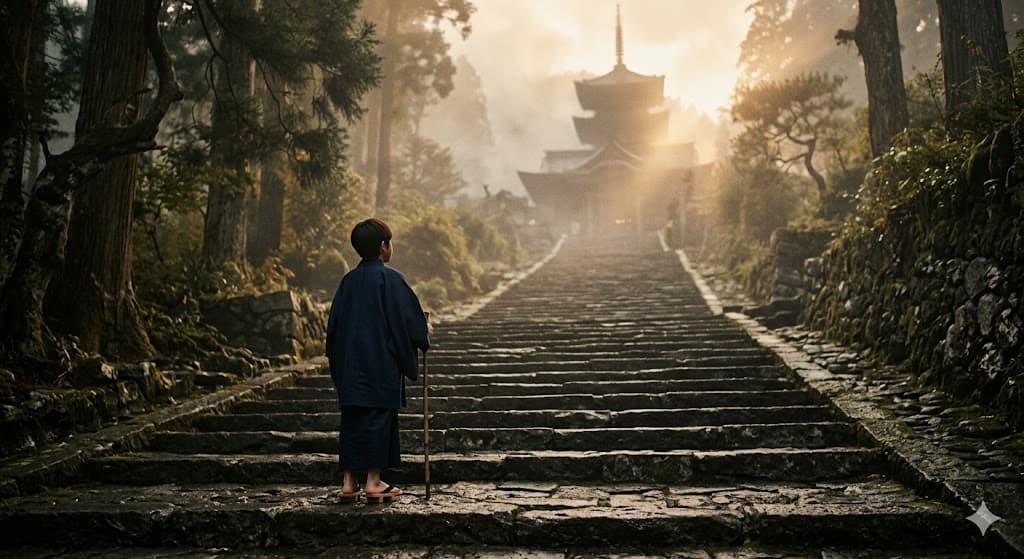
 The lone figure facing the tower — the visual shorthand Japanese storytelling uses for the hero who has not yet arrived.
The question answers itself culturally once you look at the comparison set. Superman is Superman from the first frame. James Bond does not need three seasons to learn how to hold a pistol. Iron Man acquires his armor in the first film and is, effectively, done. The Hollywood hero is pre-assembled. The story is about what he does with powers he already has.
Japanese storytelling runs on the opposite assumption. The growth process itself is the drama. The training montage is not filler between the real scenes; it is the real scenes. Failure, the meeting with a teacher, the quiet rebuild after defeat — these are not obstacles to the story, they are its substance.
I learned this concretely when I was advising overseas YouTube channels in the 2020s. Thumbnails for Western audiences worked when they showed somebody who had already succeeded. Thumbnails for Japanese audiences worked when they showed somebody who was about to try, with no guarantee of winning. Two cultures, two different faces that make people click.
What Gets Lost, What Gets Kept
From a distance, I can see that hougan-biiki is a double-edged inheritance. On the good side, it produces a culture that takes growth seriously, that builds stories around people who have not yet arrived, that allows children to see themselves in protagonists who cannot yet do the thing.
The less comfortable side is that hougan-biiki can tip into a preference for suffering as proof of virtue. The hero who struggles is noble; the hero who simply wins is suspect. I have watched this pattern in myself. When I followed boxing during my years abroad, I cheered for マニー・パッキャオ (Manny Pacquiao) when he was the challenger going up in weight against bigger American fighters — and noticed that the moment he became the favorite in a given match, my emotional allegiance wobbled. The sentiment is not really about the fighter. It is about where he is standing on the slope.
When I was on the other side of the equation — the one being rooted for because a late-career pivot into AI work looked like a long shot — I felt the complicated edge of it too. Encouragement from the "this is a hard challenge so I respect you for trying" angle was genuinely welcome, but there was a part of me that wanted to be seen as a competent practitioner, not as a brave underdog. Hougan-biiki, received from inside, is a warm room with a slightly crooked floor.
The view from outside Japan has clarified, too, that this sentiment is not universal. Other cultures have underdog stories. But the specific sticky attachment to the losing side, regardless of merit, and the cultural prestige granted to the ochikobore-turned-hero — that shape is Japanese. It has a twelfth-century name. It is called Hougan-biiki.
FAQ
Q: Is 判官贔屓 (Hougan-biiki) the same as the English word "underdog"?
A: Not quite. "Underdog" is a neutral description of someone with lower odds of winning. Hougan-biiki is an active emotional disposition — a cultural habit of siding with the losing party because they are losing, often independent of merit or moral standing. The English word describes a position; the Japanese term describes a feeling.
Q: Why is Yoshitsune specifically the figure behind this sentiment rather than another tragic hero?
A: Yoshitsune's story hits several buttons at once: youth, brilliance, loyalty, and destruction by his own side rather than by an enemy. The combination of competence and unjust betrayal — destroyed not by failure but by politics — is what made his story the template. Centuries of 能 (Nō), 歌舞伎 (Kabuki), and popular narrative kept the wound fresh.
Q: Does every Japanese shōnen story really follow this pattern?
A: Most do, but not all. Works that play with the "already strongest" premise, like stories built around the absurdity of a hero who wins too easily, are often commenting on the convention precisely because the convention is so strong. The weak-to-strong arc is so baseline that subverting it is itself a recognizable genre move.
Key Insights to Remember
- Hougan-biiki is a centuries-old cultural reflex, not a vague fondness for underdogs. Its specificity — a twelfth-century general, a particular betrayal, a specific court title embedded in the word itself — is what gives the sentiment its grip. When you feel the pull toward Will Serfort, you are inheriting an emotional pattern shaped by audiences who wept for Yoshitsune seven hundred years before anime existed.
- The weak-to-strong structure is not a storytelling shortcut; it is a cultural grammar. Japanese narratives treat the process of growth as the primary dramatic substance, which is why training sequences, failures, and quiet acts of recognition from mentors carry the emotional weight that Hollywood usually assigns to action set-pieces. Understanding this shift in emphasis changes how you watch almost every shōnen work.
- Being the object of hougan-biiki is not only a gift. Sympathy for the weaker side can crystallize into a preference for struggle as a moral credential, which puts later-career competence in an awkward position — welcomed when framed as a brave long shot, less easily recognized when framed as simply being good at the job. The sentiment that makes a culture generous to beginners can also be slow to let them graduate.
Sources & References
- Hogan-biiki — an entry on the Japanese cultural sentiment — Wikipedia
- Minamoto no Yoshitsune — biographical overview — Wikipedia
- The Life and Legacy of Minamoto no Yoshitsune — Nippon.com
- Shōnen Manga and the Growth-Arc Tradition — Tofugu
About the author

Spoiler-free cultural deep-dives into anime, manga & live-action Japanese drama
- ●Tokyo-born, 3rd-generation Edokko (江戸っ子)
- ●Lifelong manga reader & anime viewer since the kaiju era
- ●Writes from outside Japan — distance as a cultural lens
- ●Spoiler-free · sourced · Kanji + Romaji + English
A Tokyo-born, 3rd-generation Edokko writer who has spent years living outside Japan. I use the anime, manga, and live-action Japanese drama you already love as a doorway into the folklore, language, religion, and everyday history behind them — written so even first-time fans can follow along, with sources for every claim.
Enjoy this article?
Get the next spoiler-free cultural deep-dive straight to your inbox.
Related Articles

Crayon Shin-chan and Nagashi Somen: Why Japan Sends Its Summer Noodles Down a Bamboo Flume
How a Crayon Shin-chan episode turns nagashi somen into salaryman theatre — and the real 1955 origin of Japan's flowing noodles, from Takachiho Gorge to Kagoshima's rotating rival.
8/9/2026

Naruto and the Naruto Strait Whirlpools: The Real Uzushio Behind the Uzumaki Name
How the anime Naruto links to the real Uzushio whirlpools of Tokushima's Naruto Strait — a tidal wonder you can visit, and the spiral motif behind it.
7/17/2026
SPY x FAMILY and O-juken: The Real Exams Behind Eden Academy
How SPY x FAMILY dramatizes O-juken, Japan's high-stakes early-childhood entrance exams, and the parent-child interview that judges the whole family.
7/8/2026

Attack on Titan and On-Gaeshi: Why Hannes's Debt to the Jaeger Family Is More Than a Favor
How Attack on Titan dramatizes on-gaeshi — the lifelong Japanese debt of gratitude behind Hannes's vow, and why the English word favor can't carry its weight.
7/6/2026
Death Note and Hissatsu Shigotonin: Japan's Shadow Justice
How Death Note channels Japan's shadow-justice tradition — the TV drama Hissatsu Shigotonin, whose hidden killers punish evil the law itself cannot touch.
7/1/2026

Kaiju No. 8 and the Ritual of All Night Nippon: The Late-Night Radio Culture Behind Hoshi Night Nippon
How Kaiju No. 8's Hoshi Night Nippon bit recreates Japan's late-night radio ritual, from radio names to the postcard-artisan culture of listener submissions.
6/28/2026