That Time I Got Reincarnated as a Slime and the Quiet Architecture of Japanese Workplace Loyalty
How That Time I Got Reincarnated as a Slime opens with a senpai-kōhai ritual at a yakiniku table — and what zenekon and salaryman exhaustion mean to viewers.

Tokyo-born, 3rd-generation Edokko · writing on Japanese culture from outside Japan
Spoiler-Free Cultural Analysis
This article explores the real workplace customs, social hierarchies, and corporate archetypes that frame the opening minutes of That Time I Got Reincarnated as a Slime — no plot spoilers, only the Japanese cultural and linguistic context behind a very ordinary Tokyo afternoon.
Key Takeaways
- The protagonist's job at a 「ゼネコン」(Zenekon: a major general contracting company) is a quiet social signal that most non-Japanese viewers miss entirely — it places him in a specific tier of mid-career stability that colors every beat of the opening scene.
- The 先輩・後輩(Senpai-Kōhai: senior-junior) relationship is not simply "older and younger colleagues." It is a two-way contract of care and deference that explains why an established salaryman reaches for his wallet at a 焼肉(Yakiniku: Japanese-style grilled meat) restaurant before the conversation even begins.
- The "ordinary salaryman who dies and gets another life" is not a neutral setup. It taps into a very specific late-昭和(Shōwa: the 1926–1989 imperial era) to 平成(Heisei: the 1989–2019 imperial era) exhaustion that Japanese viewers feel before a single sword is drawn.
Key Terms Explained
- ゼネコン (Zenekon) / General Contractor — A shortened form of "General Contractor" used in Japanese business. In Japan it refers to the large construction and civil-engineering firms that anchor infrastructure work nationwide.
- 先輩 (Senpai) / Senior — A person who entered a school, workplace, or discipline before you. Not just "older" — it is a role that carries both privilege and responsibility.
- 後輩 (Kōhai) / Junior — The counterpart to senpai. A kōhai owes deference and attentiveness but is also owed guidance, protection, and the occasional paid-for meal.
- 奢る (Ogoru) / To Treat — The verb for paying for someone else's meal. In senior-junior contexts it is less a favor than an expectation tied to one's position.
- サラリーマン (Sararīman) / Salaryman — A white-collar male company employee. A postwar category that carries specific cultural weight around loyalty, routine, and quiet exhaustion.
The Yakiniku Tab That Was Already Decided Before We Sat Down
In my working years in Japan, the moment I knew I had crossed from kōhai into senpai was not a promotion or a title change. It was the first time I caught myself, almost without thinking, picking up the bill at a 焼肉(Yakiniku: Japanese-style grilled meat) restaurant for a younger colleague who had just finished a hard project. He protested once, softly. I waved the money away the way the older men in my own twenties had waved mine away. Neither of us said anything about it. The transaction had already been decided before we walked in.
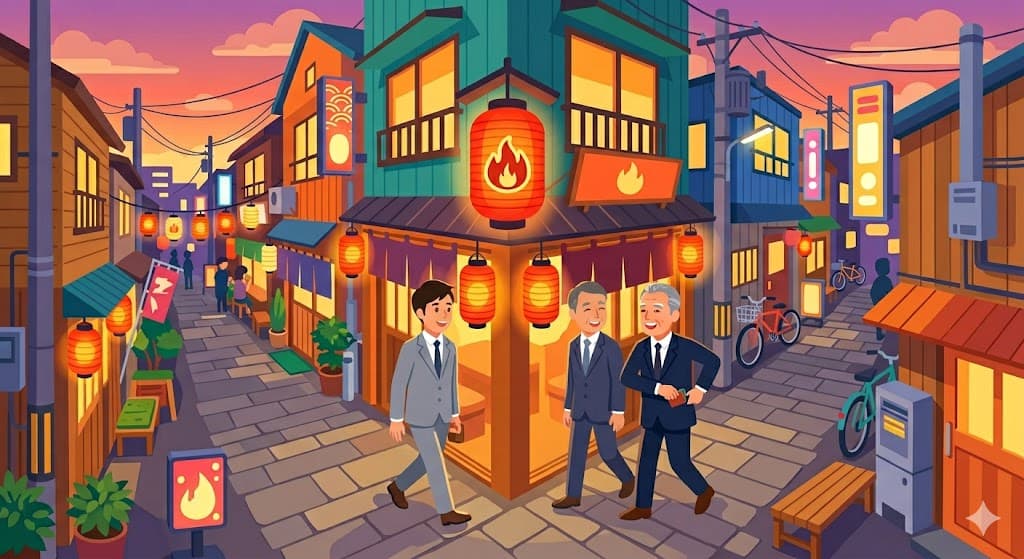
 A 焼肉 table in Tokyo — the most ordinary stage in the country for the small ceremonial exchange that holds 先輩 and 後輩 in their positions.
Yakiniku, in those years, was the most natural setting for that exchange. It was a step warmer than a 居酒屋(Izakaya: a Japanese-style pub), but a step less formal than sushi or 割烹(Kappō: a small chef-counter Japanese restaurant) — easy enough to invite a junior to without making the meal itself the message. We sat around the same grill, watched each other's timing on the meat, and the conversation always loosened by the second round of plates. The bill arriving felt almost incidental by then. The structure had already done its work.
I open with that exchange because, years later, watching the opening minutes of That Time I Got Reincarnated as a Slime, I froze at an equally small moment. The protagonist is meeting his 後輩(Kōhai: a junior colleague), who has brought along a woman he wants to introduce. The internal monologue slides almost invisibly past a line about a yakiniku reservation — the kōhai picked a place he knew his senpai liked. And the senpai, unprompted, thinks about treating them.
To a Western viewer this reads as pleasant generosity. To anyone who has been on either side of that table in a Japanese workplace, it reads as something closer to a small ceremonial exchange. The kōhai arranged the venue as a gesture of respect. The senpai would cover the bill as a gesture of care. Neither had to be discussed. The whole thing is already in motion by the time they sit down.
That is the opening the show is betting you will absorb — and the Japanese audience absorbs it in seconds.
The Salaryman, the Zenekon, and the Weight of "Ordinary"
What a Zenekon Actually Signals
 A yakiniku reservation is rarely a neutral choice — the kōhai picks the place, the senpai pays the bill.
When the protagonist explains that he was employed at a major 「ゼネコン」(Zenekon: a general contracting company) after university, he is not just naming an industry. He is placing himself on a very specific rung of Japanese corporate life.
Zenekon is a Japanese-English compression of "General Contractor," and in Japan it refers to the large construction firms that handle everything from railway tunnels to stadium builds. The top-tier zenekon are among the most established employers in the country. Getting hired by one, especially straight out of university, has historically signaled several things at once: stable lifetime employment, above-average salary, and a certain social respectability that mothers-in-law were known to approve of.
So when the show's narrator describes himself as ordinary, living without inconvenience, a Japanese viewer is doing some fast reading between the lines. He is not ordinary in the global sense. He is, in domestic Japanese terms, an under-celebrated success: financially secure, socially legible, and — this is the part the show cares about — entirely unsatisfied.
The Salaryman as a Cultural Archetype
The word サラリーマン(Sararīman: salaryman) emerged in the 大正(Taishō: the 1912–1926 era) period and settled into its modern meaning across the postwar decades. It names a specific figure: the male white-collar employee whose life is organized around a single company, a long commute, scheduled drinking sessions with colleagues, and a family he sees mostly on weekends.
By the late Heisei period, the salaryman archetype had accumulated a second layer of meaning — tiredness. Decades of deflation, 過労死(Karōshi: death from overwork) headlines, and a creeping sense that lifetime employment was a promise the economy could no longer quite keep had turned the once-aspirational figure into something more ambivalent. The salaryman was still secure, but his life was no longer the envy it had been in the バブル(Baburu: the asset-price bubble of the late 1980s) years.
This is the exhaustion the show taps into immediately. The protagonist is not presented as a failure. He is presented as someone who won the game he was told to play and found the prize smaller than expected.
Senpai-Kōhai: The Two-Way Contract
The relationship between the two men in the opening is labeled in the subtitles as "junior," which does the word kōhai a minor disservice. The 先輩(Senpai: senior) and 後輩(Kōhai: junior) pairing is not a ranking. It is a relationship with duties that run in both directions.
A kōhai is expected to show deference, remember the senpai's preferences, pour the senpai's drink first at gatherings, and generally keep the senior's life a little easier. In return, a senpai is expected to mentor, cover the check, offer advice at significant life moments, and — critically — be someone the kōhai can bring a fiancée to meet. That last part is not trivial. In a traditional reading, introducing a future spouse to one's senpai is a way of seeking informal blessing from someone whose judgment the kōhai respects.
When the kōhai books a yakiniku place his senpai likes and brings his future wife along, he is not just being friendly. He is performing a small but recognizable ritual. And the senpai, receiving it, is already reaching for his wallet in his head. The show does not explain any of this. It trusts that the Japanese viewer already knows.
The Ordinary Life You Leave Behind
Watching this scene again, years into living outside Japan, I noticed something I had not noticed when I first read the manga. The show spends almost its entire opening establishing that the protagonist's life is 平凡(Heibon: ordinary, plain, unremarkable). The word sits in the narration like a diagnosis. And the whole 異世界(Isekai: another-world) genre that this series belongs to is, at one level, a long conversation between Japanese storytelling and the weight of that word.
 The postwar salaryman ideal has grown heavier over the decades, quietly reshaping the stories Japan tells itself.
Heibon was once a virtue. The postwar contract was, roughly: work hard at a stable company, marry, raise children, retire with dignity, and you will have done well. By the time this show aired, Heibon had curdled into something closer to a sentence. A stable job at a zenekon, a decent salary, no inconveniences — and still, the protagonist's first instinct, upon being given a second life, is to do everything he did not do in the first one.
Living outside Japan for more than a decade now, I have watched the isekai shelf grow steadily on every streaming service I can access in my region, and I do not think the volume is accidental. The system inside Japan still works. The trains still run on time. The senpai still buys the kōhai yakiniku. But something about the bargain has loosened, and the sheer quantity of isekai stories being written, animated, and imported is, I suspect, one way the culture is processing that loosening.
What strikes me most from the outside is how much of the scene's emotional weight depends on customs that are still quietly intact. The senpai-kōhai choreography at that yakiniku table is a piece of cultural continuity. The salaryman's weariness is what is new. The show places one on top of the other and lets the contrast do the work.
FAQ
Q: Is the senpai-kōhai relationship only found in workplaces?
A: No. It runs through schools, sports clubs, martial arts dōjō, music ensembles, and almost any setting where people enter a group at different times. The workplace version is the most visible to international viewers, but anyone who attended a Japanese high school sports team knows the dynamic from around age twelve.
Q: Do people in Japan still actually treat their kōhai to meals, or is this a dated stereotype?
A: It varies. In more traditional industries and older companies, the custom is very much alive. In newer sectors and startups, it has softened considerably, and splitting the bill — 割り勘(Warikan: splitting the check equally) — is increasingly common. The show leans on the traditional reading because it paints its narrator as a specific kind of established mid-career man.
Q: Why are general contractors such a recognizable status marker in Japan specifically?
A: Post-war Japanese economic growth was built on enormous infrastructure programs, and the major zenekon handled much of that work. Over decades these firms accumulated size, stability, and prestige that made them comparable in social standing to top banks and trading houses. A zenekon job signaled that someone had cleared a very selective hiring gate, and that association still holds in the public imagination.
Key Insights to Remember
- The opening minutes of this anime are built on cultural shorthand a Japanese viewer reads instantly: the zenekon signals class position, the yakiniku reservation signals kōhai respect, the internal reach for the wallet signals senpai duty. None of it is explained in dialogue. That efficiency is itself a cultural artifact — Japanese storytelling often assumes the audience already lives inside the customs being depicted.
- The isekai genre's preoccupation with ordinary protagonists who get second chances is not unrelated to the postwar salaryman archetype's slow fall from grace. What was once the socially approved life has become, for a significant slice of viewers, the thing the story exists to escape. The genre is, in part, a ritual processing of that shift.
- Customs like senpai-kōhai persist not because they are formally enforced but because a thousand small moments — who books the restaurant, who pours the first drink, who reaches for the bill — keep them in motion. Watch for these micro-choreographies in the first minutes of any Japanese show set in the modern world. They are almost always doing more work than the dialogue.
Sources
About the author

Spoiler-free cultural deep-dives into anime, manga & live-action Japanese drama
- ●Tokyo-born, 3rd-generation Edokko (江戸っ子)
- ●Lifelong manga reader & anime viewer since the kaiju era
- ●Writes from outside Japan — distance as a cultural lens
- ●Spoiler-free · sourced · Kanji + Romaji + English
A Tokyo-born, 3rd-generation Edokko writer who has spent years living outside Japan. I use the anime, manga, and live-action Japanese drama you already love as a doorway into the folklore, language, religion, and everyday history behind them — written so even first-time fans can follow along, with sources for every claim.
Enjoy this article?
Get the next spoiler-free cultural deep-dive straight to your inbox.
Related Articles

My Neighbor Totoro and the Katori Senko: The Meiji Invention That Gave Japanese Summer Its Smell
How My Neighbor Totoro's summer evokes the katori senko, the Meiji-era mosquito coil whose spiral was imagined in 1895 by the wife of Kincho's founder.
8/8/2026

Anohana and Kingyo-sukui: Why Japan Replaced a Working Net With Paper That Dissolves
How Anohana's summer world explains kingyo-sukui, the festival stall game where Japan swapped a net that worked for a paper scoop designed to fail.
8/2/2026

Chibi Maruko-chan and Rajio Taisō: Why Japanese Kids Spend Summer Mornings Doing Radio Calisthenics in a Car Park
How Chibi Maruko-chan's Shōwa childhood preserves rajio taiso, the summer radio calisthenics Japan imported from an American insurer that dropped it a decade later.
8/1/2026

Rurouni Kenshin and Uchimizu: Why Old Tokyo Cooled Its Streets With a Ladle of Water
How the Meiji-era streets of Rurouni Kenshin open onto uchimizu — a summer custom that began as tea-ceremony courtesy and spread through Edo because of dust.
7/31/2026

Ace of Diamond and the Dirt of Koshien: Why Japan's Losing Teams Scoop Soil Into Their Bags
How Ace of Diamond treats Koshien as a destination, and why eliminated high school players kneel to fill bags with soil that groundskeepers blend by season.
7/30/2026
Neon Genesis Evangelion and the Walkman: Why Shinji Retreats Into His Headphones
Why does Shinji's SDAT cassette player feel so Japanese? From Sony's 1979 Walkman to quiet packed trains and the meiwaku ethic, a Tokyo-born writer unpacks the headphone culture behind Evangelion's most human prop.
7/23/2026