Sayuu-sama Meaning: Japan's Twin Deities in Daemons of the Shadow Realm
Sayuu-sama (左右様) is the 'Lord Left-and-Right' twin deity in Daemons of the Shadow Realm — explained through Japan's real tradition of paired guardians: komainu, Niō, and a-un.

Tokyo-born, 3rd-generation Edokko · writing on Japanese culture from outside Japan
Spoiler-Free Cultural Analysis
This piece explores the real Japanese religious and historical traditions that sit behind the 左右様(Sayuu-sama: the "Lord Left-and-Right" twin guardians) in 黄泉のツガイ(Yomi no Tsugai: Daemons of the Shadow Realm). No plot points beyond the premise of the first episode are discussed — only themes, iconography, and the cultural grammar of paired guardianship in Japan.
Key Takeaways
- 左右様(Sayuu-sama) is a fictional deity, but the structural idea — naming a single divine presence by its twin left-right form — is deeply Japanese, echoing 狛犬(komainu: shrine guardian lion-dogs) and 仁王(Niō: Buddhist temple gate guardians).
- The 阿吽(a-un: open-and-closed-mouth pair) iconography arrived in Japan via Buddhism from India through China, and then migrated onto Shinto shrine guardians, which is why the same visual grammar governs both temples and shrines.
- In traditional Japanese protocol, the left side outranks the right, a quiet hierarchy that explains why 左大臣(Sadaijin: Minister of the Left) outranks 右大臣(Udaijin: Minister of the Right) and why that ordering survived into the Hinamatsuri doll tier.
Key Terms Explained
- 左右様 (Sayuu-sama) / Lord Left-and-Right — The fictional twin guardian daemons named Hidari (Left) and Migi (Right) in Daemons of the Shadow Realm, who protect a specific village bloodline.
- 狛犬 (Komainu) / Shrine Guardian Lion-Dogs — The paired stone guardians at Shinto shrine entrances, traditionally one with an open mouth and one with a closed mouth.
- 阿吽 (A-un) / Open-and-Closed-Mouth Pair — The paired vocal shapes representing the Sanskrit sounds "a" (beginning) and "hūṃ" (end), used across Japanese guardian figures.
- 仁王 (Niō) / Benevolent Kings — The two muscular wrathful guardians flanking the gates of Buddhist temples, also called 金剛力士(Kongō Rikishi: vajra-bearing strongmen).
- 左大臣・右大臣 (Sadaijin / Udaijin) / Ministers of the Left and Right — The senior and junior chief ministers of the Heian-period 太政官(Daijō-kan: Council of State), reproduced in miniature on the fourth tier of the Hinamatsuri doll display.
The Mossy Lion-Dogs of Nezu Shrine
| Topic | At a Glance |
|---|---|
| Setting | A childhood visit to a historic Tokyo shrine |
| Cultural element | 狛犬 (komainu) paired guardians |
| Recognition | The open-mouth / closed-mouth pair, noticed only in adulthood |
The first time I really noticed that Japan builds things in pairs was at 根津神社(Nezu Jinja: a historic Shinto shrine in 文京区(Bunkyō-ku: a ward in central Tokyo)). I grew up in a part of 足立区(Adachi-ku: a working-class ward in northeast Tokyo) that did not have many shrines nearby, but relatives lived near Nezu Shrine, and visiting them meant walking past those stone guardians. As a 江戸っ子(Edokko: a true Tokyoite) child I was too small and too spooked to go close. I would just stand at a careful distance and stare.
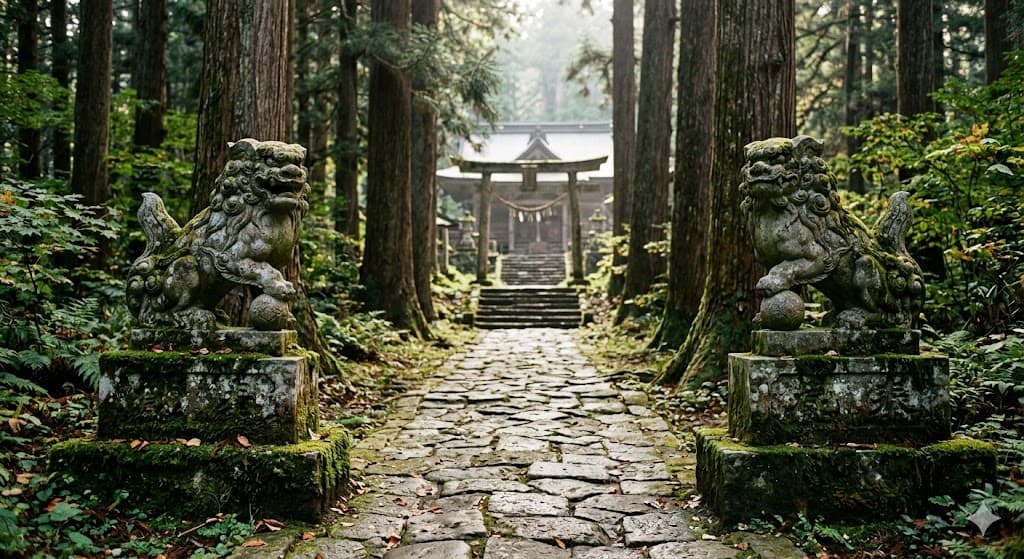
 The weathered, dignified face of a komainu — the kind of stone guardian a child stares at from a careful distance.
They were enormous. Their faces were frightening in a dignified way — not a cartoon scary, but the kind of face that was serious about its job. I remember them being mossy, weather-darkened, stone that had been sitting outdoors through decades of Tokyo summers and winters.
What I did not notice as a child — and what still embarrasses me a little — was that the two 狛犬(komainu: shrine guardian lion-dogs) were not the same statue. One had its mouth open. The other's mouth was closed. The left-right placement of the open and closed mouths is fixed by tradition, not random. I only registered this as an adult, and the moment I did, I immediately wanted to go back to Nezu Shrine to confirm it with my own eyes, to see if the childhood memory matched. That kind of delayed-recognition shock — oh, there was a whole grammar hidden here the entire time I was a kid — is exactly what I keep feeling when I watch current anime like 黄泉のツガイ(Yomi no Tsugai: Daemons of the Shadow Realm) and recognize old cultural bones under new fantasy skin.
Because 左右様(Sayuu-sama) — the paired guardian beings introduced in the first episode — is not really a new idea. It is a very, very old idea dressed up in modern manga clothing.
Related: Death Note and Japan's Shadow-Justice Tradition: Why Light Yagami Echoes the 必殺仕事人 Executioners explains this in detail.
The Grammar of Paired Guardianship in Japan
| Pair | Setting | Symbolic Function |
|---|---|---|
| 狛犬 (komainu) | Shinto shrines | Warding off evil; a-un beginning-and-end |
| 仁王 (Niō) | Buddhist temple gates | Protecting the Dharma; wrathful guardianship |
| 左大臣・右大臣 (Sadaijin / Udaijin) | Imperial court | Political hierarchy, left over right |
Look around a Japanese sacred site and you will notice that the guardians almost never come alone. They arrive as pairs, and the pairs follow a strict visual rhythm: one open, one closed. One active, one still. One on the left, one on the right. This is not a coincidence of design taste. It is an inherited system of meaning.
The A-un Pair at Shrine Gates
The komainu at shrines are almost identical except for the shapes of their mouths: one has it open, the other closed. The two forms are called 阿形(A-gyō: open-mouth form), symbolically representing the beginning of all things, and 吽形(Un-gyō: closed-mouth form), symbolically representing the end. Together they are read as 阿吽(a-un: the paired beginning-and-end sounds).
What is easy to miss is that this iconography is not originally Shinto at all. The a-un symbolism was imported from Buddhism, and is the same symbolism associated with the Niō, the two Buddhist gatekeeper deities. The open mouth pronounces the first letter of the Sanskrit alphabet ("a"), and the closed mouth pronounces the last ("hūṃ"). Together they span everything between. It functions as the Japanese equivalent of alpha and omega — arrived via India, routed through China, and naturalized so thoroughly into local culture that most visitors assume it is native Shinto.
And the placement is not casual. From the visitor's perspective approaching a shrine, the a-gyō (open mouth) is conventionally on the right, the un-gyō (closed mouth) on the left. This is a different convention from the court protocol I discuss below — guardian-iconography placement and imperial-protocol placement are two separate systems that happen to share the word "left" and "right." Once you see the a-un arrangement, you cannot un-see it. Every shrine approach becomes a sentence you can read.
The Niō and the Shift to Wrath
At Buddhist temples, the same grammar is expressed through a very different body type. 仁王(Niō: Benevolent Kings), more formally 金剛力士(Kongō Rikishi: vajra-bearing strongmen), are the muscular, bare-chested, wrathful guardians who stand at the temple gate. The Niō pair developed from a single protective power into two complementary bodies — what had originally been one guardian of the historical 釈迦(Shaka: Shakyamuni Buddha) was, over time, doubled and set on either side of the gate.
 A Niō guardian at a temple gate: a single protective power split into two complementary bodies, one roaring, one silent.
That detail is the one I find most interesting as someone who thinks about Daemons of the Shadow Realm. A single protective power, split into two complementary bodies. One roars; one holds the roar in. The pair together symbolize the birth and death of all things, functioning much as alpha and omega do in Christian symbolism.
The Sayuu-sama of the anime — explicitly named Hidari (Left) and Migi (Right), explicitly paired, explicitly acting as a single guardian system for a bloodline — is a very direct restatement of this ancient logic. 荒川弘(Arakawa Hiromu: the manga's author) did not invent the structure. She gave it a new shell.
Why Left Outranks Right
Here is the part that usually surprises non-Japanese readers. In Japanese court protocol, left is the higher-ranked side. 左大臣(Sadaijin: Minister of the Left) was the Senior Minister of State, overseeing all functions of government with 右大臣(Udaijin: Minister of the Right) as his deputy. The court hierarchy built into the 太政官(Daijō-kan: Heian-period Council of State) under the 大宝律令(Taihō Ritsuryō: 701 CE legal code) put left above right.
The same rule still structures the Hinamatsuri doll platform, at least in the classic Kyoto-style arrangement. In traditional Japanese court hierarchy, the Minister of the Left holds a higher rank than the Minister of the Right. However, from the viewer's perspective, this can feel counterintuitive because when looking at a display, the Minister of the Left actually appears on the right, while the Minister of the Right appears on the left. Modern Kantō-style displays sometimes flip the emperor and empress positions under Western influence, but the minister tier has tended to keep its older logic.
That "from whose point of view" problem is the sneaky part. Left and right in Japanese court culture are stated from the subject's perspective — the deity's, the emperor's, the doll's — not the viewer's. The Sayuu-sama follow the same logic: Hidari and Migi are named from the position of the one they guard, not the one looking at them.
What We Still Keep, Quietly
| Frame | Description |
|---|---|
| Author lens | A childhood in Adachi-ku, years of life outside Japan |
| Observation | Paired symmetry has receded from belief into habit |
| Everyday examples | Chopsticks, torii, geta, shrine guardians |
I did not grow up in a shrine-keeper's family, but the two-of-everything logic still ran through small things in our 足立区(Adachi-ku) house without anyone naming it. Shoes lined up at the 玄関(genkan: the lowered entryway where shoes are removed) two by two each evening. The pair of stone 狛犬(komainu) at 根津神社(Nezu Jinja), which I had been too small to approach as a child, sat in my memory not as identical figures but as a single image with two halves — though it would take adulthood to register that the two halves were a deliberate pair, one open and one closed, not a duplicated set.
 The paired uprights of a torii — everyday Japanese symmetry that has receded from belief into habit but never quite vanished.
That is the pattern with almost every Japanese cultural form I grew up around. The symmetry was so everywhere that I could not see it.
I have lived outside Japan for many years now, and from this distance I notice something else: the paired-guardian logic has not really disappeared from Japan. It has just receded into places people do not look anymore. 割り箸(waribashi: disposable wooden chopsticks) still split into two before they can be used. Family chopsticks in my childhood home were color-coded by tradition — my father's black, my mother's red, mine printed with anime characters — a gendered left-right pairing so unconsciously obeyed that no one in the family would have called it a tradition. Every 鳥居(torii: shrine gate) still arrives as two uprights. 下駄(geta: traditional wooden clogs) still come as a pair. The symmetry is quieter than it used to be, but it is still there.
What anime like Daemons of the Shadow Realm does — and what makes it worth watching with a cultural ear, not just a fan's ear — is that it takes this submerged grammar and brings it back to the visible surface. The show names the thing out loud. It says: your guardians are two. The two are one. They stand on the left and the right because that is how protection is shaped in our world. It does this while also telling an entertaining twin story, which is how Japanese popular culture has always done its most serious cultural work — sideways, through entertainment, with no lecture attached.
I think the reason I find the Sayuu-sama conceit moving is that it sits at exactly the place where religion becomes memory. A village child in the anime says he is safe because Sayuu-sama will protect him. He does not mean it theologically. He means it the way I might have said, as a child, that an お守り(omamori: small protective amulet) in my drawer would protect me — which is to say, as a comfort that had outlived the belief system that produced it. The amulets I was given as a kid eventually went missing in a move. Sayuu-sama, in the anime's logic, does not.
FAQ
Q: What does 左右様 (Sayuu-sama) mean?
A: 左右様 reads as "Lord Left-and-Right" — 左 (left) and 右 (right) joined with the honorific 様 (-sama). In Daemons of the Shadow Realm it names a single guardian presence expressed as a left-and-right twin pair. The deity is a fictional coinage, but the naming pattern is genuinely Japanese: guardian figures are routinely set out as left-right pairs, as with 狛犬 (komainu: shrine lion-dogs) and 仁王 (Niō: temple gate guardians).
Q: Is 左右様 (Sayuu-sama) based on a real Shinto deity?
A: No. Sayuu-sama is a fictional creation specific to Daemons of the Shadow Realm. However, the underlying idea of a guardian power expressed through a left-right pair is drawn from real, deeply rooted Japanese traditions including 狛犬(komainu: shrine guardian lion-dogs) and 仁王(Niō: Buddhist temple guardians).
Q: Why does Japanese tradition place left above right?
A: The precedence dates to the 大宝律令(Taihō Ritsuryō: 701 CE legal code) and the court structure of the 太政官(Daijō-kan: Council of State), which placed the 左大臣(Sadaijin) above the 右大臣(Udaijin). The convention is thought to reflect influence from Tang-dynasty China and became standard in imperial ceremony, surviving in modern form in the Kyoto-style Hinamatsuri doll arrangement and other ritual contexts.
Q: Are the open-mouth and closed-mouth statues really saying something?
A: Yes, symbolically. The open-mouth figure is pronouncing the Sanskrit "a" (the first sound) and the closed-mouth figure is pronouncing "hūṃ" (the last sound). Together they cover everything between beginning and end — a compressed cosmology hidden in stone faces you walk past without a second glance.
Key Insights to Remember
| Insight | Lens |
|---|---|
| Sayuu-sama as restatement | Fantasy grammar over ancient pairing logic |
| Functional twins | One protective force, two complementary bodies |
| Tradition as habit | Grammar outlives theology |
- Sayuu-sama in Daemons of the Shadow Realm is not a stylistic flourish. It is the restatement, in fantasy grammar, of a protective-pair logic that runs from the Kamakura-period Niō at 東大寺(Tōdai-ji: major Buddhist temple in Nara) all the way down to the stone komainu at a neighborhood shrine. The anime is fluent in something most modern Japanese viewers no longer consciously parse — and that is exactly why the conceit lands.
- Japan's paired guardians are not twins in the genetic sense. They are twins in the functional sense — a single protective force articulated through two complementary bodies. One open, one closed. One on the left, one on the right. This is the same logic that gives Japanese culture its distinctive aesthetic rhythm across chopsticks, shrine gates, doll platforms, and court hierarchies.
- The cultural memory of paired symmetry survives in modern Japan largely as habit rather than as belief. I stopped noticing amulets long before I understood what the komainu's mouths meant, but the mouths kept their meaning anyway. That is the quiet trick of Japanese tradition: its grammar outlives its theology, and a show like Daemons of the Shadow Realm can still reach into the old grammar and pull something living out of it.
Sources & References
- Komainu — Wikipedia
- "Komainu": The Shrine's Guardian Figures — Nippon.com
- Niō: The Guardians at the Temple Gates — Nippon.com
- Nio (Buddhism) — Wikipedia
- Ni-ō — Encyclopædia Britannica
- Minister of the Left — Wikipedia
- Minister of the Right — Wikipedia
- Hinakazari: The Dolls and Tiers of Japan's Hinamatsuri Display — Tsukushi Japan
- Daemons of the Shadow Realm — Wikipedia
- Guardian Lion-Dogs — The Metropolitan Museum of Art
About the author

Spoiler-free cultural deep-dives into anime, manga & live-action Japanese drama
- ●Tokyo-born, 3rd-generation Edokko (江戸っ子)
- ●Lifelong manga reader & anime viewer since the kaiju era
- ●Writes from outside Japan — distance as a cultural lens
- ●Spoiler-free · sourced · Kanji + Romaji + English
A Tokyo-born, 3rd-generation Edokko writer who has spent years living outside Japan. I use the anime, manga, and live-action Japanese drama you already love as a doorway into the folklore, language, religion, and everyday history behind them — written so even first-time fans can follow along, with sources for every claim.
Enjoy this article?
Get the next spoiler-free cultural deep-dive straight to your inbox.
Related Articles

Vinland Saga and the Paradise Beyond the Western Sea: What Vinland Shares with Japan's Tokoyo and Fudaraku Tokai
How Vinland Saga's warm land beyond the western sea echoes Japan's Tokoyo belief and the Fudaraku tokai monks who once sailed toward a paradise across the water.
7/18/2026
Jujutsu Kaisen and Goryō Shinkō: Why Japan Turns a Vengeful Curse Into a God
How Jujutsu Kaisen dramatizes goryō shinkō — the Japanese belief that turns a wronged spirit's resentment into a curse, then enshrines it as a worshipped god.
6/27/2026
Delicious in Dungeon and Itadakimasu: The Mealtime Word That Means I Receive This Life
How Delicious in Dungeon makes Itadakimasu visible — the Buddhist and Shinto idea of receiving life behind a phrase foreign viewers mistake for let's eat.
6/15/2026

Yu Yu Hakusho and the River Sanzu: The Ferry-Toll, the Stripping Crone, and the Three Crossings of the Dead
How Yu Yu Hakusho's ferrywoman Botan opens a door onto the River Sanzu, where six coins and a clothes-stripping crone decide how the Japanese dead cross over.
6/14/2026
The Elusive Samurai and the Suwa Faith: The Shrine Where the Priest Was Also a Warlord
How The Elusive Samurai uses the priest Suwa Yorishige to open up the Suwa faith — the living-god high priests, the honden-less shrine, and the war god medieval samurai prayed to.
6/8/2026
Frieren and the Drinking Monk: Heiter, the 'Corrupt Priest'
How Heiter's running Corrupt Priest joke in Frieren: Beyond Journey's End opens a door into hannyatō and Japan's long, gently bent rule against monks drinking.
5/26/2026