The Elusive Samurai and the Suwa Faith: The Shrine Where the Priest Was Also a Warlord
How The Elusive Samurai uses the priest Suwa Yorishige to open up the Suwa faith — the living-god high priests, the honden-less shrine, and the war god medieval samurai prayed to.

Tokyo-born, 3rd-generation Edokko · writing on Japanese culture from outside Japan
Spoiler-Free Cultural Analysis
This article uses The Elusive Samurai only as a doorway into the real religious history behind one of its central figures — the Suwa faith, its honden-less shrine, and its priests who were treated as living gods. It deals with atmosphere, setting, and historical background, not with plot turns beyond the premise already given in the show's opening.
Key Takeaways
- The strange priest who shelters the young lord in The Elusive Samurai is rooted in a real institution: the Suwa clan's high priest, who was regarded as a living embodiment of the deity while his family also held real political and military weight in Shinano.
- 諏訪大社(Suwa Taisha: Suwa Grand Shrine) is one of Japan's oldest shrines, and three of its four sanctuaries famously have no main hall — worshippers face a mountain or a sacred tree instead of an enshrined building.
- The Suwa deity was venerated as a war god by medieval warrior houses such as the Hōjō and the Takeda, which is why a Suwa priest standing beside a fleeing Hōjō heir is not a writer's whim but a thread pulled straight out of medieval religious politics.
Key Terms Explained
- 諏訪大社 (Suwa Taisha) / Suwa Grand Shrine — An ancient shrine complex in present-day Nagano, made up of four sanctuaries split across two sites on either side of Lake Suwa, and the head shrine of thousands of Suwa shrines nationwide.
- 本殿 (Honden) / Main Sanctuary Hall — The innermost building that usually houses a shrine's sacred object. Suwa Taisha is striking precisely because most of its sites lack one.
- 大祝 (Ōhōri) / High Priest as Living God — The hereditary head priest of the Upper Shrine, treated not merely as someone who worships the god but as the god's living vessel.
- 諏訪明神 (Suwa Myōjin) / The Suwa Deity — Another name for the enshrined god Takeminakata, worshipped as a patron of wind, water, hunting, and — crucially for the samurai — warfare.
- 御柱祭 (Onbashira Matsuri) / Pillar Festival — A festival held roughly once every six to seven years in which enormous fir trunks are cut and hauled down from the mountains to mark the four corners of each sanctuary.
A Surname Before a Shrine
For most of my life, the word "Suwa" reached me not as a place of worship but as a person's name. I knew someone whose family name was 諏訪(Suwa), and when I first heard it I remember thinking it sounded somehow handsome, even auspicious — the kind of name that carries a little weight when you say it aloud. That was my real point of contact. The shrine itself stayed at arm's length. My family went camping in 長野(Nagano: the prefecture that contains the Suwa region) when I was a child, but I have no memory of visiting Suwa Taisha, no recollection of standing under its torii.
I bring this up because I suspect my distance is closer to the norm than the tourist brochures admit. Most Japanese people have never made a pilgrimage to Suwa Taisha. Far more of us know "Suwa" as a place name on a map or a surname on a meishi than as a god we have prayed to. So when The Elusive Samurai introduces a priest from Shinano named Suwa Yorishige, a Japanese viewer doesn't necessarily arrive with deep reverence already loaded. We arrive, many of us, about as curious as an overseas reader — which is a more honest place to start than pretending otherwise.
A God You Worship Without a Building
The first thing worth unlearning is the assumption I carried for decades: that a shrine is a building, and that the god lives inside it. Torii gate, a hall, a pair of 狛犬(komainu: the paired guardian lion-dogs), and somewhere in the back, an enclosed sanctuary. That picture, formed in a downtown Tokyo childhood, is so ordinary to most Japanese that we never question it.
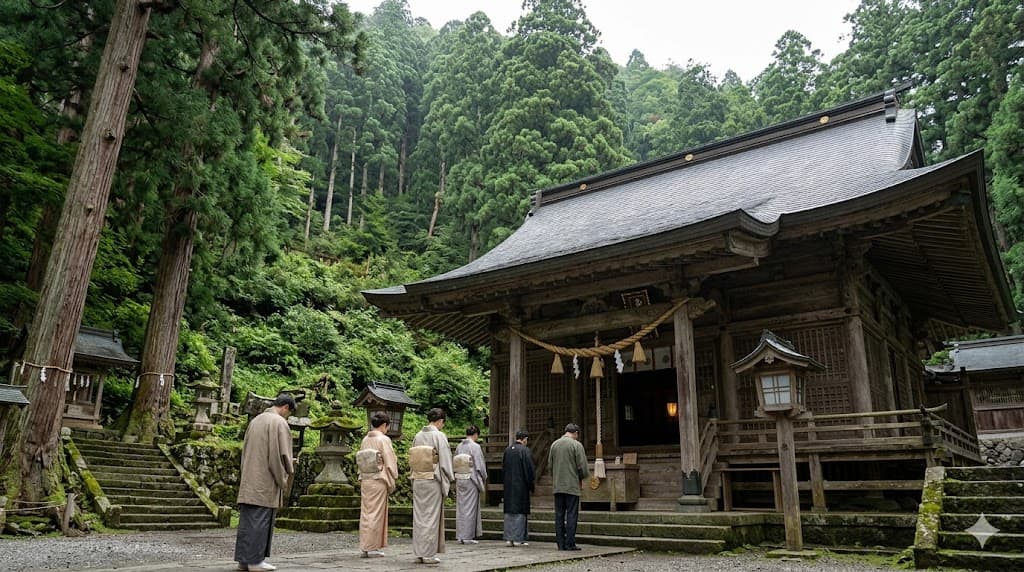 Where most shrines would place an inner sanctuary, Suwa Taisha leaves the mountain itself as the object of worship.
Suwa Taisha quietly takes that assumption apart.
A Shrine With No Building to Worship
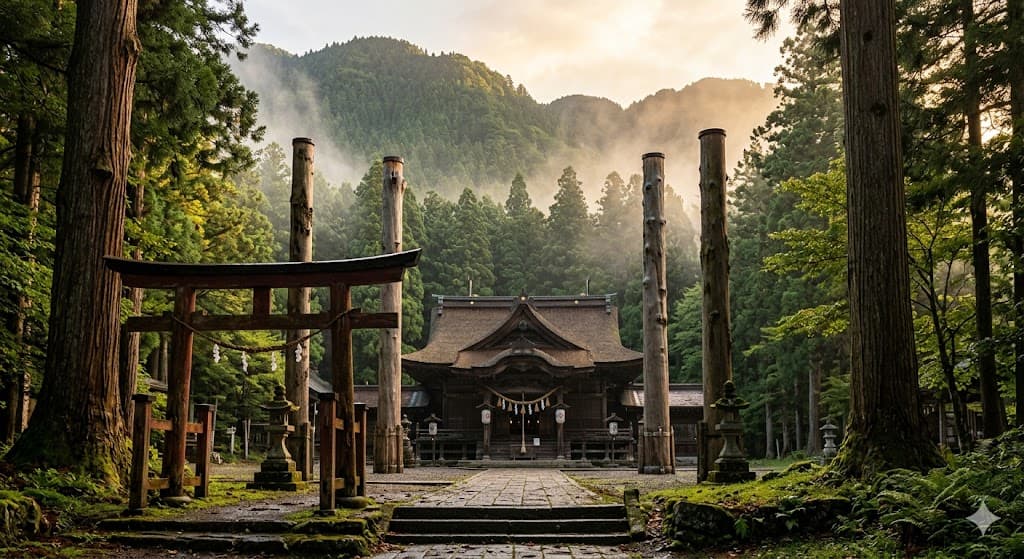
Three of Suwa Taisha's four sanctuaries have no honden at all. At the Kamisha Honmiya (one of the Upper Shrines), the object of worship is Mount Moriya, the mountain rising behind the precinct. At the two Lower Shrines, the sacred bodies are great trees — a towering cedar at one, a venerable yew at the other. There is a worship hall to stand before, but no inner building holding the god, because the god is the mountain, the god is the tree. This is widely understood as a survival of a very old form of 自然崇拝(shizen sūhai: nature worship) that predates the whole architecture of shrine-building in Japan.
When I first absorbed this, it genuinely surprised me — and I say that as someone born and raised here. I had simply never knelt before a shrine where the mountain itself was the deity. Growing up among concrete and narrow lanes, I learned "shrine" as torii-plus-hall-plus-komainu. The idea that nature itself could be the god, with no structure required, felt new rather than familiar. That reaction is, I think, the useful one to keep. If you are reading this from outside Japan, you are not being asked to recover a feeling every Japanese person already has. The honest framing is: drop the premise that "a shrine is a god inside a building," go back to the older idea that the mountain or the tree is the god, and Suwa Taisha suddenly makes sense.
The Living God Who Was Also a Warlord
Here is where the show's priest stops being a fantasy character and starts being history.
The Upper Shrine's hereditary high priest, the Ōhōri, was not simply a clergyman. He was regarded as the visible embodiment of Suwa Myōjin — a living god, an object of worship in his own right. The office was traditionally taken up by a boy, and a separate priestly lineage, the Moriya family serving as 神長官(jinchōkan: the chief administrative priest), performed the rite that summoned the divine presence — a mysterious power known as 御左口神(Mishaguji) — to dwell in him. In other words, a human being was, by ritual, turned into the god.
I had never really sat with the idea that a person could be treated not as a worshipper but as the god himself. My whole relationship with shrines assumed a clean line: the kami is one kind of being, people are another, and our job is to bow. The notion of a living human deity was, frankly, fresh and a little startling to me — which is exactly why I'd warn against presenting it to overseas readers as some self-evident "Japanese instinct." It isn't. It surprises Japanese people too.
And the Suwa clan that produced these living gods also held worldly power over land and people in Shinano. Religious authority and local rule were not neatly separated; by the late Heian period this dual priest-and-ruler role was already pronounced. This is the genuine historical bedrock under a character like Yorishige: a figure who is simultaneously a sacred vessel and a player in real politics and warfare. A "diviner who nonetheless moves armies" is not a contradiction the author invented. It is roughly what the Suwa Ōhōri institution actually was.
Why Warriors Prayed to Suwa
The enshrined deity, Takeminakata — known as Suwa Myōjin — was worshipped as a god of wind, water, and agriculture, but also as a patron of hunting and warfare. During the medieval period he drew an especially fervent following from warrior houses, the Hōjō and the Takeda foremost among them. The very old origin myth has the Suwa god arriving from outside and defeating a resident god in a contest of strength before taking the land — a story of a victorious, martial deity.
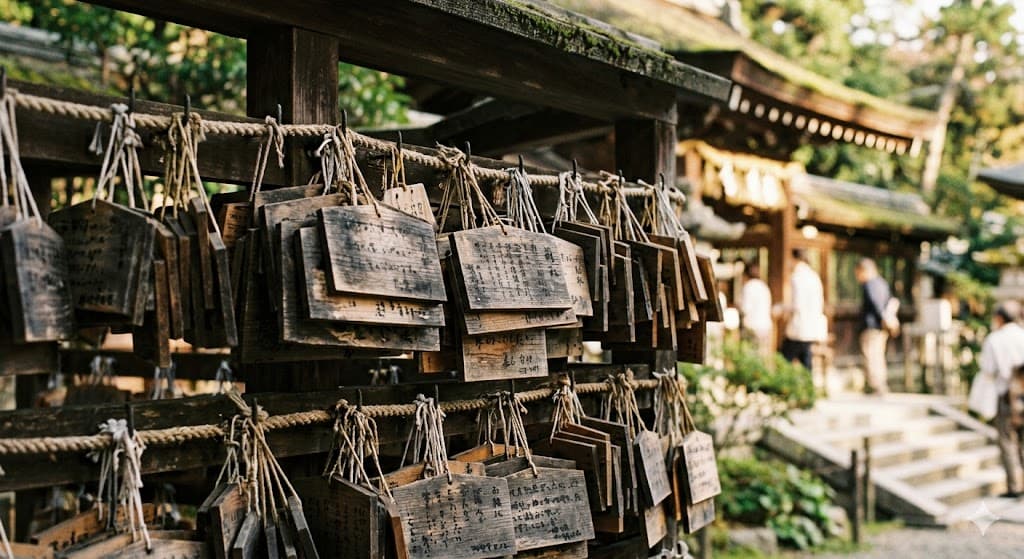 The habit of asking the gods for a final push before a contest links the medieval warrior to the modern student.
So when a Suwa priest appears at the side of a Hōjō heir at the moment the Kamakura order collapses, the pairing carries a logic that history supplies for free. The Hōjō were exactly the kind of warrior house that held Suwa Myōjin in deep regard.
This is the thread that runs all the way down to my own life, and probably to yours if you grew up here. I am not someone who hands my decisions to fortune-tellers; I keep a cool distance from horoscopes and luck. But there is one exception I've always made — the prayer before a contest. Before important sports matches and entrance exams, I have gone to a shrine to pray for victory or for passing. Even when I didn't go myself, the sight of 絵馬(ema: the small wooden plaques on which people write their wishes) lined up by the hundreds, or a 達磨(daruma: the round wish-making doll whose second eye you fill in when a goal is reached), was part of the ordinary scenery of my childhood. In Japan, we don't treat winning and losing as purely a matter of our own ability; we reserve a little space to ask the gods for the final push. The medieval warrior praying to Suwa before battle and the modern student praying before an exam are standing on the same ground. The war god is not a distant relic — he's the ancestor of a habit a lot of us still have.
What an Honden-less Shrine Asks of Us Now
Living outside Japan for many years has a way of turning familiar things over so you can see their undersides. I grew up taking it for granted that a shrine is a building you enter, and it took distance — and a topic like this one — to notice how much that assumption had narrowed my sense of what worship could be.
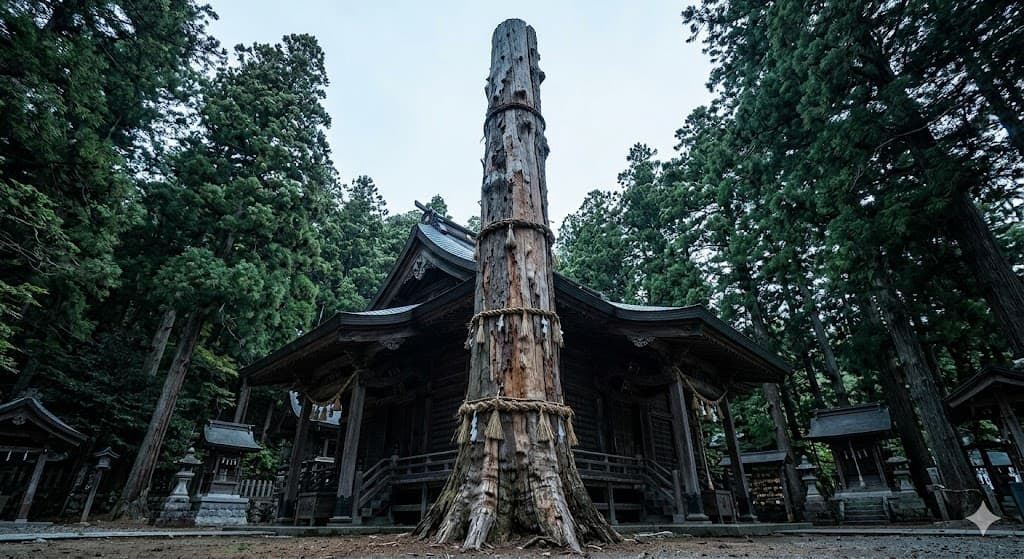 The great Onbashira pillars mark the sacred ground of a faith that has outlasted nearly every dynasty that prayed to it.
The Suwa faith preserves something most of modern Japanese religious life has quietly let go: the willingness to leave the god un-housed. No hall, no roof, nothing to contain it — just a mountain you face, or a tree old enough to outlast every priest who ever served it. There is a kind of honesty in that. The newer instinct, the one I absorbed, wants to put the sacred safely indoors. The older Suwa instinct lets it stay outside, as weather and slope and timber.
I don't want to romanticize this into a lecture about a purer past. Plenty of what Suwa Taisha keeps alive is strange and demanding — the Onbashira festival, in which men ride ten-ton logs down a hillside, has genuinely cost lives. This is not gentle nostalgia; it is a faith with edges. But for an outsider's eye, and for an insider's eye that has spent long enough away to become a little outside, the lesson is the same. Before there were buildings, before there were even clear lines between priest and ruler, between worshipper and god, the Japanese once stood in front of a mountain and called it holy. Suwa is one of the few places where you can still feel the shape of that.
And it reframes the very thing The Elusive Samurai is built around. The era it depicts prized dying gracefully in battle above almost everything. The show's wager — voiced through its odd, luminous priest — is that surviving can be its own kind of heroism. There's something fitting in routing that argument through Suwa, a tradition whose god is a mountain that simply endures, and whose oldest forms have outlasted nearly every dynasty that ever prayed to them.
FAQ
Q: Is Suwa Yorishige in The Elusive Samurai based on a real person?
A: Yes. Hōjō Tokiyuki, Suwa Yorishige, and Ashikaga Takauji are all historical figures. The real Yorishige was a Suwa figure who sheltered the surviving Hōjō heir after the fall of Kamakura in 1333; the supernatural "divine power" is the author's dramatic embellishment laid over a real relationship.
Q: Why does Suwa Grand Shrine have no main hall?
A: Three of its four sanctuaries worship nature directly — a mountain at one Upper Shrine site, great sacred trees at the Lower Shrines — rather than an object housed in a building. This is understood as a survival of an ancient form of nature worship that predates the development of shrine architecture in Japan.
Q: Why did samurai worship the Suwa deity?
A: The Suwa deity, Takeminakata or Suwa Myōjin, was venerated as a patron of hunting and warfare, and his founding myth is martial. Medieval warrior houses, notably the Hōjō and the Takeda, held him in particularly strong regard, which is why a Suwa priest beside a Hōjō heir reflects real medieval religious allegiances.
Key Insights to Remember
- The fusion of priest and warlord in The Elusive Samurai is not fantasy logic but a compressed portrait of a real institution: at Suwa, religious authority and worldly power genuinely ran through the same hereditary line, and the high priest was both a living god and a member of a clan that ruled land and fielded men.
- Suwa Taisha's missing main hall is the most economical way to grasp what Japanese worship looked like before it moved indoors. Worship aimed at a mountain or a tree, with no building between the believer and the god, is the older layer beneath the torii-and-hall image most of us carry — and recognizing it surprises Japanese visitors as much as foreign ones.
- The war god of Suwa and the modern habit of praying before an exam or a match are continuous, not separate. Treating victory as something you ask the gods to help secure, rather than something owed purely to your own effort, links the medieval warrior at Suwa to the student filling in a daruma's eye today.
Sources
- Suwa Taisha Shrine | Travel Japan (JNTO)
- "Sacred Deer" Documentary Takes a Deep Look at Suwa Taisha Rituals | Nippon.com
- Nagano Prefecture's Suwa Taisha: One of Japan's Oldest Shintō Shrine Complexes | Nippon.com
- The Four Shrines | 信濃國一之宮 諏訪大社 (Official Site)
- Suwa clan | Wikipedia
- Suwa clan | Japan Reference
- Takeminakata | Shinto Wiki
- The Elusive Samurai | Wikipedia
- Who Is Yusei Matsui, the Author of "The Elusive Samurai"? | ABEMA TIMES
About the author
Spoiler-free cultural deep-dives into anime, manga & live-action Japanese drama
- ●Tokyo-born, 3rd-generation Edokko (江戸っ子)
- ●Lifelong manga reader & anime viewer since the kaiju era
- ●Writes from outside Japan — distance as a cultural lens
- ●Spoiler-free · sourced · Kanji + Romaji + English
A Tokyo-born, 3rd-generation Edokko writer who has spent years living outside Japan. I use the anime, manga, and live-action Japanese drama you already love as a doorway into the folklore, language, religion, and everyday history behind them — written so even first-time fans can follow along, with sources for every claim.
Enjoy this article?
Get the next spoiler-free cultural deep-dive straight to your inbox.
Related Articles
Vinland Saga and the Paradise Beyond the Western Sea: What Vinland Shares with Japan's Tokoyo and Fudaraku Tokai
How Vinland Saga's warm land beyond the western sea echoes Japan's Tokoyo belief and the Fudaraku tokai monks who once sailed toward a paradise across the water.
7/18/2026
Jujutsu Kaisen and Goryō Shinkō: Why Japan Turns a Vengeful Curse Into a God
How Jujutsu Kaisen dramatizes goryō shinkō — the Japanese belief that turns a wronged spirit's resentment into a curse, then enshrines it as a worshipped god.
6/27/2026
Delicious in Dungeon and Itadakimasu: The Mealtime Word That Means I Receive This Life
How Delicious in Dungeon makes Itadakimasu visible — the Buddhist and Shinto idea of receiving life behind a phrase foreign viewers mistake for let's eat.
6/15/2026

Yu Yu Hakusho and the River Sanzu: The Ferry-Toll, the Stripping Crone, and the Three Crossings of the Dead
How Yu Yu Hakusho's ferrywoman Botan opens a door onto the River Sanzu, where six coins and a clothes-stripping crone decide how the Japanese dead cross over.
6/14/2026
Frieren and the Drinking Monk: Heiter, the 'Corrupt Priest'
How Heiter's running Corrupt Priest joke in Frieren: Beyond Journey's End opens a door into hannyatō and Japan's long, gently bent rule against monks drinking.
5/26/2026
Kengan Ashura and the Buddhist Realm of Strife: Why a Fight Manga Wears the Name of a Warring Deity
How Kengan Ashura draws on the Buddhist concept of 修羅 (Shura) — the warring demigod, the realm of endless combat, and the everyday word for a scene of conflict.
5/15/2026