Frieren and the Drinking Monk: Heiter, the 'Corrupt Priest'
How Heiter's running Corrupt Priest joke in Frieren: Beyond Journey's End opens a door into hannyatō and Japan's long, gently bent rule against monks drinking.

Tokyo-born, 3rd-generation Edokko · writing on Japanese culture from outside Japan
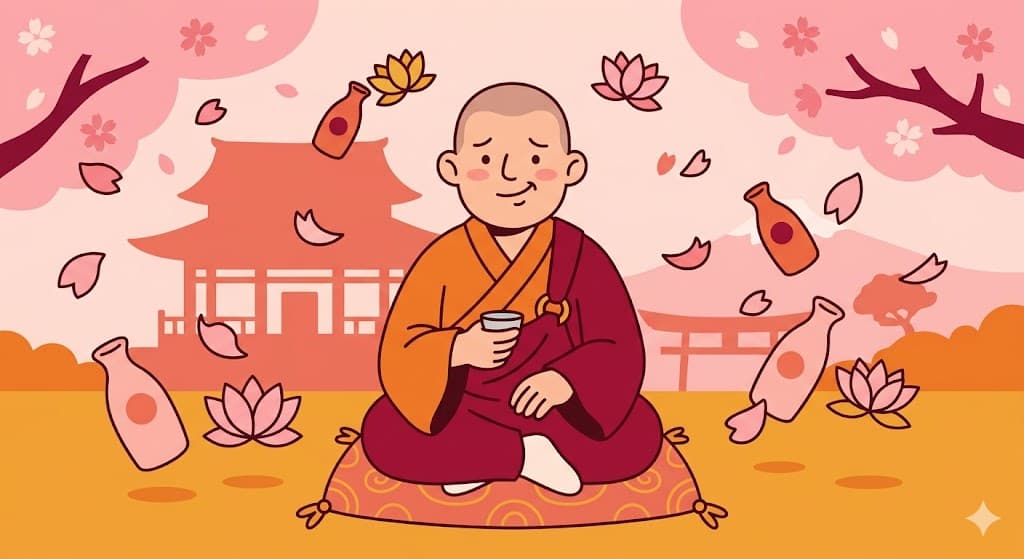
Spoiler-Free Cultural Analysis
This article looks at the cultural and historical background behind a running joke in the first episode of 葬送のフリーレン (Sōsō no Frieren) / Frieren: Beyond Journey's End — the way Heiter the priest is teased as a "Corrupt Priest." No plot beyond what an official synopsis already shows is revealed. The focus is on the long, oddly forgiving relationship between Japanese Buddhism and alcohol.
Key Takeaways
- The English insult "Corrupt Priest" lands much more softly in Japanese ears because Japanese Buddhism has a long, half-winking tradition of monks bending the rule against drinking, rather than the harsh moral image carried by the Western "corrupt clergyman."
- 般若湯 (Hannyatō) / "wisdom water" is the most famous of several monastic code words used to dress sake up as something more permissible, and its existence itself is evidence that the precept against drinking was being routinely worked around.
- The label 生臭坊主 (Namagusa Bōzu) / "fishy-smelling monk" in Japanese is closer to teasing than to moral condemnation, which is why Heiter's friends can call him a "Corrupt Priest" while still treating him with deep affection.
Key Terms Explained
- 五戒 (Gokai) / The Five Precepts — The five basic moral rules of lay Buddhism: no killing, no stealing, no sexual misconduct, no lying, no intoxicants.
- 不飲酒戒 (Fuonjukai) / The Precept Against Drinking — The fifth of the five precepts, prohibiting the consumption of alcohol.
- 般若湯 (Hannyatō) / "Wisdom Water" — A monastic code word for sake, coined so that monks could refer to alcohol without naming it directly.
- 生臭坊主 (Namagusa Bōzu) / "Fishy Monk" — A monk who eats meat or fish, drinks alcohol, or otherwise ignores precepts; used in Japanese more as good-natured ribbing than serious accusation.
- 破戒僧 (Hakaisō) / Precept-Breaking Monk — A more formal term for a monk who openly violates the rules of monastic discipline.
The Friend Everyone Has Who Drinks a Little Too Much
The first time I watched the opening episode of Frieren, I caught myself laughing not at the big moments but at the smallest one: a hero teasing the party priest as a Corrupt Priest because all he wants from peacetime is a job where he can keep drinking. The English subtitle reads sharper than the Japanese felt to me. In Japanese, the line lands like the way you might tease an uncle who always asks for one more drink at New Year's — affectionate, slightly resigned, not really an accusation.
 The casual warmth of a Japanese izakaya — the cultural setting where the line between sacred and ordinary has long blurred.
I grew up in 東京 (Tōkyō) / Tokyo, in a household that never had a regular relationship with a temple. The only times I ever spoke to a monk were at funerals and memorial services. We had no 仏壇 (Butsudan) / family Buddhist altar and no 神棚 (Kamidana) / household Shinto shelf. Buddhism, for me as a child, was a man in robes who came to the house when someone died, chanted, ate the food my mother had prepared, and went home. I never witnessed a monk drinking with my own eyes, and the word 般若湯 (Hannyatō) / wisdom water is something I only learned recently as an adult.
So when Heiter is teased for his hangovers, I do not feel the same thing an American or European viewer might feel hearing the phrase "Corrupt Priest." I do not feel scandal. I feel something closer to the warm, slightly tired joke that Japanese Buddhism has been telling about itself for centuries.
The Precept, the Workaround, and the Word "Wisdom Water"
To understand why Heiter's drinking reads as teasing rather than condemnation, you have to start with the rule he is supposedly breaking.
 Sake and scripture, side by side — the quiet compromise that produced the code word Hannyatō.
The Fifth Precept and Its Awkward Position
Buddhism is generally said to have arrived in Japan in the sixth century, carrying with it the 五戒 (Gokai) / Five Precepts that every lay Buddhist is supposed to follow. The fifth of these, 不飲酒戒 (Fuonjukai) / the precept against intoxicants, forbids the consumption of alcohol. The reasoning in early Buddhist texts is not moralistic in the Christian sense — it is not that alcohol is sinful in itself, but that intoxication clouds the mind and undermines the other four precepts. A monk who drinks may then steal, lie, or harm.
This was the inherited rule. What happened to it in Japan is one of the more interesting cultural compromises in Japanese religious history.
How Hannyatō Was Born
By the medieval period, sake was being produced and consumed at Japanese temples on a routine basis. Sake was offered to the gods of 神道 (Shintō) / Shinto, used in temple ceremonies, and — quietly, then less quietly — drunk by the monks themselves.
The problem was the rule. The solution was a word. 般若湯 (Hannyatō), literally "the hot water of 般若 (Hannya) / prajñā, the Buddhist concept of transcendent wisdom," let monks talk about sake in the temple without naming it. The joke embedded in the word is theological: sake, far from clouding wisdom, was being half-seriously reframed as a vehicle for it. A similar impulse can be seen in other monastic and culinary code words, where forbidden foods were sometimes referred to by indirect names rather than their plain ones.
These code words are evidence of something important. They were not invented by people who had given up on the precepts. They were invented by people who still cared enough about the precepts to want a fig leaf. The result is a culture in which the rule is technically still there and openly bent at the same time.
Namagusa Bōzu and Hakaisō: Two Words, Two Tones
Japanese has two main words for a monk who breaks the rules, and the gap between them is exactly the gap between English "corrupt priest" and the Japanese feeling.
生臭坊主 (Namagusa Bōzu) literally means "fishy-smelling monk" — a monk who eats fish or meat, drinks, or otherwise ignores the dietary and behavioral precepts. In daily Japanese, the word carries a teasing edge. It is the kind of thing you might mutter with a half-smile about a temple-priest neighbor who is too fond of the local izakaya. It is rarely a serious moral accusation.
破戒僧 (Hakaisō) / precept-breaking monk is the heavier word. This one is closer in tone to the English "corrupt priest." It implies a real violation, a fall from monastic discipline, sometimes with criminal or scandalous undertones.
When Heiter's friends tease him, what they are doing in Japanese cultural shorthand is calling him a namagusa bōzu, not a hakaisō. The English subtitle "Corrupt Priest" flattens this distinction. To a Japanese viewer, the joke is gentler than it sounds in English.
Jōdo Shinshū and the Officially Bent Rule
There is one more layer worth knowing. In the thirteenth century, 親鸞 (Shinran) / founder of the True Pure Land School of Buddhism shaped what became the 浄土真宗 (Jōdo Shinshū) / True Pure Land School, one of the largest schools of Japanese Buddhism. Shinran did something remarkable for a monk of his era: he married openly, ate meat, and taught that priests should live as ordinary householders. His descendants and successors followed suit.
In 1872 (Meiji 5), the government formally permitted Buddhist clergy to marry, eat meat, and grow their hair — a policy known as 肉食妻帯 (Nikujiki Saitai) / "meat-eating and wife-taking." What had been a code-worded compromise became, for much of Japanese Buddhism, simply how things worked. Many temple priests today live with their families above or beside the temple, raise children, and yes — drink at the local izakaya.
This is the cultural water Heiter is swimming in, even though Frieren is a European-style fantasy. The writers know their Japanese audience will hear the joke through this long-running compromise.
What I Notice from Outside
Living outside Japan for many years now, I have started to see this from a different angle.
 A Japanese temple at dusk — where the rule, the workaround, and the human being have lived together for centuries.
In the country where I now live, the boundary between religious vocation and ordinary life is drawn far more sharply. A priest is expected to look and live like a priest in a way that has no real equivalent in modern Japanese Buddhism. When I try to explain to friends here that the monk who chanted at a family funeral may well have gone home that night and had a beer with dinner, I get puzzled looks. The idea seems faintly improper.
But the more I sit with it, the more I think the Japanese arrangement says something honest about how rules and human beings actually work. Japanese Buddhism did not pretend its monks were not drinking. It also did not abandon the precept. It found a third path: keep the rule on the books, invent a softer language, and let the community tease the priest who indulges a little too obviously. The teasing itself is the discipline — gentle, communal, embarrassing enough to keep things from going too far.
When I watch Heiter being called a Corrupt Priest by friends who clearly love him, who fought beside him for ten years, who will mourn him properly when he is gone, I see this whole cultural inheritance compressed into a single running joke. The word "corrupt" is too harsh in English. What he actually is, in Japanese cultural terms, is a namagusa bōzu — and that is a thing one can be while still being a good man, a brave one, and a friend.
There is something I have lost, living away from Japan, that I did not realize I had until I started writing pieces like this one. It is the casual, lived-in tolerance of contradiction. The shrine inside the temple. The priest at the bar. The rule everyone knows and almost no one fully keeps. Watching Frieren tease Heiter, I feel a small, surprising homesickness — not for any specific place, but for that particular kind of warmth.
FAQ
Q: Is it really true that Buddhist monks in Japan drink alcohol?
A: For most schools of modern Japanese Buddhism, yes. Since the Meiji-era edict of 1872 (肉食妻帯, Nikujiki Saitai) formally permitted clergy to marry, eat meat, and live as householders, and given that schools like 浄土真宗 (Jōdo Shinshū) / True Pure Land School had already embraced this lifestyle centuries earlier, drinking by priests is widely accepted. Stricter monastic traditions still observe the precept.
Q: What does 般若湯 (Hannyatō) literally mean, and why did monks use it?
A: It literally means "wisdom water" — combining 般若 (Hannya) / prajñā, transcendent wisdom, with 湯 (Tō) / hot water or broth. Monks used it as a code word so they could refer to sake within the temple without openly naming alcohol, technically preserving the precept against intoxicants while practically working around it.
Q: Is "Corrupt Priest" a fair translation of what Heiter's friends call him in the original Japanese?
A: It captures the surface meaning but loses the tone. The Japanese feeling is closer to 生臭坊主 (Namagusa Bōzu) / "fishy monk" — affectionate teasing about a monk who indulges, not a serious accusation of corruption. The harsher Japanese equivalent of "corrupt priest" would be 破戒僧 (Hakaisō) / precept-breaker, which carries weight Heiter's friends never intend.
Key Insights to Remember
- The word 般若湯 (Hannyatō) is a small linguistic monument to a larger Japanese cultural habit: keeping the rule formally in place while letting practice quietly diverge from it. The code word is not a sign that the precept failed; it is a sign that the precept and the human appetite for sake were both being taken seriously at the same time.
- Western and Japanese religious humor about clergy run on different fuels. The Western joke about a "corrupt priest" leans on the gap between holy ideal and hidden vice, with shame as the engine. The Japanese joke about a 生臭坊主 (Namagusa Bōzu) / "fishy monk" leans on shared, open acknowledgment that the priest is also an ordinary person, with warmth as the engine. Frieren's running gag about Heiter draws from the second tradition, not the first.
- A small piece of vocabulary can carry a whole worldview. Knowing that 般若湯 (Hannyatō) / wisdom water exists changes how you hear every scene where Heiter asks for another drink. The joke is no longer just a joke about one priest in one fantasy world — it is the latest entry in a long-running conversation Japanese Buddhism has been having with itself about how to be holy and human at the same time.
Sources & References
About the author
Spoiler-free cultural deep-dives into anime, manga & live-action Japanese drama
- ●Tokyo-born, 3rd-generation Edokko (江戸っ子)
- ●Lifelong manga reader & anime viewer since the kaiju era
- ●Writes from outside Japan — distance as a cultural lens
- ●Spoiler-free · sourced · Kanji + Romaji + English
A Tokyo-born, 3rd-generation Edokko writer who has spent years living outside Japan. I use the anime, manga, and live-action Japanese drama you already love as a doorway into the folklore, language, religion, and everyday history behind them — written so even first-time fans can follow along, with sources for every claim.
Enjoy this article?
Get the next spoiler-free cultural deep-dive straight to your inbox.
Related Articles

Vinland Saga and the Paradise Beyond the Western Sea: What Vinland Shares with Japan's Tokoyo and Fudaraku Tokai
How Vinland Saga's warm land beyond the western sea echoes Japan's Tokoyo belief and the Fudaraku tokai monks who once sailed toward a paradise across the water.
7/18/2026
Jujutsu Kaisen and Goryō Shinkō: Why Japan Turns a Vengeful Curse Into a God
How Jujutsu Kaisen dramatizes goryō shinkō — the Japanese belief that turns a wronged spirit's resentment into a curse, then enshrines it as a worshipped god.
6/27/2026
Delicious in Dungeon and Itadakimasu: The Mealtime Word That Means I Receive This Life
How Delicious in Dungeon makes Itadakimasu visible — the Buddhist and Shinto idea of receiving life behind a phrase foreign viewers mistake for let's eat.
6/15/2026

Yu Yu Hakusho and the River Sanzu: The Ferry-Toll, the Stripping Crone, and the Three Crossings of the Dead
How Yu Yu Hakusho's ferrywoman Botan opens a door onto the River Sanzu, where six coins and a clothes-stripping crone decide how the Japanese dead cross over.
6/14/2026
The Elusive Samurai and the Suwa Faith: The Shrine Where the Priest Was Also a Warlord
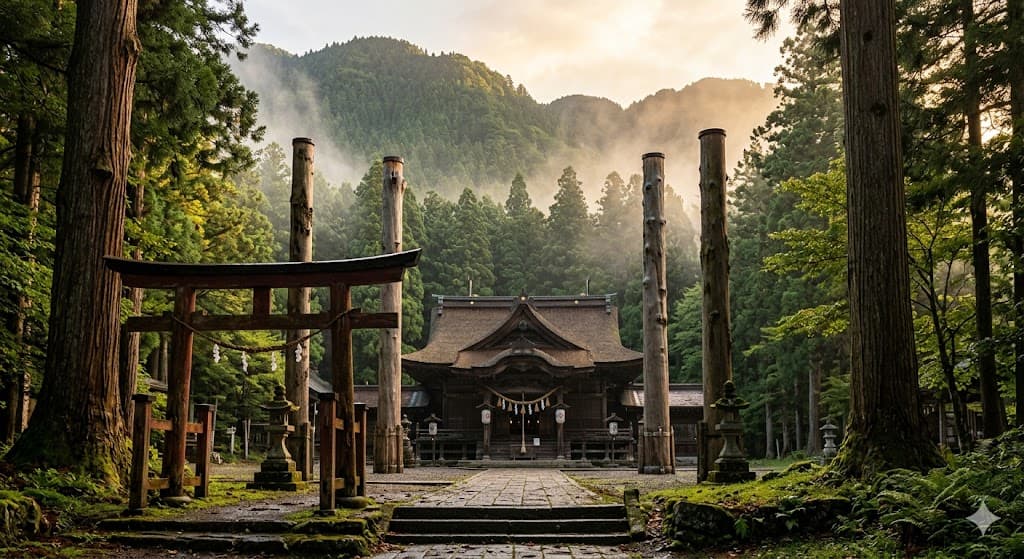
How The Elusive Samurai uses the priest Suwa Yorishige to open up the Suwa faith — the living-god high priests, the honden-less shrine, and the war god medieval samurai prayed to.
6/8/2026
Kengan Ashura and the Buddhist Realm of Strife: Why a Fight Manga Wears the Name of a Warring Deity
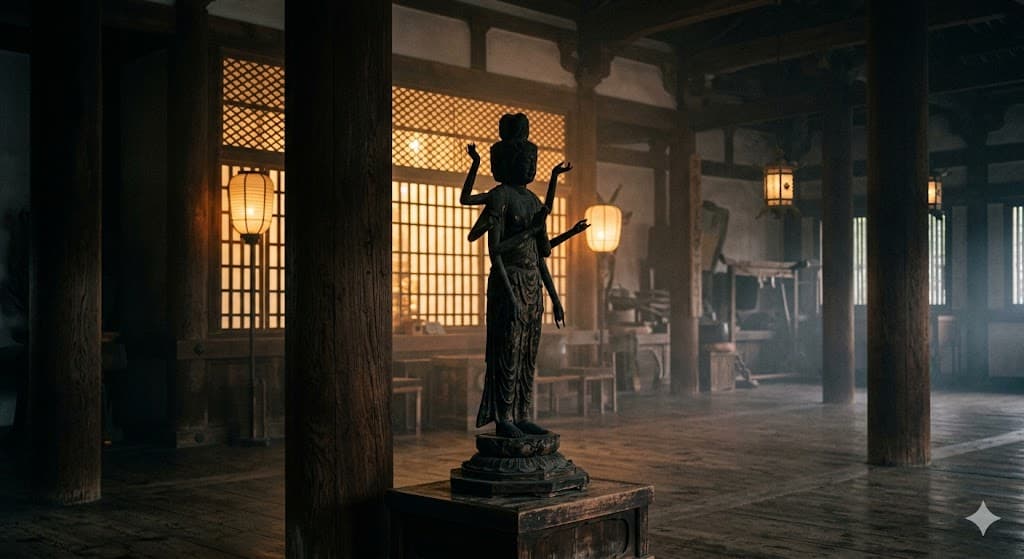
How Kengan Ashura draws on the Buddhist concept of 修羅 (Shura) — the warring demigod, the realm of endless combat, and the everyday word for a scene of conflict.
5/15/2026