Vinland Saga and the Paradise Beyond the Western Sea: What Vinland Shares with Japan's Tokoyo and Fudaraku Tokai
How Vinland Saga's warm land beyond the western sea echoes Japan's Tokoyo belief and the Fudaraku tokai monks who once sailed toward a paradise across the water.

Tokyo-born, 3rd-generation Edokko · writing on Japanese culture from outside Japan
Spoiler-Free Cultural Analysis
This article looks only at the atmosphere and themes of the first episode of Vinland Saga — a land dreamed of across the sea — and the real Japanese beliefs and religious practices that rhyme with it. There are no plot revelations here beyond the premise found in any official synopsis: that Vinland is imagined as a distant promised land.
Key Takeaways
- Long before Vinland Saga framed a warm land past the western horizon, Japanese belief already held that a place without suffering lay beyond the sea — and gave it several names, from 常世 (Tokoyo) to ニライカナイ (Niraikanai).
- 補陀落渡海 (Fudaraku tokai) was not a metaphor but a real, documented practice: monks sealing themselves into small boats and setting off toward a paradise across the water, never to return.
- The longing at the heart of the episode — that safety and abundance exist somewhere else, across the water — is one of the oldest emotional currents in Japanese religion, and it cuts both ways: sometimes the paradise is ahead of you, and sometimes it is the place you left behind.
Key Terms Explained
常世 (Tokoyo) / The Eternal Land — An ancient Japanese otherworld located beyond the sea, a place of permanence and abundance that appears in Japan's oldest chronicles.
補陀落渡海 (Fudaraku tokai) / Crossing the Sea to Fudaraku — A medieval religious practice in which devotees set sail toward Fudaraku, the southern Pure Land of the bodhisattva Kannon, in a deliberate, one-way voyage.
蓬莱 (Hōrai) / Isle of the Immortals — A paradise island of deathlessness, borrowed from Chinese lore (Mount Penglai) and woven into the Japanese imagination of far-off blessed lands.
ニライカナイ (Niraikanai) / Paradise Across the Sea — In Okinawan and Amami belief, the realm beyond or beneath the ocean from which the gods bring life and to which the dead return.
観音 (Kannon) / Bodhisattva of Compassion — The merciful figure (Avalokiteśvara) whose southern Pure Land, Fudaraku, drew the sea-crossing monks.
The Dragon Palace Was the Only Sea-Paradise I Knew
I grew up inland in Tokyo, and the truth is that the sea was never really part of my daily horizon. It was a rare, special place we went to now and then, not a line I watched at the edge of every day. So the idea of "a land of happiness across the water" was not something the landscape taught me. It arrived through a single door: 竜宮城 (Ryūgū-jō: the Dragon Palace) from the folktale of 浦島太郎 (Urashima Tarō: a fisherman carried to an undersea kingdom).
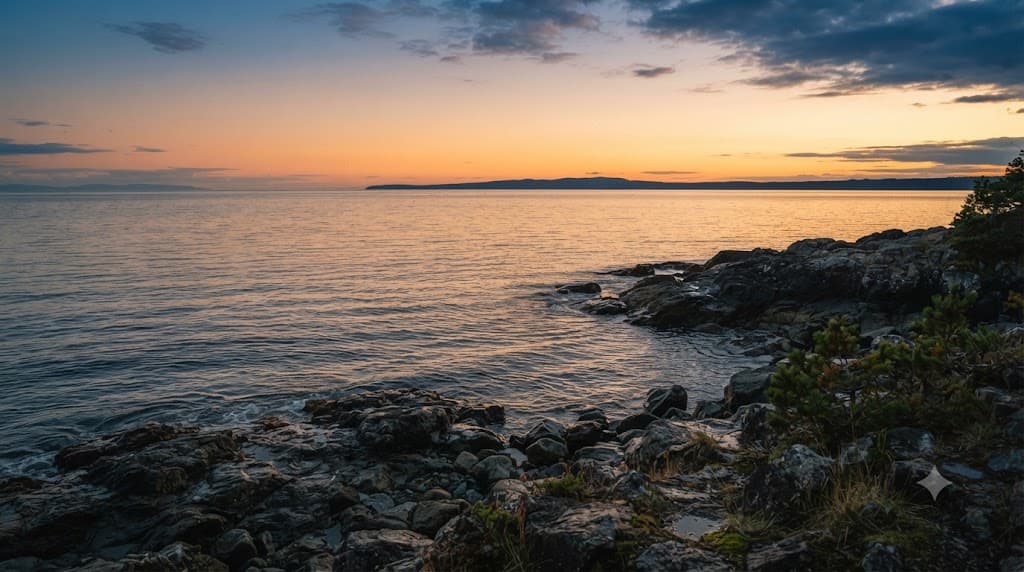
 The sea as a boundary of a better world — the image at the heart of both Vinland Saga and Japan's oldest paradise beliefs.
I read that story in a picture book as a child, and the part that stayed with me was the ending — the moment he opens the 玉手箱 (tamatebako: a forbidden box) and turns into an old man in an instant. It frightened me, and it made me sad in a way I couldn't name yet. That was my whole vocabulary for the far paradise: a beautiful place beyond the sea, and a return that costs you everything.
The other words — 常世 (Tokoyo), 蓬莱 (Hōrai), ニライカナイ (Niraikanai), and the sea-crossing rite of 補陀落渡海 (Fudaraku tokai) — I only met as an adult, and some of them still feel unfamiliar on my tongue. I say this because it matters for how we read Vinland Saga. When the first episode plants the idea of Vinland as a warm, bountiful place far to the west — a refuge the story treats almost as a promised land, beyond where the great serpent Jörmungandr is said to guard the edge of the world — a Japanese viewer doesn't need a footnote to feel it. The shape of that longing is old and familiar here, even for those of us who grew up nowhere near the waves. What we may not know is how literally our ancestors once took it.
The Long Memory of a Land Across the Water
The premise of the episode — that a dying, exhausted man glimpses a distant land where slave traders and the flames of war cannot reach, and receives it almost as a vision of paradise — lands so cleanly on a Japanese audience because Japan has been telling versions of this story for well over a thousand years. The details differ; the emotional coordinates are the same.
 A reconstructed Fudaraku crossing boat: the cabin was sealed from the outside for a one-way voyage toward Kannon's southern Pure Land.
常世 — The Land That Never Changes, Beyond the Waves
The oldest layer is 常世 (Tokoyo: the eternal land), which surfaces in Japan's earliest texts. In the mythological volumes of the ancient chronicles, the small deity 少彦名 (Sukunabikona: a diminutive god of medicine and craft) crosses over from a cape in 熊野 (Kumano: a sacred mountain region on the Kii Peninsula) and finally reaches Tokoyo no kuni, the world beyond the sea. It is described less as a place of pleasure than as a place of permanence — a realm where the wearing-down of ordinary life is suspended. The very word carries the sense of "the unchanging world," set against our own world of decay and death.
That is a subtle but important difference from a Western heaven. Tokoyo is not primarily a reward for the good; it is simply elsewhere, across the water, where the rules of loss are gentler. When the episode gives us a man at the end of his strength imagining a warm land free of chains, it is reaching for exactly this register — not salvation earned, but a place where suffering finally stops.
補陀落渡海 — The One-Way Voyage to Kannon's Southern Paradise
Here is where the belief stops being a story and becomes something people actually did with their bodies. The word 補陀落 (Fudaraku) is the Japanese rendering of the Sanskrit Potalaka, the Pure Land of the compassionate bodhisattva 観音 (Kannon: the bodhisattva of compassion), believed to lie in the south, out across the sea. In medieval Japan, some teachers held that this southern Pure Land was easier to reach than the more famous western Pure Land of 阿弥陀 (Amida: the Buddha of the western Pure Land) — and from that conviction grew the practice of 補陀落渡海 (Fudaraku tokai: crossing the sea to Fudaraku).
It was, in plain terms, a ritual voyage toward death. A practitioner would be placed in a small boat whose cabin was nailed shut from the outside, with no window or door, carrying a limited store of food, water, and lamp oil so he could keep chanting to Kannon to the very end. The cabin was ringed by a fence of forty-nine palings and four vermillion 鳥居 (torii: Shinto shrine gates) — a distinctly syncretic touch, mixing Shinto forms into a Buddhist rite, in the way that was so typical of the Kumano faith. The boat was towed out and set adrift toward the open southern sea. It did not come back.
The great center of this practice was 補陀洛山寺 (Fudarakusan-ji: the temple that served as the main departure point) at 那智勝浦 (Nachi-Katsuura: a coastal town in present-day Wakayama), in the Kumano district of the 紀伊半島 (Kii Peninsula: the peninsula south of Osaka), though records also point to capes like 足摺 (Ashizuri: a cape in Shikoku) and 室戸 (Muroto: another Shikoku cape) and other coastal sites. Of the roughly forty recorded crossings, more than half departed from 那智 (Nachi), from around the ninth century until well into the early eighteenth. The stretch of the Kumano Sea there was literally called "the sea of Fudaraku." The tie to the older belief is explicit: Kumano already held that an ideal land, Tokoyo, lay beyond the horizon, and Kannon worship fused with that conviction to send real men out onto the water toward it.
When I first read the details of Fudaraku tokai as an adult, I felt the same chill I'd felt as a child at Urashima's box. The episode's image of a broken man crossing over into a warm far country is fiction. The monks of Nachi turned that image into a boat with the door nailed shut.
蓬莱 and ニライカナイ — Immortal Isles and the Realm the Gods Come From
Two more names round out the map. 蓬莱 (Hōrai) came from Chinese lore — the isle of the immortals, Mount Penglai — and gave the Japanese imagination a paradise of deathlessness somewhere out at sea, a motif that recurs in poetry and New Year decorations alike. And in the far south of the archipelago, in Okinawa and the Amami islands, there is ニライカナイ (Niraikanai: the paradise across the ocean), a realm believed to lie beyond — or beneath — the sea. Niraikanai is at once the source of life and abundance, the home of the gods who arrive by boat to bless the villages, and the place the dead return to. It sits remarkably close to mainland Tokoyo, and even the Dragon Palace of Urashima is another face of the same idea.
So the single childhood door I thought I had — Ryūgū-jō — turns out to open onto a whole country of belief: the sea as the boundary of a better world, and the crossing of it as the deepest act of hope or of surrender. That is the well Vinland Saga is drawing from, whether or not it means to.
When the Paradise Is the Place You Left
There is a second half to this longing that the episode understands, and that I have only come to feel by living far from home.
 During Obon, spirits are welcomed from a far elsewhere and sent off again across the water — the same geography as Tokoyo and Niraikanai.
My family were never diligent about grave-visits, but even so, the rhythm of お盆 (Obon: the summer festival of the returning dead) settled into me early — the sense that at that time of year the spirits come back from some far elsewhere, and when the days are over you send them off again across that same distance. I never worked out exactly where that "elsewhere" was. But the shape of it — a faraway place, connected to ours by a crossing, spirits passing back and forth — is the very same geography as Tokoyo and Niraikanai. The paradise across the water is not only where you long to go. It is also where the ones you've lost have gone, and where, at the edges of the year, the two worlds briefly touch.
And here is the strange thing I did not expect. I crossed a real sea and built a life on the far side of it, and I never found a utopia waiting there. If anything, the longer I've been away, the more the country I left has started to look like the lost paradise — its safety, the cleanliness of its streets, the way the seasons actually turn. The vision that once pointed outward, toward some warm land past the horizon, quietly reverses. You realize the promised land may not be something you sail toward at all. It may be the place whose outline only becomes clear once you can no longer return to it.
That is why the closing mood of the first episode cuts so deep for a viewer who carries this older layer. A land across the western sea, imagined by someone who will not reach it — that is not a fantasy element grafted onto a Viking tale. In Japan, it is one of the oldest true things we have ever felt.
FAQ
Q: Was Fudaraku tokai really a form of religious suicide?
A: It is usually described as a ritual self-martyrdom rather than despair-driven suicide. Practitioners believed they were crossing, in their living bodies, toward Kannon's southern Pure Land of Fudaraku, hoping to bring spiritual benefit both to themselves and to the world. That said, the sealed boat and the limited provisions meant it was, in practice, a one-way voyage toward death, and modern readers understandably find it a heavy and troubling practice.
Q: How is Tokoyo different from a Western idea of heaven?
A: Tokoyo is defined more by permanence and location than by moral reward. It is "the eternal land," a world beyond the sea where the ordinary decay of life is suspended, rather than a destination earned by righteousness. It is also porous — a place the dead may go and from which blessings or spirits may return — rather than a final, sealed-off afterlife.
Q: Is Vinland Saga actually referencing these Japanese beliefs?
A: There's no need to assume a direct reference. Vinland belongs to Norse history, and the sea-serpent imagery is Norse. The point is that the emotional structure — a suffering person imagining a warm, safe land beyond the western sea — maps almost one-to-one onto a longing that Japanese culture has expressed for centuries through Tokoyo, Fudaraku, and Niraikanai, which is part of why the scene resonates so strongly with a Japanese audience.
Key Insights to Remember
- The dream of a land without suffering across the sea is not a piece of set-dressing in Vinland Saga; it taps a belief system that ran through Japanese religion for over a thousand years, from the eternal land of Tokoyo to the Okinawan Niraikanai. The story feels emotionally "true" to a Japanese viewer for reasons older than the anime itself.
- Fudaraku tokai shows how literally people once took this longing. A metaphor about paradise beyond the horizon became a boat with the cabin nailed shut, launched from Nachi toward the southern sea. Understanding that turns the episode's gentle vision into something with a much darker historical shadow.
- The longing runs in two directions. The same geography that sends a dying man's imagination outward toward a promised land is the geography that, for anyone who has left home, slowly turns the abandoned homeland into the lost paradise. The sea does not only separate you from utopia ahead; it can quietly place utopia behind you.
Sources
- Fudaraku-tokai: Crossing the Sea to the Southern Pure Land — Japan Tourism Agency multilingual commentary database
- World Heritage: Fudarakusan-ji Temple — Nachi Katsuura official tourism site
- 補陀落渡海(ふだらくとかい) — Mikumano Net, keywords for understanding Kumano
- 補陀落渡海 〜南海の果ての補陀落浄土を目指して〜 — Wakayama Historical Stories
- [Fudaraku-tokai (Crossing the sea to Fudaraku)](https://www.japanesewiki.com/history/Fudaraku-tokai%20(Crossing%20the%20sea%20to%20fudaraku%20%5Bor%20Potalaka;%20holy%20sites%20associated%20with%20Kannon,%20Deity%20.html) — Japanese Wiki Corpus
- Nirai-kanai Praying Spot — Ocean Expo Park official site (Okinawa)
- Niraikanai — Amakuma Ryukyu (on Niraikanai's link to Tokoyo, Ne no Kuni, and Ryūgū)
- Ryukyuan religion — Wikipedia
About the author

Spoiler-free cultural deep-dives into anime, manga & live-action Japanese drama
- ●Tokyo-born, 3rd-generation Edokko (江戸っ子)
- ●Lifelong manga reader & anime viewer since the kaiju era
- ●Writes from outside Japan — distance as a cultural lens
- ●Spoiler-free · sourced · Kanji + Romaji + English
A Tokyo-born, 3rd-generation Edokko writer who has spent years living outside Japan. I use the anime, manga, and live-action Japanese drama you already love as a doorway into the folklore, language, religion, and everyday history behind them — written so even first-time fans can follow along, with sources for every claim.
Enjoy this article?
Get the next spoiler-free cultural deep-dive straight to your inbox.
Related Articles
Jujutsu Kaisen and Goryō Shinkō: Why Japan Turns a Vengeful Curse Into a God
How Jujutsu Kaisen dramatizes goryō shinkō — the Japanese belief that turns a wronged spirit's resentment into a curse, then enshrines it as a worshipped god.
6/27/2026
Delicious in Dungeon and Itadakimasu: The Mealtime Word That Means I Receive This Life
How Delicious in Dungeon makes Itadakimasu visible — the Buddhist and Shinto idea of receiving life behind a phrase foreign viewers mistake for let's eat.
6/15/2026
Yu Yu Hakusho and the River Sanzu: The Ferry-Toll, the Stripping Crone, and the Three Crossings of the Dead
How Yu Yu Hakusho's ferrywoman Botan opens a door onto the River Sanzu, where six coins and a clothes-stripping crone decide how the Japanese dead cross over.
6/14/2026
The Elusive Samurai and the Suwa Faith: The Shrine Where the Priest Was Also a Warlord
How The Elusive Samurai uses the priest Suwa Yorishige to open up the Suwa faith — the living-god high priests, the honden-less shrine, and the war god medieval samurai prayed to.
6/8/2026
Frieren and the Drinking Monk: Heiter, the 'Corrupt Priest'
How Heiter's running Corrupt Priest joke in Frieren: Beyond Journey's End opens a door into hannyatō and Japan's long, gently bent rule against monks drinking.
5/26/2026
Kengan Ashura and the Buddhist Realm of Strife: Why a Fight Manga Wears the Name of a Warring Deity
How Kengan Ashura draws on the Buddhist concept of 修羅 (Shura) — the warring demigod, the realm of endless combat, and the everyday word for a scene of conflict.
5/15/2026