Kengan Ashura and the Buddhist Realm of Strife: Why a Fight Manga Wears the Name of a Warring Deity
How Kengan Ashura draws on the Buddhist concept of 修羅 (Shura) — the warring demigod, the realm of endless combat, and the everyday word for a scene of conflict.

Tokyo-born, 3rd-generation Edokko · writing on Japanese culture from outside Japan
Spoiler-Free Cultural Analysis
This article explores the Buddhist and linguistic roots behind the title of 『ケンガンアシュラ』(Kengan Ashura: a Japanese combat manga and anime) — specifically the concept of 阿修羅 (Ashura), the realm of 修羅道 (Shurado), and the everyday word 修羅場 (Shuraba). No plot spoilers beyond the opening narration of the very first episode and the title itself; everything else discussed here is real-world Buddhist cosmology, art history, and Japanese vocabulary.
Key Takeaways
- The word 修羅 (Shura) in the title carries three layered meanings at once: a Buddhist deity of war, a realm of endless combat in the cycle of rebirth, and a common Japanese idiom for a brutal real-world conflict.
- The Ashura figure has a striking double nature — originally a guardian deity, simultaneously consumed by jealousy and wrath — and the most famous statue at 興福寺 (Kofuku-ji) shows him not as a snarling monster but as a sorrowful adolescent.
- The opening narration of Kengan Ashura episode one places the manga's underground combat economy directly into the Buddhist framework of 修羅道 (Shurado), a realm not of punishment but of compulsive, unending struggle.
Key Terms Explained
- 阿修羅 (Ashura) / Asura Deity — A class of warring demigods in Buddhist cosmology, transliterated from the Sanskrit asura; powerful but consumed by anger and envy.
- 修羅道 (Shurado) / The Asura Realm — One of the 六道 (Rokudo: Six Realms) of rebirth in Buddhist thought; the realm of those addicted to combat and pride.
- 修羅場 (Shuraba) / Scene of Carnage — An everyday Japanese word for a moment of fierce, ugly conflict; originally describing the battlefield between asura and gods, now used for everything from a lovers' confrontation to a deadline crunch.
- 六道 (Rokudo) / Six Realms — The six possible states of rebirth in Buddhism: heaven, humans, asura, animals, hungry ghosts, and hell.
- 興福寺 (Kofuku-ji) / Kofuku-ji Temple — A major Buddhist temple in 奈良 (Nara: the ancient capital), home to the most celebrated Ashura statue in Japan.
A Sorrowful Boy with Six Arms
The first time I met an Ashura in the flesh — or rather in dry lacquer — was at 興福寺(Kofuku-ji: a major Buddhist temple in 奈良 Nara). I had grown up in 足立区(Adachi-ku: a working-class ward of downtown Tokyo) where temples were small and unremarkable, and my earliest exposure to serious Buddhist sculpture was a middle-school class trip that swept us through 京都(Kyoto), 奈良(Nara), and 日光(Nikko: the mountain temple complex north of Tokyo) in a single exhausting week. We saw 金閣寺(Kinkaku-ji: the Golden Pavilion), 法隆寺(Horyu-ji), 三十三間堂(Sanjusangen-do), and what felt like a thousand other halls. Most of it blurred together at that age.
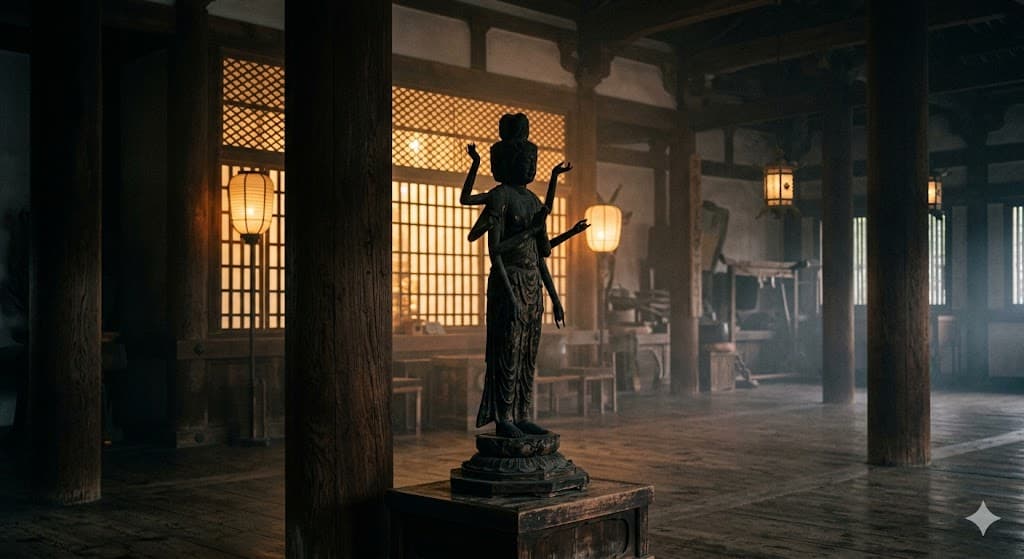
 The eighth-century Ashura statue at 興福寺 (Kofuku-ji) in Nara, whose sorrowful adolescent face contradicts every expectation of a warring deity.
What did not blur was the Ashura.
You expect a god of war to look like a war god — fanged, snarling, knotted with rage. The famous 興福寺 (Kofuku-ji) Ashura is none of those things. The statue, made using the dry lacquer technique in the eighth century, has three faces and six arms, and its serene and melancholic expression has made it one of Nara's most beloved and photographed sculptures. You would expect fury from a deity associated with war — yet the Kofuku-ji statue shows none of that anger, and instead wears the sweet countenance of a boy that charms those who see it.
That was the contradiction I could not put down. Why is the deity of strife in this country's most famous statue shaped like a thoughtful child? The answer to that question, I came to realize many years later, is also the answer to why a hyper-violent combat manga like Kengan Ashura — about salarymen hiring fighters to settle business disputes with their fists — would title itself with the name of this same deity.
What Shura Actually Means
The Word Has Three Layers, Not One
The Japanese word 修羅 (Shura) is doing something quite specific in the title of this manga, and it is worth pulling the layers apart slowly. In Buddhism, 修羅 is a shortened form of 修羅道 (Shurado), meaning the realm of Asura — one of the six realms of reincarnation in Buddhist thought.
The most common dictionary definition of 修羅 is straightforward: 激しい戦闘 (hageshii sentō: intense fighting). This is the meaning behind expressions such as 修羅場 (Shuraba), written with the kanji for "field of carnage" — a scene of bloodshed or violent conflict.
So we have a word that simultaneously means a Buddhist deity, a realm of rebirth, an idiom for ugly conflict, and — in a more obscure usage — even a forestry term for a wooden chute used to slide felled logs down mountainsides. One short word, multiple worlds stacked on top of each other. Japanese does this often. English tends to have one word do one job. Japanese will let a single two-kanji compound carry a Sanskrit transliteration, a religious cosmology, and a piece of bar-room slang at the same time.
From Ancient Persia to a Nara Temple
The deeper origin of Ashura is older than Japan, older than Buddhism, older even than India in its present form. The Old Indic term Asura is cognate with Old Iranian Ahura, a term designating a group of benevolent supernatural beings in conflict with the malevolent Daevas. Both the Sanskrit asura and the Avestan ahura derive from a common Proto-Indo-Iranian root meaning "lord."
In other words, the same root word travels west into Zoroastrian Persia and becomes Ahura Mazda, the supreme good god; it travels east into India and becomes asura, the powerful being who in later Hindu tradition gets recast as an enemy of the deva (gods). In the earliest Vedic literature, the benevolent Asura were called Aditya and led by Varuna, while the malevolent ones were called Danava. In later Vedic and post-Vedic texts, the benevolent gods are called Deva, while malevolent Asura compete against these Deva and are considered enemies of the gods.
When Buddhism absorbed this lineage and carried it through China to Japan, the asura was reshaped yet again. The name is traditionally explained through a myth of defeat at the hands of the god 帝釈天 (Taishakuten: Śakra in Sanskrit): the asuras were thrown down from their place in the heavens after becoming drunk on sura (a kind of liquor), and were never permitted to return. While all the gods of the desire realm are subject to passions to some degree, the asuras above all are described as addicted to them — especially wrath, pride, envy, falseness, boasting, and bellicosity.
This is the figure that arrives in Japan. Not pure evil. Not pure good. A being of enormous power who simply cannot stop fighting.
The Six Realms and the Place Reserved for Endless Combat
To understand why a fighting deity gets his own dimension, you need to know the Buddhist map of existence. In Japanese Buddhism, after someone dies, they are eventually reborn in one of six realms: 天道 (Tendō: the Heavenly Realm), 人間道 (Ningendō: the Human Realm), 修羅道 (Shurado: the Asura Realm), 畜生道 (Chikushōdō: the Animal Realm), 餓鬼道 (Gakidō: the Realm of Hungry Ghosts), and 地獄道 (Jigokudō: the Hell Realm). Of these, only two — Tendō and Ningendō — are considered "happy" rebirths.
 A traditional depiction of the 六道 (Rokudo: Six Realms) of rebirth, with 修羅道 (Shurado) sitting between the human and animal realms.
I should pause here and be honest. I learned the 六道 (Rokudo: the Six Realms) not from any temple sermon but from school textbooks and the occasional television documentary. My family did not own a 仏壇(butsudan: a household Buddhist altar), and we did not visit our ancestors' graves on the equinoxes. Among the six realms, 地獄道 (Jigokudō: hell) is broadly familiar to most Japanese — and the related Pure Land concept of 極楽 (Gokuraku: paradise, a separate idea from the cosmological Tendō) is also widely known — but 修羅道 (Shurado) is the one realm most of us could not place if you asked us cold. It is the dim corner of the cosmology.
And yet it is precisely 修羅道 that the opening of Kengan Ashura invokes. The narrator describes a world of merchants whose violent rivalries had grown so out of control that "this world was on the verge of becoming Shurado." The line is not poetic decoration. It is a specific theological claim: that human commerce, when stripped of restraint, slides into the same realm as those beings who can do nothing but fight forever.
Of the unhappy rebirths, Jigokudō (hell) is the worst, followed by Gakidō (hungry ghosts). The animal realm is not a good rebirth because animals are ruled by their desires and thus cannot obtain enlightenment. Shurado — the realm of the ashura — is considered the least unpleasant of the unhappy rebirths. However, because ashura are so controlled by their emotions, it is almost impossible for them to achieve enlightenment, become buddhas, and escape the cycle of endless reincarnation.
That last line is the heart of the title. The asura is not damned in the Christian sense. The asura is trapped. The asura has power, intelligence, a long life, and pleasures beyond what humans experience — and uses all of it to keep fighting, forever, with no exit. A combat manga whose underlying premise is "powerful people settle their disputes through endless ritualized violence" is, structurally, a story about Shurado.
Why the Statue Smiles Like a Boy
This brings me back to the Kofuku-ji statue. An Ashura's two side-faces typically display anger, while the front face reveals a more complex expression of hubris and suffering. Ashura may be the most human of Buddhist deities, which could explain the adulation this statue inspires.
The Kofuku-ji Ashura is not heroic. He is sad. The eighth-century sculpture portrays him as a sensitive and melancholy youth. The sculptor understood something the manga's narration also understands: the most truthful image of a being addicted to combat is not a roar. It is the quiet face of someone who knows he cannot stop.
Shuraba — When the Realm Comes Down to Earth
The third layer of 修羅 is the one ordinary Japanese people actually use every day. In Japanese, a situation of constant conflict is sometimes called 修羅場 (Shuraba) — borrowing the imagery of the asura battlefield. It refers to a place where fierce fighting is going on, or any situation that feels like one.
 The kanji 修羅場 (Shuraba), an everyday Japanese word whose Buddhist origins have faded almost entirely from common usage.
I have used the word 修羅場 (Shuraba) my whole life without once thinking about its religious origin. We say it for a couple breaking up at a restaurant. For a mangaka pulling an all-nighter to make deadline. For a workplace where two factions are openly at war. None of us, in those moments, are thinking about three-faced demigods on a mountain beneath the ocean. The Buddhist sediment has been worn down by daily use until it is almost invisible.
This is part of what makes Kengan Ashura's title clever in a way an English-speaking reader can easily miss. To a Japanese reader, ASHURA simultaneously summons (a) the Kofuku-ji statue's sorrowful face, (b) the cosmological realm of endless combat, and (c) the very banal idiom you use when describing the chaos at your office on Monday morning. The title is a three-octave chord. Most Western titles are a single note.
What Is Lost in Translation, and What Lives On
Living outside Japan for many years now, I have tried more than once to explain 修羅場 to friends in English and failed gracefully every single time. "Hell" is too theological. "Battlefield" is too literal. "Chaos" or "mess" is far too light. The English language has no single word that compresses pandemonium, theatrical melodrama, and the Buddhist cycle of suffering into two syllables. So you end up either over-explaining or under-translating, and either way the chord loses its lowest note.
I notice the same thing happens with the title of the work itself. When Kengan Ashura travels overseas, "Ashura" reads to many viewers as just an exotic-sounding word, perhaps recognized vaguely as a demon name. The triple resonance — guardian deity, realm of rebirth, everyday idiom — survives the trip with only its surface intact. The fight scenes survive perfectly; the religious framing of why these fights are happening tends to evaporate.
What stays alive inside Japan is more subtle. The Kofuku-ji Ashura remains one of the most photographed and beloved statues in the country, and his sorrowful boy-face appears on postcards, exhibition posters, and even fan club merchandise. The realm of Shurado has faded from active belief, but the idiom Shuraba has kept the underlying intuition warm: that human conflict has a shape, and that shape was named long ago by people who watched it carefully.
And then, every so often, a contemporary work like Kengan Ashura goes back to the original deep meaning of the word and uses it on purpose. The narrator's line — that the merchants' violence threatened to turn this world into Shurado — is not a flourish. It is the manga telling you in its opening minute what kind of story you are about to read. A story not about heroes and villains, but about people who are trapped in a realm of compulsive combat and cannot, for the life of them, find the exit.
That a culture lets a fight manga quote Buddhist cosmology with a straight face, without anyone needing it explained, is itself one of the small wonders of Japanese as a literary language. The shrine, the temple sculpture, and the underground fighting ring are all using the same word, and somehow none of them feel out of place borrowing it.
FAQ
Q: Is the Ashura of Kengan Ashura the same Ashura you find in Hindu mythology?
A: They share a common Sanskrit root (asura), but the manga is drawing specifically on the Japanese Buddhist version, in which Ashura is one of the 八部衆 (Hachi Bushū: Eight Legions of Buddhist guardian deities) — neither purely good nor purely evil, but a being defined by its addiction to combat.
Q: Is 修羅場 (Shuraba) a religious word, or is it casual?
A: It is fully casual today. Most Japanese speakers use it without any awareness of its Buddhist origin, applying it to relationship arguments, workplace chaos, or any moment of high-intensity conflict. The religious roots are real but mostly invisible in daily use.
Q: Why does the Kofuku-ji Ashura statue look so young and sad if Ashura is supposed to be a warrior?
A: The eighth-century sculptor at Kofuku-ji chose to depict the inner contradiction of the figure rather than the outer violence. The asura in Buddhist thought is powerful but trapped by its own emotions, and the statue's haunting boyish face captures that captivity better than any snarling demon mask could.
Key Insights to Remember
- The brilliance of the title Kengan Ashura is not the word's exotic sound but its theological precision. The opening narration's claim that the world was "about to become Shurado" places a story about hired fighters and corporate violence inside the same Buddhist framework that produced the Kofuku-ji statue — a realm of beings powerful enough to do anything except stop fighting.
- The Buddhist asura travels through thousands of years and three civilizations before arriving in a Japanese fight manga. The same Proto-Indo-Iranian root that becomes Ahura Mazda in Persia becomes the warring asura in India and finally the sorrowful boy-deity in Nara. Few title words in popular fiction carry that much sediment.
- The Japanese language has a particular gift for letting religious cosmology, art history, and street slang share a single word. 修羅 (Shura) means a Buddhist deity, a realm of rebirth, and an ugly argument at a wedding reception, all at once. To translate it as any single English word is to lose the chord and keep only one note.
Sources & References
- Asura (Buddhism) — Wikipedia
- Asura — Wikipedia
- Ashura — Yokai.com
- The Meaning of Japanese "Shura" Demystified — Linguaholic
- Ashura — Japanese Wiki Corpus
- 修羅 — Wiktionary
- Kofuku-ji — Planetyze
- Kofuku-ji: 5-Story Pagoda & Ashura Statue — Goshuin
- Kōfuku-ji (Kofukuji Temple) — Walktionary
- Masters of Mercy: Navigating the Six Realms — Smithsonian
- Three Faces and Six Arms — An Ashura — Moe and Irene's RTW blog
- Daijirin (大辞林) — Sanseidō Japanese Dictionary, Third Edition
About the author
Spoiler-free cultural deep-dives into anime, manga & live-action Japanese drama
- ●Tokyo-born, 3rd-generation Edokko (江戸っ子)
- ●Lifelong manga reader & anime viewer since the kaiju era
- ●Writes from outside Japan — distance as a cultural lens
- ●Spoiler-free · sourced · Kanji + Romaji + English
A Tokyo-born, 3rd-generation Edokko writer who has spent years living outside Japan. I use the anime, manga, and live-action Japanese drama you already love as a doorway into the folklore, language, religion, and everyday history behind them — written so even first-time fans can follow along, with sources for every claim.
Enjoy this article?
Get the next spoiler-free cultural deep-dive straight to your inbox.
Related Articles

Vinland Saga and the Paradise Beyond the Western Sea: What Vinland Shares with Japan's Tokoyo and Fudaraku Tokai
How Vinland Saga's warm land beyond the western sea echoes Japan's Tokoyo belief and the Fudaraku tokai monks who once sailed toward a paradise across the water.
7/18/2026
Jujutsu Kaisen and Goryō Shinkō: Why Japan Turns a Vengeful Curse Into a God
How Jujutsu Kaisen dramatizes goryō shinkō — the Japanese belief that turns a wronged spirit's resentment into a curse, then enshrines it as a worshipped god.
6/27/2026
Delicious in Dungeon and Itadakimasu: The Mealtime Word That Means I Receive This Life
How Delicious in Dungeon makes Itadakimasu visible — the Buddhist and Shinto idea of receiving life behind a phrase foreign viewers mistake for let's eat.
6/15/2026

Yu Yu Hakusho and the River Sanzu: The Ferry-Toll, the Stripping Crone, and the Three Crossings of the Dead
How Yu Yu Hakusho's ferrywoman Botan opens a door onto the River Sanzu, where six coins and a clothes-stripping crone decide how the Japanese dead cross over.
6/14/2026
The Elusive Samurai and the Suwa Faith: The Shrine Where the Priest Was Also a Warlord
How The Elusive Samurai uses the priest Suwa Yorishige to open up the Suwa faith — the living-god high priests, the honden-less shrine, and the war god medieval samurai prayed to.
6/8/2026
Frieren and the Drinking Monk: Heiter, the 'Corrupt Priest'
How Heiter's running Corrupt Priest joke in Frieren: Beyond Journey's End opens a door into hannyatō and Japan's long, gently bent rule against monks drinking.
5/26/2026