Oshi no Ko and the Idol Love Ban (恋愛禁止): Why Romance Can Quietly End a Career
How Oshi no Ko dramatizes the Japanese idol love ban (renai kinshi) — the unwritten rule that a confirmed romance can quietly end an idol's career.

Tokyo-born, 3rd-generation Edokko · writing on Japanese culture from outside Japan
Spoiler-Free Cultural Analysis
This article looks at the real cultural and legal background behind the idol "love ban" that drives 推しの子(Oshi no Ko: literally "my favorite idol's child"), focusing on themes, atmosphere, and the history of the idol system rather than any plot twists. Nothing here reveals where the story goes; it only explains the world the opening sets up.
Key Takeaways
- The 恋愛禁止(renai kinshi: love ban) is not a single law but a web of unwritten expectations and, in many cases, actual contract clauses that discourage Japanese idols — especially young women — from having a public romantic life.
- The ban exists because a large part of an idol's commercial value rests on a one-sided romantic fantasy held by fans, so a confirmed relationship is treated as a breach of the product itself, not merely a private matter.
- Japanese courts have split on whether punishing an idol for dating is even legal, and the same tension — a private feeling colliding with a manufactured image — is exactly the engine that powers the premise of Oshi no Ko.
Key Terms Explained
恋愛禁止 (Renai Kinshi) / Love Ban — The rule, formal or informal, that an idol must not have a public romantic relationship while active. It ranges from a quiet expectation to an explicit clause in a contract.
疑似恋愛 (Giji Ren'ai) / Pseudo-Romance — The one-sided, fantasy relationship a fan is encouraged to feel toward an idol. The idol's apparent availability is part of what is being sold.
清純派 (Seijunha) / Pure-Image Type — A performer marketed on an image of innocence and chastity. The label sits at the center of why romance is seen as so damaging for female idols.
握手会 (Akushukai) / Handshake Event — A paid meet-and-greet where fans briefly shake hands with idols. It turns the sense of personal closeness into a direct source of revenue.
推し (Oshi) / One's Favorite — The specific idol or member a fan most supports and promotes. The whole title 推しの子 is built on this word.
A Poster on the Wall and a Word That Had No Name Yet
I was never the kind of fan who lined up for handshake events or chased after merchandise. My involvement was the light, ordinary sort: a poster on the wall, a 下敷き(shitajiki: a plastic writing board placed under paper) with a favorite singer's photo on it, the songs playing in the background of an afternoon. Idols were a pleasant corner of daily life, not the center of it.
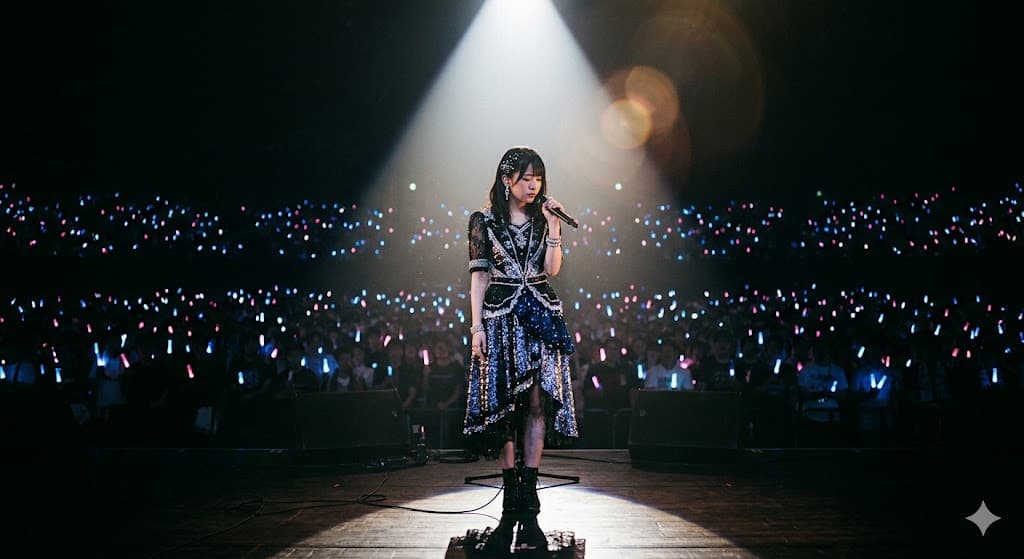
 Idols are sold on a sense of closeness, an appeal built as much on intimacy as on talent.
What I notice now, looking back, is something about language. In the years before 1990, when I was young, I have no memory of actually hearing the phrase 恋愛禁止 spoken aloud about idols. That does not mean there were idols openly announcing boyfriends — there were not. Even without a clearly stated rule, there was an unspoken air that an idol simply did not put romance on display. The feeling existed long before the words did. The blunt phrase "love ban," discussed openly as a thing with a name, belongs to a later era than the one I grew up in.
That gap between an unwritten mood and a named rule is, in a way, the whole story of how this custom hardened. And it is precisely the pressure that the opening of Oshi no Ko drops the viewer into without explanation, as if everyone already understands why a pregnant teenage idol and her management treat the news as a catastrophe rather than a celebration.
The Economics of a Beautiful Lie
The premise of Oshi no Ko leans on a single assumption it never bothers to argue: that if the public learned this idol had a private romantic life, both she and her agency would be finished. To an audience inside Japan, that assumption needs no defense. To explain why, you have to look at what an idol actually is, and what is actually being sold.
 Paid handshake events turn the feeling of personal closeness into a direct source of revenue.
The Idol as a Shared Fantasy
An アイドル(aidoru: idol) in the Japanese sense is not simply a singer. The role is closer to a heavily produced personality who performs across music, television, and live events, and whose appeal rests at least as much on closeness as on talent. The product is intimacy — or the convincing illusion of it.
This is where 疑似恋愛 comes in. Fans, particularly the male fan base that historically anchored the industry's economics, are invited into a one-sided romantic fantasy. The idol smiles as if for you; the handshake event lets you feel, for a few seconds, that the distance has closed. Within that frame, an idol's perceived availability is not a detail. It is part of the merchandise. A confirmed boyfriend does not just disappoint fans; it punctures the specific fantasy they have been paying to maintain. The 清純派(seijunha: pure-image) marketing makes the damage sharper still, because innocence is the thing being sold and a relationship is read as its loss.
Oshi no Ko states this logic almost as a thesis. It frames idols as beings who shine through lies, and lets its central idol treat a beautiful lie as her own form of love — a way of giving fans the bright, untroubled image they came for. Stripped of the drama, that is a fairly exact description of how the real industry justifies the love ban to itself.
From Unspoken Air to Written Clause
The shift I felt in language was real. The idol boom of the 1970s and 1980s already ran on an image of wholesomeness, but the explicit, openly named "love ban" became a mainstream talking point later, in the era of very large fan-voted groups built around handshake events and member elections. Once closeness itself was monetized at scale, the prohibition on visible romance became less a vague expectation and more a stated condition of the job.
The clearest cultural flashpoint came in early 2013, when a member of one of the biggest such groups was photographed leaving a man's apartment. She shaved her head and posted a tearful video apology, begging to stay in the group. The clip was viewed millions of times within a day and set off an enormous argument both inside and outside Japan about whether any of this was reasonable. It crystallized, in one image, everything the love ban demands: not just discretion, but public penance for a private life.
When the Ban Reached the Courts
The most surprising part, for many readers abroad, is that this is not only a matter of custom. Agencies have written no-dating terms into contracts and have gone to court when they were broken, and the rulings have not been consistent.
In one 2015 case, the Tokyo District Court ordered a former teenage idol to pay her agency several hundred thousand yen in damages after a relationship surfaced that contributed to her group disbanding. The presiding judge reasoned that, for a female idol, a no-dating policy was necessary to keep the support of male fans — essentially endorsing the commercial logic above as a legal one.
Then, in early 2016, a different judge at the same court went the other way. Facing a claim of nearly ten million yen against a former idol who had begun dating a fan, Judge Katsuya Hara dismissed the suit. He framed romantic relationships as part of the constitutional right to pursue happiness, and held that damages could be recognized only in narrow circumstances, such as when an idol deliberately set out to harm the company. Two courtrooms, two opposite readings of the same custom. The law itself has not decided whether a beautiful lie can be enforced.
What the Ban Looks Like From the Outside
Living outside Japan for many years has changed how this custom looks to me. When I was inside it, the love ban was simply part of the scenery — too obvious to question. I watched idol news the way much of the country did: from the living room, a step removed. A reported romance, a sudden marriage, an abrupt retirement, and the whole 茶の間(chanoma: the family living room, as a stand-in for the ordinary public) would buzz at once, fans feeling betrayed on the other side of the screen. I was never the one who felt betrayed. I watched it as a social phenomenon, one step back.
 A reported romance can set off a public storm, with fans feeling betrayed from the other side of the screen.
From a distance, the contrast with how fame works elsewhere is hard to miss. In much of the West, a celebrity's relationship is itself a story, often a welcome one, something fans celebrate rather than mourn. The idea that romance must be hidden, that revealing it is a kind of failure, starts to look constricting and a little unnatural — even though, when I lived inside it, it never occurred to me to find it strange. Oshi no Ko works as well as it does partly because it takes that quiet strangeness and turns the volume all the way up. It asks what it costs a person to be loved by many on the condition that she never visibly loves anyone back.
That is the real cultural payload underneath the fiction. The story is invented and exaggerated, as it openly admits about itself. The system it is built on is not.
FAQ
Q: Is the idol love ban an actual law in Japan?
A: No. There is no statute called the love ban. It exists as an industry expectation and, in many cases, as a clause in an idol's contract with their agency. Whether punishing a breach is legally enforceable has been tested in court, with conflicting results.
Q: Why does losing romance "ruin" an idol's career in the story?
A: Because a large part of an idol's commercial value rests on pseudo-romance — a one-sided fantasy of closeness and availability sold to fans, reinforced by a pure-image marketing style. A confirmed relationship is treated as damaging the product itself, which is why the premise of Oshi no Ko treats a hidden private life as career-ending.
Q: Does the love ban apply equally to male and female idols?
A: Historically the pressure has fallen hardest on young female idols, tied to expectations of innocence aimed at a male fan base. Male idols face their own version, but the public penance and the "purity" framing have been most intense for women, which is part of why the custom is so often debated.
Key Insights to Remember
-
The love ban is best understood not as prudishness but as economics. When the thing being sold is a feeling of closeness, an idol's visible singleness becomes part of the inventory, and a real relationship is filed as a loss of value rather than a personal milestone. Oshi no Ko simply dramatizes that accounting.
-
The custom hardened over time. What was once an unspoken atmosphere — idols quietly keeping romance offstage — became, in the era of monetized closeness, an openly named rule and sometimes a written contract term. The language caught up to the mood, and then the courts were asked to rule on it.
-
The unresolved legal split is the deepest point. One judge upheld the ban as commercially necessary; another struck a suit down by appealing to the freedom to pursue happiness. That unsettled tension — a private heart against a manufactured image — is the same fault line the story stands on, which is why a fictional, exaggerated tale can still feel uncomfortably true.
Sources
- Court ruling sparks online outcry after teen idol told to pay damages for dating — The Japan Times
- Japanese judge dismisses lawsuit against idol singer who violated contract's no-dating clause — SoraNews24
- Is the 'No-Dating Clause' for Idols Legally Valid? Introducing Two Court Cases — Monolith Law Office
- J-pop 'no dating' clauses ruled unconstitutional — Complete Music Update
- Japanese Pop Star Breaks 'Love-Ban Law,' Shaves Head to Apologize — TIME
- AKB48 Starlet Humiliated for Breaking "No Dating" Rule — The Diplomat
- The No Dating Clause in J-Pop Girl Bands — Japan Powered
About the author

Spoiler-free cultural deep-dives into anime, manga & live-action Japanese drama
- ●Tokyo-born, 3rd-generation Edokko (江戸っ子)
- ●Lifelong manga reader & anime viewer since the kaiju era
- ●Writes from outside Japan — distance as a cultural lens
- ●Spoiler-free · sourced · Kanji + Romaji + English
A Tokyo-born, 3rd-generation Edokko writer who has spent years living outside Japan. I use the anime, manga, and live-action Japanese drama you already love as a doorway into the folklore, language, religion, and everyday history behind them — written so even first-time fans can follow along, with sources for every claim.
Enjoy this article?
Get the next spoiler-free cultural deep-dive straight to your inbox.
Related Articles

My Neighbor Totoro and the Katori Senko: The Meiji Invention That Gave Japanese Summer Its Smell
How My Neighbor Totoro's summer evokes the katori senko, the Meiji-era mosquito coil whose spiral was imagined in 1895 by the wife of Kincho's founder.
8/8/2026

Anohana and Kingyo-sukui: Why Japan Replaced a Working Net With Paper That Dissolves
How Anohana's summer world explains kingyo-sukui, the festival stall game where Japan swapped a net that worked for a paper scoop designed to fail.
8/2/2026

Chibi Maruko-chan and Rajio Taisō: Why Japanese Kids Spend Summer Mornings Doing Radio Calisthenics in a Car Park
How Chibi Maruko-chan's Shōwa childhood preserves rajio taiso, the summer radio calisthenics Japan imported from an American insurer that dropped it a decade later.
8/1/2026

Rurouni Kenshin and Uchimizu: Why Old Tokyo Cooled Its Streets With a Ladle of Water
How the Meiji-era streets of Rurouni Kenshin open onto uchimizu — a summer custom that began as tea-ceremony courtesy and spread through Edo because of dust.
7/31/2026

Ace of Diamond and the Dirt of Koshien: Why Japan's Losing Teams Scoop Soil Into Their Bags
How Ace of Diamond treats Koshien as a destination, and why eliminated high school players kneel to fill bags with soil that groundskeepers blend by season.
7/30/2026
Neon Genesis Evangelion and the Walkman: Why Shinji Retreats Into His Headphones
Why does Shinji's SDAT cassette player feel so Japanese? From Sony's 1979 Walkman to quiet packed trains and the meiwaku ethic, a Tokyo-born writer unpacks the headphone culture behind Evangelion's most human prop.
7/23/2026