Ōoku: The Inner Chambers and the Real Ōoku of Edo Castle: The Sealed World Only One Person Could Enter
How Ōoku: The Inner Chambers reimagines the real Ōoku of Edo Castle — the sealed inner quarters where only the shogun could enter and women held the power.

Tokyo-born, 3rd-generation Edokko · writing on Japanese culture from outside Japan
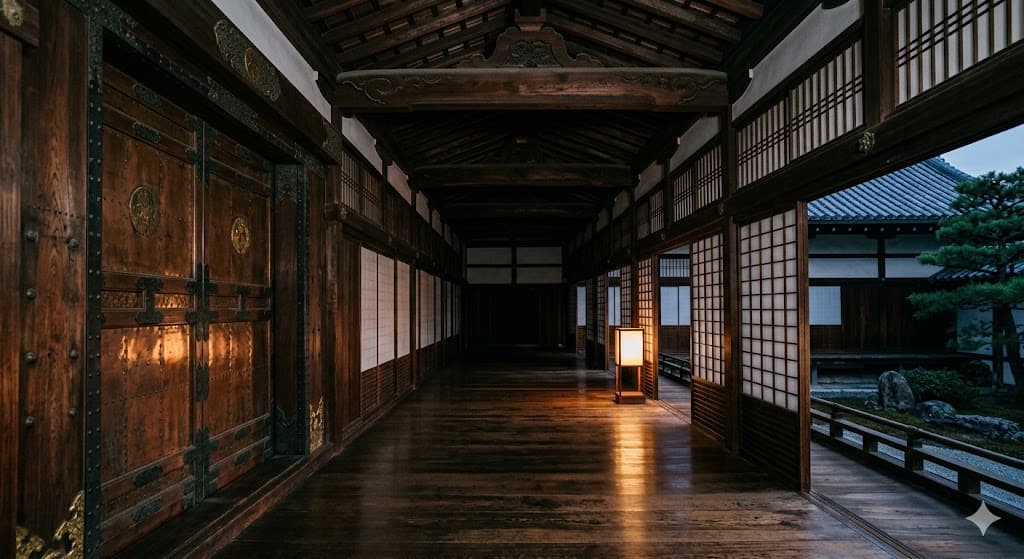
Spoiler-Free Cultural Analysis
This article looks at the real history behind Ōoku: The Inner Chambers — the architecture, the ranks, and the rules of the actual women's quarters of Edo Castle. The series rests on an invented gender-reversal premise, but the institution it borrows its name from was a genuine part of the Tokugawa state, so nothing here touches the plot. Themes, setting, and history only.
Key Takeaways
- The Ōoku was a real wing of Edo Castle, not a setting invented for the manga — a strictly sealed residence where the women attached to the shogun lived, governed by an internal hierarchy of women whose senior ranks wielded influence comparable to the male councillors who ran the country.
- Edo Castle's central palace was split into three zones, and the Ōoku sat behind copper-plated walls reachable through only two guarded "bell corridors." With rare, supervised exceptions, the reigning shogun was the single adult man permitted to cross that threshold.
- The series flips the genders — a plague culls the male population, and a female shogun keeps a harem of beautiful men — but the offices, the etiquette, and the closed-world logic it dramatizes map closely onto the actual institution, which is why the history reads as fascinating on its own.
Key Terms Explained
- 大奥 (Ōoku) / The Great Interior — The women's quarters at the rear of Edo Castle's main palace, home to the women connected to the shogun and the staff who served them.
- 御台所 (Midaidokoro) / The Shogun's Official Wife — The highest-status resident of the Ōoku, the formal consort of the reigning shogun.
- 御年寄 (Otoshiyori) / Senior Matron — The women who actually administered the Ōoku day to day; the most senior held sway rivaling that of the shogunate's male councillors.
- 御中臈 (Otchūrō) / Mid-Rank Chamberlain — Attendants who waited closely on the shogun and the official wife, and the rank from which concubines were typically chosen.
- 御鈴廊下 (Osuzu-rōka) / The Bell Corridors — The two passageways, named for the bell that signaled the shogun's approach, that were the only links between his quarters and the sealed Ōoku.
The Inner Wing Behind My Childhood Period Dramas
As a third-generation 江戸っ子(Edokko: a true-born Tokyoite), I grew up with 時代劇(Jidaigeki: Japanese period drama) running in the background of the living room — the dependable, almost ritual kind. 水戸黄門(Mito Kōmon: a long-running samurai TV drama) and 暴れん坊将軍(Abarenbō Shōgun: a samurai TV drama about a sword-wielding shogun) were staples, and I watched them happily. The "Ōoku dramas," though — the ones centered on the women of the inner chambers and their rivalries — never pulled me in the same way. I knew the word, I knew there were shows and films built around it, but the palace intrigues of the back rooms left me oddly cold.
 Growing up, the dependable jidaigeki were a fixture of the living room, though the Ōoku dramas never pulled me in.
What did interest me was the machinery around it. I was drawn less to the glamour of the sealed wing than to how the shogun's house actually worked — how the Tokugawa state was organized, how power moved through the castle, how the whole period hung together. Same Edo, different doorway: my curiosity ran toward the structure of the regime rather than the drama of the women behind the wall.
So when a story like Ōoku: The Inner Chambers takes the institution and turns it inside out, the part that catches my attention now is not the romance but the scaffolding underneath. Strip away the invented premise, and what remains is a real place with real rules — and those rules turn out to be stranger and more deliberate than any drama I skipped as a boy.
Inside the Real Inner Chambers of Edo Castle
A Castle Divided: Omote, Naka-oku, and the Bell Corridor
 The Honmaru palace was carved into three zones, with the Ōoku sealed off behind copper-plated walls and two bell corridors.
The heart of 江戸城(Edo-jō: Edo Castle) was the main palace, and it was carved into three distinct zones. The 表(Omote: the public front) held the audience halls, reception rooms, and government offices — the visible face of the regime. Behind it lay the 中奥(Naka-oku: the shogun's private middle interior), where the shogun lived and handled his personal affairs. Beyond that, marked off by copper-plated walls, was the 大奥(Ōoku: the great interior / women's quarters).
The boundary was not symbolic. The Ōoku could be reached through only two passageways, the 御鈴廊下(Osuzu-rōka: the bell corridors), so named because a bell announced the shogun's crossing. Everything about the layout was built to keep the two worlds apart, and the separation held for roughly two centuries. It is worth remembering how confined the shogun's own life was inside all this: his days ran to a fixed schedule of ceremonies and audiences, and his actual range of movement was surprisingly small for the most powerful man in the land.
The Woman Who Built the Inner Chambers
The Ōoku as a system did not appear fully formed. A women's residence took shape under the second shogun, Hidetada, around his official wife, and the name "Ōoku" itself only came into common use a generation or two later. The organization that made it a lasting institution is credited above all to one woman: 春日局(Kasuga no Tsubone: the wet nurse of the third shogun, Iemitsu).
Born Saitō Fuku, she was the daughter of a vassal of Akechi Mitsuhide — the general who turned on Oda Nobunaga — which made her, by birth, the child of a defeated faction. She was chosen as wet nurse to the young Iemitsu and rose to become the first to hold the highest female office in the Ōoku. From there she shaped the rules of succession and concubinage, negotiated with the imperial court, and accumulated political prestige that, backed by the shogun's authority, outweighed even that of the 老中(Rōjū: the shogunate's council of elders). The woman the series borrows for its founding figure was, in life, one of the most consequential political operators of her era.
The Hierarchy: Who Actually Held Power
The popular image of the Ōoku is a crowd of concubines, but the institution ran on administration, and its administrators were women with formal titles. At the ceremonial summit sat the 上臈御年寄(Jōrō Otoshiyori: the highest rank, often drawn from court-noble families), who attended and advised the 御台所(Midaidokoro: the official wife). The real operational power, though, lay with the 御年寄(Otoshiyori: senior matron) — the women who controlled appointments, discipline, budgets, and access, with an internal authority compared to that of the male councillors running the country.
Below them, the 御中臈(Otchūrō: mid-rank chamberlain) waited closely on the shogun and the official wife, and it was from this rank that concubines were generally selected. Beneath that stretched a long ladder of attendants and maids handling everything down to the most menial chores. At its height the Ōoku housed up to a thousand women — a self-contained society with its own offices, factions, and unwritten codes.
That internal politics could turn lethal in reality, not just in fiction. The Ejima-Ikushima affair of 1714, during the reign of the seventh shogun, Ietsugu, erupted from a senior attendant's conduct outside the walls and ended in mass punishments and a purge — exactly the kind of real scandal that kept the public imagination fixed on the sealed wing for generations.
Why Only the Shogun Could Enter
The defining rule is the one that sounds most extreme: adult men were forbidden inside without the shogun, which in practice meant the shogun was the only adult male who entered at all. Doctors and a few officials could be admitted under tight supervision; women of the Ōoku could not leave the castle freely, and were held to exacting standards of conduct.
The logic was dynastic. The single purpose that justified all this expense and secrecy was producing and protecting an heir, and the intimate life of the shogun was therefore not private at all — it was state business, framed by rules and observed by attendants. Seal the world, control who enters, and you control the bloodline at the top of the state. This is the structure Ōoku: The Inner Chambers inherits and inverts: a plague gutting the male population, women holding the offices of state, and a female shogun keeping a guarded chamber of beautiful men. The genders change; the architecture of a sealed, regimented inner world does not.
Closed Worlds, Hidden Ranks, and the View From Outside
Watching the series, what struck me was how familiar the deeper pattern felt, even with the genders swapped. Inside the Ōoku, raw status was decided by a tangle of seniority, looks, and political skill. In the world I came up in, the same forces were at work in plainer clothes: who you greeted first, who spoke in what order, whose family or year of entry outranked whose. I watched evaluations turn as much on appearance and social maneuvering as on substance — and then, now and again, watched someone with real ability vault the whole ladder at once. The Ōoku's mix of rank, charm, and talent was not exotic to me. It was the office politics of any tight, enclosed group.
 Inside the sealed wing, status turned on a tangle of seniority, appearance, and political skill — the office politics of any closed world.
I learned early how invisible those internal maps are from outside. During my teaching practicum in Japan, a 先輩(Senpai: a senior) warned me to be careful, because the world of schoolteachers carried strong cliques organized by which university you had graduated from. From the outside I'd never have guessed; from inside, the factions were unmistakable. Years later, when I founded my own company in Japan and helped set up an industry association, I met the same thing again — every closed organization seemed to have a second hierarchy, the one you only learn after you are already in. The Ōoku is that principle taken to its architectural limit: a hierarchy so sealed that the wall itself was made of copper.
There is one more turn I didn't see coming. As a boy I was pulled toward off-limits places precisely because they were off-limits; the locked door made me want to know what was on the other side. Having lived outside Japan for many years now, I notice that the pull never quite left — and that, somewhere along the way, I stopped being only the person peering in. More than once I've realized I had become a "person on the inside" of worlds outsiders couldn't see. The Ōoku endures in the imagination, I think, for the same reason that locked door did: we are drawn to the sealed room, and quietly unsettled when we find ourselves standing in it.
FAQ
Q: Was the Ōoku a real place, or was it invented for the manga and anime?
A: It was entirely real. The Ōoku was the women's quarters at the rear of Edo Castle's main palace, home to the women connected to the reigning shogun and their staff, and it functioned for roughly two centuries until the fall of the Tokugawa shogunate. The series keeps the real name and institution and adds a fictional gender-reversal premise on top.
Q: Could anyone besides the shogun enter the Ōoku?
A: As a rule, no adult man could enter without the shogun, so the shogun was effectively the only adult male inside. A small number of doctors and officials could be admitted under strict supervision, and the women living there could not leave the castle at will. The whole point of the copper walls and the two bell corridors was to keep the inner world sealed.
Q: Who actually ran the Ōoku day to day?
A: Women did. The senior matrons (Otoshiyori) controlled appointments, discipline, and access, with influence likened to that of the shogunate's male councillors. Above them sat the highest ceremonial rank, often filled by women of court-noble background, while the mid-rank chamberlains attended the shogun directly. It was a self-governing female administration, not merely a residence.
Key Insights to Remember
- The most striking thing about the Ōoku is that its secrecy was structural, not incidental. Three palace zones, copper-plated walls, and exactly two guarded corridors were engineered to seal one world off from another, because controlling access to the shogun's bedchamber meant controlling succession at the apex of the state. The romance the public imagined was a by-product; the real design was political.
- Power inside the wall belonged to women with titles, not just to favorites. By treating the senior matrons and chamberlains as a genuine administration, we can see why the gender-reversed premise of Ōoku: The Inner Chambers lands so cleanly — the series isn't grafting authority onto women so much as foregrounding an internal female hierarchy the actual institution already contained.
- Every closed organization grows a second, hidden map of rank that outsiders cannot read, and the Ōoku is that tendency built in copper and ritual. Recognizing this turns the inner chambers from a curiosity of the past into a lens on how sealed groups everywhere distribute status — by seniority, by appearance, by maneuvering, and once in a while by undeniable ability.
Sources
- Palace Rendezvous: Rigid Rules Governed Sex Lives of Tokugawa Shōguns — Nippon.com (https://www.nippon.com/en/japan-topics/c10808/)
- Kasuga no Tsubone and the Establishment of the Shōgun's Inner Chambers — Nippon.com (https://www.nippon.com/en/japan-topics/c10801/)
- "Ōoku": Yoshinaga Fumi's Alternative History of a Japan Run by Women — Nippon.com (https://www.nippon.com/en/japan-topics/g02132/)
- Ōoku — Wikipedia (https://en.wikipedia.org/wiki/%C5%8Coku)
- Ōoku: The Inner Chambers — Wikipedia (https://en.wikipedia.org/wiki/%C5%8Coku:_The_Inner_Chambers)
- Ōoku: Women of Power in Edo Castle (Tokyo National Museum exhibition) — Tokyo Weekender (https://www.tokyoweekender.com/event/ooku-women-of-power-in-edo-castle/)
- The Unknown World of the Ladies' Quarter in Edo Castle — EDO TOKYO Digital Museum (https://www.library.metro.tokyo.lg.jp/portals/0/edo/tokyo_library/english/edojoh/page3-1.html)
About the author

Spoiler-free cultural deep-dives into anime, manga & live-action Japanese drama
- ●Tokyo-born, 3rd-generation Edokko (江戸っ子)
- ●Lifelong manga reader & anime viewer since the kaiju era
- ●Writes from outside Japan — distance as a cultural lens
- ●Spoiler-free · sourced · Kanji + Romaji + English
A Tokyo-born, 3rd-generation Edokko writer who has spent years living outside Japan. I use the anime, manga, and live-action Japanese drama you already love as a doorway into the folklore, language, religion, and everyday history behind them — written so even first-time fans can follow along, with sources for every claim.
Enjoy this article?
Get the next spoiler-free cultural deep-dive straight to your inbox.
Related Articles
Spirited Away and Kamikakushi: The Folklore Behind the Title
Spirited Away's Japanese title ends in kamikakushi. Learn who villages said took children away, why dusk was the dangerous hour, and how they searched for them.
10/25/2026
Fruits Basket and the Zodiac Cat: The Real Japanese Folktale of the Cat Who Missed the Banquet
How Fruits Basket builds its outsider cat on the real Japanese folktale of the rat tricking the cat out of the zodiac, and what eto still means in Japan today.
10/20/2026
Your Name and Kumihimo: The Real Japanese Craft Behind Mitsuha's Braided Cord
How Your Name dramatizes kumihimo as a picture of musubi, and the real braided-cord craft behind it, from samurai armor to the modern kimono obijime.
10/12/2026

Ghost in the Shell and the Japanese Autumn Sky: Why Akikaze Signals Change Before the Leaves Do
Why autumn wind, not falling leaves, marks the turn of the year in Japanese poetry — and how Ghost in the Shell applies that inherited convention to a question about bodies that can be replaced.
8/18/2026

March Comes in Like a Lion and Tsukimi: Why Japan Watches the Moon With Rice Dumplings and Pampas Grass
How March Comes in Like a Lion opens onto tsukimi, Japan's moon-viewing harvest observance, and why dumplings, pampas grass and a shifting date belong to it.
8/17/2026

Summer Time Rendering and the Shoryo-uma: The Cucumber Horse That Carries the Dead Home
How Summer Time Rendering's Obon homecoming opens onto shoryo-uma, the cucumber horse for returning ancestors, and why it is only one of many regional forms.
8/16/2026