Kimi ni Todoke and the Ritual of Kimodameshi: Why Japanese Teens Walk Into the Summer Dark
How Kimi ni Todoke turns a summer kimodameshi into a quiet rite of passage — and why the Japanese test of courage still sends teenagers walking into the dark.

Tokyo-born, 3rd-generation Edokko · writing on Japanese culture from outside Japan
Spoiler-Free Cultural Analysis
This article explores the real folklore, history, and language behind the summer "bravery competition" that opens Kimi ni Todoke. It discusses atmosphere, custom, and the centuries-old roots of the Japanese test of courage only — no plot revelations beyond the setup of the first episode.
Key Takeaways
- The "bravery competition" in Kimi ni Todoke is 肝試し (kimodameshi), a real Japanese summer custom, not an invented anime device — a nighttime walk through a dark, eerie place to prove one's nerve.
- Kimodameshi is woven into the wider Japanese idea that summer belongs to the dead: the お盆 (Obon: Buddhist festival of the dead) season, the tradition of telling ghost stories in the heat, and the long history of summer ghost theatre all feed into it.
- What lingers after a kimodameshi is rarely the scare itself but the bond formed by surviving fear together — which is precisely the social door the story uses to bring its isolated heroine in from the cold.
Key Terms Explained
- 肝試し (Kimodameshi) / Test of Courage — Literally "a testing of the liver." A nighttime game in which people walk through a frightening place to prove their bravery, usually in summer.
- 度胸試し (Dokyō-dameshi) / Test of Nerve — A near-synonym emphasizing "guts" or composure under pressure; often used interchangeably with kimodameshi.
- 怪談 (Kaidan) / Ghost Story — The genre of Japanese tales of the strange and the dead, traditionally shared in the hot months.
- お盆 (Obon) / Buddhist Festival of the Dead — A midsummer observance when ancestral spirits are believed to return to the world of the living.
- 林間学校 (Rinkan Gakkō) / Outdoor School Camp — A multi-day school nature retreat where an organized kimodameshi is a classic evening event.
The Sound in the Grass I Could Never See
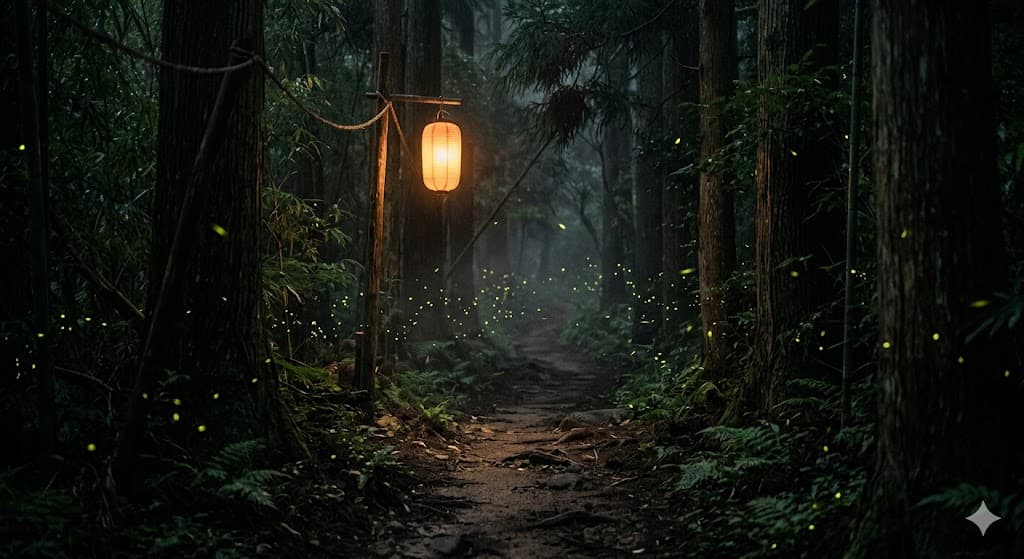
When I think back to the kimodameshi of my own childhood, I was never the one in the costume waiting to leap out. I was always on the other side — one of the nervous walkers picking my way down a dark course, certain that something was watching. And the thing that frightened me most was never the moment a friend in a sheet jumped from behind a tree. That, at least, was a thing with edges. What truly raised the hair on my neck was the sound I could not place: a rustle in the grass, a footstep that might have been a footstep, the sense that someone was near without any shape to attach it to. The unseen presence was always scarier than the visible ghost. That feeling has stayed with me longer than any costume ever did.
 The eerie nighttime course of a kimodameshi, where the unseen presence is always more frightening than any costumed scare.
And yet I did not hate those nights. The fear and the pleasure sat in the same place. The warm, slightly heavy night air, the smell of grass and earth that the daytime never had — being outside at an hour when children were normally indoors carried its own quiet thrill, even while my whole body was braced for a fright.
That is why the opening of Kimi ni Todoke lands so cleanly for anyone raised in Japan. The class organizes a "bravery competition," and the shy, misread heroine — saddled by classmates with a nickname that echoes the ghost from a famous horror film — ends up cast on the other side of the fear, the side I never stood on. While the rest cling together in the dark, she is the one calmly noting that she likes the night, the smell of the air, the rustle of leaves, the sound of insects. The story inverts the exact terror of my childhood and turns it into the gentlest possible character note. The girl everyone treats as the thing in the dark is, in fact, the only one at peace there.
Related: Onimusha and the Hidden Code of the Name Iemon: Why Japanese Viewers Hear Traitor Before the Reveal explains this in detail.
From a Heian Dare to the Schoolyard Path
Strip away the costumes and the kimodameshi is an old, old idea wearing a school uniform.
 The hyaku monogatari ghost-story gathering, an old courage ritual that shares its roots with the modern kimodameshi.
The Word: Testing Your Liver
The term itself is more visceral than the polite English "test of courage." 肝 (Kimo: liver) is, in the traditional Japanese map of the body, the seat of nerve and resolve. The phrase 肝が据わる (kimo ga suwaru: "the liver sits firm") still means to be unshakeable. So 肝試し is, word for word, a test to see whether your liver holds steady when the dark closes in — a far more bodily image than "courage" alone suggests.
A Heian Dare and a Samurai's Training
The custom reaches back roughly a thousand years, into the 平安 (Heian: the classical court era of roughly 794–1185) period. Around the early twelfth century, 花山天皇 (Kazan Tennō: Emperor Kazan) dared three noble brothers to walk alone, in the dead hours of the night, to a house said to be haunted by an 鬼 (oni: demon). Only one of them — the future power-broker 藤原道長 (Fujiwara no Michinaga: a dominant Heian court statesman) — saw it through, and he returned with a piece sliced from the building's lintel as proof he had truly been there. That small detail, the token brought back as evidence, is the genetic seed of every kimodameshi goal marker that followed.
By the warrior centuries the test had hardened into something closer to training: a way for samurai families to condition their children against fear. It ran alongside a related parlor game, 百物語 (Hyaku Monogatari: a gathering of a hundred tales), in which people lit a hundred lamps on a summer night and told a hundred ghost stories, snuffing one flame after each, daring the dark to fill the room as the light drained away.
Why Summer Belongs to the Dead
To a Western reader the timing is the strange part. Why is the season of ghosts summer, and not a crisp October the way Halloween falls? The answer is お盆 (Obon), the midsummer period when the spirits of ancestors are said to return home. With the dead close at hand, the line between worlds feels thin, and that is when 怪談 (kaidan) traditionally come out. There is also an old, half-practical logic: in the centuries before air-conditioning, a good chill down the spine was a way to cool off on a sweltering night. The summer ghost play sealed the association — the kabuki classic 東海道四谷怪談 (Tōkaidō Yotsuya Kaidan: a classic ghost-revenge kabuki play), with its wronged, vengeful お岩 (Oiwa: the disfigured spirit-wife who haunts the man who betrayed her), became fixed summer fare. Even now, Japanese television fills the August schedule with ghost-story specials, which is how many of my own generation first met those tales.
The Shape of a Modern Kimodameshi
The schoolyard version follows a remarkably stable script. Groups are usually drawn by くじ引き (kuji-biki: a lottery), and there is real wisdom in that. When luck decides who walks with whom, nobody can complain, and the randomness itself becomes part of the fun — I still remember the suspense of waiting to hear my number, hoping to be paired with a friend. Leaving the grouping to chance kept things fair, and the fairness kept everyone in good humor.
Then comes the course: a dark route through a shrine, a stretch of forest, an abandoned building, or any local 心霊スポット (Shinrei Supotto: haunted spot), with classmates stationed along the way to spring out. And at the far end, almost always, there is a goal marker to carry back — an お札 (Ofuda: paper talisman) or a small charm. In my own kimodameshi this was the whole point. The marker was the proof you had really reached the end, and on nights when I badly wanted to turn back, that one small concrete task — you have to bring it back or it doesn't count — was exactly what pushed my feet forward into the dark. A thousand years apart, a child clutching a paper charm and a Heian nobleman carrying home a sliver of lintel are doing the identical thing.
What a Land Without Seasons Forgets
Having lived for many years in a place where the heat never lets go, I have come to see the kimodameshi as a creature of the calendar. Where I live now there is no summer in the Japanese sense — no sharp season that arrives, peaks, and ends, no long school break carved out and labeled. The year simply stays warm. And without that boundary, the whole machinery of "summer equals ghosts equals walking into the dark" has nowhere to attach. It was only from this distance that I understood how much kimodameshi depended on the season having an edge.
 The goal marker carried back as proof — a custom that links a child's charm to a thousand-year-old test of courage.
What the distance also clarified is what the ritual was really manufacturing. The scares fade fast. What lasts is the camaraderie. After a kimodameshi, the residue in me was never the fear itself but the sense of having passed through something frightening together — trembling down the same dark path, then standing safe at the end saying "that part was terrifying, wasn't it." Classmates I had barely spoken to suddenly felt close. Shared fear is an efficient solvent for the distance between strangers.
That is the quiet genius of placing this custom at the very start of Kimi ni Todoke. The heroine is isolated not by malice but by misunderstanding, frozen at arm's length from everyone. A class assignment could not thaw that. A bravery competition can — because kimodameshi is socially licensed to throw people into the dark side by side and let the fear do the bonding. Whether the modern Japanese school still runs these events as freely as it once did is a fair question; concern over safety and supervision has made the organized version less casual than in my day. But the cultural memory of it is strong enough that an audience needs no footnote. They know, in their liver, exactly why a teacher pinning a sign-up sheet to the wall is the moment a lonely girl's story can finally begin.
FAQ
Q: Is kimodameshi a real activity or just an anime trope?
A: It is a real and long-standing custom. School clubs, sports clubs, and summer camps organize them, and they appear at festivals and among friends; fiction draws on the practice precisely because audiences recognize it from their own lives.
Q: Why are ghosts a summer thing in Japan rather than an autumn or winter one?
A: Mainly because of the Obon season, when ancestral spirits are said to return, and the old tradition of telling kaidan (ghost stories) in the heat. There is also the practical folk idea that a good scare helps you feel cooler on a hot night.
Q: What is the point of bringing an item back from the end of the course?
A: It is proof you actually reached the goal rather than turning back early. The convention is ancient — it echoes the Heian tale of a nobleman returning with a piece of a haunted house — and it gives the frightened walker a small, concrete reason to keep going into the dark.
Key Insights to Remember
- Kimodameshi is best read not as a horror activity but as a social technology. By sending people into fear together and handing them a shared task, it converts strangers into companions — which is why a story about a misunderstood outsider would reach for it as the engine of a first connection rather than for any scare value.
- The custom carries an unbroken thread from aristocratic dares and samurai conditioning to the schoolyard course with its lottery groups and paper-charm goal. The token carried back as proof is the oldest, most durable element, surviving a thousand years almost unchanged because it answers a permanent human need: evidence that you faced the thing and did not flinch.
- The deepest fear in a kimodameshi is usually the presence you cannot see, not the costume that jumps out — and that distinction quietly mirrors the heroine's predicament, where the frightening thing about her was never real, only an unseen shape others projected onto the dark. The ritual that scares her classmates is the very one that lets them finally see her.
Sources
About the author

Spoiler-free cultural deep-dives into anime, manga & live-action Japanese drama
- ●Tokyo-born, 3rd-generation Edokko (江戸っ子)
- ●Lifelong manga reader & anime viewer since the kaiju era
- ●Writes from outside Japan — distance as a cultural lens
- ●Spoiler-free · sourced · Kanji + Romaji + English
A Tokyo-born, 3rd-generation Edokko writer who has spent years living outside Japan. I use the anime, manga, and live-action Japanese drama you already love as a doorway into the folklore, language, religion, and everyday history behind them — written so even first-time fans can follow along, with sources for every claim.
Enjoy this article?
Get the next spoiler-free cultural deep-dive straight to your inbox.
Related Articles
Spirited Away and Kamikakushi: The Folklore Behind the Title
Spirited Away's Japanese title ends in kamikakushi. Learn who villages said took children away, why dusk was the dangerous hour, and how they searched for them.
10/25/2026
Fruits Basket and the Zodiac Cat: The Real Japanese Folktale of the Cat Who Missed the Banquet
How Fruits Basket builds its outsider cat on the real Japanese folktale of the rat tricking the cat out of the zodiac, and what eto still means in Japan today.
10/20/2026

March Comes in Like a Lion and Tsukimi: Why Japan Watches the Moon With Rice Dumplings and Pampas Grass
How March Comes in Like a Lion opens onto tsukimi, Japan's moon-viewing harvest observance, and why dumplings, pampas grass and a shifting date belong to it.
8/17/2026

Summer Time Rendering and the Shoryo-uma: The Cucumber Horse That Carries the Dead Home
How Summer Time Rendering's Obon homecoming opens onto shoryo-uma, the cucumber horse for returning ancestors, and why it is only one of many regional forms.
8/16/2026

GeGeGe no Kitaro and Hyakumonogatari: Why Japan Saves Its Ghost Stories for Summer
How GeGeGe no Kitaro connects to hyakumonogatari, the hundred-candle ghost game, and the Edo custom of staging horror in summer to chill the audience.
8/11/2026

Demon Slayer Infinity Castle and the Biwa: Heike and Hōichi
How the biwa that opens Demon Slayer's Infinity Castle leads to blind Heike reciters and Hōichi, who played night after night for a court that was not there.
8/7/2026