Hunter x Hunter and the Hidden History of Yubikiri: The Dark Truth Behind Japan's Cutest Promise
How Hunter x Hunter's departure scene turns a children's pinky promise into a doorway to yubikiri's grim Edo-era origins of severed fingers and a thousand swallowed needles.

Tokyo-born, 3rd-generation Edokko · writing on Japanese culture from outside Japan
Spoiler-Free Cultural Analysis
This article looks only at a single, gentle moment from the opening of Hunter x Hunter — a boy and his aunt sealing a promise — and the real folklore and Edo-period history behind the gesture they perform. There are no plot revelations here, only atmosphere, language, and cultural history.
Key Takeaways
- The "thousand needles" line in Hunter x Hunter's farewell scene is not invented dialogue but an almost word-for-word rendering of a traditional Japanese children's chant that nearly every Japanese person grows up reciting.
- Behind that singsong promise lies a much darker history: in the licensed pleasure quarters of Edo, severing a fingertip was once a literal proof of devotion, and the threats in the rhyme were once real punishments.
- The gesture survives today as a tender ritual of trust, but its survival depends on the meaning being forgotten — children keep the rhythm and lose the blood that once gave it weight.
Key Terms Explained
- 指切り (Yubikiri) / Finger-Cutting — Literally "cutting the finger." Today it means hooking little fingers to seal a promise, but the words preserve the memory of an actual amputation.
- げんまん・拳万 (Genman) / Ten Thousand Fists — Written with the characters for "fist" and "ten thousand," it names the punishment for a broken vow: ten thousand strikes of the fist.
- 心中立て (Shinjū-date) / Proof of Devotion — A demonstration of sincere love offered by a courtesan to a client, ranging from gentle tokens to extreme acts of self-harm.
- 遊女 (Yūjo) / Courtesan — A woman working in the licensed pleasure quarters of the Edo period.
- 吉原 (Yoshiwara) / Edo's Licensed Quarter — The famous walled pleasure district of old Tokyo, the cultural heartland where many of these vows were made.
The Rhyme I Sang Without Ever Hearing It
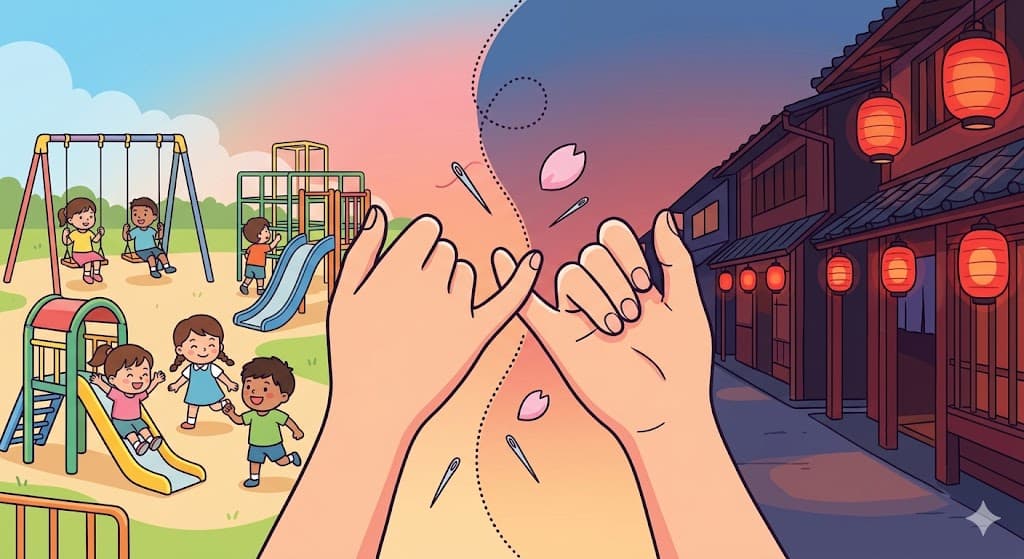
When I was a child, the pinky promise was less about the promise and more about the act itself. Whenever a friend and I had something that was "just between the two of us," we would hook our little fingers together, squeeze, and chant in unison. I remember the feeling of that small secret coming into existence the instant our fingers locked far more vividly than I remember anything we actually swore. The version I grew up reciting ran all the way to the end — the finger-cutting, the lie, the thousand needles, the cut sealed. And here is the strange part: not one of us was frightened.
 Two children seal a secret the way generations have: little fingers hooked, chanting in unison without ever asking what the words mean.
We sang about being made to swallow a thousand needles the way you might sing about the weather. The threat was gruesome, but it reached us as pure rhythm — a well-worn formula the body learns long before the mind asks what the words mean. That gap between the violence of the line and the lightness of the singing is exactly what I felt watching the opening of Hunter x Hunter.
In the very first episode, the young hero Gon prepares to leave his home, Whale Island, and his aunt Mito asks him to promise to come back safely. They seal it with a pinky swear, and the English subtitles carry the threat of a thousand needles almost intact. For a Japanese viewer, this is an instant jolt of recognition — that's the chant, the real one, the one we all knew. The show didn't soften it into a generic "cross my heart." It kept the needles. And keeping the needles is what opens the door to a history most of us never learned.
From a Courtesan's Vow to a Schoolyard Game
The Severed Pinky as Proof of Love
 In the licensed quarters of Edo, a courtesan's sincerity was almost impossible to prove — and the most drastic proofs of devotion left the gesture's dark roots behind.
The most widely cited origin of 指切り (Yubikiri: finger-cutting) is far heavier than anything a playground suggests. In the Edo period, a 遊女 (Yūjo: courtesan) working in districts like 吉原 (Yoshiwara: Edo's licensed quarter) lived in a world where affection was a transaction and sincerity was almost impossible to prove. To convince a particular client that her feelings were genuine — that he was not simply one customer among many — a woman might offer a 心中立て (Shinjū-date: proof of devotion).
These proofs existed on a spectrum. Some were gentle: a letter written in earnest, a lock of hair, a tattoo of the beloved's name. But at the extreme end was 指切り — the cutting off of a fingertip, usually part of the little finger, sent to the client as undeniable evidence of commitment. A body cannot lie the way words can. A severed piece of yourself was a vow you could not take back. The phrase we now use for a harmless children's promise still carries, fossilized inside it, the memory of that knife.
Ten Thousand Fists and a Thousand Needles
The second half of the chant is just as literal in its origins. げんまん (Genman) is written 拳万 — the character for "fist" joined to the character for "ten thousand." It names a forfeit: if you break the promise, you submit to ten thousand blows of the fist. The needles work the same way. Being "made to swallow a thousand needles" was not whimsy but a vivid catalogue of pain promised to the oath-breaker.
Strung together, the full traditional phrase is a small contract of escalating consequences — the finger cut, the lie named, the needles swallowed, the cut confirmed. Each clause was once a genuine penalty or a genuine pledge. What reaches a modern child is the music; what the words actually describe is a binding agreement enforced by self-mutilation and bodily punishment. The line in Hunter x Hunter lands so naturally on Japanese ears precisely because the rhyme has spent centuries shedding its weight while keeping its shape.
How the Blood Drained Out of the Words
The journey from the pleasure quarter to the playground is a long quiet process of forgetting. As the licensed quarters faded and their customs lost their context, the gesture detached from its source and floated free. The intensity that once made it meaningful — the courtesan's knife, the real fist, the real needles — was steadily emptied out, until only the form remained: two little fingers, a shared rhythm, a sealed secret.
This is a common fate for folk customs. The ritual outlives the belief that powered it. By the time children like me were hooking pinkies behind the school building, the chant was a game with a faint shiver of menace, nothing more. We were performing, without knowing it, the hollow shell of a vow that men and women had once sealed in blood. It was only as an adult that I learned the origin, and I was genuinely startled. I had thought it was nothing but a cute promise game, and never imagined that something this heavy and this raw was buried underneath. Even the needles I had sung so innocently turned out to trace back to something far more painful.
What the Gesture Holds That Words Cannot
Living outside Japan for many years has made me notice something I never would have seen from the inside: there is no fixed equivalent gesture here. People make promises with words, or with a handshake, but I have not found a custom where a specific bodily movement and a spoken chant are bound together the way yubikiri binds them. A handshake confirms an agreement; the pinky promise does something stranger. It creates a tiny private world between two people, sealed by touch.
 Stripped of its origins, yubikiri survives as a small ceremony of trust — the needles still in the words, the meaning moved entirely to the touch.
I have noticed, too, that I almost never do it anymore. The feel of a little finger hooked around mine has become a memory of childhood rather than a living habit. And that loss is what makes the Hunter x Hunter scene quietly moving rather than morbid. Stripped of its origins, the gesture has become something almost purer than what it replaced — not a threat enforced by punishment, but a small ceremony of trust between a child and the person who raised him. The needles are still in the words, but the meaning has migrated entirely to the act.
There is something honest in that. We tend to assume that knowing a custom's "true" origin reveals its real nature. But the pinky promise suggests the opposite. Its current meaning — tenderness, secrecy, the warmth of a shared bond — is no less real for having grown out of something dark. A culture does not only preserve its traditions; it quietly transforms them, and sometimes the forgetting is the gift.
FAQ
Q: Did Japanese people really cut off their fingers to make promises?
A: The widely cited origin traces the gesture to Edo-period courtesans who, in extreme cases, severed part of a little finger and sent it to a client as proof of sincere devotion. This was one of several "proofs of devotion," and the most drastic. The everyday children's version today involves no cutting at all — only hooked fingers and a chant.
Q: Is the "thousand needles" line in Hunter x Hunter accurate to the original?
A: Yes. The threat of swallowing a thousand needles is a real part of the traditional Japanese pinky-promise chant, not something written for the show. The English subtitles preserve it closely, which is why the moment reads as authentic rather than invented to Japanese viewers.
Q: What does "genman" actually mean?
A: It is written with the characters for "fist" and "ten thousand," and refers to a forfeit of ten thousand fist-strikes for breaking the promise. Like the needles, it was once a literal threatened punishment, now sung as a harmless rhythmic flourish.
Key Insights to Remember
- The power of the Hunter x Hunter farewell scene for a Japanese audience comes from authenticity, not invention. By keeping the genuine "thousand needles" chant instead of substituting a generic Western promise, the show roots a fictional departure in a ritual the viewer has performed in real life, collapsing the distance between screen and memory.
- Folk customs often survive by losing their original meaning. The pinky promise endured precisely because the courtesan's severed finger and the threatened thousand needles drained away, leaving a portable gesture light enough for children to carry. What looks like cultural amnesia is also what kept the tradition alive.
- A custom's origin and its present meaning are not the same thing, and neither one cancels the other. Knowing that the gesture began in the pleasure quarters does not make a child's promise less sincere. Cultures continually repurpose their inheritance, and the gentle ritual of trust we know today is a genuine creation, not a degraded copy.
Sources & References
About the author

Spoiler-free cultural deep-dives into anime, manga & live-action Japanese drama
- ●Tokyo-born, 3rd-generation Edokko (江戸っ子)
- ●Lifelong manga reader & anime viewer since the kaiju era
- ●Writes from outside Japan — distance as a cultural lens
- ●Spoiler-free · sourced · Kanji + Romaji + English
A Tokyo-born, 3rd-generation Edokko writer who has spent years living outside Japan. I use the anime, manga, and live-action Japanese drama you already love as a doorway into the folklore, language, religion, and everyday history behind them — written so even first-time fans can follow along, with sources for every claim.
Enjoy this article?
Get the next spoiler-free cultural deep-dive straight to your inbox.
Related Articles
Spirited Away and Kamikakushi: The Folklore Behind the Title
Spirited Away's Japanese title ends in kamikakushi. Learn who villages said took children away, why dusk was the dangerous hour, and how they searched for them.
10/25/2026
Fruits Basket and the Zodiac Cat: The Real Japanese Folktale of the Cat Who Missed the Banquet
How Fruits Basket builds its outsider cat on the real Japanese folktale of the rat tricking the cat out of the zodiac, and what eto still means in Japan today.
10/20/2026

March Comes in Like a Lion and Tsukimi: Why Japan Watches the Moon With Rice Dumplings and Pampas Grass
How March Comes in Like a Lion opens onto tsukimi, Japan's moon-viewing harvest observance, and why dumplings, pampas grass and a shifting date belong to it.
8/17/2026

Summer Time Rendering and the Shoryo-uma: The Cucumber Horse That Carries the Dead Home
How Summer Time Rendering's Obon homecoming opens onto shoryo-uma, the cucumber horse for returning ancestors, and why it is only one of many regional forms.
8/16/2026

GeGeGe no Kitaro and Hyakumonogatari: Why Japan Saves Its Ghost Stories for Summer
How GeGeGe no Kitaro connects to hyakumonogatari, the hundred-candle ghost game, and the Edo custom of staging horror in summer to chill the audience.
8/11/2026

Demon Slayer Infinity Castle and the Biwa: Heike and Hōichi
How the biwa that opens Demon Slayer's Infinity Castle leads to blind Heike reciters and Hōichi, who played night after night for a court that was not there.
8/7/2026