Naruto and Hitobashira: Why Japan Seals a Monster Inside a Body Instead of Killing It
How Naruto's opening — a fox demon sealed into a newborn — leads into hitobashira, fūin, and Japan's instinct to contain a monster instead of destroying it.

Tokyo-born, 3rd-generation Edokko · writing on Japanese culture from outside Japan
Spoiler-Free Cultural Analysis
This piece looks only at the opening premise of Naruto's first episode — a destructive spirit bound into a human host — and uses it as a doorway into real Japanese folklore, religion, and language. There are no plot revelations beyond that opening setup.
Key Takeaways
- Japan's mythic instinct, again and again, is to contain a destructive force rather than annihilate it — sealing it into a foundation, a talisman, a shrine, or even a living body.
- The very word for Naruto's condition, 人柱力 (jinchūriki), is built on 人柱 (hitobashira), the old term for a person buried alive in a structure's foundation — so the show's premise rests on a real folk vocabulary, not invented fantasy.
- In 御霊信仰 (goryō shinkō), a feared, cursing spirit is not destroyed but enshrined as a god, because in this worldview the same power that brings ruin can also be turned into protection.
Key Terms Explained
- 人柱 (Hitobashira) / Human Pillar — A person buried alive in the foundation of a bridge, castle, or embankment to appease spirits and steady the structure.
- 人柱力 (Jinchūriki) / Power of the Human Sacrifice — In Naruto, a person who carries a tailed beast sealed inside them; the term literally reuses the word hitobashira.
- 封印 (Fūin) / Sealing — The ritual binding of a dangerous force with talismans, scrolls, or barriers, so that it is held in place rather than killed.
- 御霊信仰 (Goryō Shinkō) / Cult of Vengeful Spirits — The belief that the angry dead can be calmed, and even turned into protectors, by honoring them as deities.
- 祟り (Tatari) / Divine Curse — Misfortune such as plague, storm, or disaster, understood as the wrath of an offended spirit or kami.
Setsubun Beans, a Sealed Fox, and a Scholar Who Became a God
The first episode of Naruto opens not with the boy but with a catastrophe: a giant nine-tailed fox tearing through a village, leveling mountains and driving waves onto the shore, until a leader who cannot defeat it spends his own life to seal it inside a newborn child. Watching that scene again with adult eyes, what held me was not the spectacle but the choice of verb. The 火影 (Hokage: the title of the village's leader) does not slay the monster. He locks it away — inside a person.
 During Setsubun, families fling roasted beans out the door with the cry "Demons out, fortune in" — the instinct to expel evil rather than contain it.
As a child I could not have explained why that felt natural, but it did. Every February I knew the other reflex by heart: 節分 (Setsubun: the seasonal bean-throwing rite), when you fling roasted beans out the door and shout 鬼は外、福は内 (Oni wa soto, fuku wa uchi: "Demons out, fortune in") to chase the 鬼 (Oni: an ogre-demon) out of the house. That is the expelling instinct — get the bad thing outside, past the threshold, away from us.
But Japan has always carried the opposite reflex too, and it took me years to see it clearly. Sometimes the bad thing is not thrown out at all. It is kept in, bound, and even honored. The example I now reach for first is 天神様 (Tenjin-sama: the deified spirit of a wronged court scholar). I came to understand, only as an adult, that the same being can be both a feared, cursing force and a sacred one — and once that clicked, the nine-tailed fox of Naruto stopped looking foreign. It wears both faces at once: a hated destroyer and a wellspring of power. The word the series uses for Naruto's situation, 人柱力 (Jinchūriki: power of the human sacrifice), is built directly on 人柱 (Hitobashira: a human pillar). The opening is not a writer's flourish. It is sitting on something very old.
Related: Jujutsu Kaisen and Goryō Shinkō: Why Japan Turns a Vengeful Curse Into a God explains this in detail.
The Vessel Instead of the Grave: Three Ways Japan Bound Its Monsters
If you trace the sealing instinct backward, it keeps reappearing in different forms — under bridges, on paper, in shrines. Each one says the same quiet thing: a force too large to kill can still be held.
人柱 (Hitobashira): A Life Buried in the Foundation
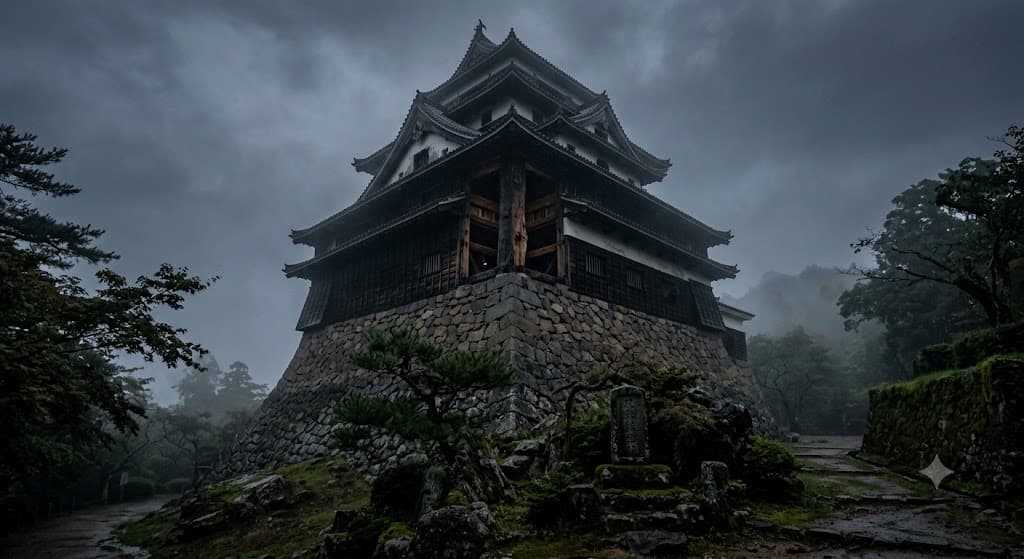
The oldest written hint of the practice appears in the 日本書紀 (Nihon Shoki: Japan's oldest official chronicle), in a tale set in the reign of Emperor Nintoku, where embankments that kept collapsing were finally steadied after human offerings were made to the river spirits. Later legends gather around famous structures. At 丸岡城 (Maruoka-jō: an old castle in Fukui), a one-eyed woman named O-shizu is said to have agreed to be buried under the central pillar in exchange for her son being raised to samurai status — a promise the lord left unkept, after which the spring rains that flooded the moat were called her tears. At the Matsue Ōhashi bridge, a man named Gensuke is remembered as the body sealed beneath the most treacherous pillar, the span said to have stood firm for three centuries afterward.
 Legends of human pillars cluster around castles and bridges, where a life was said to be buried in the foundation to hold the structure firm.
The word repays a closer look. 柱 (Hashira: a pillar) is also the counter used for kami themselves, and old shrines were raised on sacred pillars. So the buried person was imagined not merely as structural fill but as something enshrined — a literal pillar that also became a link to the gods, often marked by a small memorial stone that still stands today. I want to be honest about the history: there is no conclusive physical proof that living people were routinely walled into foundations, the custom had faded across Japan by the late Edo period, and scholars largely treat the famous cases as folklore. But folklore that survives this long is carrying a real conviction — that a life given to a structure would hold it up. The body itself becomes the seal.
Related: Naruto and the Nine-Tailed Fox: Why Japan's Most Sacred Animal Is Also Its Most Feared explains this in detail.
封印 (Fūin): Binding With Scrolls, Talismans, and Barriers
The episode also hands us a "Scroll of Sealing" — a fictional cousin of a real family of practices. In Buddhist, Shinto, and 陰陽道 (Onmyōdō: the way of yin-yang divination) traditions, a dangerous power is not erased but bound: pinned with an お札 (Ofuda: a paper talisman), shut behind a ritual barrier, fixed in place by a name written down. The logic is precise. You do not destroy the demon, because you may not be able to. You contain it, and the containment has to be maintained — which is exactly why, in story after story, a weakening seal is the thing everyone fears.
I'll admit my own distance here. I grew up in the downtown wards of Tokyo, and the world of the 陰陽師 (Onmyōji: a yin-yang master) and his 式神 (Shikigami: a spirit servant) was never the center of my childhood; for me these were genre furniture long before I understood them as religion. Many Japanese are the same — the imagery is everywhere in manga and anime, but the underlying 封印 (Fūin: sealing) tradition usually arrives second, as something you read back into the picture later. That, I think, is the honest entry point: the seal is familiar as a mood before it is understood as a belief.
Related: Black Summoner and the Shikigami Tradition: Why Japan's Summoners Bond Instead of Bind explains this in detail.
御霊信仰 (Goryō Shinkō): Turning a Curse Into a Guardian
The most striking version of the instinct involves people, not monsters. When 菅原道真 (Sugawara no Michizane: a brilliant Heian scholar-official) was slandered, demoted, and exiled to die far from the capital, the disasters that followed — lightning striking the palace, plague, the deaths of his rivals — were read as 祟り (Tatari: a divine curse) sent by his furious spirit. The court's answer was not exorcism. It was enshrinement. They restored his titles, then built 北野天満宮 (Kitano Tenmangū: a great shrine in Kyoto) and elevated him into a god, Tenjin-sama. An earlier case set the pattern: Prince Sawara, exiled and dead, was blamed for an epidemic and quieted by being raised to the status of a kami.
 At Tenmangū shrines, a once-feared vengeful spirit is honored as Tenjin, the god of learning students still pray to today.
This is the engine of goryō shinkō, the worship of vengeful spirits: the same energy that curses is the energy that can guard, so you flip it by honoring it. A disgraced, terrifying scholar becomes the gentle patron of learning. Seen through this lens, the nine-tailed fox sealed into a child is not a strange premise at all. It is the human-vessel version of a very old bargain — the feared destroyer, bound and carried, becomes a source of strength.
Foundation, scroll, shrine — and finally a body. Across all three, the reflex is the same: not erasure, but containment plus relationship. You do not get to be rid of the thing. You get to hold it, and live with it.
What a Country Keeps When It Stops Burying People
The enshrining instinct never really left. Tenmangū shrines still draw crowds of students before exams, rubbing the bronze ox and writing wishes for the wronged scholar to grant — a curse, centuries later, still doing the work of a blessing. The machinery of turning fear into patronage runs quietly under modern, ordinary life.
Living outside Japan for many years, I started to notice the shape of the instinct by contrast. So many of the imported hero stories I encountered end by killing the monster: the dragon slain, the dark lord destroyed, the threat removed so the world can be clean again. The stories I grew up inside lean the other way. They bind the monster and then ask you to live beside it. Naruto's long road is never really "kill the fox." It is "come to terms with the fox." That preference — containment and coexistence over annihilation — is something Japanese storytelling kept, and you feel its oddness most sharply from the outside, where the cleaner ending is the default.
There is a heavier echo I can't quite set down, though. The hitobashira logic — one body quietly buried so that the larger structure can stand — has a long afterlife in how groups can still ask the individual to be sacrificed for the whole. I don't say that to scold; the same culture that buries a pillar also builds it a memorial stone, and the same impulse that demands the sacrifice also insists on honoring it. What I find worth sitting with is the trade itself. A culture that prefers binding to killing accepts a responsibility the monster-slayers get to skip: you have to keep tending what you chose not to destroy.
FAQ
Q: Was hitobashira a real practice or only a legend?
A: References appear from ancient chronicles onward, and the custom had disappeared across Japan by the late Edo period, but there is no conclusive physical proof that people were routinely buried alive in foundations. Most scholars treat the famous cases — Maruoka Castle, the Matsue bridge — as folklore that preserved a genuine belief: that a life offered to a structure would steady it.
Q: Why seal a monster instead of simply killing it?
A: In this worldview a force that powerful is often seen as unkillable — it can only be bound, and the binding has to be maintained. Sealing also keeps the power available rather than gone: contained, it can protect instead of destroy, which is why a sealed beast can become a source of strength for the one who carries it.
Q: Why would anyone enshrine a vengeful spirit as a god?
A: Under goryō shinkō, the same energy that curses can also guard, so honoring the angry dead as a deity is meant to flip their wrath into patronage. That is how a feared, disgraced scholar became Tenjin, the benevolent god of learning that students still pray to today.
Key Insights to Remember
- Naruto's opening is not borrowed exoticism but a compression of a deep Japanese habit of mind: faced with something too powerful to defeat, you build a vessel for it. Historically that vessel was a foundation, a talisman, or a shrine — and in the show, a child. The premise is old folklore wearing a new face.
- Japanese folklore tends to refuse the clean line between monster and protector. Buried sacrifices become guardian spirits, cursing dead become benevolent kami, and the nine-tails edges toward ally. The boundary between the thing you fear and the thing that shields you is left deliberately porous.
- A seal is never a finished act. It can weaken, a curse can return, a spirit must be re-honored each year. The culture that chooses binding over killing quietly accepts the harder part of the bargain — the long obligation of living alongside what it did not destroy.
Sources
- Hitobashira — Wikipedia
- Hitobashira (Human Pillar) — Yokai.com
- Sugawara no Michizane — Wikipedia
- Goryō — Wikipedia
- Tatari — Japanese Wiki Corpus
- Nine-Tailed Demon Fox's Attack — Narutopedia
About the author

Spoiler-free cultural deep-dives into anime, manga & live-action Japanese drama
- ●Tokyo-born, 3rd-generation Edokko (江戸っ子)
- ●Lifelong manga reader & anime viewer since the kaiju era
- ●Writes from outside Japan — distance as a cultural lens
- ●Spoiler-free · sourced · Kanji + Romaji + English
A Tokyo-born, 3rd-generation Edokko writer who has spent years living outside Japan. I use the anime, manga, and live-action Japanese drama you already love as a doorway into the folklore, language, religion, and everyday history behind them — written so even first-time fans can follow along, with sources for every claim.
Enjoy this article?
Get the next spoiler-free cultural deep-dive straight to your inbox.
Related Articles
Spirited Away and Kamikakushi: The Folklore Behind the Title
Spirited Away's Japanese title ends in kamikakushi. Learn who villages said took children away, why dusk was the dangerous hour, and how they searched for them.
10/25/2026
Fruits Basket and the Zodiac Cat: The Real Japanese Folktale of the Cat Who Missed the Banquet
How Fruits Basket builds its outsider cat on the real Japanese folktale of the rat tricking the cat out of the zodiac, and what eto still means in Japan today.
10/20/2026

March Comes in Like a Lion and Tsukimi: Why Japan Watches the Moon With Rice Dumplings and Pampas Grass
How March Comes in Like a Lion opens onto tsukimi, Japan's moon-viewing harvest observance, and why dumplings, pampas grass and a shifting date belong to it.
8/17/2026

Summer Time Rendering and the Shoryo-uma: The Cucumber Horse That Carries the Dead Home
How Summer Time Rendering's Obon homecoming opens onto shoryo-uma, the cucumber horse for returning ancestors, and why it is only one of many regional forms.
8/16/2026

GeGeGe no Kitaro and Hyakumonogatari: Why Japan Saves Its Ghost Stories for Summer
How GeGeGe no Kitaro connects to hyakumonogatari, the hundred-candle ghost game, and the Edo custom of staging horror in summer to chill the audience.
8/11/2026

Demon Slayer Infinity Castle and the Biwa: Heike and Hōichi
How the biwa that opens Demon Slayer's Infinity Castle leads to blind Heike reciters and Hōichi, who played night after night for a court that was not there.
8/7/2026