Haikyu!! and the Yatagarasu: Why Karasuno's Crows Are a Symbol of Good Fortune, Not Doom
How Haikyu!!'s Karasuno crows echo the Yatagarasu, Japan's three-legged crow of guidance — and why a bird of doom in the West is a sign of good fortune here.

Tokyo-born, 3rd-generation Edokko · writing on Japanese culture from outside Japan
Spoiler-Free Cultural Analysis
This article looks at the real folklore and history behind the crow imagery that gives 烏野(Karasuno: "crow field," the school in Haikyu!!) its name and emblem. It draws only on premise-level facts established in the very first episode — the school's name and its crow symbol — and on Japanese mythology. There are no plot revelations here, only the cultural context behind the bird on the jersey.
Key Takeaways
- In Western storytelling the crow tends to signal death or bad luck, but in Japan the same bird can be a sacred guide: the mythical 八咫烏(Yatagarasu: the three-legged crow) is said to have led Japan's legendary first emperor to safety, making the crow a symbol of guidance, good fortune, and victory.
- The choice to name an underdog volleyball team "the crows" is not accidental irony. It plugs directly into a much older Japanese image of the crow as a navigator — the bird that finds the path when everyone else is lost.
- The same three-legged crow that decorates 熊野(Kumano: a sacred region in Wakayama) also sits on the crest of Japan's national soccer team, so the imagery behind Haikyu!! reaches from ancient myth to the modern sporting present.
Key Terms Explained
- 烏 (Karasu) / Crow — The specific word for a crow, written with a kanji distinct from the general word for "bird." It is the character hidden inside the name Karasuno.
- 八咫烏 (Yatagarasu) / Eight-Span Crow — A giant divine crow of Shinto myth, later pictured with three legs, sent from heaven as a guide. The name literally means "very large crow."
- 神武天皇 (Jimmu Tennō) / Emperor Jimmu — Japan's legendary first emperor, whom the Yatagarasu is said to have guided through the mountains to found his court.
- 熊野三山 (Kumano Sanzan) / The Three Grand Shrines of Kumano — The trio of shrines in Wakayama where the Yatagarasu is venerated as a messenger of the gods.
- 神使 (Shinshi) / Divine Messenger Animal — An animal understood to serve as a go-between for a deity and human beings; the crow fills this role in Kumano.
The Bird at the Garbage Collection Point
Ask most people who live in Tokyo what comes to mind when they hear the word 烏(karasu: crow), and the honest first answer is rarely "sacred." It is the raider at the morning trash pile. I grew up with that image and never lost it: netting draped over the collection point, and a crow working a gap in the mesh, tugging food scraps out and scattering them down the whole street. They are clever and stubborn, and shooing one away only buys a minute before it circles back. Nothing about that felt divine. If anything, a big black bird cawing over a mess of garbage struck me as a little ominous, a little unpleasant — closer to the Western image of the crow as bad luck than to anything holy.
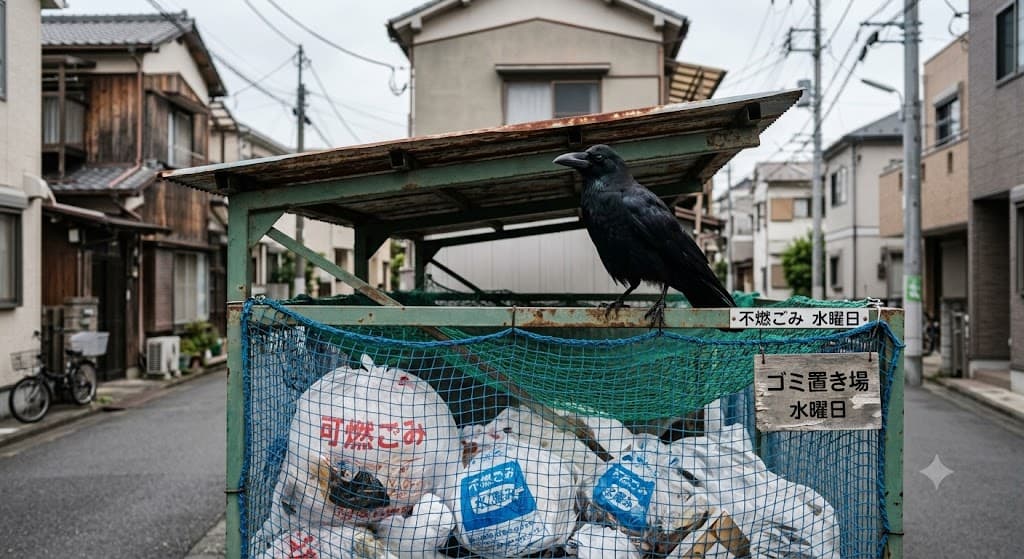 In everyday Tokyo life, the crow is best known as the clever raider of the morning trash pile — an image not far from the Western omen of bad luck.
That is worth admitting up front, because English-speaking fans sometimes assume Japanese people all see the crow as a mystical creature. In daily life, plenty of us mostly see a nuisance. So when a story hands the crow to a struggling, overlooked team and treats it as something to be proud of, the interesting question is not just "why crows?" but "why does Japan have a second, older meaning for this bird sitting underneath the everyday annoyance?"
From Garbage-Raider to Heaven's Guide: The Older Meaning of the Crow
The name 烏野(Karasuno) carries the kanji 烏, "crow," rather than 鳥(Tori: the general word for "bird") — a distinction close enough that other characters in the series sometimes misread it. The team's banner carries a single word urging them to fly, and their old, unflattering nickname as "the flightless crows" says everything about where they start. A crow that cannot fly is a perfect picture of a former power that has fallen. But the reason the crow works as an emblem of hope — and not just of failure — reaches back more than a thousand years.
The Crow Who Guided an Emperor
The oldest chronicles of Japan, the 古事記(Kojiki: Records of Ancient Matters, compiled 712) and the 日本書紀(Nihon Shoki: Chronicles of Japan, compiled 720), tell of the legendary first emperor, 神武天皇(Jimmu Tennō), on a campaign to unify the land. His army lands and then loses its way in the steep, forested mountains near 熊野(Kumano). According to the myth, the sun goddess 天照大神(Amaterasu Ōmikami: the supreme sun goddess) — with the creator deity 高皇産霊(Takamimusubi: a high heavenly god) — sends down a giant crow to lead the way. Guided by the bird, Jimmu crosses to 大和(Yamato: the ancient heartland) and founds his court.
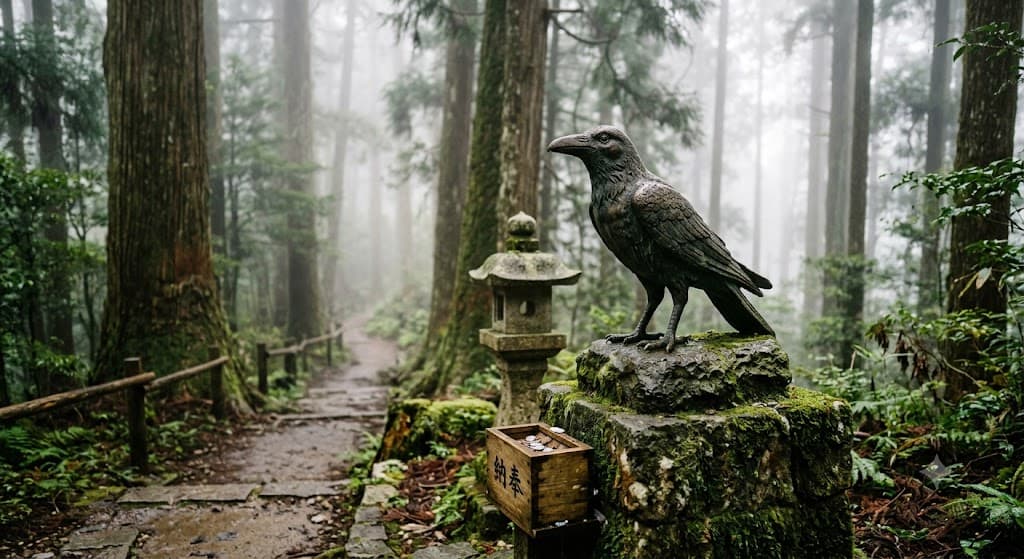 Myth holds that the Yatagarasu was sent from heaven to guide Japan's legendary first emperor through the mountains near Kumano to Yamato.
That crow is the 八咫烏(Yatagarasu). The name is best read as "eight-span crow," where the "span" is an old unit of length and "eight" is really just an old way of saying "huge." What matters is its job: it is not a fighter or a killer but a navigator, the one who finds the path in unfamiliar country. In Japanese, its role is summed up in a single idea — guidance. That is the thread that runs straight to a volleyball team told to find its way back to the top.
Why Three Legs?
Most modern depictions — on shrine banners, on stamps, on team crests — give the Yatagarasu three legs, though, curiously, the oldest chronicles never actually say it had them. The three-legged version seems to have arrived later, absorbing a much older East Asian image: in Chinese folklore a three-legged crow was said to live inside the sun, its shape imagined from the dark specks of sunspots. Since the Japanese crow was already tied to the sun goddess, the two ideas merged, and by roughly the tenth century the divine crow gained its extra leg.
As for what the three legs mean, the priests of Kumano themselves admit no one is certain. The explanations passed down include heaven, earth, and humankind — all born of the same sun and therefore like brothers; the three ancient clans that once held power in the Kumano region; and the three virtues of wisdom, benevolence, and valor. The honest answer, "we don't really know," is part of the charm.
The Crow as Divine Messenger in Kumano
In the 熊野三山(Kumano Sanzan) — the three grand shrines of Hongū, Hayatama, and Nachi in Wakayama — the crow is treated as a 神使(shinshi: divine messenger), the go-between that carries a deity's will. Old talismans issued by these shrines were printed with flocks of crows, and there were even rituals in which offerings were laid out and people read fortunes from how crows pecked at them. Here the crow is not a scavenger to be chased off but a bringer of good fortune, an animal that can lead a person toward happiness.
None of this fully erases the darker reading. Growing up, the crow superstitions I actually heard were the gloomy kind — that a crow calling near the house was an ill omen, a sign that something bad was coming, enough to make you tense up when you heard it. That is the fascinating thing about this bird: the reverence of Kumano and the unease of the everyday coexist in the same creature, and Japanese culture never really forced them to resolve into one clean meaning.
The Crow That Flew Onto a National Crest
The first time I consciously registered the three-legged crow, it was not at a shrine at all — it was the emblem on the chest of Japan's national soccer team. I remember being puzzled: why on earth would the national team be a crow? Only much later did I learn it was the Yatagarasu, the divine guide of Emperor Jimmu, and that the bird was chosen for exactly its mythic job — to help the ball find its way to the goal. There is a nice historical reason too: a founding figure of Japanese soccer came from Nachi-Katsuura in Wakayama, the very home of the Kumano crow, and the association later adopted the bird. The winner of the Emperor's Cup even earns the right to wear the Yatagarasu mark the following season. It genuinely surprised me that a bird I filed under "garbage-raider" carried so sacred a meaning.
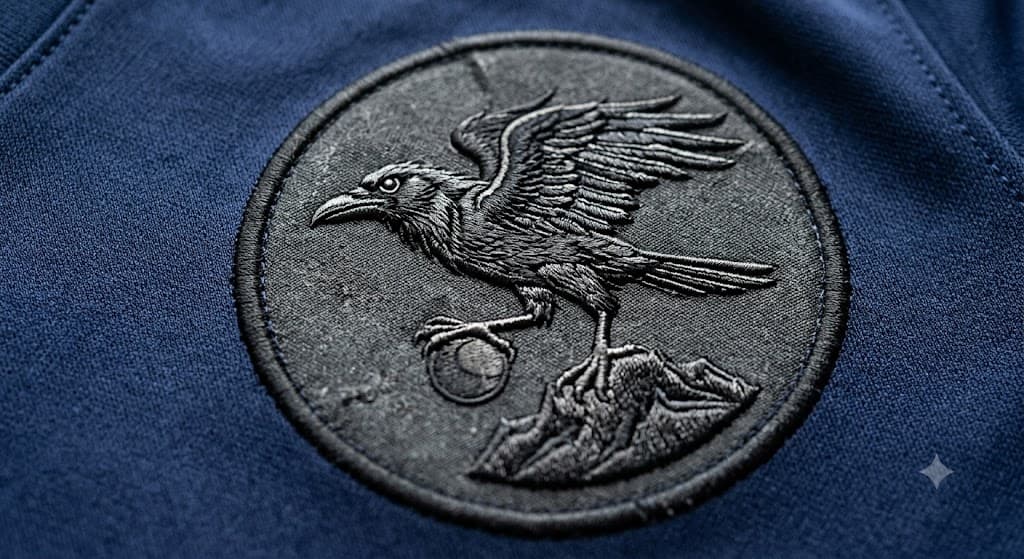 The same divine crow of guidance decorates the crest of Japan's national soccer team, carrying an ancient symbol into the modern sporting present.
That double life is easier to notice from a distance. Living outside Japan for many years, I have watched how thoroughly the Western imagination fixes the crow and the raven as birds of death, battlefields, and ill fortune — the harbinger at the window. Against that backdrop, a national team and a beloved sports story both proudly wearing a crow looks almost paradoxical. It stops looking paradoxical once you know the Yatagarasu: in Japan the same silhouette can mean victory and safe passage, not doom.
I will admit the limits of my own vantage point. The heartland of this faith, the Kumano Sanzan and the old pilgrimage roads of Wakayama, I have never actually visited — for me the crow of Kumano remains a distant sacred place I would like to see someday, known through books and images rather than pilgrimage. But even from the outside, the logic is clear enough. Handed to an underdog team, the crow is not a joke about failure. It is a quiet promise that the lost can be led back to the path — which is the oldest thing this bird has ever meant.
FAQ
Q: Does "Karasuno" literally mean "crow"?
A: The name contains 烏(karasu), the specific kanji for "crow," so the school is closely tied to crow imagery — which is why its banner urges the team to fly and why it is nicknamed "the flightless crows" early on. The character is distinct from the more general kanji for "bird."
Q: Is the crow a good or bad symbol in Japan?
A: Both, depending on context. In everyday life crows are often seen as clever nuisances, and some old superstitions treat a crow's cry as an ill omen. But in myth and at the Kumano shrines, the crow — especially the three-legged Yatagarasu — is a sacred guide associated with good fortune and victory.
Q: What is the Yatagarasu and why does it have three legs?
A: The Yatagarasu is a giant divine crow said to have guided Japan's legendary first emperor through the mountains near Kumano. The three-legged form does not appear in the oldest chronicles; it seems to have come later, blending in an older East Asian image of a three-legged sun-crow. Its meanings — heaven-earth-humanity, three local clans, or three virtues — are debated even at Kumano.
Key Insights to Remember
- The crow in Haikyu!! is not a random mascot but a bridge to one of Japan's oldest images of guidance. Where the West reads the crow as a messenger of death, Japan preserves a parallel reading — the crow as heaven's navigator — and a team named for that bird inherits the promise of finding its way, not just the shame of having lost it.
- Japan's comfort with a single creature carrying opposite meanings is itself the lesson. The garbage-raider and the sacred guide are the same bird, and the culture never demanded that one cancel the other. Holding the ominous and the auspicious together, rather than sorting them into pure good and pure evil, is a habit of mind worth noticing in far more than crows.
- The Yatagarasu shows how living Japanese symbolism really is. The same crow moves from an eighth-century chronicle to a shrine talisman to a national soccer crest to a high-school sports anime without ever feeling out of place — proof that myth here is not a museum piece but a working image, still doing its old job of pointing the way forward.
Sources & References
- Yatagarasu — Wikipedia
- The Yatagarasu: The Three-legged Crow That Guided Emperor Jimmu on His Journey — Kokugakuin University
- Yatagarasu — Yokai.com
- The Three-Legged Crow — Unforgettable Guardian of the Kumano Kodo Pilgrimage — More Than Tokyo
- Yatagarasu (the Three-Legged Crow) — Green Shinto
- Karasuno High — Haikyū!! Wiki (Fandom)
About the author

Spoiler-free cultural deep-dives into anime, manga & live-action Japanese drama
- ●Tokyo-born, 3rd-generation Edokko (江戸っ子)
- ●Lifelong manga reader & anime viewer since the kaiju era
- ●Writes from outside Japan — distance as a cultural lens
- ●Spoiler-free · sourced · Kanji + Romaji + English
A Tokyo-born, 3rd-generation Edokko writer who has spent years living outside Japan. I use the anime, manga, and live-action Japanese drama you already love as a doorway into the folklore, language, religion, and everyday history behind them — written so even first-time fans can follow along, with sources for every claim.
Enjoy this article?
Get the next spoiler-free cultural deep-dive straight to your inbox.
Related Articles

Spirited Away and Kamikakushi: The Folklore Behind the Title
Spirited Away's Japanese title ends in kamikakushi. Learn who villages said took children away, why dusk was the dangerous hour, and how they searched for them.
10/25/2026
Fruits Basket and the Zodiac Cat: The Real Japanese Folktale of the Cat Who Missed the Banquet
How Fruits Basket builds its outsider cat on the real Japanese folktale of the rat tricking the cat out of the zodiac, and what eto still means in Japan today.
10/20/2026

March Comes in Like a Lion and Tsukimi: Why Japan Watches the Moon With Rice Dumplings and Pampas Grass
How March Comes in Like a Lion opens onto tsukimi, Japan's moon-viewing harvest observance, and why dumplings, pampas grass and a shifting date belong to it.
8/17/2026

Summer Time Rendering and the Shoryo-uma: The Cucumber Horse That Carries the Dead Home
How Summer Time Rendering's Obon homecoming opens onto shoryo-uma, the cucumber horse for returning ancestors, and why it is only one of many regional forms.
8/16/2026

GeGeGe no Kitaro and Hyakumonogatari: Why Japan Saves Its Ghost Stories for Summer
How GeGeGe no Kitaro connects to hyakumonogatari, the hundred-candle ghost game, and the Edo custom of staging horror in summer to chill the audience.
8/11/2026

Demon Slayer Infinity Castle and the Biwa: Heike and Hōichi
How the biwa that opens Demon Slayer's Infinity Castle leads to blind Heike reciters and Hōichi, who played night after night for a court that was not there.
8/7/2026