Death Note and the Japanese Shinigami: Why Ryuk Is Not the Grim Reaper
How Death Note's Ryuk reveals the Japanese shinigami as a fairly recent figure, built from Buddhist ideas, Edo stage spirits, and Western death tales.

Tokyo-born, 3rd-generation Edokko · writing on Japanese culture from outside Japan
Spoiler-Free Cultural Analysis
This article looks at the real folklore and religious history behind the 死神(Shinigami: a Japanese death god or death spirit) using the opening premise of Death Note as a doorway. It discusses only the official setup established in the first episode — who Ryuk is and how the notebook reaches the human world — and stays away from anything that follows.
Key Takeaways
- The Japanese shinigami is not an ancient deity. Its very name only becomes common in the 江戸(Edo: the Edo period, roughly 1603–1868), long after Buddhist death figures like Enma were already familiar, which makes it one of the youngest "monsters" in the Japanese folk imagination.
- The recognizable shinigami took shape on the popular stages of Edo and 明治(Meiji: the Meiji period, 1868–1912) Japan — puppet theater, 歌舞伎(Kabuki: classical Japanese theater), and a famous comic-storytelling piece that was itself adapted from a European tale — rather than descending from old myth.
- When Ryuk flatly refuses to "take a soul," he is marking the deepest gap between East and West: the Japanese death god is neither the soul-harvesting reaper nor the soul-buying devil of European tradition.
Key Terms Explained
- 死神 (Shinigami) / Death God or Death Spirit — A supernatural being tied to death. In the older Japanese imagination it sits closer to a spirit or monster than to a single, supreme ruler of the dead.
- 閻魔 (Enma) / King of Buddhist Hell — The judge of the dead in Japanese Buddhism, who weighs a person's deeds and decides where they go. He has been familiar in Japan far longer than the word shinigami.
- 無常 (Mujō) / Impermanence — The Buddhist sense that all things constantly change and pass away. It is the quiet philosophical backdrop to how death was understood in Japan.
- 心中 (Shinjū) / Lovers' Double Suicide — A recurring theme in Edo puppet and kabuki drama, where a clinging death-spirit was imagined to draw two lovers toward death together.
- 妖怪 (Yōkai) / Supernatural Monsters — The broad family of folk creatures and spirits. The early shinigami lived inside this crowd, as merely one kind of being among many.
One Monster Among Many
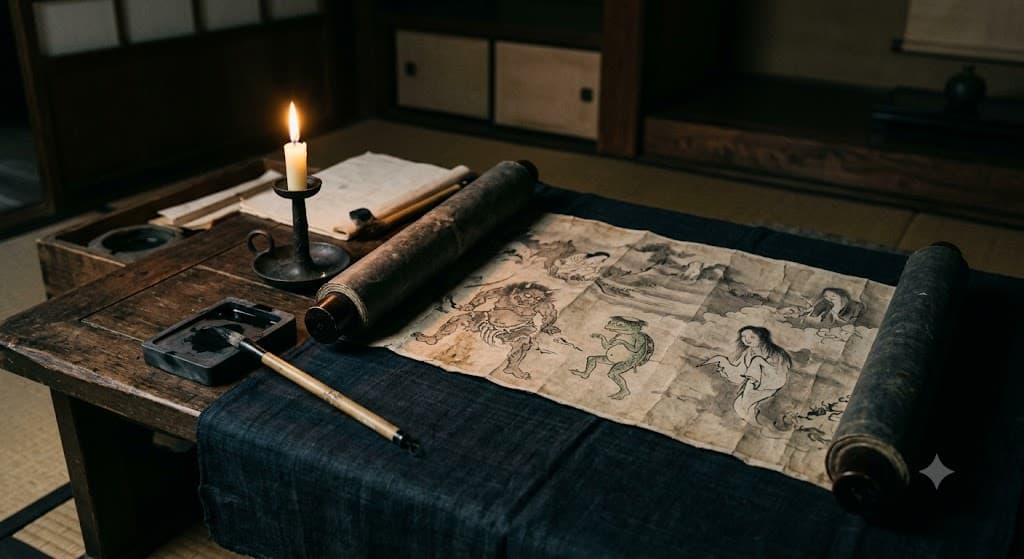
The first time I met a 死神(Shinigami: a death god) as a child, it was not a towering figure of doom. It was one face in a crowd. In the manga and anime I read in downtown Tokyo, the death god turned up inside stories already packed with 妖怪(Yōkai: supernatural monsters) and shape-shifting spirits, and it was drawn as just another member of that menagerie — not the world's single, terrifying overlord of death, but a monster among monsters. To my young mind a shinigami felt light, almost casual, the sort of thing you might bump into alongside a goblin or a talking fox.
 In the older Japanese imagination, the shinigami was just one creature among a crowd of yokai, not a single ruler of death.
That impression is exactly why Ryuk landed the way he did. I came to Death Note braced for something solemn, and instead the whole story is set in motion by a bored death god who drops his notebook into the human world simply because eternity in the death gods' realm had grown dull. He turns out to be obsessed with apples. He hangs around making wry comments. He is whimsical and faintly ridiculous in a way that has far more in common with the mischievous spirits of old Japanese folktales than with anything grave or majestic.
What sharpened the contrast for me came later, watching Western films and dramas. There the death figure is almost always the same: a hooded skeleton in a black robe, a scythe over one shoulder, one absolute being who is death itself. Set that beside the loose, slippery, half-comic shinigami I grew up with, and the two barely look like relatives. The same word, "death god," conjures two completely different pictures. That gap is the real subject here — and the history behind it is stranger than the fiction.
Related: Death Note and Japan's Shadow-Justice Tradition: Why Light Yagami Echoes the 必殺仕事人 Executioners explains this in detail.
A Death God Stitched Together in the Edo Period
The Word That Barely Existed
 The recognizable shinigami was assembled on Edo and Meiji stages — puppet theater, kabuki, and rakugo — rather than handed down from old myth.
The first surprise is how recent the shinigami is. Older Japanese tradition did not really hand death to a single, named "death god." Figures such as イザナミ(Izanami: a creator goddess of Japanese myth) from myth, or Enma, the king of the underworld, were sometimes treated as death deities, and the Western idea of a death god was often felt to be different from anything Japan had — or simply absent. The word itself is a latecomer: in the Japanese classics the name "shinigami" was not common, and references are scarce; it is only from the Edo period that the term starts to appear, in 近松門左衛門(Chikamatsu Monzaemon: a leading Edo-period playwright)'s love-suicide puppet plays and in old books.
So while 閻魔(Enma: the Buddhist king of hell) had been a fixture in the Japanese mind for centuries, the shinigami as a word and a character was still being assembled relatively late in the day — and on the entertainment stage, not the temple altar.
Related: Why Does a Ghost Cling to the Spot Where It Died in Bleach? Roadside Flowers and the Folklore of the Jibakurei explains this in detail.
Born on the Stage and in the Puppet Theater
This is the part that genuinely changed how I see the figure. The shinigami did not climb down from heaven; it was written into being by performers. In Edo-period 浄瑠璃(Jōruri: chanted narrative puppet theater) and the writing of the time, the death-spirit appears bound up with 心中(Shinjū: lovers' double suicide) — a spirit that fastens onto a person and pulls them toward death. An 1850 essay collection describes a shinigami-possessed courtesan luring a man into a love-suicide, and a Kabuki play staged in 1886 imagines a death-spirit entering a person's thoughts so that he dwells on his own crimes and is seized by the urge to die. In other words, this early shinigami was less a god than a haunting. These versions are understood as closer to a ghost or evil spirit than to a deity.
Then there is the detail I find almost too good to be true. One of the most famous shinigami in Japanese popular culture comes from a single piece of 落語(Rakugo: traditional comic storytelling), and that piece is not even homegrown. The classic rakugo "Shinigami" was created in the Meiji 20s by the first 三遊亭圓朝(Sanyūtei Enchō: a celebrated Meiji-era rakugo storyteller), who adapted a European death tale — most likely passed to him by 福地桜痴(Fukuchi Ōchi: a Meiji-era writer and dramatist) — with the source usually identified as the Grimm fairy tale "Godfather Death" or the Ricci brothers' opera "Crispino e la comare." Enchō reworked that European story into the world of Edo tenements and merchant houses, and the result became one of the best-loved comic ghost stories in the repertoire. The "traditional" Japanese death god, in this telling, has a European grandparent.
The Buddhist Layer and the Skeleton from the West
Underneath the stage figure runs a Buddhist current. Buddhism supplies a death-demon of its own: there is the concept of a "death-demon" that makes a person long to die, a scripture describing a demon that fixes the time of a being's death, and a tradition in which Enma and the ox-headed and horse-headed demons beneath him are counted among death's agents. Add the steady hum of 無常(Mujō: Buddhist impermanence) — the sense that everything is passing — and you have the spiritual soil the shinigami grew in.
The skeleton and scythe most people now picture, though, are an import. It was after the war, when the Western notion of a death god flowed into Japan, that the shinigami came to be told as a personified being and began appearing across television dramas, manga, and games. The modern shinigami is therefore a composite: a Buddhist undertone, an Edo stage-spirit, and a borrowed Western silhouette, all fused into one.
Why Ryuk Is Not the Reaper — and Not Faust Either
To see what makes the shinigami its own thing, it helps to know what the Grim Reaper actually is. The hooded skeleton with a scythe is Western culture's personification of Death, a composite image that grew out of the 14th-century Black Death and the Danse Macabre tradition that followed, with the English name "Grim Reaper" itself not appearing in print until the 1840s. The scythe is an agricultural symbol — the harvesting of human souls in great numbers — and the reaper is, at heart, a soul collector. Western imagination then layered a second transaction on top: the soul one bargains away, the Faustian deal in which a person trades their soul for power. Harvest, or bargain — either way, the soul is the currency.
This is precisely the assumption Ryuk demolishes in his first conversation with Light. When Light braces himself and asks whether his soul is now forfeit, Ryuk treats the question as a quaint human delusion and tells him, in effect, that he is going to do nothing of the kind. There is no harvest and no bargain. The notebook, once it falls, simply belongs to the human world — and therefore to whoever picks it up. There is no price beyond the fear and unease the user carries, and a destination after death that is neither the Christian heaven nor hell.
That single shrug is the whole thesis in miniature. The Western death figure deals in souls; the Japanese one, as Ryuk embodies it, does not bother. He is a being who finds humans interesting, who would rather watch than judge, closer in spirit to a capricious old spirit than to a cosmic harvester. Strip away the borrowed skeleton-and-feathers look, and what is left is something much older and much more Japanese: a death god who is, frankly, in it for the entertainment.
What the Reaper Lost in Translation
Living outside Japan for many years has made the contrast impossible to miss. In the films and shows around me, the death figure is rigid — the same robe, the same scythe, the same single grim entity, every time. The Japanese shinigami never settled into one fixed costume or one fixed job, and that looseness now reads to me as a feature, not a flaw. Japan's shinigami arrived in folklore relatively late and then multiplied through manga, and that very lateness is why they could stay so flexible: there was no thousand-year-old image to obey.
 The fixed, scythe-wielding Western reaper looks nothing like the loose, whimsical Japanese shinigami it is often translated as.
What I also notice, from a distance, is that the death god was never the figure that actually disciplined me as a child. The beings invoked to keep a Japanese kid in line were different ones entirely. The threat I heard was that 閻魔(Enma: the king of Buddhist hell) would pull out the tongue of a child who told lies, and that the ancestors were always watching, so I had better not shame them. Death, in that upbringing, was less about someone coming to collect me and more about being judged afterward and watched always. A lone reaper arriving with a scythe simply was not part of the furniture.
That, I think, is what gets lost when "shinigami" is rendered as "Grim Reaper" in a subtitle. The English word drags in a whole Christian-medieval backstory — the harvest, the equalizing skeleton, the soul as cargo — and quietly overwrites a figure that came from puppet stages, comic monologues, and Buddhist impermanence. Ryuk dropping a notebook because he was bored is not a quirk of one manga. It is the long memory of a folklore tradition that never decided death needed to be solemn.
FAQ
Q: Is the shinigami an ancient Japanese god like the 神(kami: a Shinto deity) of 神道(Shinto: Japan's indigenous religion)?
A: No. Unlike the old Shinto deities, the shinigami is a relatively late arrival whose name only becomes common from the Edo period. Death itself was long handled by figures like Enma or by Buddhist ideas of judgment and impermanence, rather than by a single named "death god."
Q: What is the real difference between a shinigami and the Grim Reaper?
A: The Grim Reaper is the Western personification of Death itself — one fixed skeletal figure who collects or harvests souls. The Japanese shinigami was historically looser and more spirit-like, often just one monster among many, and it does not center on the soul as something to be taken or traded.
Q: Does Ryuk accurately represent traditional Japanese folklore?
A: Ryuk blends the modern manga death god with much older instincts. His whimsy, boredom, and capriciousness echo the mischievous spirits of Japanese folktale, and his refusal to deal in souls fits the tradition far better than a scythe-wielding harvester would.
Key Insights to Remember
- The shinigami is best understood not as an inherited myth but as a cultural assembly — a Buddhist sense of impermanence and judgment, an Edo stage-spirit tied to love-suicide, and a Western skeletal silhouette adopted only after the war. Calling it "ancient" mistakes a recent composite for something timeless.
- The single most telling moment in Death Note's setup is Ryuk's dismissal of the soul. Western death and demonic figures run on souls — harvested by the reaper, bargained for by the devil — while the Japanese death god, as Ryuk plays it, finds the whole transaction beside the point. The difference is theological, not just aesthetic.
- Translation flattens this. Rendering shinigami as "Grim Reaper" imports a medieval Christian backstory and erases the playful, spirit-like, judgment-and-watching framework that actually shaped how death was imagined in Japan. The fun of Ryuk is not a writer's invention so much as a tradition refusing to take death seriously.
Sources & References
About the author

Spoiler-free cultural deep-dives into anime, manga & live-action Japanese drama
- ●Tokyo-born, 3rd-generation Edokko (江戸っ子)
- ●Lifelong manga reader & anime viewer since the kaiju era
- ●Writes from outside Japan — distance as a cultural lens
- ●Spoiler-free · sourced · Kanji + Romaji + English
A Tokyo-born, 3rd-generation Edokko writer who has spent years living outside Japan. I use the anime, manga, and live-action Japanese drama you already love as a doorway into the folklore, language, religion, and everyday history behind them — written so even first-time fans can follow along, with sources for every claim.
Enjoy this article?
Get the next spoiler-free cultural deep-dive straight to your inbox.
Related Articles
Spirited Away and Kamikakushi: The Folklore Behind the Title
Spirited Away's Japanese title ends in kamikakushi. Learn who villages said took children away, why dusk was the dangerous hour, and how they searched for them.
10/25/2026
Fruits Basket and the Zodiac Cat: The Real Japanese Folktale of the Cat Who Missed the Banquet
How Fruits Basket builds its outsider cat on the real Japanese folktale of the rat tricking the cat out of the zodiac, and what eto still means in Japan today.
10/20/2026

March Comes in Like a Lion and Tsukimi: Why Japan Watches the Moon With Rice Dumplings and Pampas Grass
How March Comes in Like a Lion opens onto tsukimi, Japan's moon-viewing harvest observance, and why dumplings, pampas grass and a shifting date belong to it.
8/17/2026

Summer Time Rendering and the Shoryo-uma: The Cucumber Horse That Carries the Dead Home
How Summer Time Rendering's Obon homecoming opens onto shoryo-uma, the cucumber horse for returning ancestors, and why it is only one of many regional forms.
8/16/2026

GeGeGe no Kitaro and Hyakumonogatari: Why Japan Saves Its Ghost Stories for Summer
How GeGeGe no Kitaro connects to hyakumonogatari, the hundred-candle ghost game, and the Edo custom of staging horror in summer to chill the audience.
8/11/2026

Demon Slayer Infinity Castle and the Biwa: Heike and Hōichi
How the biwa that opens Demon Slayer's Infinity Castle leads to blind Heike reciters and Hōichi, who played night after night for a court that was not there.
8/7/2026