Bleach and the Jibakurei: Ghosts Tied to Where They Died
How Bleach's quiet opening scene dramatizes the jibakurei — the spirit bound to where it died — and Japan's living custom of leaving roadside flowers for the dead.

Tokyo-born, 3rd-generation Edokko · writing on Japanese culture from outside Japan
Spoiler-Free Cultural Analysis
This piece looks only at the opening moments of the first episode of Bleach — the brief, quiet scene of flowers left for a child who died at a certain spot — and the real Japanese folklore that stands behind it. There are no plot revelations here, only atmosphere, belief, and the history that shaped that single cut.
Key Takeaways
- Japanese folklore recognizes a kind of ghost that travels nowhere after death and instead stays fixed to the exact place it died — the jibakurei — which is a distinct idea from crossing a river to the afterlife or being led away by a death-figure.
- The custom of laying flowers at the site of a fatal accident, still very much alive on Japanese roadsides, quietly treats the place of death itself as where the dead person lingers, separate from the grave or the family altar.
- Both ideas rest on the same emotional logic: a spirit held back by unfinished feeling cannot move on, and helping settle that feeling is what finally lets it go.
Key Terms Explained
- 地縛霊 (Jibakurei) / Place-Bound Spirit — A ghost tied to the specific spot where it died, unable or unwilling to leave that ground.
- 献花 (Kenka) / Offering of Flowers — The act of laying flowers for the dead, including at the roadside where a fatal accident happened.
- 未練 (Miren) / Lingering Attachment — Unfinished feeling, regret, or reluctance to let go that keeps a spirit tethered to this world.
- 成仏 (Jōbutsu) / Passing On — In Buddhist terms, a soul settling and moving beyond this world; the release that a lingering spirit has not yet reached.
Fresh Flowers at the Foot of a Utility Pole
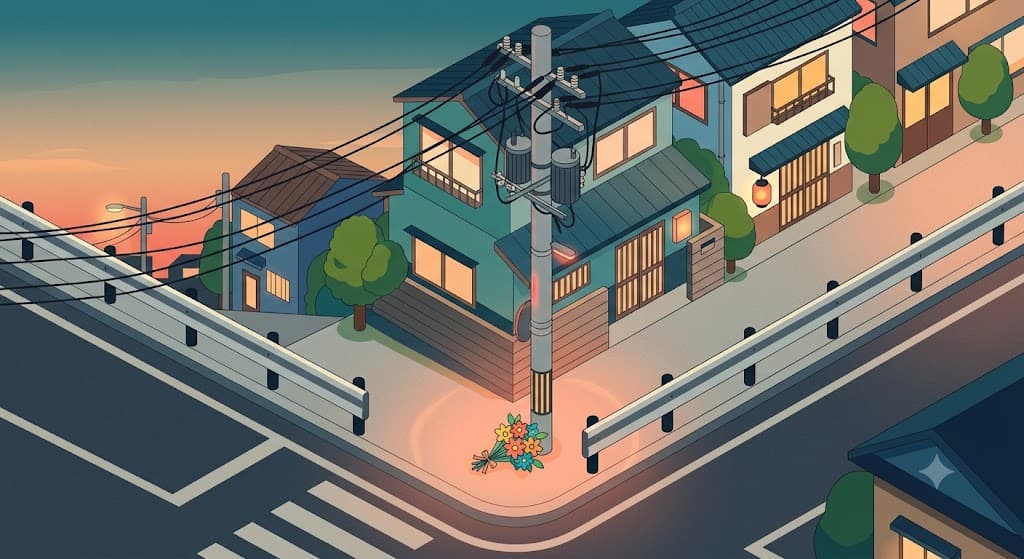
The scene that opens Bleach is small and almost domestic before anything supernatural happens. A young man tells off some skateboarders who have knocked over a vase of flowers — flowers set out for a child who died at that spot not long before. He promises to bring fresh ones, and a small spirit thanks him and says that now she can finally rest. Nothing about it is loud. And yet, watching it, something very old in me recognized the setup instantly.
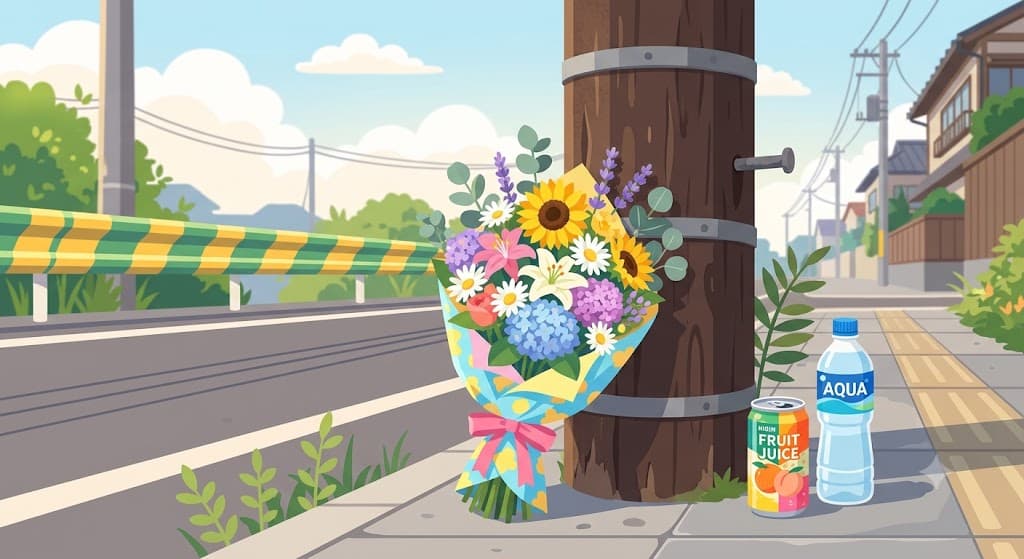 Roadside flowers marking the spot of a fatal accident, tended and replaced over time.
When I was a child walking the streets of my neighborhood, I would sometimes come across flowers left at the site of a traffic accident. They would be tucked against the base of a utility pole, or set by the edge of a guardrail, usually with a can of juice or a plastic bottle of water beside them. After a while the wilted flowers would be gone and fresh ones would be there in their place. I never saw who tended them, but I understood, without anyone spelling it out, that someone had died there.
No adult ever told me to press my hands together in front of those flowers, and no one told me to stay away either. Still, without being instructed, I would go quiet at that one stretch of pavement and walk past a little faster. The sense that you did not fool around there, that this small patch of ground was somehow set apart, reached me before it ever became words. A great deal of the Japanese feeling toward the dead is absorbed exactly this way — not taught as a rule, but soaked up until it sits in the body.
That childhood reflex is the same instinct the Bleach scene is built on. The flowers are not at a grave. They are at the place where a life ended. And the story treats that place as somewhere the dead person is still present — still able to be thanked, still able to be let go.
Related: Death Note and the Japanese Shinigami: Why Ryuk Is Not the Grim Reaper explains this in detail.
A Ghost That Goes Nowhere
Popular Japanese ideas about death tend to imagine some kind of journey. There is 三途の川(Sanzu no Kawa: the river the dead are said to cross into the next world), a boundary you pass over and do not return from. There is the figure who comes to lead a soul away — the 死神(Shinigami: a death-spirit or reaper) at the center of Bleach itself. Both of these picture death as movement: away from here, toward somewhere else.
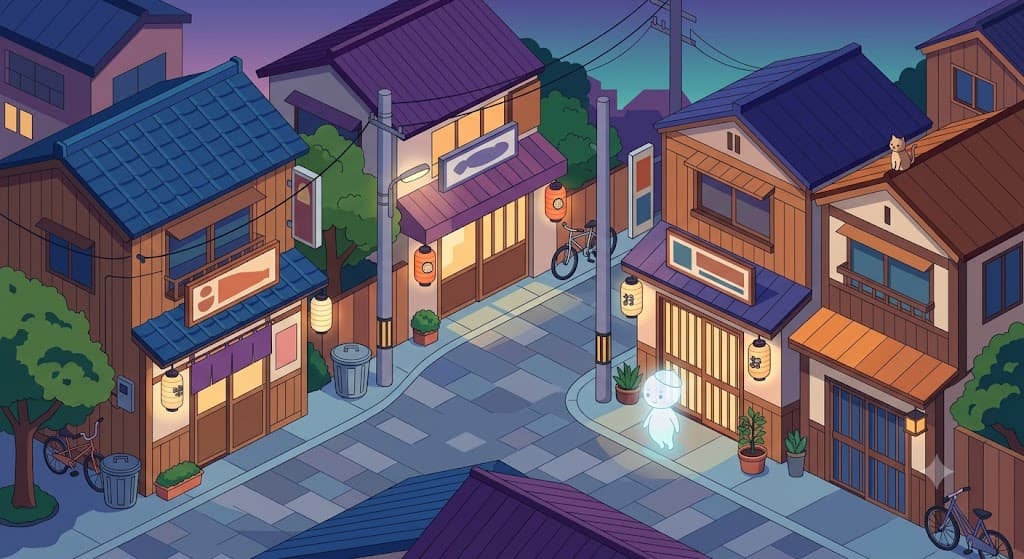 The jibakurei stays put — bound not to a person or object, but to the ground where a life ended.
The jibakurei is the quiet exception to all of that.
Related: Yu Yu Hakusho and the River Sanzu: The Ferry-Toll, the Stripping Crone, and the Three Crossings of the Dead explains this in detail.
The Spirit That Stays Put
A jibakurei does not cross a river and is not led anywhere. It stays. The word itself carries the image — a spirit bound to the ground, fastened to one location rather than to a person or an object. Where a family ancestor is remembered through the grave and the household altar, and where a vengeful spirit might follow the one it hates, the jibakurei belongs to a place. Whatever happened there holds it there.
I should be honest that I did not learn this from any temple or scripture. I learned the term the way most people my age did: from the ghost programs and 怪談(Kaidan: traditional ghost stories) that Japanese television runs every summer. Year after year those shows returned to the same premise — a spirit remaining at the scene of an accident or a tragedy, unable to leave — and the word jibakurei lodged itself in me long before I ever thought about what it meant. It was frightening, and I watched it anyway, the way you do with a summer ritual.
Held Back by Miren
What actually pins a spirit to a spot, in this way of thinking, is 未練(Miren: lingering attachment). Miren is the feeling of not being finished — a regret, a worry, an attachment strong enough that a person cannot simply release the world and move on.
The counterpart to miren is 成仏(Jōbutsu: passing on, or in strict Buddhist language, attaining Buddhahood after death). To reach jōbutsu is for the soul to settle and pass beyond this world. A spirit full of miren has not settled; it cannot pass. This is why sudden, violent, or premature deaths loom so large in Japanese ghost lore. Someone who dies with no warning — a child struck down on an ordinary street — is imagined to have the most unfinished feeling of all, and so the most reason to remain.
That is the whole emotional shape of the Bleach opening compressed into a few seconds. The spirit lingers because something is unresolved. When a stranger promises to keep her flowers fresh, the small thing she was waiting for is answered, and only then can she pass on. The drama is not exorcism by force. It is the quieting of an attachment.
Flowers Laid Where Someone Fell
This is where the folklore reaches straight out of the screen and onto a real street corner. The custom of kenka, offering flowers, is not confined to graves in Japan. People lay flowers at the exact place a person died — the roadside, the crossing, the foot of the pole. The grave is where the body and the ancestors are honored; the accident site is treated as though the dead one is, in some sense, still there, at the last place they stood.
Seen through the jibakurei idea, this stops looking like mere sentiment and starts looking like care directed at a specific spirit in a specific place. You stop, you offer flowers, you press your hands together — and the gesture says both we have not forgotten you and you can be at peace now. It is the everyday, real-world version of exactly what the Bleach scene stages: tending the place of death so that the one bound there can finally rest.
The Places We Still Stop For
Having lived outside Japan for many years, I notice this custom most clearly by its absence. Where I live now, I rarely see flowers laid at the roadside where someone was killed. It is not that people here grieve less — of course they do not. The forms that grief takes are simply different, and the impulse to mark the ground itself is not shared everywhere in the same way.
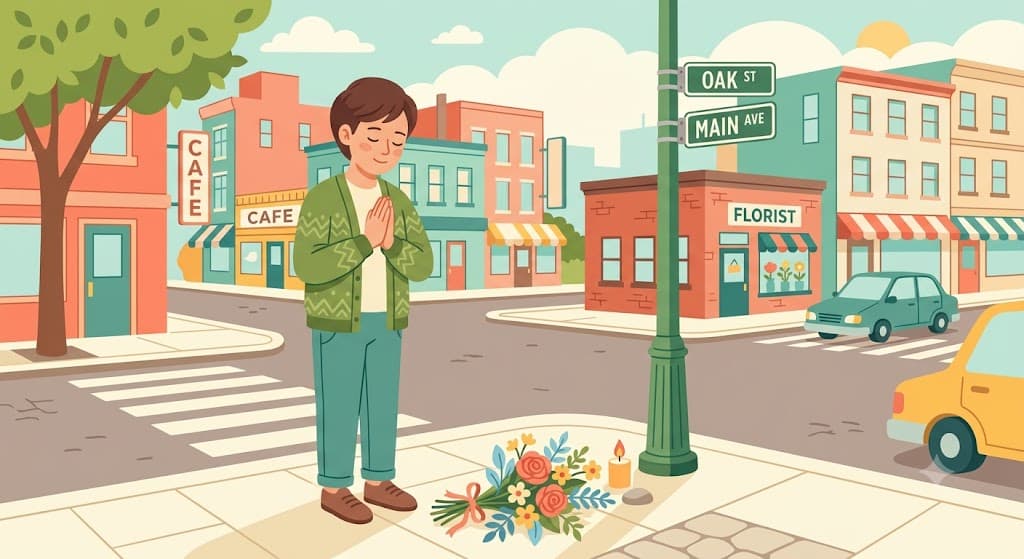 Stopping to press one's hands together at the place of death, a soft custom carried in habit rather than doctrine.
That distance is what made me see the Japanese roadside offering for what it is: an act that quietly assumes the dead may still linger at the place they fell, and that the living have a small, ongoing duty to that place. It is a soft, unspoken belief, carried not in doctrine but in the habit of stopping, of replacing wilted flowers with fresh ones, of walking a little more gently past one patch of pavement.
I find it moving that a story about death-spirits and soul-cutting begins not with a battle but with this. Before Bleach becomes anything else, its very first gesture is a child asking to have her flowers looked after so she can rest — the oldest, gentlest Japanese answer to death, dressed in a new form. And I suspect that habit is quietly thinning even inside Japan, as roads widen and neighborhoods turn over. Which is perhaps why I stop, in memory, at that foot of a utility pole, and pay attention.
FAQ
Q: Is a jibakurei the same as a Western haunted-house ghost?
A: They overlap but are not identical. Both stay in one location, but a jibakurei is defined specifically by being bound to the place of its death through lingering attachment, and the emphasis is on helping it settle and pass on rather than on it menacing the living. The tone is closer to unfinished sorrow than to horror-for-horror's-sake.
Q: Why do Japanese people leave flowers at the exact spot of an accident rather than only at a grave?
A: The grave honors the body and the family's ancestors, while the accident site is felt to be where the person actually lingers, at the last place they lived. Offering flowers there is a way of tending that specific place and easing the spirit toward rest — a gesture separate from, and additional to, visiting the grave.
Q: Does watching the opening scene of Bleach spoil the story?
A: No. The whole small episode of the flowers and the child's spirit resolves within the first moments of the first episode and stands on its own. It introduces the world's tone and its ideas about lingering spirits without giving away anything about where the larger story goes.
Key Insights to Remember
- The Japanese imagination holds several very different pictures of death at once — a river to cross, a reaper who leads you away, and a spirit that stays exactly where it fell. The jibakurei is the one that goes nowhere, and it is the one the Bleach opening quietly chooses, which is why the scene turns on tending a place rather than making a journey.
- The mechanism behind a place-bound spirit is emotional, not merely spooky. Miren, unfinished feeling, is what holds a soul; jōbutsu, passing on, is the release. Resolving the attachment — even by something as small as a promise about flowers — is what allows the spirit to move on, and that logic runs through much of Japanese ghost storytelling.
- The roadside flowers still appearing on Japanese streets are the living continuation of the same belief a fantasy anime borrows. Fiction and folk custom are not two separate worlds here; the anime is dramatizing a real gesture that ordinary people quietly perform, and seeing one illuminates the other.
Sources & References
- Onryō — Wikipedia
- Goryō — Wikipedia
- Roadside memorial — Wikipedia
- Encyclopedia of Shinto — Kokugakuin University
About the author

Spoiler-free cultural deep-dives into anime, manga & live-action Japanese drama
- ●Tokyo-born, 3rd-generation Edokko (江戸っ子)
- ●Lifelong manga reader & anime viewer since the kaiju era
- ●Writes from outside Japan — distance as a cultural lens
- ●Spoiler-free · sourced · Kanji + Romaji + English
A Tokyo-born, 3rd-generation Edokko writer who has spent years living outside Japan. I use the anime, manga, and live-action Japanese drama you already love as a doorway into the folklore, language, religion, and everyday history behind them — written so even first-time fans can follow along, with sources for every claim.
Enjoy this article?
Get the next spoiler-free cultural deep-dive straight to your inbox.
Related Articles
Spirited Away and Kamikakushi: The Folklore Behind the Title
Spirited Away's Japanese title ends in kamikakushi. Learn who villages said took children away, why dusk was the dangerous hour, and how they searched for them.
10/25/2026
Fruits Basket and the Zodiac Cat: The Real Japanese Folktale of the Cat Who Missed the Banquet
How Fruits Basket builds its outsider cat on the real Japanese folktale of the rat tricking the cat out of the zodiac, and what eto still means in Japan today.
10/20/2026

March Comes in Like a Lion and Tsukimi: Why Japan Watches the Moon With Rice Dumplings and Pampas Grass
How March Comes in Like a Lion opens onto tsukimi, Japan's moon-viewing harvest observance, and why dumplings, pampas grass and a shifting date belong to it.
8/17/2026

Summer Time Rendering and the Shoryo-uma: The Cucumber Horse That Carries the Dead Home
How Summer Time Rendering's Obon homecoming opens onto shoryo-uma, the cucumber horse for returning ancestors, and why it is only one of many regional forms.
8/16/2026

GeGeGe no Kitaro and Hyakumonogatari: Why Japan Saves Its Ghost Stories for Summer
How GeGeGe no Kitaro connects to hyakumonogatari, the hundred-candle ghost game, and the Edo custom of staging horror in summer to chill the audience.
8/11/2026

Demon Slayer Infinity Castle and the Biwa: Heike and Hōichi
How the biwa that opens Demon Slayer's Infinity Castle leads to blind Heike reciters and Hōichi, who played night after night for a court that was not there.
8/7/2026