Kuroko's Basketball and the Kurogo: How a Black-Clad Stagehand Became the Phantom Sixth Man
How Kuroko's Basketball builds its phantom sixth man on kurogo, the kabuki and bunraku stagehand who stands in full view yet is treated as unseen.

Tokyo-born, 3rd-generation Edokko · writing on Japanese culture from outside Japan
Spoiler-Free Cultural Analysis
This article looks at the real theatrical convention hiding inside a character's surname — the black-clad stage assistant of classical Japanese theater — and what it tells us about a uniquely Japanese idea of presence and absence. It discusses only the themes and atmosphere set up in the opening of Kuroko's Basketball, all of which the first episode itself lays on the table; there are no later plot revelations here.
Key Takeaways
- The protagonist's surname is not a random name — it is the literal word for a stagehand in classical Japanese theater, a figure who stands on stage in full view while everyone agrees to treat him as invisible.
- Both 歌舞伎(Kabuki: classical Japanese theater) and 文楽 (Bunraku) puppet theater run on the same tacit rule: the color black is understood to mean "this person is not here," which lets assistants and puppeteers operate in plain sight.
- Western stagecraft tends to hide the crew in darkness and in the wings; classical Japanese theater does the opposite — it puts the helper where you can see him and asks the audience to perform the act of not-seeing.
Key Terms Explained
- 黒衣 (Kurogo) / Black-Clad Stage Assistant — A stagehand in kabuki and bunraku dressed head to toe in black, understood by convention to be invisible to the audience.
- 黒子 (Kuroko) / The Same Stage Assistant, Read Differently — An alternate writing and reading of the same role; it is also, with the same characters, the surname of the protagonist of Kuroko's Basketball.
- 文楽 (Bunraku) / Traditional Puppet Theater — A classical form in which large puppets are brought to life by puppeteers who are physically visible on stage.
- 約束事 (Yakusokugoto) / Tacit Convention — A shared rule agreed between performer and audience; here, the agreement to treat a black-clad figure as if he were not there.
- 後見 (Kōken) / Noh Stage Attendant — The equivalent supporting figure in 能 (Noh) theater, who works in black but unmasked.
The Black Figure Standing Right Next to the Actor
When I was a child watching 時代劇(Jidaigeki: period drama) and stage broadcasts on television, I would sometimes notice a person wrapped entirely in black standing right beside the actors. As a kid it puzzled me. What was that black figure, and why did everyone behave as though they could not see him? He was clearly there, moving, handing things over, and yet the world of the play simply flowed around him as if he occupied no space at all.
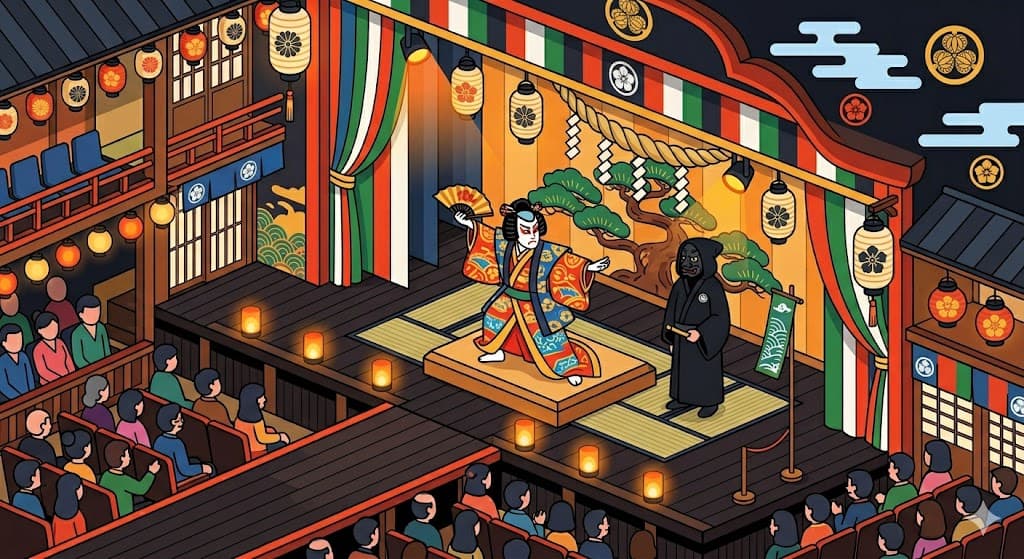
 A kurogo stands in full view beside the actor, present on stage yet treated as invisible by the audience.
Only later did I learn that this was the 黒衣(Kurogo: a black-clad stage assistant), a backstage worker who stands openly on the stage under a shared agreement that the audience will treat him as if he does not exist. He is not hidden. He is in the light, in the frame, sometimes inches from the lead. The trick is not concealment but consent: everyone in the theater has quietly agreed to look past him.
That childhood confusion came rushing back the first time I sat down with the opening of Kuroko's Basketball. The hero's surname, 黒子(Kuroko), is written with the very characters used for that invisible stagehand. The first episode wastes no time spelling out what kind of player he is — a "phantom" sixth man whom teammates somehow fail to register, a presence so faint that people standing in front of him forget he is there, and a style built on drawing the opponent's attention elsewhere. The character is not merely named after the technique. He is constructed on top of it.
The Convention That Lets Someone Disappear in Plain Sight
Dressed in Black to Be Treated as Nothing
In kabuki, the kurogo handles the kind of work a Western running crew would do — moving props and scenery, assisting with the lightning-fast costume changes the form is famous for, and timing every motion to the actor so that his own effort seems to vanish. Sometimes he even "plays" an animal or a will-o'-the-wisp by holding a prop, his own body simply not counted. The rule underneath all of this is blunt and elegant at once: black means invisible. Because the audience has accepted that black equals "not here," the man in black can do almost anything in the open.
The convention is flexible, too. When a scene is set in a snowstorm the assistant wears white and is called 雪衣(Yukigo: a snow-colored stage assistant); for a scene at sea he wears pale blue as 波衣(Namigo: a wave-colored stage assistant). The principle never changes — only the camouflage that the agreed-upon blindness is dressed in. 能 (Noh) theater has its own version, the 後見(Kōken: a Noh stage attendant), who works in black without a mask. Across the classical stage, in other words, there is a whole grammar for being present and uncounted at the same time.
Bunraku and the Puppeteers You Train Yourself Not to See
Nowhere is this clearer than in 文楽(Bunraku: traditional Japanese puppet theater). A single main puppet is brought to life by three people working as one: the 主遣い(Omozukai: the lead puppeteer) controls the head and right hand, a second operator works the left hand, and a third manages the feet. This three-person method was a 大阪(Osaka: Japan's western metropolis) innovation introduced in 1734, and mastering it can take a decade of apprenticeship on each role before one is trusted with the head.
 In bunraku, three operators work one puppet in plain sight while the audience learns to see only the doll.
Here is the astonishing part. The puppeteers are not hidden at all. Two of them are hooded in black, while the lead is often uncovered, dressed in formal crested robes, his face fully exposed — a style called 出遣い(Dezukai: visible-style puppeteering). Three grown adults cluster around a half-life-size doll in full view of the hall, and yet within minutes the audience stops seeing them and sees only the puppet breathing, weeping, hesitating. The watcher does the work of erasing the operators. The art depends on that cooperation. A first-time viewer is startled by three people on one puppet; a seasoned one no longer registers them at all.
The Aesthetic of Presence and Absence
What ties the kurogo and the puppeteer together is an idea that runs deep in Japanese performance: 在/不在(Zai / Fuzai: presence and absence) are not opposites to be kept apart but states that can occupy the same body at the same time. The man in black is fully present and formally absent. The puppeteer's hand is the source of every gesture and is counted as nothing. This is not a flaw the theater apologizes for; it is the load-bearing idea of the whole structure.
It is worth noticing how comfortable this is for an audience raised on it. Long before I had any vocabulary for theater, I had already absorbed, as a child, the lesson that something visible could be agreed into nonexistence. That is a strange and specific kind of literacy, and the opening of Kuroko's Basketball is, in effect, written for people who possess it.
Hiding the Crew vs. Agreeing Not to See
The contrast with Western stagecraft is sharp and instructive. In the Western tradition, the crew is genuinely concealed — they move sets in the dark between scenes, stay in the wings, dress in black so the shadows swallow them. The goal is for the helper to be literally unseen. Japanese classical theater chose the opposite solution to the same problem: it places the helper squarely in the light and asks the audience to supply the invisibility themselves.
That difference is the whole reason the character's name lands the way it does. A "phantom" player who disappears from his opponents' awareness while standing right in front of them is not a fantasy invented for a sports story. He is the kurogo, walked off the stage and onto the court — a figure whose technique is not to hide, but to be looked past while drawing every eye elsewhere.
What "Not Seeing" Still Asks of Us
Across many years of IT and web work, and later in AI development, I have often found myself in the kurogo's role: arranging the mechanism, organizing the order of things, while the client or the person out front took the visible credit. I came to feel a quiet satisfaction in running the whole thing from a spot no one was watching. The word for that role was sitting in the language the entire time, and I only recognized it once I started watching the old stage again with adult eyes.
 The convention of looking past the figure in black survives today, carried forward into anime and manga.
Living outside Japan for many years sharpened something else. The Japanese habit of "seeing but agreeing not to see" — looking past someone's small public stumble to protect their dignity, hearing something and treating it as unheard — is far more distinctive than it feels from the inside. Elsewhere, people are quicker to point things out, quicker to step in and help directly. Watching that difference from a distance, I realized that the kurogo is not only a stage device. It is a rehearsal of a social skill: the discipline of granting another person the grace of being unobserved. The theater taught the audience to do on purpose what daily life later asked of them quietly.
There is something a little melancholy in noticing how much of that art now survives mostly inside fiction. Bunraku itself has leaned on public support since the 明治(Meiji: the Meiji era), and most people meet the kurogo not in a theater seat but inside an anime episode. That a sports manga can carry the convention forward — can hand a new generation the experience of a present-yet-unseen figure — is, I think, its own small form of preservation.
FAQ
Q: Is Kuroko's surname really the same word as the stage assistant?
A: Yes. The black-clad theater assistant is written 黒子 or 黒衣 and read kurogo or kuroko, and the protagonist's surname uses the very same characters, 黒子. The name is a direct reference to the role, not a coincidence.
Q: Are kurogo and bunraku puppeteers actually invisible, or just dim?
A: They are fully visible and often well-lit. What makes them "invisible" is convention — the audience has agreed that a figure in black is to be treated as not present. The unseeing is performed by the watcher, not achieved by the lighting.
Q: Does Western theater have anything like the kurogo?
A: It has stage crews, but the logic differs. Western crews are meant to be genuinely hidden in darkness or the wings, whereas the kurogo stands in plain view and relies on a shared agreement to be looked past. That reversal is what makes the Japanese version culturally distinctive.
Key Insights to Remember
- The kurogo embodies a rule that sounds like a paradox but works perfectly in practice: a person can be physically present and formally absent at once. A story that names its hero after this figure is borrowing centuries of stagecraft to make a "phantom" feel natural rather than supernatural.
- Bunraku reveals that invisibility on the Japanese stage is a collaboration. The puppeteers do not vanish; the audience erases them. That shared labor between performer and watcher is the quiet engine of the whole tradition, and it explains why a "present-yet-unseen" character reads as elegant rather than absurd to a Japanese audience.
- The deepest layer is social, not theatrical. The convention of agreeing not to see someone — to spare their dignity, to keep a space functioning smoothly — is a habit the classical stage trained into its audiences and that everyday life still draws on. The kurogo is, in the end, a lesson in the courtesy of looking away.
Sources
- Kuroko — Wikipedia
- Kurogo — Production and Music in Kabuki — Invitation to Kabuki, Japan Arts Council
- Puppeteer — Invitation to Bunraku — Japan Arts Council
- The Rich History and Uncertain Future of Bunraku Puppet Theater — Nippon.com
- TRIVIA of Noh Q51: Who is the "overseer" of the stage? — the-noh.com
About the author

Spoiler-free cultural deep-dives into anime, manga & live-action Japanese drama
- ●Tokyo-born, 3rd-generation Edokko (江戸っ子)
- ●Lifelong manga reader & anime viewer since the kaiju era
- ●Writes from outside Japan — distance as a cultural lens
- ●Spoiler-free · sourced · Kanji + Romaji + English
A Tokyo-born, 3rd-generation Edokko writer who has spent years living outside Japan. I use the anime, manga, and live-action Japanese drama you already love as a doorway into the folklore, language, religion, and everyday history behind them — written so even first-time fans can follow along, with sources for every claim.
Enjoy this article?
Get the next spoiler-free cultural deep-dive straight to your inbox.
Related Articles

Frieren: Beyond Journey's End and the Weight of Time: Why the Anime Measures Life in Decades, Not Days
How Frieren: Beyond Journey's End turns the Japanese sense of 無常 (mujō, impermanence) into narrative structure — running its clock in decades so an elf's long life reveals the beauty and worth of our short human ones.
7/27/2026
Cowboy Bebop and the Jazz Kissa: How Japan Turned Listening to Music into a Ritual
How Cowboy Bebop's jazz soundtrack opens a door into the jazu kissa, Japan's silent listening cafés, where hearing a single record became a ritual.
7/13/2026

Blue Lock and the Riddle of Samurai Blue: Why Japan's Football Team Wears Blue When the Flag Is Red
How Blue Lock's blue-drenched world opens onto a real puzzle — why Japan's Samurai Blue football team wears indigo when the national flag holds no blue at all.
7/10/2026

Demon Slayer and Mono no Aware: How Tanjiro's Mother Speaks the Aesthetics of Impermanence
How Demon Slayer dramatizes mono no aware — the mother's weather metaphor in episode one and the Japanese aesthetics of impermanence woven quietly behind it.
7/9/2026
Dandadan and the Ghost of Ken Takakura: Why Japan Adored the Man Who Couldn't Say I Love You
How Dandadan turns a heroine's crush on Ken Takakura into a window onto bukiyō, the Showa ideal that read a man's silence as proof of sincerity.
5/30/2026
The Apothecary Diaries and the Art of Playing Dumb: Why Maomao Hides Her Brilliance
How The Apothecary Diaries dramatizes deru kui wa utareru, the Japanese habit of hiding talent, and why Maomao's playing dumb feels so familiar in Japan.
4/30/2026