Dandadan and the Ghost of Ken Takakura: Why Japan Adored the Man Who Couldn't Say I Love You
How Dandadan turns a heroine's crush on Ken Takakura into a window onto bukiyō, the Showa ideal that read a man's silence as proof of sincerity.

Tokyo-born, 3rd-generation Edokko · writing on Japanese culture from outside Japan
Spoiler-Free Cultural Analysis
This article looks at the real cultural history behind a name that the first episode of Dandadan keeps invoking — the actor 高倉健(Takakura Ken: the legendary postwar film star known in English as Ken Takakura) — and the masculine ideal his image came to stand for. It discusses themes, atmosphere, and the history behind that ideal only, with no plot revelations.
Key Takeaways
- The heroine's longing for a "Ken Takakura type" is not random nostalgia; it points to a whole Shōwa-era model of masculinity in which emotional inarticulacy was read as proof of sincerity rather than as a flaw.
- The Japanese word at the center of this ideal, 不器用(Bukiyō: clumsy or inept), was quietly recoded by Takakura's image into a virtue — a man too honest and too deep to make his feelings glib.
- This way of reading silence depends on a shared cultural code; exported to places where love and gratitude must be said out loud, the same restraint can register not as depth but as coldness.
Key Terms Explained
- 高倉健 (Takakura Ken) / Ken Takakura — A film actor (1931–2014) who became Japan's defining "man of few words," first as a yakuza-film star and later as the face of stoic, tender ordinary men.
- 不器用 (Bukiyō) / Clumsy, Inept — Literally "unskilled with one's hands"; figuratively, someone bad at smoothing things over with words, often used affectionately for a person whose sincerity outruns their eloquence.
- 任侠映画 (Ninkyō Eiga) / Chivalry Films — A genre of stylized yakuza films, hugely popular in 1960s Japan, built on duty, endurance, and honor among outlaws.
- 寡黙 (Kamoku) / Taciturn — Habitually saying little; in the Shōwa ideal, a sign of inner weight rather than emptiness.
- 以心伝心 (Ishin-denshin) / Heart-to-Heart Without Words — The belief that true understanding passes silently between people, so that needing to spell things out can feel like a small failure.
The Neighborhood Men Who Never Said Sorry
Of all of Takakura's films, the ones that stayed with me were never the 任侠映画(ninkyō eiga: chivalry films) where he cut down a roomful of enemies. It was the quieter pictures — Shiawase no Kiiroi Hankachi(幸福の黄色いハンカチ: "The Yellow Handkerchief")and Poppoya(鉄道員: "Railroad Man")— where he played men who said almost nothing but clearly felt everything. He carried their feelings in his back and his silence, not his mouth, and for a long stretch of the 昭和(Shōwa: the era spanning 1926–1989) that was exactly what "manly" meant.
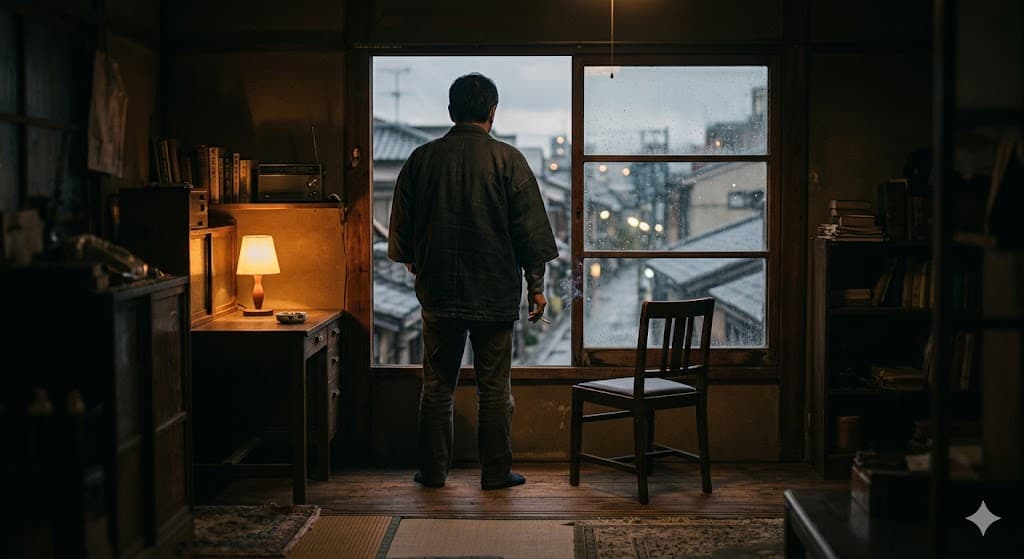
 The silent, hardworking father was a fixture of Shōwa-era family life — affection carried in actions rather than words.
I did not have to go to the cinema to meet that type. There were men like that all around me — the older man down the street, the senior bosses and seniors at the workplaces I passed through, the kind who would almost never say thank you or I was wrong out loud. As a kid and as a young man, I thought that was cool. The withholding looked like strength.
Looking back now, I'm less sure. A lot of those silences cost the men who kept them. Things went unsaid, were misread, and quietly turned into resentment or distance that a single sentence could have prevented. Living outside Japan for many years sharpened that thought into something I can't unsee: the unspoken understanding only works inside Japan. Elsewhere, gratitude, apology, and affection have to be put into words, or they simply do not arrive — and the person who keeps them locked away is read not as deep but as cold. The first episode of Dandadan drops a teenage girl's crush on a "Ken Takakura type" into the middle of all this, and the joke lands precisely because she's mourning a kind of man the world has, supposedly, already buried.
How a Yakuza Star Became the Nation's Quiet Conscience
To understand why a Gen-Z heroine in a 2020s supernatural comedy would pine for a man born in 1931, you have to follow how Takakura's silence changed meaning across his career.
 In the 1960s, Toei's chivalry films filled Japanese screens, turning the brooding, restrained hero into a national archetype.
The Yakuza Years: Endurance as Performance
Takakura made his name at the Toei studio in the 1960s, the decade when 任侠映画(ninkyō eiga: chivalry films) ruled Japanese screens. In series like the Abashiri Prison films and the chivalry pictures, he played the honorable outlaw who absorbs insult after insult in near silence, holding back until the final reel when restraint finally breaks. Western critics reached for the nearest shorthand and called him "Japan's Clint Eastwood," a terse, spring-loaded presence who let the camera do what other actors did with dialogue. The pattern was so fixed that a beautiful woman was usually left waiting in the wings while the hero stayed too busy with duty — or a prison cell — to ever say what he felt. Saying little, here, was not shyness. It was a discipline, almost a moral exercise.
The Pivot to the Ordinary Man
In his mid-forties Takakura left his Toei contract, and the turn that followed is the key to everything. In Shiawase no Kiiroi Hankachi(幸福の黄色いハンカチ), directed by Yamada Yōji in 1977, he played not a gangster but an awkward, ordinary man — someone who could not arrange his own feelings into speech. He poured his own way of living into the role, and the stoic, tender everyman became his lasting image. Eki(駅: "Station," 1981)and later Poppoya(鉄道員, 1999), in which he plays a railwayman wedded to his platform and his duty, cemented it. The violence dropped away; the silence stayed, now pointed at love and grief instead of revenge.
"不器用ですから": A Catchphrase That Became a Creed
The phrase that fused the man and the myth did not come from a film at all. In 1984, a life-insurance commercial cast Takakura as a husband and father who fumbles every attempt at affection — botching small gestures, unable to say the warm thing he obviously means — and closes, roughly, with "I'm a clumsy man, after all… so please, be happy." That single word, 不器用(bukiyō: clumsy), ran through a string of these spots over the rest of the decade until it became his nickname in the public mind. The genius of it was the reframe: clumsiness with words was no longer a deficiency. It was the outward sign of a feeling too large and too honest to be made smooth. When Dandadan's heroine reaches for that exact catchphrase as her benchmark for "a real man," she is quoting, knowingly or not, the most famous emotional alibi in modern Japanese culture.
Why Silence Read as Sincerity
None of this would compute without the interpretive habit underneath it. 以心伝心(ishin-denshin: heart-to-heart understanding without words) treats the deepest communication as something that passes silently, which means a man who explains himself can seem to be trying too hard, even cheapening the feeling. Add 照れ隠し(terekakushi: hiding one's embarrassment), the very Japanese move of masking tenderness with gruffness or a joke, and you get a culture primed to read a 寡黙(kamoku: taciturn) man as full rather than empty. Takakura did not invent this logic; he gave it a face. His image let an entire generation tell itself that the father who never said "I love you," the boss who never said "well done," was not failing to feel — he was feeling too much to speak.
Are Men Like That Really Extinct?
The cleverest thing the first episode of Dandadan does with all this is to have its heroine declare, half-comically, that men like Ken Takakura simply don't exist anymore. That line is itself a small cultural document. It marks a generation that has half-inherited the old ideal — enough to find it attractive — while sensing that the ground beneath it has shifted.
 Younger Japan increasingly values saying things plainly, leaving the strong-silent ideal caught between nostalgia and obsolescence.
I think both the loss and the gain are real. Something genuine is fading: a particular texture in which restraint carried meaning, where a long pause between two people could be trusted to be full. But the cost of that ideal was always borne quietly by the people on the other side of the silence, the ones left to guess. Younger Japan increasingly prizes saying things plainly, and the misunderstandings that the old model bred are part of why.
From a distance, the contrast is starkest. In places where you have to voice your thanks and your love or they don't register, the silent, deep-feeling man doesn't read as noble — he reads as someone who never showed up emotionally. That isn't a verdict on which culture is right. It's a reminder that 不器用(bukiyō) as a virtue is not a law of nature but a local agreement, one that holds only where everyone has agreed to read silence the same way. Dandadan keeps the ghost of Takakura around precisely so it can ask, gently and through comedy, whether that agreement still holds.
FAQ
Q: Who was Ken Takakura, and why does Dandadan keep mentioning him?
A: Ken Takakura (1931–2014) was one of postwar Japan's most beloved actors, famous first for stoic yakuza roles and later for silent, tender ordinary men. Dandadan invokes him as cultural shorthand for an old-fashioned masculine ideal — the strong, quiet man — that the heroine idolizes, which sets up much of the episode's comedy and warmth.
Q: What does bukiyō actually mean?
A: 不器用(bukiyō) literally means "clumsy" or "unskilled with one's hands," but emotionally it describes a person who is bad at expressing feelings smoothly in words. Through Takakura's image it became a backhanded compliment: the bukiyō man is too sincere to be glib, so his awkwardness is taken as proof that the feeling underneath is real.
Q: Is the silent, inarticulate man still considered ideal in Japan today?
A: Less so, and that shift is part of the joke. Younger generations increasingly value clear, spoken communication, and many now see the strong-silent model as a recipe for misunderstanding. The ideal still carries romantic appeal — which is why the heroine craves it — but it is widely felt to be on its way out.
Key Insights to Remember
- The most interesting cultural move here is the recoding of a defect into a virtue. Calling a man 不器用(bukiyō) should be mild criticism, yet Takakura's image flipped it into the highest praise — the implication being that anyone who can express love fluently must not feel it very deeply. That inversion only makes sense inside a specific moral universe.
- Silence as sincerity is not portable. It works because everyone in the room shares the code of 以心伝心(ishin-denshin) and knows how to read a pause. Move that same silence into a culture where affection must be stated, and it stops meaning "depth" and starts meaning "absence." The behavior is identical; only the reading changes.
- A throwaway gag — a teenager calling Takakura-type men "extinct" — can be a sharper record of generational change than any survey. Dandadan uses the gap between an inherited ideal and a heroine who no longer fully believes in it to show, without lecturing, that a culture's definition of a good man is quietly being rewritten.
Sources
About the author

Spoiler-free cultural deep-dives into anime, manga & live-action Japanese drama
- ●Tokyo-born, 3rd-generation Edokko (江戸っ子)
- ●Lifelong manga reader & anime viewer since the kaiju era
- ●Writes from outside Japan — distance as a cultural lens
- ●Spoiler-free · sourced · Kanji + Romaji + English
A Tokyo-born, 3rd-generation Edokko writer who has spent years living outside Japan. I use the anime, manga, and live-action Japanese drama you already love as a doorway into the folklore, language, religion, and everyday history behind them — written so even first-time fans can follow along, with sources for every claim.
Enjoy this article?
Get the next spoiler-free cultural deep-dive straight to your inbox.
Related Articles

Frieren: Beyond Journey's End and the Weight of Time: Why the Anime Measures Life in Decades, Not Days
How Frieren: Beyond Journey's End turns the Japanese sense of 無常 (mujō, impermanence) into narrative structure — running its clock in decades so an elf's long life reveals the beauty and worth of our short human ones.
7/27/2026
Cowboy Bebop and the Jazz Kissa: How Japan Turned Listening to Music into a Ritual
How Cowboy Bebop's jazz soundtrack opens a door into the jazu kissa, Japan's silent listening cafés, where hearing a single record became a ritual.
7/13/2026

Blue Lock and the Riddle of Samurai Blue: Why Japan's Football Team Wears Blue When the Flag Is Red
How Blue Lock's blue-drenched world opens onto a real puzzle — why Japan's Samurai Blue football team wears indigo when the national flag holds no blue at all.
7/10/2026
Demon Slayer and Mono no Aware: How Tanjiro's Mother Speaks the Aesthetics of Impermanence
How Demon Slayer dramatizes mono no aware — the mother's weather metaphor in episode one and the Japanese aesthetics of impermanence woven quietly behind it.
7/9/2026
Kuroko's Basketball and the Kurogo: How a Black-Clad Stagehand Became the Phantom Sixth Man
How Kuroko's Basketball builds its phantom sixth man on kurogo, the kabuki and bunraku stagehand who stands in full view yet is treated as unseen.
6/4/2026
The Apothecary Diaries and the Art of Playing Dumb: Why Maomao Hides Her Brilliance
How The Apothecary Diaries dramatizes deru kui wa utareru, the Japanese habit of hiding talent, and why Maomao's playing dumb feels so familiar in Japan.
4/30/2026