Demon Slayer and Mono no Aware: How Tanjiro's Mother Speaks the Aesthetics of Impermanence
How Demon Slayer dramatizes mono no aware — the mother's weather metaphor in episode one and the Japanese aesthetics of impermanence woven quietly behind it.

Tokyo-born, 3rd-generation Edokko · writing on Japanese culture from outside Japan
Spoiler-Free Cultural Analysis
This article looks only at the atmosphere and worldview voiced in a single quiet moment near the start of Demon Slayer: Kimetsu no Yaiba's first episode — a mother's short reflection on happiness and change — and the centuries of Japanese aesthetics standing behind it. There are no plot revelations here, only the cultural roots of one line of dialogue.
Key Takeaways
- The mother's brief monologue about life being "like the weather" is not a throwaway line; it channels 無常 (Mujō: impermanence), one of the oldest ideas in Japanese thought, in the plain speech of an ordinary parent.
- The habit of describing a human life through seasons and weather — sunshine that won't last, snow that will melt — descends directly from classical 和歌 (Waka: classical Japanese poetry) and the war chronicle Heike Monogatari, giving the scene a lineage most overseas viewers never see.
- Japanese storytelling often finds beauty precisely in what is about to disappear, an attitude named もののあはれ (Mono no Aware: the pathos of passing things), and Demon Slayer opens by placing that sensibility in the mouth of a mother rather than a philosopher.
Key Terms Explained
- 無常 (Mujō) / Impermanence — The Buddhist idea that nothing lasts; all things arise, change, and pass away. The bedrock of the Japanese sense that happiness is on loan.
- もののあはれ (Mono no Aware) / The Pathos of Things — A gentle, aching awareness that beautiful things are fleeting, and that their fleetingness is part of their beauty.
- 諸行無常 (Shogyō Mujō) / All Things Are Impermanent — The famous opening phrase of Heike Monogatari, learned by generations of Japanese schoolchildren.
- 盛者必衰 (Jōsha Hissui) / The Mighty Must Fall — The companion idea that those who flourish will inevitably decline; prosperity contains its own ending.
- 花 (Hana) / Cherry Blossom — In Japanese aesthetics, the supreme emblem of transient beauty: adored not despite its short life, but because of it.
Petals That Were Already Leaving When I Noticed Them
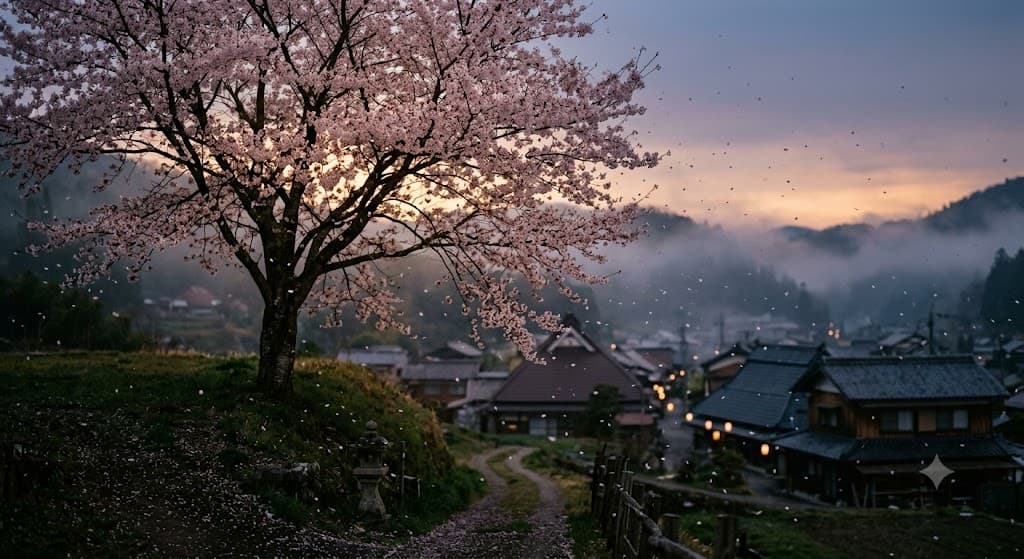
The first time I understood, in my body rather than my head, that happiness does not stay, I was a child watching cherry blossoms come apart in the wind. In Tokyo the blossoms hold on for only a handful of days. One afternoon the trees are heavy and pink, and by the next strong gust the petals are already loosening and drifting down onto the pavement. I remember standing there, admiring how full the branches looked, and realizing almost in the same breath that the show was nearly over. Nobody had to explain 無常 (Mujō: impermanence) to me — the falling petals said it before I had any word for it.
 Falling cherry blossoms hold on only a handful of days — an early, wordless lesson in impermanence.
Years later, in a school classroom, I met that same feeling in language. We were made to read aloud and memorize the opening of 平家物語 (Heike Monogatari: The Tale of the Heike) — "the sound of the Gion Shōja bells echoes the impermanence of all things... the proud do not endure." I did not grasp the weight of it then. I only felt the rhythm, and it stuck; even now the passage comes out of my mouth on its own. And on the level of ordinary speech, I grew up with weather-shaped proverbs about life's ups and downs — the sort that reassure you that today's bad luck will shift, because tomorrow brings its own wind. Watching Tanjiro's mother speak, decades later, I recognized all three of these at once: the falling petal, the recited chronicle, and the everyday proverb, folded into a few plain sentences a parent might really say.
She tells her children, in effect, that living is not easy but that they are happy — and then, gently, that happiness is like weather: it is always changing, sunny days will not last, and the snow will not keep falling either. It is only afterward that a colder note enters, a sense that when happiness does collapse, something ominous comes with it. I will not reproduce the lines here, but the shape of them is worth pausing on. That is not a demon-hunting speech. That is a Japanese aesthetic, spoken by a mother at a doorway.
Related: Frieren: Beyond Journey's End and the Weight of Time: Why the Anime Measures Life in Decades, Not Days explains this in detail.
The Long Lineage Behind One Mother's Weather Metaphor
To an English-speaking viewer, "life is like the weather" can sound like a mild, almost generic sentiment. Inside Japanese culture it is the surface of something very deep and very old.
 The opening lines of Heike Monogatari made impermanence a phrase generations of Japanese schoolchildren could recite.
Related: Uncle from Another World and Urashima Tarō: The Folktale Behind the Man Who Came Back to a Future He Didn't Recognize explains this in detail.
The Buddhist Root: Mujō and Shogyō Mujō
The idea that nothing lasts entered Japan with Buddhism and never left. 諸行無常 (Shogyō Mujō: all things are impermanent) is one of the core marks of existence in Buddhist teaching — everything conditioned is in flux, nothing can be gripped and kept. Over centuries this hardened, in the Japanese imagination, into a general emotional temperature rather than a doctrine you had to consciously believe. You did not need to be devout to feel that a good season, a good harvest, a full house of children, was something passing through your hands. When the mother says happiness will not stay, she is not being pessimistic by Japanese standards. She is being accurate.
Mono no Aware: Finding Beauty in the Passing
Impermanence could have produced only grief. Instead, Japanese aesthetics turned it toward a strange tenderness. The scholar 本居宣長 (Motoori Norinaga: an Edo-period literary thinker) gave a name to this feeling — もののあはれ (Mono no Aware: the pathos of things) — while writing about 源氏物語 (Genji Monogatari: The Tale of Genji). The phrase points to the soft ache you feel precisely because a thing is fleeting: the moon that will wane, the love that will fade, the child who will grow and leave. In this sensibility, transience is not the enemy of beauty; it is the source of it. This is why, in Japan, people can say a cherry blossom is beautiful because it falls. A flower that bloomed forever would move no one.
Related: Ghost in the Shell and the Japanese Autumn Sky: Why Akikaze Signals Change Before the Leaves Do explains this in detail.
Weather and Seasons as the Language of a Human Life
Japanese poetry solved a very old problem — how to speak about the human heart — by pointing at the sky and the seasons. Classical 和歌 (Waka: classical Japanese poetry) is saturated with 季語 (Kigo: seasonal words), single terms that pin an image to a moment in the year: scattering blossoms, the first snow, the cry of autumn insects. A poet rarely announced "I am grieving." They wrote of petals falling, and the grief arrived on its own. To describe a life through weather — bright days that end, snow that melts — is therefore not a casual comparison in Japanese. It is the inherited grammar of feeling. Tanjiro's mother is speaking, without knowing it, the same dialect as a thousand years of poets.
Jōsha Hissui: The Mighty Must Fall
Heike Monogatari took impermanence and aimed it at power. Its worldview is captured in 盛者必衰 (Jōsha Hissui: the mighty must fall) — the conviction that those who rise highest are exactly those destined to come down, that prosperity carries the seed of its own ruin. The chronicle watches a great warrior clan bloom and then collapse, and it reads the collapse not as an accident but as the natural order of things asserting itself. That is the darker edge inside the mother's monologue: her sense that when happiness comes crashing down, it does not simply fade — it breaks. She is a mother in a mountain village, not a court chronicler, yet the structure of her thought is Heike: the sunny day is real, and its ending is already written into it.
A Calendar Without Falling Petals
Living for many years outside Japan sharpened all of this for me, oddly, by taking it away. In the place where I now live there is no true four-season cycle — no run of days when the whole country watches the same blossoms fall, no first snow, no autumn insects marking the tilt of the year. The light and the heat sit at nearly the same setting month after month. It is comfortable. But something quietly disappears with it.
 Where the seasons never turn, the yearly rehearsal of impermanence quietly disappears.
I noticed it first in small ways: a summer dish that, back home, meant "summer has arrived" was simply available all year round, its seasonal message erased. Only after long enough away did I understand what the four seasons had been doing for me. They were not just weather. They were a constant, gentle rehearsal of impermanence — a yearly reminder, written across the landscape, that everything full is also leaving. A calendar without falling petals is a calendar in which it is easy to forget that anything ends — which may be exactly why the reminder had to be built into the culture in the first place.
That is what makes the Demon Slayer scene land so precisely for a Japanese viewer. The mother is not warning her children of a specific danger. She is handing down a way of holding happiness: lightly, gratefully, with both hands open rather than clenched, because the season will turn regardless. It is the same lesson the cherry trees gave me as a child, before I had the words — and the same one I now find myself missing, in a place where the weather never insists on it.
FAQ
Q: Is the mother's monologue in Demon Slayer actually about Buddhism?
A: Not directly or explicitly. She never cites doctrine. But the underlying idea — that happiness is impermanent and that its ending is part of its nature — is 無常 (Mujō), an idea that entered Japanese culture through Buddhism and became a general emotional sensibility. She is speaking the popular, lived version of it, not the scriptural one.
Q: What is the difference between mujō and mono no aware?
A: 無常 (Mujō) is the fact that nothing lasts — impermanence itself. もののあはれ (Mono no Aware) is the human feeling about that fact: the tender, bittersweet appreciation of things precisely because they are fleeting. Mujō is the condition; mono no aware is the emotional response to it.
Q: Why do Japanese stories use weather and seasons to talk about emotions so often?
A: It descends from classical 和歌 (Waka: classical poetry), which used 季語 (Kigo: seasonal words) to convey feeling indirectly. Rather than naming an emotion, a poet named an image — falling blossoms, melting snow — and let the emotion follow. That habit is now deeply built into how Japanese narrative expresses inner life, which is why a line like "life is like the weather" carries centuries of weight.
Key Insights to Remember
- A single line of ordinary dialogue can be a cultural fossil. When Tanjiro's mother compares happiness to changing weather, she is not being poetic in a private way — she is voicing 無常 (Mujō) and 盛者必衰 (Jōsha Hissui), ideas refined over a millennium of poetry and chronicle, now compressed into the speech of a village parent. Recognizing that lineage changes how the scene feels.
- Japanese aesthetics did something unusual with the fact that nothing lasts: it turned that fact into a form of beauty rather than only a form of grief. もののあはれ (Mono no Aware) is the reason a falling petal can be called more beautiful than a permanent bloom, and it is the emotional key that unlocks why so much Japanese storytelling lingers, tenderly, on things about to vanish.
- Impermanence is easier to feel where the seasons enforce it. The four-season cycle acts as a yearly, landscape-wide reminder that everything full is also leaving — which is why the sensibility runs so deep in a culture shaped by sharp seasons, and why it can quietly fade for anyone living where the weather never turns.
Sources & References
About the author

Spoiler-free cultural deep-dives into anime, manga & live-action Japanese drama
- ●Tokyo-born, 3rd-generation Edokko (江戸っ子)
- ●Lifelong manga reader & anime viewer since the kaiju era
- ●Writes from outside Japan — distance as a cultural lens
- ●Spoiler-free · sourced · Kanji + Romaji + English
A Tokyo-born, 3rd-generation Edokko writer who has spent years living outside Japan. I use the anime, manga, and live-action Japanese drama you already love as a doorway into the folklore, language, religion, and everyday history behind them — written so even first-time fans can follow along, with sources for every claim.
Enjoy this article?
Get the next spoiler-free cultural deep-dive straight to your inbox.
Related Articles
Frieren: Beyond Journey's End and the Weight of Time: Why the Anime Measures Life in Decades, Not Days
How Frieren: Beyond Journey's End turns the Japanese sense of 無常 (mujō, impermanence) into narrative structure — running its clock in decades so an elf's long life reveals the beauty and worth of our short human ones.
7/27/2026
Cowboy Bebop and the Jazz Kissa: How Japan Turned Listening to Music into a Ritual
How Cowboy Bebop's jazz soundtrack opens a door into the jazu kissa, Japan's silent listening cafés, where hearing a single record became a ritual.
7/13/2026

Blue Lock and the Riddle of Samurai Blue: Why Japan's Football Team Wears Blue When the Flag Is Red
How Blue Lock's blue-drenched world opens onto a real puzzle — why Japan's Samurai Blue football team wears indigo when the national flag holds no blue at all.
7/10/2026
Kuroko's Basketball and the Kurogo: How a Black-Clad Stagehand Became the Phantom Sixth Man
How Kuroko's Basketball builds its phantom sixth man on kurogo, the kabuki and bunraku stagehand who stands in full view yet is treated as unseen.
6/4/2026
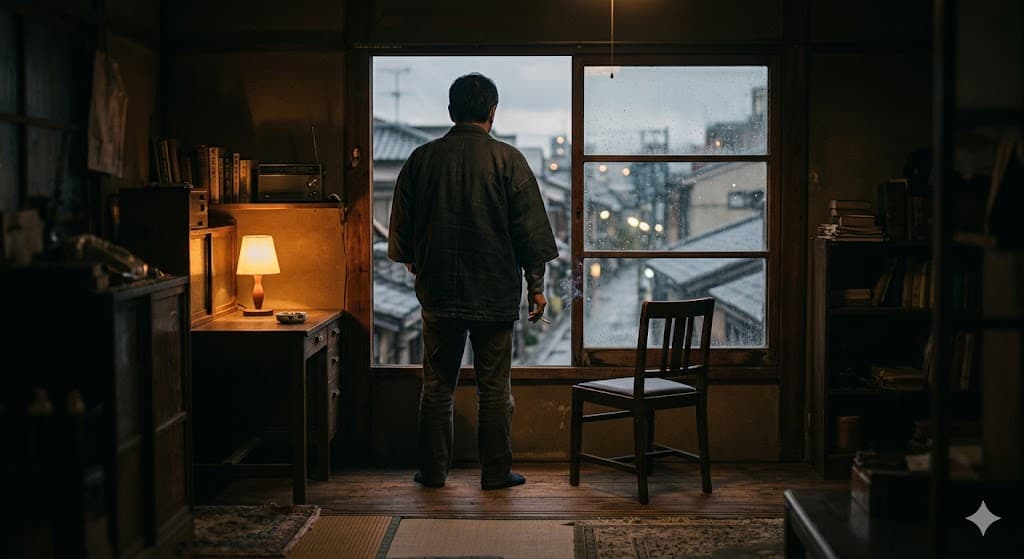
Dandadan and the Ghost of Ken Takakura: Why Japan Adored the Man Who Couldn't Say I Love You
How Dandadan turns a heroine's crush on Ken Takakura into a window onto bukiyō, the Showa ideal that read a man's silence as proof of sincerity.
5/30/2026
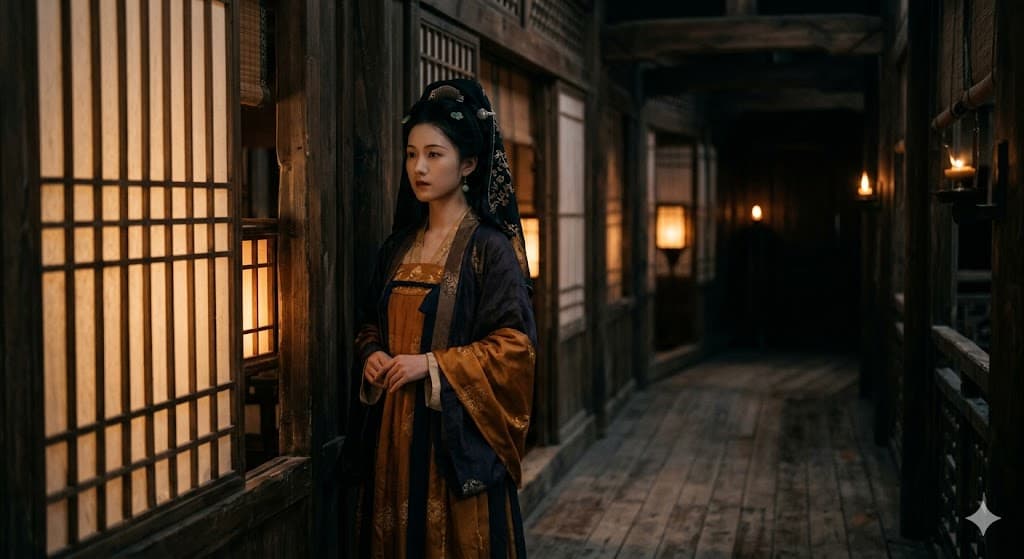
The Apothecary Diaries and the Art of Playing Dumb: Why Maomao Hides Her Brilliance
How The Apothecary Diaries dramatizes deru kui wa utareru, the Japanese habit of hiding talent, and why Maomao's playing dumb feels so familiar in Japan.
4/30/2026