Blue Lock and the Riddle of Samurai Blue: Why Japan's Football Team Wears Blue When the Flag Is Red
How Blue Lock's blue-drenched world opens onto a real puzzle — why Japan's Samurai Blue football team wears indigo when the national flag holds no blue at all.

Tokyo-born, 3rd-generation Edokko · writing on Japanese culture from outside Japan
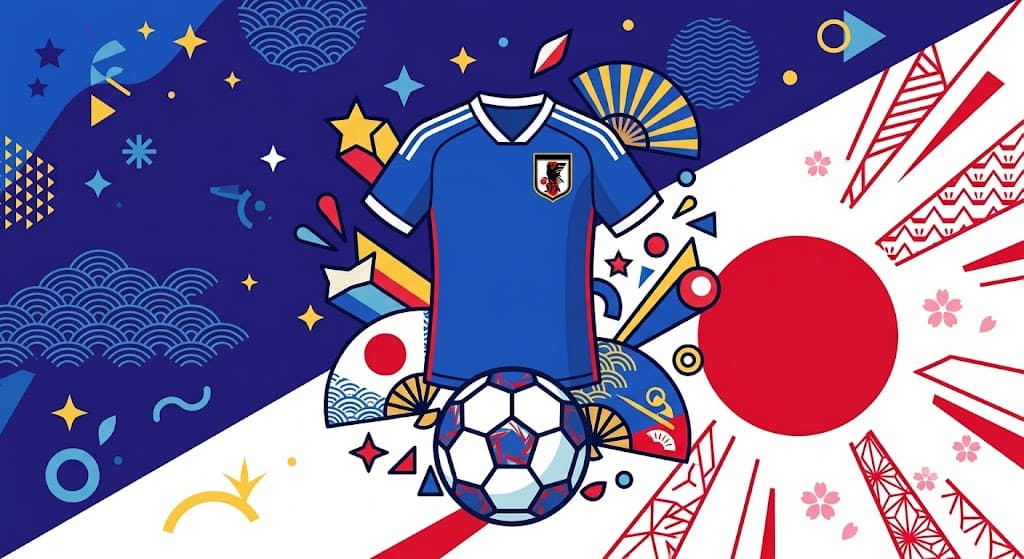
Spoiler-Free Cultural Analysis
This article uses the setting and premise of ブルーロック(Burū Rokku: the football manga and anime "Blue Lock," subtitled 青い監獄 Aoi Rōgoku, "the blue prison") only as a doorway into the real history of color in Japan. It discusses the work's atmosphere, its national-team framing, and the culture behind the color blue — no plot developments or outcomes are revealed.
Key Takeaways
- The blue of Japan's national football team has no connection to the national flag, which is red and white; the color most likely came from a university team in 1930 and hardened into tradition after a single famous match in 1936.
- Deep indigo carried a martial meaning in old Japan through 勝色 (Kachi-iro), a "victory color" prized by warriors because its sound echoed the word for winning — a link the football association itself later chose to lean on.
- Indigo dyeing was so woven into ordinary Japanese life that a foreign chemist in the nineteenth century named the shade "Japan Blue," which is why blue can feel like the country's true color even though the flag says otherwise.
Key Terms Explained
- 藍染 (Aizome) / Indigo Dyeing — The traditional craft of dyeing cloth deep blue using fermented leaves of the indigo plant, once found across everyday Japanese life.
- 勝色 (Kachi-iro) / Victory Color — The darkest, near-black shade of indigo. Its name puns on "victory," so warriors treated it as an auspicious color for armor and clothing.
- サムライブルー (Samurai Burū) / Samurai Blue — The nickname of Japan's men's national football team, joining the blue of the kit to the image of the samurai.
- 日の丸 (Hinomaru) / The Sun Disc Flag — Japan's national flag: a single red circle on a white field, containing no blue at all.
- 八咫烏 (Yatagarasu) / Three-Legged Crow — A mythical guiding crow that appears on the football association's crest, worn on the players' chests.
A Blue Team on the Living-Room Television, and a Red Flag on the Wall
When the World Cup came around, my family and friends would gather in front of the television and cheer for the national team with real intensity. People who barely followed football the rest of the year got pulled in, and the whole living room — sometimes it felt like the whole street — would rise and fall together with a single match. What stayed with me was the sight of those players in blue, running the length of the pitch while everyone around me held their breath.
 Fans in Samurai Blue fill living rooms and streets every World Cup, though the flag they wave beside them is red and white.
And yet, even as a child, a small question sat quietly at the back of my mind. Our flag, the 日の丸(Hinomaru: the red sun disc on white), has no blue in it anywhere. So why was the team I was cheering for dressed head to toe in blue? Nobody ever sat me down and explained it. I simply cheered for the blue team as if it were the most natural thing in the world, and the "why" stayed unanswered.
That childhood puzzle is exactly the hook a work like Blue Lock plays with. Its very title is built on the color — a "blue prison" where young strikers are locked away and reforged, set against the backdrop of Japan's youth national squads at the U-18 and U-20 levels. The story leans on blue as the color of the national dream. But the deeper question it accidentally raises is the one I never resolved as a boy: for サムライブルー(Samurai Burū: Japan's national football team), where did the blue actually come from?
The Long Road from a University Kit to the Victory Color
The honest starting point is that no one can give a single, fully documented answer. The exact original reason is not known for certain. What the historical record does offer is a chain of events across the 1930s that shows how blue took hold, even if it cannot name the one person who first chose it.
 The darkest indigo, called kachi-iro or "victory color," was prized by warriors because its sound echoed the word for winning.
A Team Built from a University in 1930
The most widely accepted explanation is almost disappointingly ordinary. Japan first appeared in blue around 1930, at the Far Eastern Championship Games, and the squad of that era was drawn heavily from students of the old Tokyo Imperial University, whose own athletic color happened to be a light blue. The national team simply carried that color forward. It would be a little like England's first national side being assembled from one university and quietly keeping that university's blue ever after. There was never a grand declaration — the way Brazil's yellow or the Netherlands' orange can be traced to a flag or a royal house — and the incomplete records of the period leave the rest to inference.
The Miracle of Berlin
If a university kit gave Japan its blue, a single match gave that blue its aura. At the 1936 Berlin Olympics, a Japanese team came from two goals down to beat Sweden 3–2 — remembered ever after as the "Miracle of Berlin," and often described as the first Olympic football win by an Asian side. Blue became fused with that upset victory in the memory of fans, and the association stuck. Football supporters are rarely persuaded by statistics once a superstition is working, and to this day many point to blue as the color Japan must never abandon.
Kachi-iro, the Warrior's Victory Color
Here the story reaches back much further than any football pitch, into the world Blue Lock invokes with its very name. In old Japan, the deepest shade of 藍染(Aizome: indigo dyeing) — an indigo so dark it borders on black — carried a name loaded with meaning: 勝色(Kachi-iro: "victory color"). The "kachi" came from the pounding of the dyed cloth against a mortar, repeated again and again to force the color darker, and that sound was a homophone for 勝ち(kachi: winning, victory). Because the word rang of triumph, 武士(Bushi: warriors) favored this near-black indigo for their 鎧(Yoroi: armor) and garments, treating it as an auspicious color to carry into battle.
That association never fully died. For the 2018 World Cup, the national kit was deliberately shifted toward this deep indigo, and the design was openly framed around the victory color, complete with 刺し子(Sashiko: reinforcing running stitches) that many Japanese read as an echo of older cloth traditions. Whether the warriors' victory color had anything to do with the choice of blue back in 1930 is undocumented — but the association reached for it on purpose, wrapping a modern football shirt in a centuries-old wish to win. I should be fair here: the direct samurai-to-jersey link may be later marketing rather than proven fact. What is not in dispute is that the meaning existed in the culture long before it was stitched onto a shirt.
Indigo as "Japan Blue"
There is one more layer, and it is the one closest to my own childhood. Deep indigo was not a rare or ceremonial color in Japan; it was everywhere in ordinary life. Growing up, the blue-dyed のれん(Noren: the split fabric curtain hung in a shop entrance) and the 手ぬぐい(Tenugui: a thin cotton hand towel) with white patterns on an indigo ground were simply part of the scenery. In the nineteenth century, an English chemist visiting Japan was so struck by how thoroughly this indigo saturated daily life that he named the shade "Japan Blue." The color had already appealed to the Japanese eye for centuries, evoking sea and sky, before anyone thought to give it a foreign label.
What I Only Understood After Leaving
For most of my life, that indigo was invisible to me precisely because it was everywhere. A blue noren, a blue towel — these were not "Japanese blue," they were just blue, the ordinary background of an ordinary day. It took distance to see it.
 Hand-dyed blue noren and tenugui once filled everyday life — the ordinary "Japan Blue" that has quietly grown rarer.
After living outside Japan for many years, I began to feel that indigo really is the color of my country. The deep blue I had glanced past a thousand times on curtains, towels, and pottery started to stand out, from the outside, as unmistakably Japanese. Something too close to notice only rose into view once I was far enough away to look back at it. And when I did, the childhood riddle resolved itself in an unexpected direction. The team was never wearing the flag's red because, on some quieter level, blue was already the country's lived color — the color of the cloth in the doorway, not the emblem on the pole.
There is a small loss folded into this, too. Machine dyes and mass production have thinned out the everyday indigo I grew up around. The victory color still gets invoked for a football kit every few years, brought out for the cameras and the crowds. But the ordinary blue noren fluttering at a shop entrance, dyed by hand and faded by sun — that is the version of Japan Blue that has quietly grown rarer, and it is the one I find myself missing most.
FAQ
Q: Why does Japan's football team wear blue if the flag is red and white?
A: There is no single confirmed reason. The most accepted account is that Japan's 1930 team was drawn largely from a university whose color was light blue, and the color carried over. A dramatic 1936 win in blue then turned it into a lucky tradition that never left.
Q: What is kachi-iro, and is it really connected to the jersey?
A: 勝色 (Kachi-iro) is the darkest, near-black shade of indigo, historically treated as a "victory color" because its name sounds like the word for winning. Warriors used it on armor. The football association explicitly drew on that meaning for the 2018 kit, though whether it influenced the original 1930 choice of blue is not documented.
Q: Why is indigo sometimes called "Japan Blue"?
A: In the nineteenth century, a visiting English chemist was struck by how widespread indigo-dyed cloth was in everyday Japanese life and called the color "Japan Blue." The name stuck because indigo genuinely was woven through ordinary Japanese living, from shop curtains to work clothes.
Key Insights to Remember
- National sporting colors often have humbler roots than the myths attached to them. Japan's blue most likely began as a borrowed university kit and only later acquired its samurai grandeur — a reminder that tradition tends to manufacture its own sense of destiny after the fact.
- The victory color shows how deeply sound and meaning intertwine in Japanese culture. A dyeing technique named for the act of pounding cloth became a talisman for winning simply because the word echoed "victory," and that pun outlived the samurai who first trusted it.
- A color can be invisible from the inside and obvious from the outside. Indigo was too ordinary for me to see as Japanese until I had left Japan — which is precisely how much of a culture's identity hides in the things that feel too everyday to notice.
Sources
- Explained: Japan's 'Samurai Blue' nickname & national team colours — Goal.com
- Why do Japan wear blue? Samurai myth and an unlucky charm — FourFourTwo
- Samurai Blue: Japan's Football Identity Explained — Japan Den
- 勝色(かついろ)とは?:伝統色のいろは — Irocore (Japanese Traditional Colors)
- 'All Japan' World Cup team gave fans and the media much to mull over — The Japan Times
- A scent of Wabi-sabi: Indigo called Japan Blue — Tozando
- Nobody Really Knows Why Japan Plays Football in Blue — Satoshi Ashkanemura
About the author

Spoiler-free cultural deep-dives into anime, manga & live-action Japanese drama
- ●Tokyo-born, 3rd-generation Edokko (江戸っ子)
- ●Lifelong manga reader & anime viewer since the kaiju era
- ●Writes from outside Japan — distance as a cultural lens
- ●Spoiler-free · sourced · Kanji + Romaji + English
A Tokyo-born, 3rd-generation Edokko writer who has spent years living outside Japan. I use the anime, manga, and live-action Japanese drama you already love as a doorway into the folklore, language, religion, and everyday history behind them — written so even first-time fans can follow along, with sources for every claim.
Enjoy this article?
Get the next spoiler-free cultural deep-dive straight to your inbox.
Related Articles
Frieren: Beyond Journey's End and the Weight of Time: Why the Anime Measures Life in Decades, Not Days
How Frieren: Beyond Journey's End turns the Japanese sense of 無常 (mujō, impermanence) into narrative structure — running its clock in decades so an elf's long life reveals the beauty and worth of our short human ones.
7/27/2026
Cowboy Bebop and the Jazz Kissa: How Japan Turned Listening to Music into a Ritual
How Cowboy Bebop's jazz soundtrack opens a door into the jazu kissa, Japan's silent listening cafés, where hearing a single record became a ritual.
7/13/2026
Demon Slayer and Mono no Aware: How Tanjiro's Mother Speaks the Aesthetics of Impermanence
How Demon Slayer dramatizes mono no aware — the mother's weather metaphor in episode one and the Japanese aesthetics of impermanence woven quietly behind it.
7/9/2026
Kuroko's Basketball and the Kurogo: How a Black-Clad Stagehand Became the Phantom Sixth Man
How Kuroko's Basketball builds its phantom sixth man on kurogo, the kabuki and bunraku stagehand who stands in full view yet is treated as unseen.
6/4/2026
Dandadan and the Ghost of Ken Takakura: Why Japan Adored the Man Who Couldn't Say I Love You
How Dandadan turns a heroine's crush on Ken Takakura into a window onto bukiyō, the Showa ideal that read a man's silence as proof of sincerity.
5/30/2026
The Apothecary Diaries and the Art of Playing Dumb: Why Maomao Hides Her Brilliance
How The Apothecary Diaries dramatizes deru kui wa utareru, the Japanese habit of hiding talent, and why Maomao's playing dumb feels so familiar in Japan.
4/30/2026